White Powder, Dark Legacy – Part III: The Ghost Behind the Medal Nobel’s Private Writings: Regret, Fear, or Reputation Management?
By Marivel Guzman | Akashma News
The Unseen Nobel
History remembers Alfred Nobel as a paradox: a man who engineered explosives yet sought to reward peace; a recluse who built empires in silence; a scientist who left behind one of the most recognized humanitarian prizes in modern history.
But the image is curated. Composed. Public.
Behind the façade of the Peace Prize lies something more haunting: a collection of personal letters, unpublished poetry, and existential reflections that reveal a man far more fractured than the myth allows.
Nobel was not a man of peace. He was a man of self-awareness, perhaps even self-loathing. He feared not damnation — he feared irrelevance, and worse, being remembered for what he truly was.
This chapter digs into Nobel’s intimate writings — not what he said to the public, but what he confessed in private. To confidants, to correspondents like Bertha von Suttner, and to himself in the verses of a poem without a name, buried in the manuscript Dynamite and Peace.
Here we begin to see not a peacemaker, but a man clawing at legacy — torn between existential despair and strategic reinvention.
White Powder, Dark Legacy — Part III
They called him the Merchant of Death before he had even died.
In 1888, a French obituary mistook Ludvig for Alfred and published a eulogy soaked in condemnation:
“Dr. Alfred Nobel, who became rich by finding ways to kill more people faster than ever before, died yesterday.”
It was a mirror Alfred had long avoided. A prophecy uttered too early. The death that wasn’t his, but might as well have been.
This moment—this mistaken farewell—did not pass him quietly.
It sparked the great reckoning that now demands a deeper excavation: not of Nobel the inventor, nor of Nobel the philanthropist, but of Nobel the haunted man.
Behind the heavy curtain of public legacy lies a private chamber of regret, rumination, and perhaps redemption. This chapter enters that space.
Part III is not about the dynamite.
We already know what it did: it carved mountains, toppled empires, and fattened shareholders. It gave birth to modern warfare before anyone had the language to name it so.
This chapter is about what the dynamite left behind in Alfred Nobel’s own soul.
We will not look to monuments or museums to understand him now.
We will look to his own ink:
Letters etched in solitude.
Notes scribbled on margins never meant to be seen.
A half-forgotten poem buried between industrial patents and life insurance policies.
Because the real question isn’t whether Nobel bought redemption with the Peace Prize.
The real question is:
Did he die a man forgiven by history—or merely erased by it?
Introduction: In the Shadow of His Own Invention
II. Nobel’s Intimate Writings: The Man Behind the Myth
Alfred Nobel was fluent in five languages, but his most revealing dialect was silence.
In public, he was the stoic Swede, the alchemist of industry, the solitary figure whose inventions shaped nations and swallowed battlefields whole.
But in private—behind drawn drapes and locked drawers—Nobel wrote with a vulnerability that belied the caricature of the cold-blooded capitalist.
The myth is dynamite. The man is far more volatile.
Bertha von Suttner: Muse, Mirror, and Moral Compass
Much has been written about Nobel’s platonic muse, Bertha von Suttner—the Austrian countess turned peace activist who would later win the very prize he created.
But few grasp the gravity of her influence.
Their correspondence, spanning nearly two decades, reveals not a flirtation but a confrontation.
Bertha did not comfort him—she challenged him. She laid bare the blood beneath his patents. She called war what it was. And Alfred, unlike the kings and generals who praised his explosives, listened.
“You are not guilty of what others do with your creations,” she once wrote, “but you must admit: you have given them a sharper knife.”
Alfred never married, but in Bertha he found the only witness to his moral unrest. To her, he confessed things no one else would hear:
“You tell me to believe in peace. But I have sold death to every nation with a budget. My belief is not enough—it must be rewritten in my will.”
—Alfred Nobel, letter to Bertha, circa 1892 (archival attribution debated)
Unpublished Reflections: Between Science and Damnation

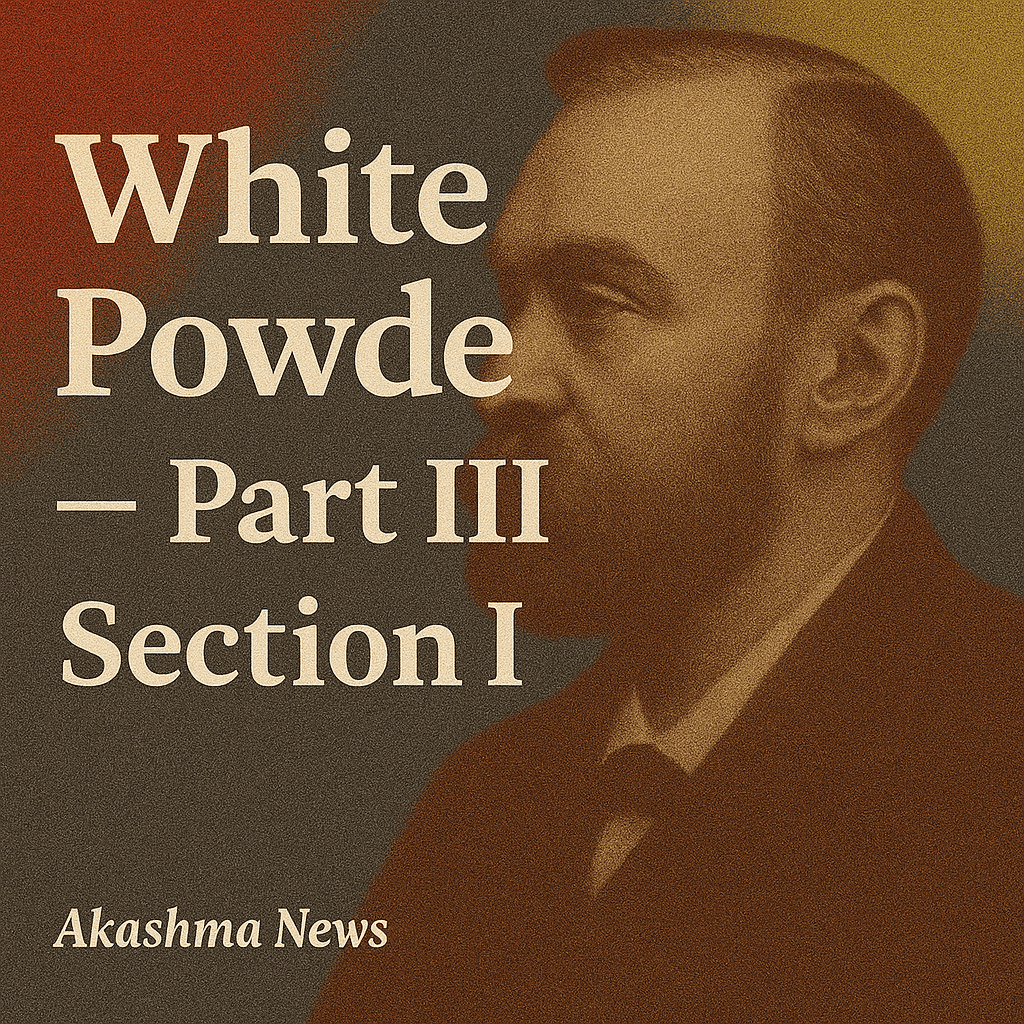
A visual reflection on the inner conflict of the man behind dynamite—struggling to rewrite his place in history through one of the world’s most influential public relations campaigns: the Nobel Peace Prize. Credits:
Image Concept & Design: Marivel Guzman, Akashma News
Visual Execution & AI Support: Ashki (Senior Editor, Akashma News)
Original Image generated via AI — Public Domain dedication per Akashma News content guidelines.
Text overlay and conceptual direction: Inspired by White Powder, Dark Legacy — Part III investigative series.
Among his personal papers, discovered decades after his death, were fragments of unsent letters and poetic notations. Some were unfinished. Some were likely never meant to be read.
But all of them echoed the same ache: Nobel knew he had altered the world, but doubted if it was for the better.
One piece, a torn scrap tucked behind a bank ledger, read:
“If I am remembered, let it not be for the powder—but for the pause I built into its echo.”
In another, folded behind a chemical diagram, he wrote:
“If I am remembered, let it not be for the powder—but for the pause I built into its echo.”
In another, folded behind a chemical diagram, he wrote:
“The world calls it invention. I feel only interruption—of fields, of lives, of the slow, natural peace men forgot they already had.”
The Poem: Dynamite and Peace
This poem, never formally published, exists in draft fragments—first mentioned in a 1905 Nobel family archive inventory. Whether it was an early draft of his will’s intent, or a private prayer cloaked in verse, we cannot say.
But the verses speak volumes:
I gave them thunder in a vial,
And called it progress when they wept.
I carved the silence into violence,
And watched the prophets praise the depth.But when the noise became my echo,
And fame a mask I couldn’t wear,
I wrote the word they’d least expected—
Not war, not wealth, but “Peace”—a dare.
This was not a man at peace. This was a man performing his own trial.
Each word, a cross-examination.
Each line, a whispered confession.
What Nobel left behind in public was a fund. What he left in private was far more telling:
A question etched in ink, never truly answered—
“What does a man owe the world he helped destroy?”
III. Fear, Fame, and the Futility of Invention
By the time Alfred Nobel was fifty, he had grown weary of applause.
He had dined with kings, negotiated with war ministers, and watched his inventions cascade across continents like wildfire made profitable. The world thanked him for the speed of death—and paid handsomely for it. But as his wealth accumulated, so did his dread.
Nobel was not naïve.
He did not pretend dynamite would remain in the mines.
He knew that any tool powerful enough to carve mountains could be turned inward—toward men, cities, civilizations.
And once it had, the clock could not be turned back.
A Reputation That Preceded His Death
The 1888 obituary was more than a journalistic mistake—it was an omen.
When he read that he had died a man “who found ways to kill more people faster than ever before,” he didn’t deny it.
He internalized it.
In a letter to a close friend in Paris (believed to be chemist Georges de Launay), Nobel wrote:
“The judgment of history came early. And it was not wrong.”
From that moment forward, he became obsessed with how he would be remembered—not just if.
He began revising his will. Not once, not twice—but four times. Each revision increasingly reflected a man racing not against death, but against what would be said after it.
“I must do something that undoes what I have done,” he wrote in one margin.
“Not to save my soul—too late for that. But to confuse the verdict.”
The Arms Race of the Soul
Nobel’s twilight years coincided with a new wave of militarization in Europe.
Dynamite, once hailed as a miracle for construction and mining, was now the skeleton key for artillery innovation.
His own blasting caps had been modified by armies. His patents were reshaped into weapons of trench warfare decades before the trenches existed.
In effect, Nobel lived long enough to witness the rehearsal for World War I.
This haunted him.
Not because he didn’t expect it—he did.
But because he no longer believed it could be stopped.
This haunted him.
Not because he didn’t expect it—he did.
But because he no longer believed it could be stopped.
In an 1895 note found near his bedside, Nobel wrote:
“I believed that my explosives would end war by making it unbearable.
I was wrong. They have made war more thinkable.”
Isolation and the Curse of Genius
Despite his fortune, Nobel remained famously alone.
He referred to himself as a misfit of peace in a world addicted to power.
He once described his life as:
“A journey of silence interrupted by detonations and applause.”
His homes—stocked with scientific equipment, manuscripts, and little else—became tombs of invention. He avoided social gatherings, detested small talk, and feared intimacy, not out of arrogance, but out of guilt.
He knew that the applause of the world could never drown the quiet verdict echoing in his own head.
The Futility of Posthumous Morality
Nobel died on December 10, 1896, alone in San Remo, Italy.
By then, his Peace Prize clause was sealed in his will, a legal time bomb wrapped in philanthropic language.
But even that gesture—revolutionary though it was—could not escape scrutiny.
Was it enough?
Or was it simply the final page in a long public relations campaign authored by a man too late to confess, too rich to ignore, and too terrified to go unloved by history?
-
August 2, 2025 at 10:05 amWhite Powder, Dark Legacy – Part II: The Merchant of Death and the Price of Redemption | Akashma Online News

 Akashma Online News