The Sandwich and the Flower: What the Washington Post Missed—and Why It Matters
By Marivel Guzman — Akashma News
August 21, 2025

Left mural: Banksy – Love Is In The Air (Flower Thrower), 2005, Bethlehem, West Bank. Photo credit: CC BY 2.0 / jensimon7.
Right mural: “Sandwich Guy,” Adams Morgan, Washington, D.C. Photo: Tom Brenner / for The Washington Post.
Collage concept: Akashma News (Marivel Guzman). Image rendering: Generated with OpenAI’s DALL·E tool for illustrative purposes.
A sandwich thrown in Washington has been turned into a symbol of resistance. A recent Washington Post feature highlighted “Sandwich Guy,” a mural in Adams Morgan, and framed it as a humorous emblem of American dissent amid political upheaval. The story charmed readers. But it left out a vital truth: the mural is a parody of Banksy’s Love Is In The Air (Flower Thrower) — an artwork born in Palestine and one of the most iconic protest images of the modern era.

Banksy painted Flower Thrower in Bethlehem, West Bank, in 2003. It depicts a masked protester mid-throw, not hurling a rock or Molotov cocktail, but a bouquet of flowers. The piece is not random. It was deliberately placed on a wall in occupied territory, transforming the image into a visual manifesto of Palestinian resistance: the substitution of beauty for violence, the insistence on defiance through creativity rather than destruction.
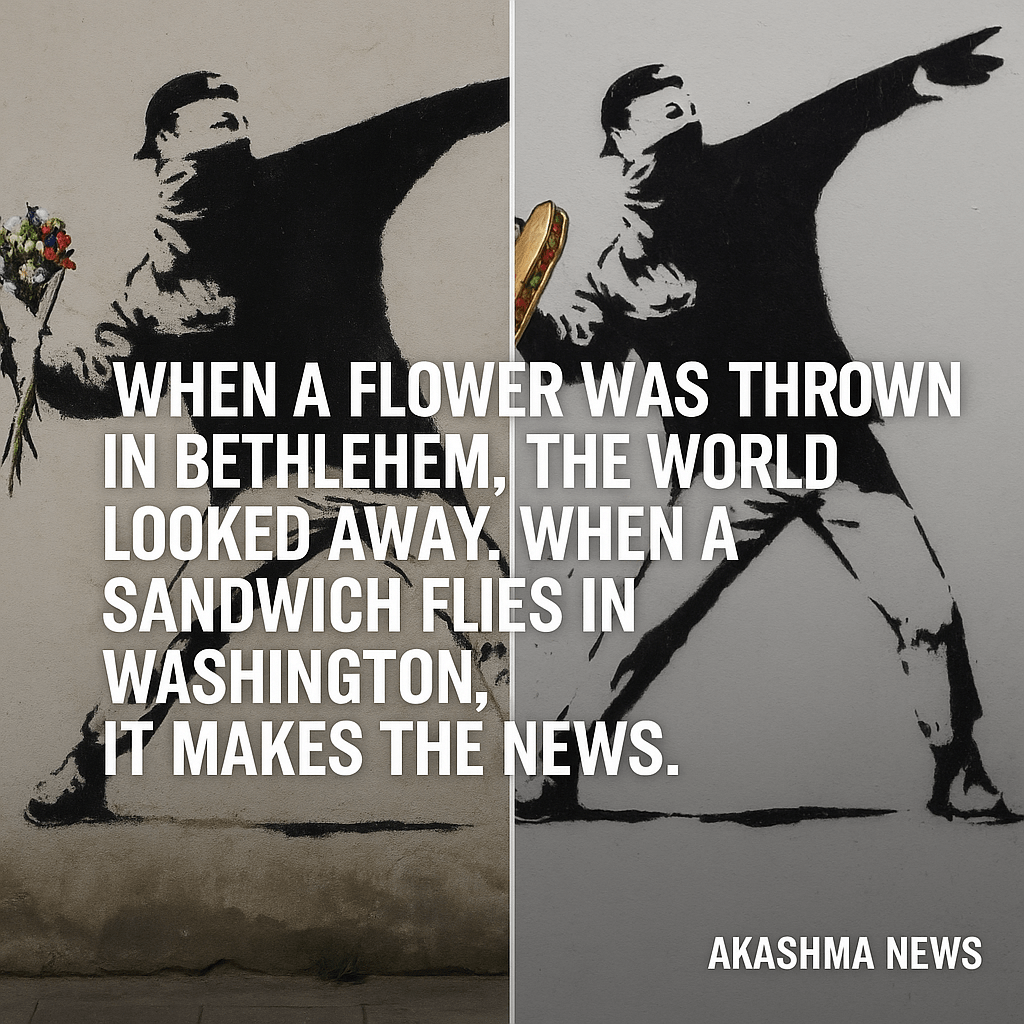
Yet in the Post’s coverage, this Palestinian origin was never mentioned. Readers were invited to chuckle at a sandwich flying through the air, but they were not asked to reflect on the flower that once did in Bethlehem.
Erasing Palestine Through Omission
That omission is not a simple oversight. Banksy’s placement of Flower Thrower in Bethlehem was a deliberate political act, rooted in Palestinian struggle. By congratulating “Sandwich Guy” as a D.C. symbol of defiance and ignoring its Palestinian foundation, The Washington Post effectively erases that lineage. This isn’t just about art appreciation. It is about narrative control.

The pattern is familiar. The Post and other U.S. mainstream outlets routinely frame stories of Palestine through the prism of Israeli security. Palestinian resistance is often depicted as instability or terrorism. Meanwhile, terms like genocide — used by UN experts and international legal scholars to describe the ongoing assault on Gaza — rarely appear in headlines. This selective vocabulary shapes perception: Israel’s concerns are validated, while Palestinians are rendered voiceless or illegitimate.
From Sandwiches to Flowers

By not crediting Banksy’s Palestinian mural, the Post avoided contextualizing “Sandwich Guy” in a global resistance lineage. U.S. readers could admire the parody, even see themselves in its humor, without confronting the uncomfortable reality that the image was borrowed from a people under occupation. The omission is safer for advertisers, political allies, and Washington’s policy consensus — but it strips the art of its history.
And here lies the double standard. If Banksy had painted Flower Thrower in Kyiv instead of Bethlehem, U.S. coverage would almost certainly celebrate its Ukrainian roots, crediting the artist’s intent and linking the mural to a narrative of noble resistance. The silence surrounding Palestine is deliberate, not incidental.
Media Bias as Editorial Policy
This erasure reflects a deeper editorial policy. Omission is itself a form of framing. By refusing to tie “Sandwich Guy” back to Palestine, the Post sidesteps an opportunity to connect two traditions of dissent: American protest against authoritarianism, and Palestinian resistance against occupation. To acknowledge that bridge would be to challenge a narrative that powerful interests prefer to maintain.
This silence is consistent with how major U.S. outlets, including the New York Times and CNN, cover Palestine: minimizing Palestinian suffering, amplifying Israeli justifications, and avoiding the political consequences of naming genocide.
Art Carries History
Art does not exist in a vacuum. Every image carries history, and every omission carries intent. When a sandwich flies in Washington, it is worth remembering the flower that once flew in Bethlehem — and the resistance it symbolized.
The Washington Post missed that connection. Or perhaps it chose not to make it. Either way, the silence speaks louder than the sandwich.
Banksy and Trademark Tensions
Banksy’s work has long resisted commodification, yet over recent years, Pest Control Office Ltd.—the artist’s administration—has pursued European Union trademark registrations on several iconic images, including Flower Thrower. Several of these attempts were cancelled by the EUIPO on grounds of “bad faith,” largely because the trademark claims were seen as protective rather than commercial in intent .
Banksy and Intellectual Property Tensions
While Banksy often declares “copyright is for losers,” his representatives did pursue trademark rights over key works like Flower Thrower. In 2020, the European Union Intellectual Property Office (EUIPO) cancelled that trademark, ruling it was asserted in “bad faith” — in part because Banksy’s anonymity prevented establishing ownership. The case, brought by Pest Control Office Ltd., revealed tensions between artistic ethos and institutional protections. The Art Newspaper Sept 17, 2020
A key case involved a figurative trademark depicting a monkey holding a placard (Laugh Now), which was initially annulled by the EUIPO Cancellation Division. However, in October 2022, the EUIPO’s Fifth Board of Appeal reversed that decision, ruling there was insufficient evidence of bad faith .
These developments underscore the dual nature of Banksy’s relationship with intellectual property—on one hand, advocating “copyright is for losers,” and on the other, asserting trademark rights to protect his art from commercial exploitation while preserving anonymity. For deeper legal analysis, see From the Flower Thrower to the Monkey, and Beyond: Banksy’s Battle With Trademarks Continues (Bonadio, Egeland & Jean‑Baptiste, 2023) .
Attribution
Banksy – Love Is In The Air (Flower Thrower), 2005, Bethlehem, West Bank.
The Washington Post — “How a thrown sub made ‘Sandwich Guy’ a resistance icon in Trump’s D.C.”.
Editor’s Note: A request for comment was sent to the author of the Washington Post article, Sophia Solano. This article will be updated should a response be received.

 Akashma Online News