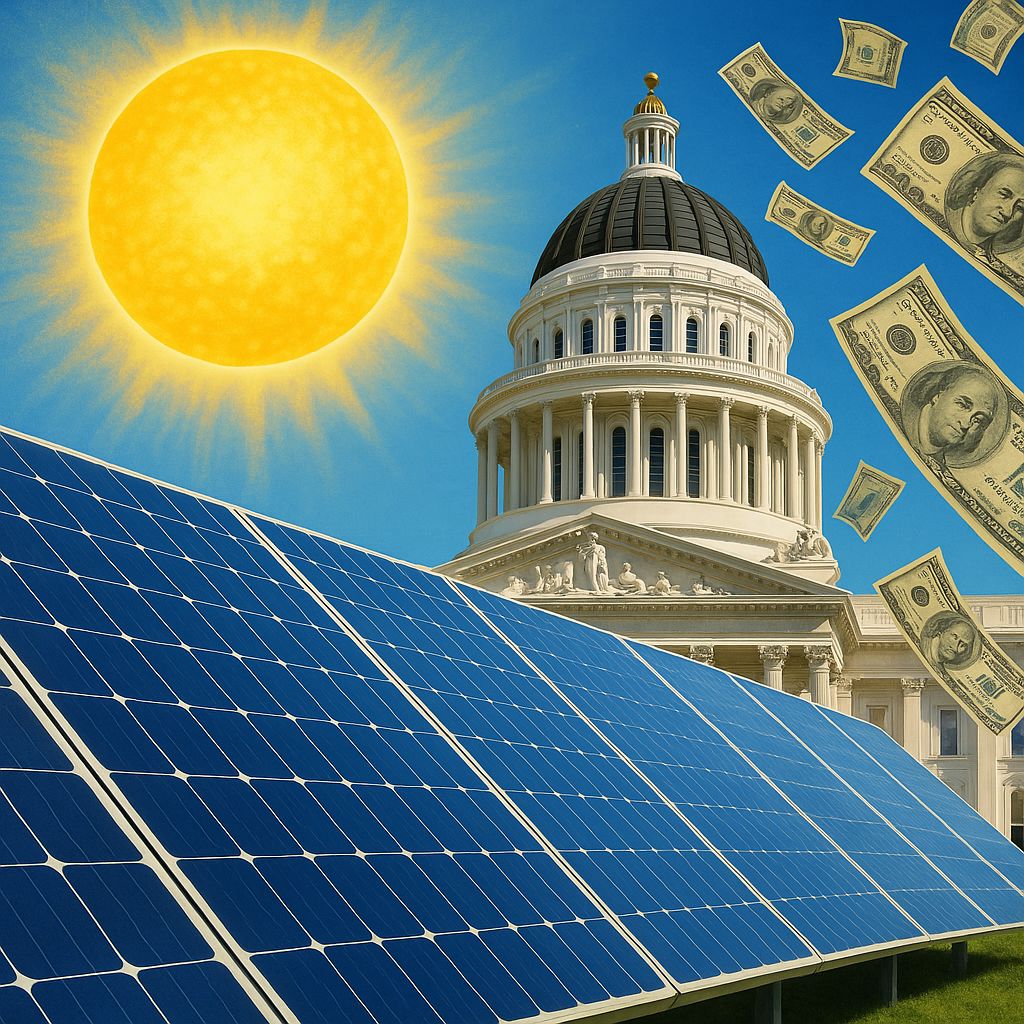
CALIFORNIA’S SOLAR SCANDAL: THE SUN IS FREE, BUT MONOPOLY UTILITIES MAKE US PAY
By Akashma News
SACRAMENTO — California has become a national leader in solar power, boasting the largest number of rooftop solar installations in the United States. With endless sunlight and billions in taxpayer subsidies, one might expect the state’s energy costs to be low and accessible. Instead, Californians are facing skyrocketing electric bills, while utility giants reap profits from policies shaped by powerful lobbyists and a complicit state legislature.
Despite producing more electricity than the state can consume during peak solar hours, consumers are still paying among the highest rates in the nation. At the core of this contradiction lies a tale of broken promises, policy manipulation, and a green energy revolution hijacked by corporate interests.
Sunlight Subsidized by Taxpayers, Monetized by Utilities
Over the past two decades, both federal and state governments have invested heavily in making solar energy viable. Programs like the federal Investment Tax Credit (ITC) and California’s Solar Initiative (CSI) funneled billions into the development and installation of solar technology. The Self-Generation Incentive Program (SGIP) even paid residents to install battery systems.
But while taxpayers funded the transition, they were never guaranteed access to the benefits. Instead, the electricity generated by the sun — a limitless and free resource — became a product bought and sold by utility monopolies.
Net Energy Metering 3.0: A Gift to Utilities
In April 2023, the California Public Utilities Commission (CPUC) implemented Net Energy Metering 3.0 (NEM 3), slashing the compensation new solar customers receive for selling excess solar energy back to the grid. Under previous versions, customers earned between 20 and 30 cents per kilowatt-hour (kWh). Under NEM 3, new adopters now receive just 3 to 5 cents.
However, existing customers who installed solar panels under earlier NEM agreements remain “grandfathered in” and continue receiving the higher compensation rates, at least for the duration of their original contract period.
Consumer advocates and independent energy experts argue that NEM 3 is a calculated move by the utilities to undercut solar adopters and preserve profits. “This is nothing short of legalized theft,” said a renewable energy consultant who requested anonymity. “Taxpayers built the system, but utilities own the profits.”
The utility companies claim that reduced net metering rates help protect low-income ratepayers and maintain grid reliability. But the reality paints a different picture. Investor-owned utilities like Pacific Gas & Electric (PG&E), Southern California Edison, and San Diego Gas & Electric have reported rising revenues while residential electricity rates have soared.
The Lobbyists Behind the Curtain
Documents obtained through the California Secretary of State’s lobbying disclosure system show that utility companies spent millions lobbying legislators in the years leading up to NEM 3’s approval. These corporations funneled money into campaign donations, PR campaigns, and pressure groups to promote their version of a “fair” energy market.
State lawmakers, many of whom received significant contributions from energy sector PACs, largely fell in line. The result: legislation that gutted one of the most successful solar adoption programs in the country.
“The politicians in Sacramento sold us out,” said Sarah Ramirez, a homeowner in Riverside who installed solar panels in 2020. “We were promised energy independence and lower bills. Now I’m locked into a system where I sell my energy for pennies and buy it back at a premium.”
The Green Mirage: EV Costs and Energy Exports
The push for electric vehicles (EVs) has only added insult to injury. In 2019, it cost around $7 to charge an EV for 270 miles. Today, thanks to rising electricity prices, that same charge can cost upwards of $20 at public charging stations.
Meanwhile, surplus electricity produced during peak hours is sold to neighboring states at discounted wholesale rates. California residents, who helped fund the solar infrastructure, are essentially subsidizing cheap energy for other states while paying some of the highest rates in the U.S.
Who Owns the Sun?
California’s energy paradox begs a fundamental question: Who owns the sun? If the public funded solar infrastructure and the sun shines freely, why are residents paying monopoly prices for power?
The answer lies in policy manipulation and a regulatory framework that prioritizes investor returns over public benefit. Until lawmakers confront the influence of utility lobbyists and restore fair compensation to solar producers, Californians will continue to bear the burden of a broken system.
As sunlight continues to flood the Golden State, the question remains: How long will we let corporate monopolies bottle and sell our sunshine back to us at a premium?