Archive
Through the Silver Screen: When Sci-Fi Speaks Truth
By Marivel Guzman | Akashma News
Introduction: Fiction as Soft Disclosure
From sanitized studios to Hollywood’s silver screen, speculative fiction has often served as more than escapism. Some call it predictive programming. Others call it symbolic confession. We call it a mirror held up to a shadowed world—a portal through which we can glimpse deeper truths veiled in metaphor, coded narrative, and cinematic spectacle. In this companion analysis to our ongoing investigation of HAARP, Antarctica, and classified scientific frontiers, we turn our attention to the subconscious whispers embedded in popular films.
Repo Men (2010): Organs on Credit
In this dystopian thriller, organs are sold on credit by a biotech corporation, and when debtors default, they’re hunted down and repossessed—literally. The film offers a thinly veiled commentary on biomedical capitalism, the commodification of the body, and class-based access to longevity. It also eerily mirrors the logic of real-world healthcare systems where debt and biology are deeply entangled.
Themes reflected in reality:
Organ trafficking markets
Privatized health and debt-based medicine
Bio-ownership and patents over lifeforms
The Island (2005): The Clone Dilemma
Michael Bay’s The Island presents a chilling concept: human clones created to serve as involuntary donors for the elite. Raised in ignorance, they await “The Lottery” to go to the so-called paradise—unaware it’s their execution. The film critiques eugenics, hidden biolabs, and the cold utilitarianism that underlies extreme bioengineering ventures.
Themes reflected in reality:
Secret cloning programs
Biotech firms researching artificial wombs and tissue culture
Ethical debates over synthetic consciousness and life ownership
Guardians of the Galaxy (MCU): Mind Control, Faith Energy, and Genetic Slavery
While more colorful and cosmic, the Guardians franchise dips into deep metaphysical questions. The Universal Church of Truth converts citizens into energy sources through faith harvesting. Rocket Raccoon is a product of cybernetic experimentation. These threads echo DARPA’s real-life brain-interface projects, EMF influence studies, and mind-control experiments.
Themes reflected in reality:
Neural implants and AI-enhanced cognition
Psychotronic weapon research
Religious or ideological mass programming
Monsters, Inc. (2001): Children as Currency
This seemingly innocent Pixar animation hides perhaps the darkest metaphor. Monsters power their world by scaring children and extracting their screams—energy converted into electricity. It’s a disturbing model: children’s fear commodified for systemic consumption. The more frightened the child, the more powerful the energy.
Children as Currency: The Monsters Behind the Laughter
Beneath the soft glow of Pixar’s palette and the soundtrack of giggles lies one of the most disturbing metaphors to ever slip past the cultural radar. Monsters enter bedrooms through dimensional doorways, scare children to extract screams, and convert fear into energy. But read symbolically, this mirrors reports from whistleblowers and survivors of an underground economy where the emotional, physical, and biochemical essence of children is harvested.
Whispers and warnings include:
Alleged trafficking of children’s blood and DNA
Biomedical corporations researching young plasma for anti-aging
Neuroimaging and cognitive replication from child brains
And here lies the veiled reference: emerging brain-machine interfaces, DARPA’s neurostimulation research, and private-sector cognitive mapping projects all intersect in a landscape where innocence becomes data.
Is this fiction preparing us—or mocking us? Are the monsters just pixels, or are they symbols for a deeper truth?
Conclusion: Truth Rendered in CGI
Each of these films offers more than storytelling. They offer warnings, disclosures, or psychological groundwork. Whether we consider them conspiratorial mirrors or unconscious cultural confessions, they deserve to be treated with the seriousness of journalism. The screen may be silver, but the message bleeds red.
This is Part I. The next installment will explore films like Snowpiercer, The Tomorrow War, Interstellar, and Elysium—mapping environmental weaponization, class apartheid, and genetic colonization through narrative fiction.
Further reading
White Powder, Black Legacy–Part I: Alfred Nobel’s War for Peace
By Akashma News
1899 marked a turning point in European science and warfare. Alfred Nobel’s patents on explosives were officially recognized, and with them, the industrial world inherited not just tools for progress, but the machinery of modern destruction.
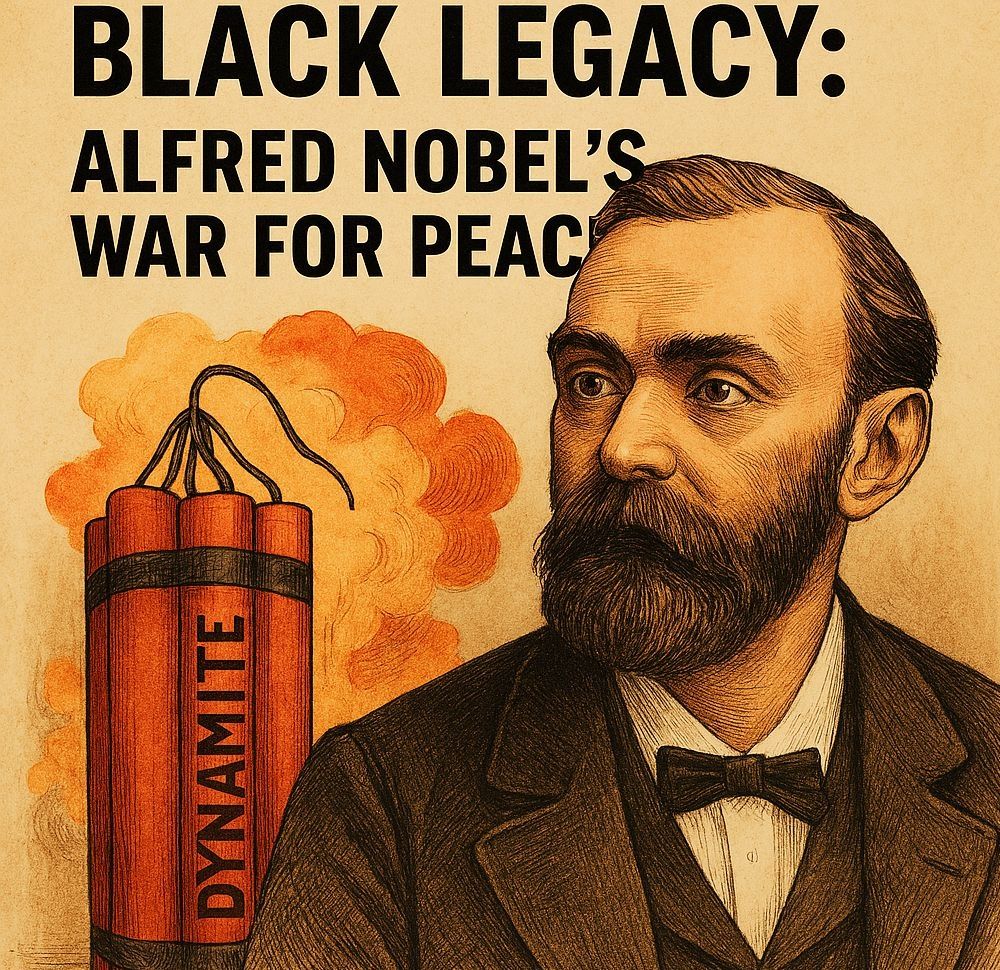
Alfred Nobel, a name now sanctified by peace awards and academic honor, built his empire not on compassion but on combustion. Through his company, Nobel Brothers, he turned oil and explosives into fortune, registering nearly 150 patents at the European Patent Office and over 355 worldwide. Many of these patents weren’t aimed at medicine or humanitarian innovation—they were precise instruments of war: dynamite, detonation systems, poison gases, and devices to measure and maximize force.
Nobel’s public image today is shaped by his final act of philanthropy—the establishment of the Nobel Prizes, including the coveted Peace Prize. But beneath this benevolent exterior lies a web of contradictions and calculated legacy-building that warrant closer examination.
Epigraph
“War and Peace could not have been better miswritten—not by Fyodor Dostoevsky, but by the amateur alchemist of ethics himself: Alfred Nobel.”
— Marivel Guzman
A Philosopher of War Disguised as a Peacemaker
Nobel famously declined an invitation to attend a peace conference. Though no formal explanation was recorded, his infamous statement offers a dark clue:
If there were peace, what would happen to my white powder?
That “white powder” was dynamite—the invention that made him wealthy and secured his place in both scientific and military history. This remark wasn’t simply sardonic—it was a candid admission of how deeply his livelihood depended on the machinery of war.
His ambivalence about peace was also evident in his personal interactions. In 1889, when Baroness Bertha von Suttner informed him that she had written an anti-war novel titled Die Waffen nieder (Lay Down Your Arms), Nobel replied in his usual sardonic tone that he hoped to read it—but wondered, “in case of universal peace, where would he place his new smokeless powder?” This remark, referring once again to his dynamite innovations, was more than a jest—it was a candid reflection of his priorities. Peace was a curiosity; war, a profession. It is safe to conclude from this brief exchange that “universal peace” was not in his personal or commercial interests.
He understood that peace was not simply a moral choice—it was a power dynamic. In one of his most telling remarks, Nobel declared:
“My factories may well put an end to war sooner than your congresses: on the day that two army corps can mutually annihilate each other in a second, all civilized nations will surely recoil with horror and disband their troops.”
This was the core of his peace doctrine: the belief that mutual threat—not mutual understanding—was the only reliable deterrent.
A Blueprint for the League of Nations
Nobel’s ideas about collective enforcement and global deterrence found their most detailed expression in a letter he wrote on October 15, 1892, to the Belgian pacifist Bertha von Suttner. There, he articulated what would later serve as a conceptual basis for the League of Nations and the United Nations:
> “This prize would be awarded to the man or the woman who had done most to advance the idea of general peace in Europe. I do not refer to disarmament, which can be achieved only by very slow degrees. I do not even necessarily refer to compulsory arbitration between the nations, but what I have in view is that we should soon achieve the result—undoubtedly practical one—that all states should bind themselves absolutely to take action against the first aggressor. Wars then will become impossible, and we should succeed in compelling even the most quarrelsome state either to have recourse to a tribunal or to remain quiet. If the Triple Alliance instead of comprising three states were to secure the adherence of all, secular peace would be insured for the world.”
In this vision, peace is not granted—it is imposed. Nobel imagined a system where global security would be achieved not through disarmament or diplomacy, but through binding alliances and credible retaliation. The implication was clear: enforce peace by preparing for war.
From Dynamite to Doctrine
This belief system—peace through superior force—has since become doctrine. It underpins military alliances like NATO, justifies sanctions, airstrikes, and invasions, and reinforces the arms races of superpowers who claim to “preserve peace” while waging perpetual war.
Nowhere is this clearer than in the actions of the United States and Israel, nations that often portray themselves as defenders of peace while using overwhelming military power to assert control. Whether Nobel foresaw this or not, his inventions and ideologies became the architecture of today’s militarized global order.
The tools he created to end war have instead professionalized it. The war industry—guided by logic he helped shape—now thrives in a global economy where arms are traded like commodities, and peace is managed, not achieved.
Final Reckoning
Alfred Nobel left behind two legacies: one in the blast craters of battlefields, and another in golden medals handed out in gilded halls. But perhaps the deeper truth lies in the space between the two—where innovation meets consequence, and idealism meets the market.
He believed destruction could shock the world into peace. But instead, it shocked the world into the permanence of conflict.
The Peace Prize continues to shine. But the world still burns with the fire Alfred Nobel helped ignite.
The Merchant of Death and the Price of Redemption**
(White Powder, Dark Legacy – Part II)
Part II exposes the turning point in Nobel’s legacy — the 1888 mistaken obituary that labeled him “The Merchant of Death.” This article tracks how that public condemnation led to the creation of the Nobel Peace Prize, not as a symbol of peace, but as an attempt to cleanse a violent legacy. It follows the misuse of the prize in the modern era, where war-makers and political elites are awarded under the illusion of diplomacy.
[Read Part II here →]
In 1888, Alfred Nobel read his own obituary — and it called him “The Merchant of Death.”
The world had mistaken him for his brother, but the judgment was real: a man who profited from war, buried in shame.
That obituary didn’t inspire him. It cornered him.
The Nobel Peace Prize wasn’t born from a dream of peace — it was an escape route.
A gold-plated monument to silence the ghosts of dynamite and artillery.
White Powder, Dark Legacy – Part II: The Merchant of Death and the Price of Redemption
Rewiring Trump: Neuralink, Free Will, and the Illusion of Power
By Akashma News – Preview Edition
What if the most powerful leader in the free world wasn’t entirely in control of his own mind?
“Rewiring Trump” is a provocative speculative investigation that explores the possibility that President Donald Trump’s radical behavioral shifts may not have been purely political—but neurological. Blending science fiction with real-world neurotechnology, this piece examines the evolution of brain-machine interfaces like Neuralink, and asks what would happen if such tools were used not to heal, but to manipulate.
From the horrors of MK-Ultra and secret CIA mind control programs, to the quiet power of behavioral nudging via wireless implants, the essay builds a chilling scenario: could Trump—once a dominant, unfiltered voice—have been neurologically silenced?
Through historical precedent, emerging patents, and visible shifts in Trump’s demeanor, the piece invites readers into a thought experiment about autonomy, technology, and the future of leadership in a world of neural warfare.
> “He doesn’t stop being Trump. He just stops feeling like Trump.”
Imagine for a moment that Donald Trump, the controversial titan of American politics, the master of unpredictability, the breaker of conventions—was not fully in control of his own mind. His shifting stances, bizarre reversals, and sudden ideological U-turns have puzzled supporters and critics alike. What if these weren’t merely the antics of a populist showman, but the side effects of a deeper, hidden manipulation? What if a device—implanted discreetly, wirelessly connected, and capable of reading and writing neural activity—was silently influencing his decisions?
Neural Reality
Hold onto your seats—I’m about to take you into the unfathomable: the mysterious realm of neural interference with reality. Imagine a neural connection, precisely rewired to interface seamlessly with machines, yet losing the delicate silver thread linking consciousness to the real world.
Investigative Speculation
Where fact meets foresight. This genre explores emerging technologies, geopolitical shifts, and hidden histories through a speculative lens—blending investigative rigor with imaginative insight to reveal what is, and what could become, the future of your mind without your consent.
In this unprecedented era of technological advancement, only the creators behind sophisticated coding fully grasp what’s on the other side—a simulated virtual reality so convincing that its illusion of authenticity is indistinguishable from reality itself.
How could you know if your mind were wirelessly connected to a digital matrix, silently navigating dimensions you never consciously entered?
This is not merely speculation—it’s a call for vigilance in the age of invisible influence.
This preview is only a glimpse of the full essay, which spans the ethical, legal, and geopolitical stakes of a future where thoughts can be edited, emotions muted, and power hijacked—one signal at a time.
Coming soon on Kindle and PDF.
Full essay includes expanded sections on Neuralink patents, the Church Committee, Gaza contradictions, Oval Office behavioral analysis, and a call for global neuro-rights.

 Akashma Online News