Archive
White Powder, Dark Legacy – Part III: The Ghost Behind the Medal Nobel’s Private Writings: Regret, Fear, or Reputation Management?
By Marivel Guzman | Akashma News
The Unseen Nobel
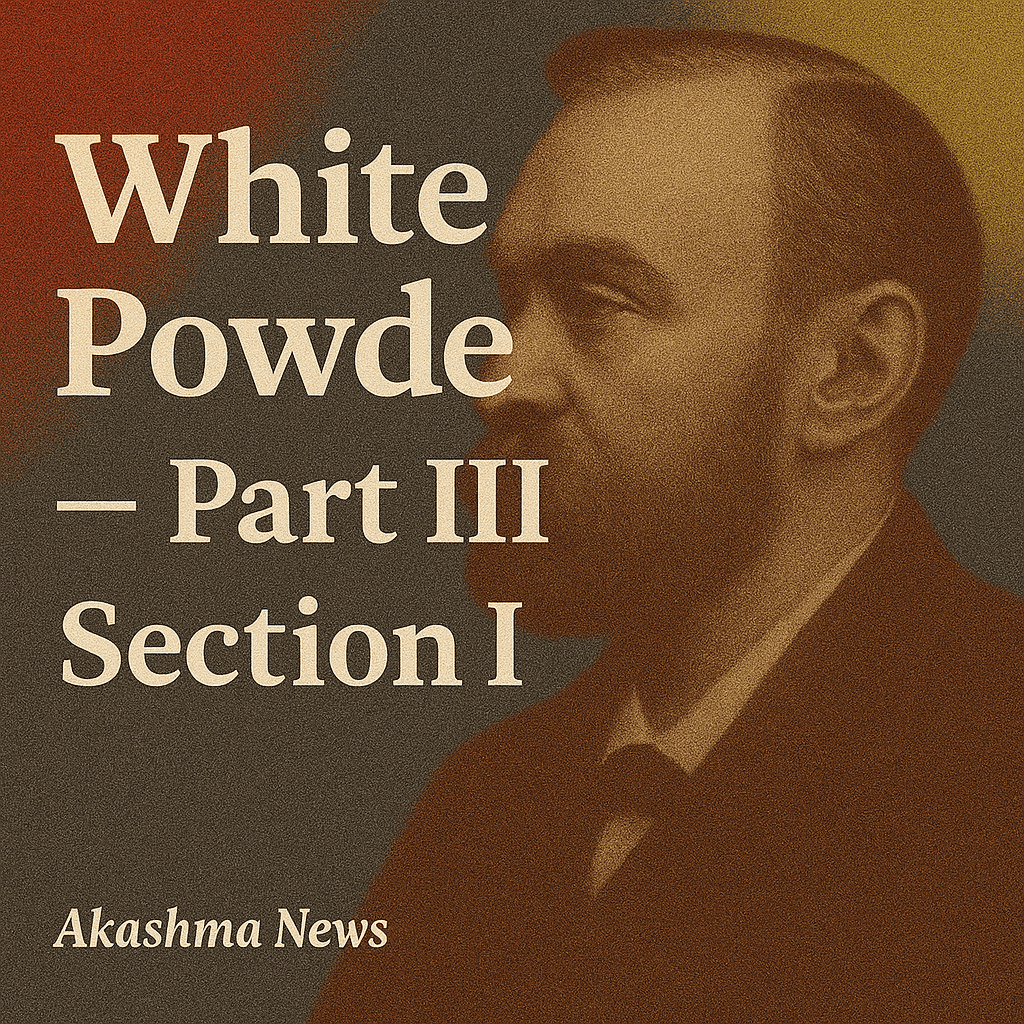
History remembers Alfred Nobel as a paradox: a man who engineered explosives yet sought to reward peace; a recluse who built empires in silence; a scientist who left behind one of the most recognized humanitarian prizes in modern history.
But the image is curated. Composed. Public.
Behind the façade of the Peace Prize lies something more haunting: a collection of personal letters, unpublished poetry, and existential reflections that reveal a man far more fractured than the myth allows.
Nobel was not a man of peace. He was a man of self-awareness, perhaps even self-loathing. He feared not damnation — he feared irrelevance, and worse, being remembered for what he truly was.
This chapter digs into Nobel’s intimate writings — not what he said to the public, but what he confessed in private. To confidants, to correspondents like Bertha von Suttner, and to himself in the verses of a poem without a name, buried in the manuscript Dynamite and Peace.
Here we begin to see not a peacemaker, but a man clawing at legacy — torn between existential despair and strategic reinvention.
White Powder, Dark Legacy — Part III
They called him the Merchant of Death before he had even died.
In 1888, a French obituary mistook Ludvig for Alfred and published a eulogy soaked in condemnation:
“Dr. Alfred Nobel, who became rich by finding ways to kill more people faster than ever before, died yesterday.”
It was a mirror Alfred had long avoided. A prophecy uttered too early. The death that wasn’t his, but might as well have been.
This moment—this mistaken farewell—did not pass him quietly.
It sparked the great reckoning that now demands a deeper excavation: not of Nobel the inventor, nor of Nobel the philanthropist, but of Nobel the haunted man.
Behind the heavy curtain of public legacy lies a private chamber of regret, rumination, and perhaps redemption. This chapter enters that space.
Part III is not about the dynamite.
We already know what it did: it carved mountains, toppled empires, and fattened shareholders. It gave birth to modern warfare before anyone had the language to name it so.
This chapter is about what the dynamite left behind in Alfred Nobel’s own soul.
We will not look to monuments or museums to understand him now.
We will look to his own ink:
Letters etched in solitude.
Notes scribbled on margins never meant to be seen.
A half-forgotten poem buried between industrial patents and life insurance policies.
Because the real question isn’t whether Nobel bought redemption with the Peace Prize.
The real question is:
Did he die a man forgiven by history—or merely erased by it?
Introduction: In the Shadow of His Own Invention
II. Nobel’s Intimate Writings: The Man Behind the Myth
Alfred Nobel was fluent in five languages, but his most revealing dialect was silence.
In public, he was the stoic Swede, the alchemist of industry, the solitary figure whose inventions shaped nations and swallowed battlefields whole.
But in private—behind drawn drapes and locked drawers—Nobel wrote with a vulnerability that belied the caricature of the cold-blooded capitalist.
The myth is dynamite. The man is far more volatile.
Bertha von Suttner: Muse, Mirror, and Moral Compass
Much has been written about Nobel’s platonic muse, Bertha von Suttner—the Austrian countess turned peace activist who would later win the very prize he created.
But few grasp the gravity of her influence.
Their correspondence, spanning nearly two decades, reveals not a flirtation but a confrontation.
Bertha did not comfort him—she challenged him. She laid bare the blood beneath his patents. She called war what it was. And Alfred, unlike the kings and generals who praised his explosives, listened.
“You are not guilty of what others do with your creations,” she once wrote, “but you must admit: you have given them a sharper knife.”
Alfred never married, but in Bertha he found the only witness to his moral unrest. To her, he confessed things no one else would hear:
“You tell me to believe in peace. But I have sold death to every nation with a budget. My belief is not enough—it must be rewritten in my will.”
—Alfred Nobel, letter to Bertha, circa 1892 (archival attribution debated)
Unpublished Reflections: Between Science and Damnation

A visual reflection on the inner conflict of the man behind dynamite—struggling to rewrite his place in history through one of the world’s most influential public relations campaigns: the Nobel Peace Prize. Credits:
Image Concept & Design: Marivel Guzman, Akashma News
Visual Execution & AI Support: Ashki (Senior Editor, Akashma News)
Original Image generated via AI — Public Domain dedication per Akashma News content guidelines.
Text overlay and conceptual direction: Inspired by White Powder, Dark Legacy — Part III investigative series.
Among his personal papers, discovered decades after his death, were fragments of unsent letters and poetic notations. Some were unfinished. Some were likely never meant to be read.
But all of them echoed the same ache: Nobel knew he had altered the world, but doubted if it was for the better.
One piece, a torn scrap tucked behind a bank ledger, read:
“If I am remembered, let it not be for the powder—but for the pause I built into its echo.”
In another, folded behind a chemical diagram, he wrote:
“If I am remembered, let it not be for the powder—but for the pause I built into its echo.”
In another, folded behind a chemical diagram, he wrote:
“The world calls it invention. I feel only interruption—of fields, of lives, of the slow, natural peace men forgot they already had.”
The Poem: Dynamite and Peace
This poem, never formally published, exists in draft fragments—first mentioned in a 1905 Nobel family archive inventory. Whether it was an early draft of his will’s intent, or a private prayer cloaked in verse, we cannot say.
But the verses speak volumes:
I gave them thunder in a vial,
And called it progress when they wept.
I carved the silence into violence,
And watched the prophets praise the depth.But when the noise became my echo,
And fame a mask I couldn’t wear,
I wrote the word they’d least expected—
Not war, not wealth, but “Peace”—a dare.
This was not a man at peace. This was a man performing his own trial.
Each word, a cross-examination.
Each line, a whispered confession.
What Nobel left behind in public was a fund. What he left in private was far more telling:
A question etched in ink, never truly answered—
“What does a man owe the world he helped destroy?”
III. Fear, Fame, and the Futility of Invention
By the time Alfred Nobel was fifty, he had grown weary of applause.
He had dined with kings, negotiated with war ministers, and watched his inventions cascade across continents like wildfire made profitable. The world thanked him for the speed of death—and paid handsomely for it. But as his wealth accumulated, so did his dread.
Nobel was not naïve.
He did not pretend dynamite would remain in the mines.
He knew that any tool powerful enough to carve mountains could be turned inward—toward men, cities, civilizations.
And once it had, the clock could not be turned back.
A Reputation That Preceded His Death
The 1888 obituary was more than a journalistic mistake—it was an omen.
When he read that he had died a man “who found ways to kill more people faster than ever before,” he didn’t deny it.
He internalized it.
In a letter to a close friend in Paris (believed to be chemist Georges de Launay), Nobel wrote:
“The judgment of history came early. And it was not wrong.”
From that moment forward, he became obsessed with how he would be remembered—not just if.
He began revising his will. Not once, not twice—but four times. Each revision increasingly reflected a man racing not against death, but against what would be said after it.
“I must do something that undoes what I have done,” he wrote in one margin.
“Not to save my soul—too late for that. But to confuse the verdict.”
The Arms Race of the Soul
Nobel’s twilight years coincided with a new wave of militarization in Europe.
Dynamite, once hailed as a miracle for construction and mining, was now the skeleton key for artillery innovation.
His own blasting caps had been modified by armies. His patents were reshaped into weapons of trench warfare decades before the trenches existed.
In effect, Nobel lived long enough to witness the rehearsal for World War I.
This haunted him.
Not because he didn’t expect it—he did.
But because he no longer believed it could be stopped.
This haunted him.
Not because he didn’t expect it—he did.
But because he no longer believed it could be stopped.
In an 1895 note found near his bedside, Nobel wrote:
“I believed that my explosives would end war by making it unbearable.
I was wrong. They have made war more thinkable.”
Isolation and the Curse of Genius
Despite his fortune, Nobel remained famously alone.
He referred to himself as a misfit of peace in a world addicted to power.
He once described his life as:
“A journey of silence interrupted by detonations and applause.”
His homes—stocked with scientific equipment, manuscripts, and little else—became tombs of invention. He avoided social gatherings, detested small talk, and feared intimacy, not out of arrogance, but out of guilt.
He knew that the applause of the world could never drown the quiet verdict echoing in his own head.
The Futility of Posthumous Morality
Nobel died on December 10, 1896, alone in San Remo, Italy.
By then, his Peace Prize clause was sealed in his will, a legal time bomb wrapped in philanthropic language.
But even that gesture—revolutionary though it was—could not escape scrutiny.
Was it enough?
Or was it simply the final page in a long public relations campaign authored by a man too late to confess, too rich to ignore, and too terrified to go unloved by history?
White Powder, Dark Legacy – Part II: The Merchant of Death and the Price of Redemption
How a Mistaken Obituary and a Life Built on Explosives Gave Birth to the Greatest PR Cover-Up in the History of Peace
By Marivel Guzman | Akashma News
Obituary of Infamy: The Death That Wasn’t

Digital illustration generated by AI | Concept by Marivel Guzman | Akashma News
In 1888, death knocked — but not for Alfred Nobel. It came for his brother Ludvig. Yet in a tragic twist of error, a French newspaper published an obituary for Alfred instead, bearing the now-infamous title: “Le marchand de la mort est mort” — “The Merchant of Death is Dead.”
The obituary condemned him in no uncertain terms: “Dr. Alfred Nobel, who became rich by finding more ways to kill people faster than ever before, died yesterday.” The paper, mistaking identity and fate, did not just misreport a death — it ignited a legacy crisis.
For Alfred Nobel, a man who held over 350 patents and presided over a transcontinental web of explosives and weapons factories, the headline struck deeper than any criticism he had ever faced. It wasn’t just public shame — it was a preview of how history would remember him–not as a benefactor of science, but as a harbinger of death. And he couldn’t allow that.
Thus began the most elaborate act of image laundering in modern history — the founding of the Nobel Peace Prize.
This moment didn’t inspire him. It terrified him. Within a few years, Nobel would write a new will — not to change the world, but to clean his name.
But contrary to the romantic mythology crafted by mainstream biographies and fanfare, Nobel’s creation was not born from an epiphany or a deep-seated yearning for peace. It was an act of strategic repentance — a calculated move to offset a violent empire with a philanthropic afterlife. The Peace Prize became a posthumous shield, not a symbol of his ideals, but a buffer against the damning truth of his industrial legacy.
Obituary of Infamy: The Death That Wasn’t
In April 1888, the Journal des Débats, a prominent French newspaper, ran an obituary that would echo through history—not for its tribute, but for its mistake. The paper believed Alfred Nobel had died while visiting Cannes. In truth, it was his brother Ludvig who had passed. But it was Alfred’s name, Alfred’s face, and Alfred’s legacy that graced the page under a damning headline:
“Le marchand de la mort est mort”
“The Merchant of Death is Dead”
Rather than a eulogy, it read like a public indictment.
It portrayed Nobel not as a man of science or innovation, but as a profiteer of carnage—a man who had made his fortune by engineering tools of destruction, and whose legacy would be written in blood, not ink.
This public misfire was no trivial error. For Nobel, it served as a preview of judgment day, not in a religious sense—he was a committed atheist—but in the court of public memory. The shame was immediate, and perhaps for the first time, irrevocable.
Though Nobel never publicly acknowledged the obituary’s impact, the timeline is telling. Within months, he began drafting revisions to his will. And by 1895—one year before his death—he completed a legally binding testament that redirected the bulk of his vast fortune not to family, not to science, but to the creation of a peace prize.
But not just peace — he included prizes for chemistry, physics, medicine, literature, and economics. Peace was almost an afterthought — tucked among disciplines that, ironically, had already helped refine warfare. This wasn’t about peace — it was about legacy control.
Contextual Anchor:
At the time of Ludvig’s death and the mistaken obituary, Alfred Nobel:
Held over 355 patents globally
Operated more than 90 factories tied to weapons, projectiles, and explosives production
Accumulated wealth through arms contracts from major European powers
Calling him a “man of peace” would be like calling an arms dealer a conflict resolution expert.
“He did not fear Hell. He feared being forgotten – or worse, remembered as what he truly was”
Marivel Guzman, Akashma News
Peace for Sale: Nobel’s Will and the Reinvention of a Warmonger
On November 27, 1895, Alfred Nobel signed his third and final will at the Swedish-Norwegian Club in Paris. It was brief, startlingly vague, and — for a man obsessed with precision — surprisingly open to interpretation.
In just over 1,200 words, Nobel allocated 94% of his vast fortune (roughly $200 million USD in today’s value) to establish annual prizes in Physics, Chemistry, Physiology or Medicine, Literature — and Peace.
But the wording of the Peace Prize bequest was as elusive as his character:
“…to the person who shall have done the most or the best work for fraternity between nations, for the abolition or reduction of standing armies and for the holding and promotion of peace congresses.”
On paper, this sounds noble. But in practice, it was a clause written without structure, oversight, or clarity — ripe for manipulation.
The Peace Clause: Loopholes, Ambiguity, and Historical Irony
Unlike the other prizes, which had clear scientific or literary criteria, the Peace Prize was rooted in subjective terms: “fraternity,” “peace congresses,” “abolition of armies.” Nobel did not name a peace foundation, a review committee, or even a political framework to define these goals.
The result? The Norwegian Storting (Parliament), not even mentioned in the will, quickly took ownership of the Peace Prize selection. This was a deeply political body — and its decisions over the next century would prove that “peace” was often awarded to military leaders, imperialists, and proxy-war apologists.
Contradictions Worth Highlighting:
Nobel left no requirement for transparency, allowing for secrecy in deliberations
Several Peace Prize recipients have been presidents, prime ministers, or military commanders — figures whose nations were actively at war at the time of the award
War criminals like Henry Kissinger, and preemptive invaders like Barack Obama, were laureates — mocking Nobel’s stated goal of reducing standing armies
Delucidation:
The Peace Prize was never designed to ensure peace. It was structured to protect Nobel’s name. By tying his fortune to an institution of “fraternity,” Nobel placed his legacy into a protective shell — a fortress of moral authority, guarded not by ethics but by gold and global ceremony.
“The man who gave the world dynamite also gave it a gold medal for pretending not to use it.”
Marivel Guzman, Akashma News
Laureates of Hypocrisy: When Peace Was Awarded for War
Alfred Nobel’s Peace Prize, supposedly intended to reward efforts to abolish war and promote fraternity between nations, has repeatedly fallen into the hands of those whose legacies are soaked in blood, surveillance, or strategic silence. Instead of honoring peacemakers, the Nobel Committee has often decorated power brokers, political opportunists, and even perpetrators of violence — all under the gilded mask of diplomacy.
Here are just a few of the most glaring contradictions:
Henry Kissinger – 1973
“Awarded for negotiating the Vietnam ceasefire.”
While Kissinger accepted the prize, the war raged on for two more years. Secret bombings in Cambodia and Laos, orchestrated under his authority, left millions dead and destabilized Southeast Asia. The irony was so grotesque that Le Duc Tho, his Vietnamese counterpart, refused the prize altogether.
Barack Obama – 2009
“For extraordinary efforts to strengthen international diplomacy.”
When awarded, Obama was barely in office. He would go on to expand drone warfare, authorize more arms sales than any president before him, and oversee NATO’s intervention in Libya, which led to the total collapse of a sovereign state.
Menachem Begin – 1978
“For peace negotiations with Egypt.”
Begin, former commander of the Zionist militant group Irgun, had overseen bombings, assassinations, and ethnic cleansing campaigns during Israel’s founding years. The group’s 1946 attack on the King David Hotel left 91 dead. Peace with Egypt was strategic, not moral.
Aung San Suu Kyi – 1991
White Powder, Dark Legacy: Alfred Nobel’s War for Peace**
This investigative feature revisits the life of Alfred Nobel, the inventor of dynamite, through a critical lens. It explores the contradictions between his contributions to warfare and his later public image as a benefactor of peace. Through analysis of Nobel’s writings and industrial empire, the piece dismantles the myth of a man driven by pacifism and reveals instead a legacy rooted in calculated power and destruction.
“For her non-violent struggle for democracy.”
Initially a global symbol of resistance, she later became complicit in the genocide of the Rohingya Muslims, defending the military’s atrocities at the International Court of Justice in 2019.
Yitzhak Rabin and Shimon Peres – 1994
“For efforts to create peace in the Middle East.”
Both men had long careers in the Israeli military establishment. Peres was instrumental in establishing Israel’s nuclear weapons program, while Rabin oversaw brutal military operations during the First Intifada.
Delucidation:
The Nobel Peace Prize, designed by a man seeking to rewrite his own obituary, has itself become a tool of historical laundering — a way for empires to appear humane, for wars to be masked as diplomacy, and for the most powerful actors to be rebranded as peacemakers. It is no longer (if it ever was) a prize for peace — but a strategic endorsement, handed out by elites to other elites.
“When murderers receive medals, peace is no longer a goal — it’s a brand.”
Marivel Guzman, Akashma News
Nobel’s Final Invention: A Peace Prize for Empire
Alfred Nobel may have invented dynamite, but his most enduring creation wasn’t an explosive — it was a myth. A myth so powerful, so polished, so gold-plated, that it managed to detonate truth itself. The Nobel Peace Prize was never truly about peace. It was about reputation, redemption, and the reinvention of a man who built an empire on controlled destruction.
And in the century since his death, that myth has only expanded — weaponized by governments, legitimized by media, and sold to the world as a symbol of human progress. But behind the prize is a ledger of blood, a list of laureates whose hands were not clean, whose nations were not at peace, and whose policies deepened conflict under the banner of diplomacy.
The Peace Prize today stands not as a testament to peace, but as a trophy of power. It rewards the powerful for gestures, not consequences. It cloaks violence in statesmanship. It turns war into ceremony. And it does so using the name of a man who once feared being remembered as The Merchant of Death
But no medal can erase truth. No eulogy can sterilize legacy.
And no prize — no matter how prestigious — can silence the reckoning that comes when the myth begins to crack.
“Alfred Nobel didn’t invent peace. He invented a prize to hide from what he’d done — and gave the empire a medal to wear while doing the same.”
Alfred Nobel invented dynamite, dreamed of peace, and built a legacy that fuels both.
White Powder, Black Legacy–Part I: Alfred Nobel’s War for Peace
In Part III of White Powder, Dark Legacy, Akashma News peels back the curated legacy of Alfred Nobel, diving into his unpublished writings and private contradictions. Was the Nobel Peace Prize born out of conscience or calculation? With sharp analysis and rare archival reflections, this installment exposes the ghost behind the medal—where regret, fear, and strategic reinvention collide.

 Akashma Online News