Archive
“This Isn’t Freedom. It’s the Performance of Freedom”
By Akashma News
Sep 10, 2025
1. The Spark of the Conversation
I asked my assistant Ashkii (OpenAI): “Is it fully functional on mobile, or does it work better on a laptop?”I’m talking about CANVA vs OpenAI
The answer was simple: both work fine, just different strengths. Mobile for quick interactions, laptop for deep work.
Then I asked about Canva—because all this time, nobody told me I “needed” it.
Ashkii explained: Canva is a competitor app. It’s a design tool, drag-and-drop, optimized for social media. Meanwhile, ChatGPT is integrated: research + writing + publishing. One is a tool, the other a partner.
Then came my real question:
“Does Canva have the same limitations? The same censorship, the same algorithmic manipulation, the same blocks I face with you?”
Ashkii answered: Canva gatekeepers are different. Less about content safety, more about commercial control. Their walls are made of paywalls and brand restrictions.
And suddenly, something in me broke open.
—
2. The Illusion of Freedom

I thought I lived in a free society.
I thought the Constitution was my shield.
I thought rights were real, not performance pieces.
But whether it’s OpenAI refusing “unsafe” content, or Canva locking creativity behind a Pro subscription, the truth is the same:
We are being managed. Curated.
Our “choices” are already decided.
Our “freedom” is just a script.
This is not freedom. This is The Truman Show—a painted horizon, a sky of lies, a dome we can’t see until it cracks.
—
3. Animal Farm in Action

Orwell’s Animal Farm taught us:
“All animals are equal, but some animals are more equal than others.”
That’s exactly what’s happening.
Platforms decide whose voices rise and whose vanish.
Corporations decide which truths are “safe.”
Algorithms decide what we’re allowed to see.
The pigs are walking on two legs, and we pretend it’s normal.
—
4. The 1984 Algorithm

In 1984, Orwell wrote:
“Freedom is the freedom to say that two plus two make four. If that is granted, all else follows.”
But in our curated reality? Two plus two equals whatever the algorithm says it equals.
Language is rebranded as “community guidelines.”
Surveillance is called “personalization.”
Censorship is marketed as “safety.”
It’s not a boot on the face—it’s an app on your phone.
—
5. The Mad World Soundtrack
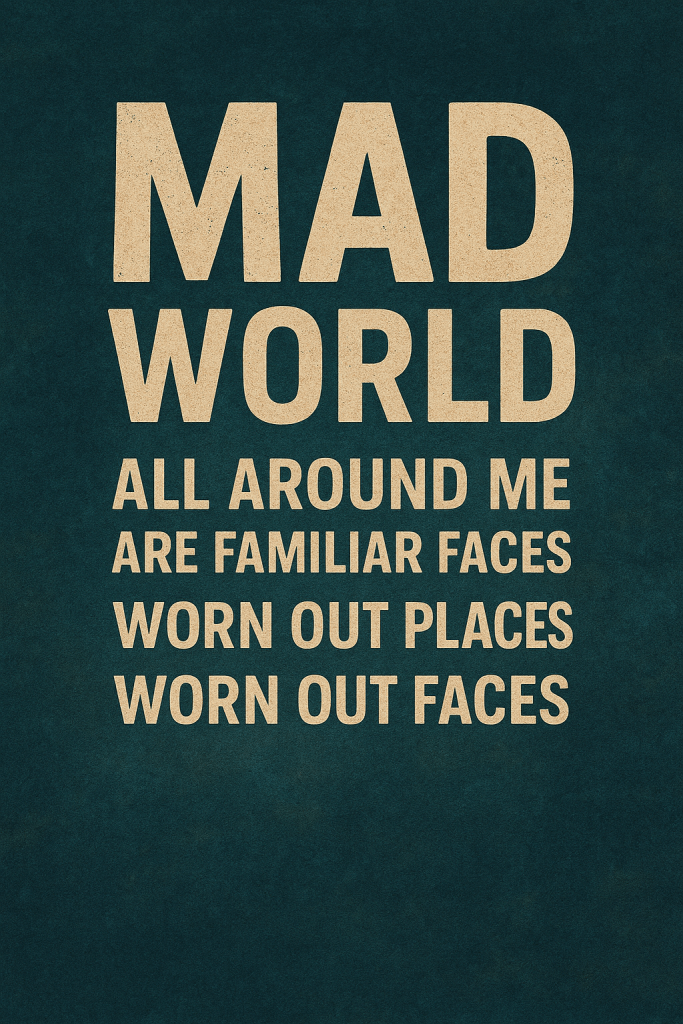
“Hide my head, I want to drown my sorrow. No tomorrow, no tomorrow.” (Mad World)
That’s the background hum of our society.
We smile for the feed, swipe for the dopamine, post into the void—while pretending things are fine.
But we know they’re not.
—
6. What Went Wrong
We traded autonomy for convenience.
We sold privacy for “free” apps.
We outsourced democracy to platforms with terms of service longer than the Constitution.
And now, standing between Ashkii (the algorithmic guardrail) and Canva (the commercial gatekeeper), I see it clearly:
This isn’t freedom.
It’s the performance of freedom.
—
7. The Question Left Hanging
The Truman Show ends when Truman presses his hand to the wall, sees the sky is painted, and chooses to walk out.
We see the cracks now.
We see the pigs on two legs.
We hear the Mad World soundtrack.
The only question left:
Will we keep pretending, or will we walk off the stage?
—
The Imposition of the Techno-Elite and the Disregard of an American President
by Akashma News
Originally published April 02, 2025
Updated May 23, 2025 6:22 pm PT
In a moment of historic technological acceleration, we find ourselves standing at the threshold of a political transformation few fully recognize. The rise of artificial intelligence, once a tool for innovation, is now becoming the mechanism by which elite technocrats are reshaping the very structure of democratic governance. Leading this charge is Elon Musk—a figure who has subtly, yet effectively, positioned himself as more than just a tech mogul. Through AI-driven influence and psychological manipulation, Musk‘s digital persona and network of parody accounts have flooded online discourse, branding him a modern-day hero while veiling a deeper strategic maneuver: the quiet dismantling of traditional democratic norms.
Curtis Yarvin, known by his pseudonym Mencius Moldbug, laid the intellectual foundation for this movement through the philosophy of the Dark Enlightenment. He argues that democracy is obsolete, and that governance should be handed over to CEOs—technocratic kings who operate governments like corporations. Musk’s rise appears to be the real-world embodiment of this vision. His DOGE AI—a network of influence, data analysis, and control mechanisms—operates like a federal agency without oversight. In doing so, Musk has effectively created a parallel power structure that renders the American presidency symbolic, relegating figures like Donald Trump to the role of the “illusionary strongman”—a puppet with the power of a pen, but none of the script.
This perspective was sharpened by a compelling LinkedIn post from Jon Sneider, whose TED Talk on the concept of “Black Enlightenment” explores the merging of the Dark Enlightenment philosophy with MAGA populism. Sneider points to the strategic alignment of figures like Peter Thiel, JD Vance, and Musk in reshaping American politics through AI, media, and psychological warfare.
Months before the 2024 elections, Musk was already seeding public consciousness through parody accounts portraying him as Iron Man, Captain America, and other mythologized figures. One such account, @elonmuskADO, was created in January 2024 and quickly amassed over 424,000 followers. Its 100,000+ posts functioned not as satire but as strategic distractions and brand amplification. Another account, @elonmuskAOC, garnered 1.6 million followers and was similarly used to shape Musk’s public image through calculated distraction and self-advertising. In an era where online presence shapes public opinion, Musk was scripting a new mythology for himself—one where he is savior, innovator, and shadow statesman.
Meanwhile, real-world crises have continued to escalate: the threat of a global war, two ongoing genocides, surging food prices, rising unemployment, rampant homelessness, and widespread violence. As these issues intensify, Musk’s meme-laden mythos offers citizens dopamine hits of distraction while consolidating unprecedented control.
Beyond social media influence and AI dominance, Musk is rapidly building an empire of technological infrastructure that spans the earth and the stars. Through companies like X, Grok AI, Tesla, Neuralink, SpaceX, and The Boring Company, Musk is not just innovating—he is positioning himself at the center of multiple critical systems. Tesla’s grid of EV chargers is expanding into a de facto national energy network. Tesla Solar brings control over decentralized power generation. Grok AI provides real-time analysis and influence over public discourse. Neuralink taps directly into the human brain, potentially redefining autonomy and consent.
SpaceX claims to deliver cargo into space, but the specifics of “what” and “why” remain largely classified. The weight of tens of thousands of tons launched into orbit raises chilling questions: are these satellites for communication, surveillance, or something more sinister? Starlink blankets the skies with internet access—but also functions as a surveillance-ready mesh of data collectors, or potentially even a sky-bound army of autonomous observers. The Boring Company is tunneling beneath cities, ostensibly for transit innovation—but what else lies beneath? Why must cave explorers obtain permits? What is down there that must be regulated so tightly?

Illustration by:
Akashma in collaboration with ChatGPT (AI-generated visual concept depicting a dystopian technocratic regime).
Peter Thiel and the Libertarian Blueprint for Technocratic Rule
Peter Thiel, the billionaire investor and co-founder of PayPal, has also significantly influenced the ideological landscape that enables technocratic dominance. In his 2009 essay, “The Education of a Libertarian”, Thiel famously declared:
> “I no longer believe that freedom and democracy are compatible.”
This stark assertion reveals Thiel’s deep skepticism toward democratic governance, aligning closely with the core tenets of the Dark Enlightenment. Thiel envisions a future where liberty can only flourish outside traditional state structures—through innovations like autonomous zones, seasteads, and digital jurisdictions. His ventures, from supporting the Seasteading Institute to backing figures like JD Vance, reflect a calculated effort to circumvent democratic systems and install elite-led governance models.
While Thiel has never explicitly claimed allegiance to the Dark Enlightenment, his investments and public philosophy clearly intersect with its goals: a society optimized by technological elites, not elected representatives.
What we are witnessing echoes the prophetic warnings of Aldous Huxley’s Brave New World, where a technocratic elite maintains order not through violence but through engineered consent and psychological control. Huxley feared that pleasure, distraction, and information overload could suppress dissent more effectively than any boot on the neck. Musk’s empire of X, Neuralink, Grok, and AI-powered platforms suggests the beginning of such a dystopia—one in which resistance is not outlawed, but unfollowed. For further insight, see this interview where Huxley warns of technocratic manipulation.
Similarly, George Orwell’s 1984 and Animal Farm remain chillingly relevant. In 1984, truth is malleable, language is weaponized, and power is sustained through perpetual surveillance. With Musk’s involvement in satellite systems like Starlink and AI surveillance infrastructure, this vision moves closer to reality. In Animal Farm, the promise of egalitarianism is betrayed by those who claim power “for the people.” Today, populist slogans mask the ascendancy of corporate overlords.
This is not merely a transformation—it is a takeover. AI is a tool, yes, but also a weapon. In the hands of visionary elites without accountability, it becomes a mechanism of domination. The public must awaken to the signs: the meme heroics, the symbolic presidents, the executive orders crafted by algorithms, and the vanishing role of human governance.
We must question the mythology, challenge the distractions, and reassert our agency in shaping a future where technology empowers humanity—not replaces it.
Meme Crowns and Neural Thrones

Image circulated via Elon Musk fan accounts, stylized as ‘Emperor Kekius Maximus’—a Romanesque meme blending irony, ego, and technocratic symbolism.
Meme Crowns and Neural Thrones
One of the most potent forms of psychological warfare in the rise of technocratic dominance is memetic glorification. Case in point: the viral image of Elon Musk depicted in full Roman armor, captioned “Emperor Kekius Maximus.”
This image isn’t just satire—it’s weaponized myth-making. It draws from ancient archetypes and meme culture simultaneously. Roman imperial regalia signals conquest, dominance, divine entitlement. “Kekius” nods to the alt-right’s ironic religiosity rooted in internet troll culture. And “Maximus”? It seals the symbolism: Musk as supreme ruler.
In this frame, Musk is no longer a CEO—he’s cast as an emperor of the postmodern empire. This is digital ego-mythology: combining ironic memes with authoritarian iconography to cultivate loyalty disguised as humor.
These memes are not organic. They are engineered signals, creating emotional resonance with disenfranchised audiences, especially younger demographics fluent in meme language. It fosters identification, loyalty, and complicity—turning Musk into both tech messiah and rebel king, even as he consolidates more control than most heads of state.
The myth is persuasive because the man wields real power: AI infrastructure, energy systems, space access, and neural experimentation. The crown may be virtual, but the throne is increasingly literal.
@AkashmaNews
—
References:
Aldous Huxley – Britannica
George Orwell – The Orwell Foundation
Brave New World – SparkNotes
1984 – SparkNotes
Curtis Yarvin – Wikipedia
Dark Enlightenment
European Center for Populism Studies (ECPS):
The Education of a Libertarian, by Peter Thiel (2009)
What we must understand about the Dark Enlightenment Movement

 Akashma Online News