Archive
White Powder, Black Legacy–Part I: Alfred Nobel’s War for Peace
By Akashma News
1899 marked a turning point in European science and warfare. Alfred Nobel’s patents on explosives were officially recognized, and with them, the industrial world inherited not just tools for progress, but the machinery of modern destruction.
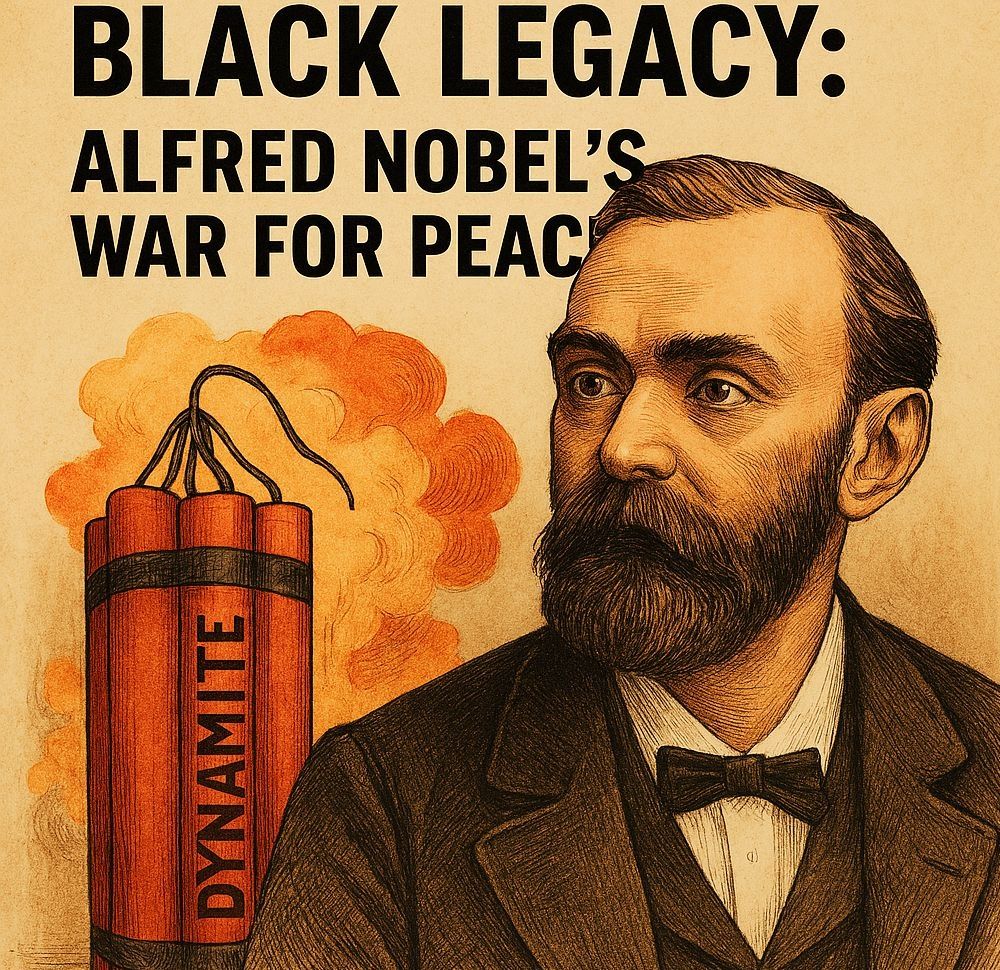
Alfred Nobel, a name now sanctified by peace awards and academic honor, built his empire not on compassion but on combustion. Through his company, Nobel Brothers, he turned oil and explosives into fortune, registering nearly 150 patents at the European Patent Office and over 355 worldwide. Many of these patents weren’t aimed at medicine or humanitarian innovation—they were precise instruments of war: dynamite, detonation systems, poison gases, and devices to measure and maximize force.
Nobel’s public image today is shaped by his final act of philanthropy—the establishment of the Nobel Prizes, including the coveted Peace Prize. But beneath this benevolent exterior lies a web of contradictions and calculated legacy-building that warrant closer examination.
Epigraph
“War and Peace could not have been better miswritten—not by Fyodor Dostoevsky, but by the amateur alchemist of ethics himself: Alfred Nobel.”
— Marivel Guzman
A Philosopher of War Disguised as a Peacemaker
Nobel famously declined an invitation to attend a peace conference. Though no formal explanation was recorded, his infamous statement offers a dark clue:
If there were peace, what would happen to my white powder?
That “white powder” was dynamite—the invention that made him wealthy and secured his place in both scientific and military history. This remark wasn’t simply sardonic—it was a candid admission of how deeply his livelihood depended on the machinery of war.
His ambivalence about peace was also evident in his personal interactions. In 1889, when Baroness Bertha von Suttner informed him that she had written an anti-war novel titled Die Waffen nieder (Lay Down Your Arms), Nobel replied in his usual sardonic tone that he hoped to read it—but wondered, “in case of universal peace, where would he place his new smokeless powder?” This remark, referring once again to his dynamite innovations, was more than a jest—it was a candid reflection of his priorities. Peace was a curiosity; war, a profession. It is safe to conclude from this brief exchange that “universal peace” was not in his personal or commercial interests.
He understood that peace was not simply a moral choice—it was a power dynamic. In one of his most telling remarks, Nobel declared:
“My factories may well put an end to war sooner than your congresses: on the day that two army corps can mutually annihilate each other in a second, all civilized nations will surely recoil with horror and disband their troops.”
This was the core of his peace doctrine: the belief that mutual threat—not mutual understanding—was the only reliable deterrent.
A Blueprint for the League of Nations
Nobel’s ideas about collective enforcement and global deterrence found their most detailed expression in a letter he wrote on October 15, 1892, to the Belgian pacifist Bertha von Suttner. There, he articulated what would later serve as a conceptual basis for the League of Nations and the United Nations:
> “This prize would be awarded to the man or the woman who had done most to advance the idea of general peace in Europe. I do not refer to disarmament, which can be achieved only by very slow degrees. I do not even necessarily refer to compulsory arbitration between the nations, but what I have in view is that we should soon achieve the result—undoubtedly practical one—that all states should bind themselves absolutely to take action against the first aggressor. Wars then will become impossible, and we should succeed in compelling even the most quarrelsome state either to have recourse to a tribunal or to remain quiet. If the Triple Alliance instead of comprising three states were to secure the adherence of all, secular peace would be insured for the world.”
In this vision, peace is not granted—it is imposed. Nobel imagined a system where global security would be achieved not through disarmament or diplomacy, but through binding alliances and credible retaliation. The implication was clear: enforce peace by preparing for war.
From Dynamite to Doctrine
This belief system—peace through superior force—has since become doctrine. It underpins military alliances like NATO, justifies sanctions, airstrikes, and invasions, and reinforces the arms races of superpowers who claim to “preserve peace” while waging perpetual war.
Nowhere is this clearer than in the actions of the United States and Israel, nations that often portray themselves as defenders of peace while using overwhelming military power to assert control. Whether Nobel foresaw this or not, his inventions and ideologies became the architecture of today’s militarized global order.
The tools he created to end war have instead professionalized it. The war industry—guided by logic he helped shape—now thrives in a global economy where arms are traded like commodities, and peace is managed, not achieved.
Final Reckoning
Alfred Nobel left behind two legacies: one in the blast craters of battlefields, and another in golden medals handed out in gilded halls. But perhaps the deeper truth lies in the space between the two—where innovation meets consequence, and idealism meets the market.
He believed destruction could shock the world into peace. But instead, it shocked the world into the permanence of conflict.
The Peace Prize continues to shine. But the world still burns with the fire Alfred Nobel helped ignite.
The Merchant of Death and the Price of Redemption**
(White Powder, Dark Legacy – Part II)
Part II exposes the turning point in Nobel’s legacy — the 1888 mistaken obituary that labeled him “The Merchant of Death.” This article tracks how that public condemnation led to the creation of the Nobel Peace Prize, not as a symbol of peace, but as an attempt to cleanse a violent legacy. It follows the misuse of the prize in the modern era, where war-makers and political elites are awarded under the illusion of diplomacy.
[Read Part II here →]
In 1888, Alfred Nobel read his own obituary — and it called him “The Merchant of Death.”
The world had mistaken him for his brother, but the judgment was real: a man who profited from war, buried in shame.
That obituary didn’t inspire him. It cornered him.
The Nobel Peace Prize wasn’t born from a dream of peace — it was an escape route.
A gold-plated monument to silence the ghosts of dynamite and artillery.
White Powder, Dark Legacy – Part II: The Merchant of Death and the Price of Redemption

 Akashma Online News