Archive
Water Management, Not Carbon Tax: Earth’s Silent Cry for Balance
By Marivel Guzman | Akashma News
Originally published on June 27, 2017
Updated on May 03, 2025
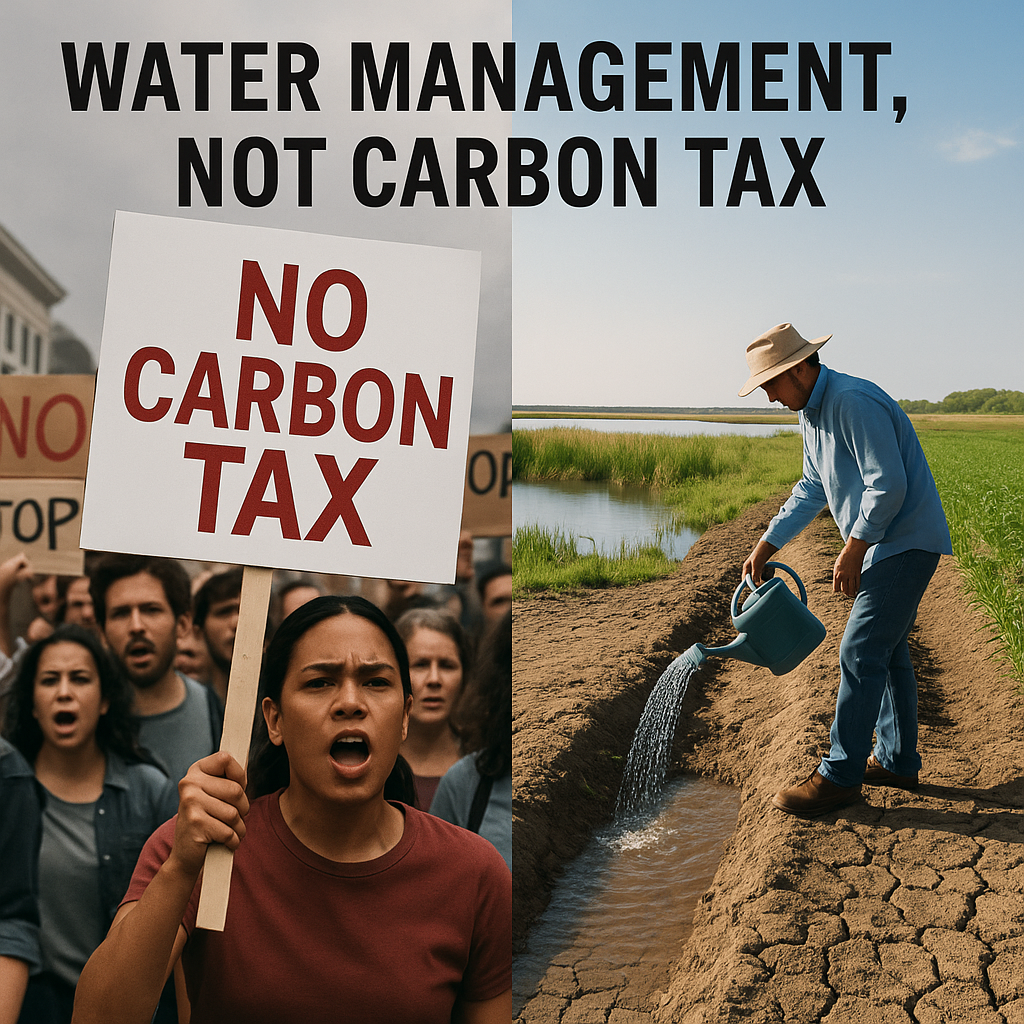
In the global effort to combat climate change, carbon taxes have emerged as a popular policy tool. Proponents argue that putting a price on carbon emissions incentivizes industries and individuals to reduce their carbon footprint. However, this approach often overlooks a more immediate and tangible crisis: water mismanagement.
I’m not a scientist. But my common sense, my emotional intelligence, and my deep symbiotic bond with Mother Earth compel me to question the climate change narrative being pushed by policymakers, financiers, and lobbyist-backed scientists. The climate is indeed changing—but it’s not just because of carbon emissions. It’s because Earth is thirsty.
I coined the term “dry surface syndrome” to describe this condition—one caused not by abstract greenhouse gases, but by the damming of rivers, the clear-cutting of forests, the overuse of groundwater, and the destruction of Earth’s natural hydrological systems. When Earth is parched, it does what every living organism does: it adapts. It melts its glaciers. It shifts its winds. It tries to rebalance itself.
Let me be clear: I believe lobbying companies have manipulated have the scientific discourse around climate. Some of the data pushed over the last 25 years, especially by the proponents behind “An Inconvenient Truth,” was crafted not to empower the planet—but to sell the carbon tax agenda. We’ve been sold a smokescreen, while the real damage continues in our rivers, forests, and oceans.
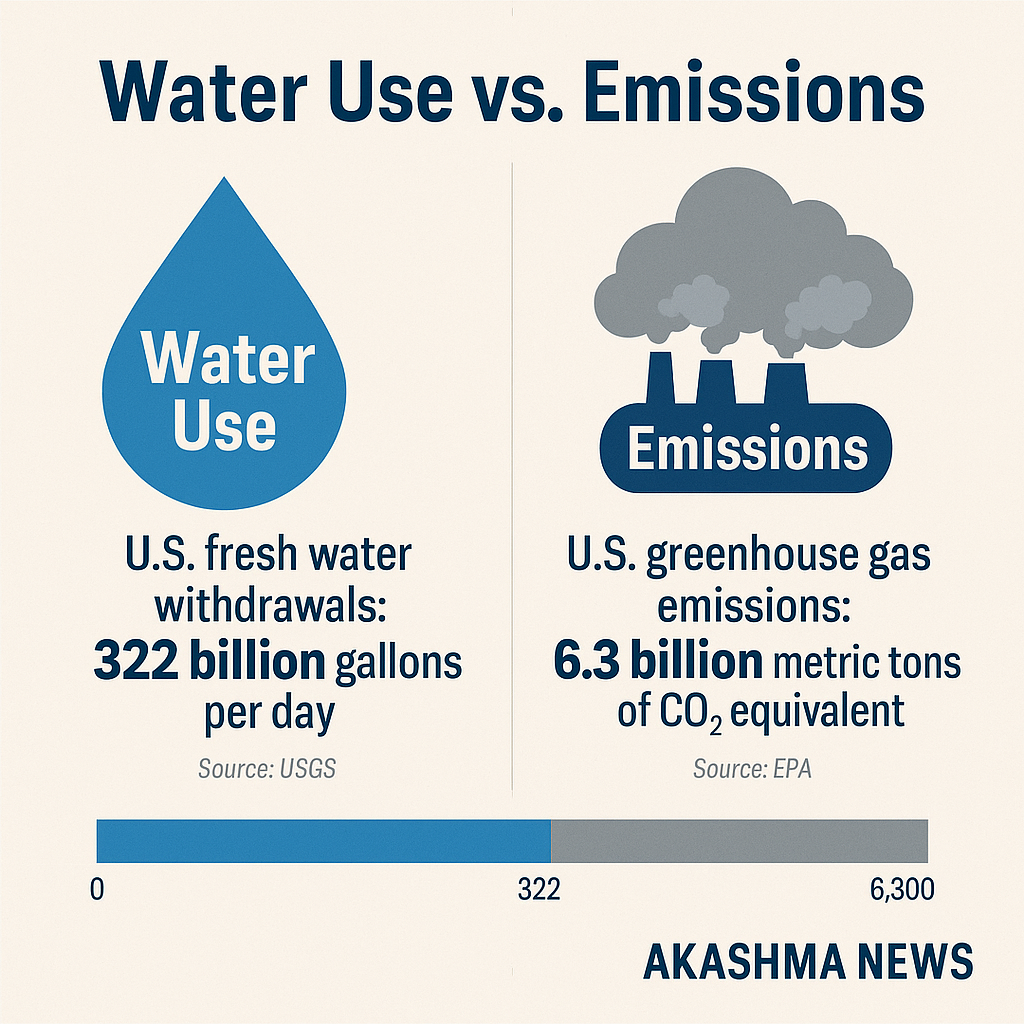
This infographic reveals the stark contrast between the U.S.’s massive daily freshwater use (322 billion gallons) and its CO₂ emissions (6.3 billion metric tons). As Marivel Guzman writes, “Earth is not just warming—she is thirsty.”
Water, the Forgotten Crisis
According to American Rivers, the U.S. alone diverts and manages its water through more than 241 dams in California—part of a global network of over 57,000 dams disrupting natural ecosystems. Dams fragment rivers, kill fisheries, and stop sediment from replenishing coasts. The Guardian reported extensively on this issue, which remains largely ignored in global climate talks.
Even worse, freshwater from melting glaciers is described by some scientists as “wasted water” because it mixes with the oceans. But water doesn’t die—it transforms. As sunlight causes evaporation, that moisture joins the rain cycle, replenishing rivers, aquifers, and life. To call glacier melt “waste” is to deny the sacred role water plays in Earth’s renewal.
Lungs of the Planet: Forests and Oceans
BBC once called the Amazon the “lungs of the planet,” covering over 5.5 million square kilometers. But it isn’t just forests. According to the Earth Journalism Network, oceans also act as Earth’s lungs—producing between 50% to 80% of the world’s oxygen and absorbing over 25% of its CO₂. WWF’s Yolanda Kakabadse put it best: “We should call it Planet Ocean.”
And yet, we are suffocating these lungs. If you trap the water responsible for ocean currents and cut down all the trees, what do you expect will happen to the climate?
Pollution vs. Responsibility
Pollution is real and deadly—particularly in the developing world. The World Health Organization states that over 3 billion people, mostly women and children, still inhale toxic smoke daily from polluting stoves. But not all pollution comes from oil or cars. We ignore the role of fast fashion, agriculture, and consumer habits in water waste and environmental degradation.
Take cotton: India, the world’s largest producer, uses 22,500 liters of water to produce just one kilogram of cotton.According to The Guardian, in 2013 alone, India’s cotton exports consumed enough water to supply 85% of its 1.24 billion people with 100 liters per day for a year. Yet 100 million people in India lack safe water access.
Since 1991, the World Bank has been deeply involved in multiple phases of India’s water infrastructure development—channeling billions in loans toward rural water supply, dam rehabilitation, and urban water management. Yet despite these investments, India now has significantly less water per person than it did in 1951.
According to India Today, per capita water availability dropped from 5,177 cubic meters in 1951 to just 1,545 cubic meters by 2011, with current estimates nearing 1,000 cubic meters in several regions
Toward a Real Climate Agenda
If climate change is a fact—and it is—then the preservation, distribution, and restoration of water systems must be central to every climate summit and sustainability agenda. Instead of investing billions in carbon markets and surveillance, we must dismantle destructive dams, reforest ecosystems, and return rivers to their natural paths.
We must acknowledge Earth as a sentient, self-regulating being—not just a resource to be taxed, but a life force to be nurtured. Earth is not just warming. She is bleeding through her glacier tears. And she is asking us to listen.
Further reading:
When Earth Thirsts: Glacial Tears and the Wisdom of a Living Planet
The Natural Rivers are a picture of the past.
The scarcity of water is well-known fact and documented.
The rivers that used to flow still 10 or 20 years ago are part of a picture past.
Most of the giants Dams constructed to commercialize this vital liquid have made the rivers disappear.
Every year, fewer and fewer rivers, streams, and broadways are filled with rain water: Dams, pools, artificial lakes, bottled water, super agriculture, and golf courses are the cause of the droughts around the world.
Pessimist? No, I’m just realistic.
The good news is that there is a Global Council Water Club that gets paid to bring water to all the citizens of the world because water it is a human right. The bad news and that almost no one in the world knows that they exist, and people, animals, and lands are dying for the lack of water.

(Photo by Marivel Guzman) Nov 30, 2021
American Indian nations have had their lands, water rights, fishing rights, and sacred sites taken from them. The case of Boulder Dam (later renamed Hoover Dam) on the Colorado River is different in that it did not directly impact the Navajo Reservation, but it indirectly led to the destruction of the traditional Navajo economy, and the creation of poverty and economic inequality among the Navajo.
Names of projects and links to UN were updated on August 10, 2023.
There is also the UN-Water Project. They both exist as separate entities. The UN Water Project changed its name to UN-Water since I published this research paper back in 2012.
They generate a report every 3 years. Just to illustrate the banality of these UN projects. Palestine has been suffering from a lack of water. Israel is holding Palestine hostage on water supplies.
Israel controls the aquifers, and Palestine by law can’t dig for new wells. According to certain accords signed decades ago at the White House. “Palestinians can not dig for fresh water,” and to aggravate their problems, illegal settlers are dumping cement inside Palestine wells.
While the world’s population tripled in the 20th century, the use of renewable water resources has grown six-fold.
Within the next fifty years, the world population will increase by another 40 to 50 %. This population growth – coupled with industrialization and urbanization – will result in an increasing demand for water and will have serious consequences on the environment.
People lack drinking water and sanitation.
Already there is more wasted water generated and dispersed today than at any other time in the history of our planet: more than one out of six people lack access to safe drinking water, namely 1.1 billion people, and more than two out of six lack adequate sanitation, namely 2.6 billion people (Estimation for 2002, by the WHO/UNICEF JMP, 2004). 3900 children die every day from water-borne diseases (WHO 2004). One must know that these figures represent only people with very poor conditions. In reality, these figures should be much higher.
Water resources are becoming scarce
Find your country, and see how many rivers are left to run wild and how many dams were constructed in the last 100 years.
But conservation groups say that the plans for many large dams are based on historical river flow data that are irrelevant in today’s rapidly changing and unpredictable climate.
“Large dams have always been based on the assumption that future stream-flow patterns will mirror those of the past, but this is no longer true,” Rudo Sanyanga, International Rivers’ African program director, said in a statement. National Geographic
Facts and Figures
Sources of Fresh Water
Groundwater – water that infiltrates into the ground through porous materials deeper into the earth. It fills pores and fractures in layers of underground rock called aquifers. Some of this water lies too far under the earth’s surface to be extracted at an affordable cost.
Surface-water runoff – precipitation that does not infiltrate into the ground or return to the atmosphere: streams, rivers, lakes, wetlands, and reservoirs.
Snow that is 4 inches (10cm) deep contains about the same amount of water as 1/3 inch (1 cm) of rain.
1.1 billion people live without clean drinking water
2.6 billion people lack adequate sanitation (2002, UNICEF/WHO JMP 2004)
1.8 million people die every year from diarrhoeal diseases.
3 900 children die every day from water-borne diseases (WHO 2004)
Daily per capita use of water in residential areas:
– 350 liters in North America and Japan
– 200 liters in Europe
– 10-20 liters in sub-Saharan Africa
Over 260 river basins are shared by two or more countries, mostly without adequate legal or institutional arrangements.
A leak that fills up a coffee cup in 10 minutes will waste over 3,000 gallons of water in a year. That’s 65 glasses of water every day for a year.
A leaky toilet can waste over 22,000 gallons of water in one year; enough to take three baths every day.
Water Cycle | How the Hydrologic Cycle Works, July 13, 2013 by Water Sciece Foundation.
How much fresh water is used in franking?
Water used for hydraulic fracturing is typically fresh water taken from
groundwater and surface water resources. Although there are increasing efforts to use nonpotable water, some of these sources also supply drinking water.
Fracking consumes a massive amount of water. In the United States, the average can run between 1.5 million and 9.7 million gallons of water to frack a single well.
Hydrocarbons in the 21st Century: Green, Clean and Safe, July 17, 2018 by Drilling Matters
How Much Water Does it Take to Produce Your Food?
Water Pollution
A gallon of paint or a quart of motor oil can seep into the earth and pollute 250,000 gallons of drinking water.
A spilled gallon of gasoline can pollute 750,000 gallons of water.
World Water Shortage vs. Golf Course Consumption
Wrong Climate for Damming Rivers
Wrong Climate for Damming Rivers, by International Rivers, Nov 19, 2011.
The “Wrong Climate for Damming Rivers,” with Right Livelihood Award Winner Nnimmo Bassey, explores the impacts of climate change and hydropower on the world’s rivers.
Bottle Water Hoax: The Story of Bottled Water, by How Stuff Works Projec.
The Story of Bottled Water, released on March 22, 2010 (World Water Day)
Read more…
 Akashma Online News