Archive
Flagging Blaze: How WordPress Promotes Sanitized History While Silencing Dissent
By Akashma News
Sep 10, 2025

I submitted my articles to WordPress Blaze.
Carefully researched, fact-based investigations into Alfred Nobel, his white-powder fortune, and the contradictions of a legacy that feeds both peace and war.
Rejected.
Not for plagiarism.
Not for hate.
Not for misinformation.
Rejected because my words didn’t fit their invisible brand-safe box.
The Gatekeeping at Work
Blaze markets itself as a tool for creators: “Promote your post, reach more readers.” But when I tried to advertise:
“White Powder, Dark Legacy” was flagged.
“Merchant of Death” in the title became unpublishable.
Rumble’s Battles in Brazil
Articles challenging comfortable historical myths were quietly buried.
Why? Because Blaze, like every ad platform, runs on sanitization:
Words like “death,” “war,” “corruption,” “contradiction” trigger filters.
Articles that expose uncomfortable truths are “sensitive content.”
Meanwhile, safe consumer fluff sails through.
Blaze as a Historical Gatekeeper
By rejecting investigative work, Blaze isn’t just avoiding controversy—it is promoting historical misinformation by omission.
It tells readers:
Praise the Nobel Prize, but never question its bloody roots.
Celebrate legacies, but never analyze contradictions.
Advertise entertainment, but not truth.
This isn’t neutrality. This is bias in favor of sanitized history.
The Illusion of Free Expression
WordPress claims to champion creators. But Blaze proves otherwise. Blaze wants content that’s glossy, uncontroversial, advertiser-friendly.
What does that mean?
It means the very platform that claims to empower voices is quietly silencing those who interrogate power.
Freedom of speech exists—but not in the marketplace of ads. There, only what sells survives.
Why I’m Flagging Blaze
I will not re-title my work to appease algorithmic gatekeepers.
I will not dilute history to fit a marketing funnel.
I’m flagging Blaze itself as biased—because when it blocks truth under the banner of “policy,” it becomes complicit in promoting the very myths it pretends to be neutral about.
History is messy. History is bloody. History is contradiction.
To erase those realities in the name of “safety” is not protecting readers—it is protecting power.
Akashma News will continue publishing unfiltered.
Because if journalism bends to Blaze, then journalism is lost.
Rumble’s Battle in Brazil: A Clash of Jurisdictions and Ideologies
By Marivel Guzman – Akashma News
August 11, 2025
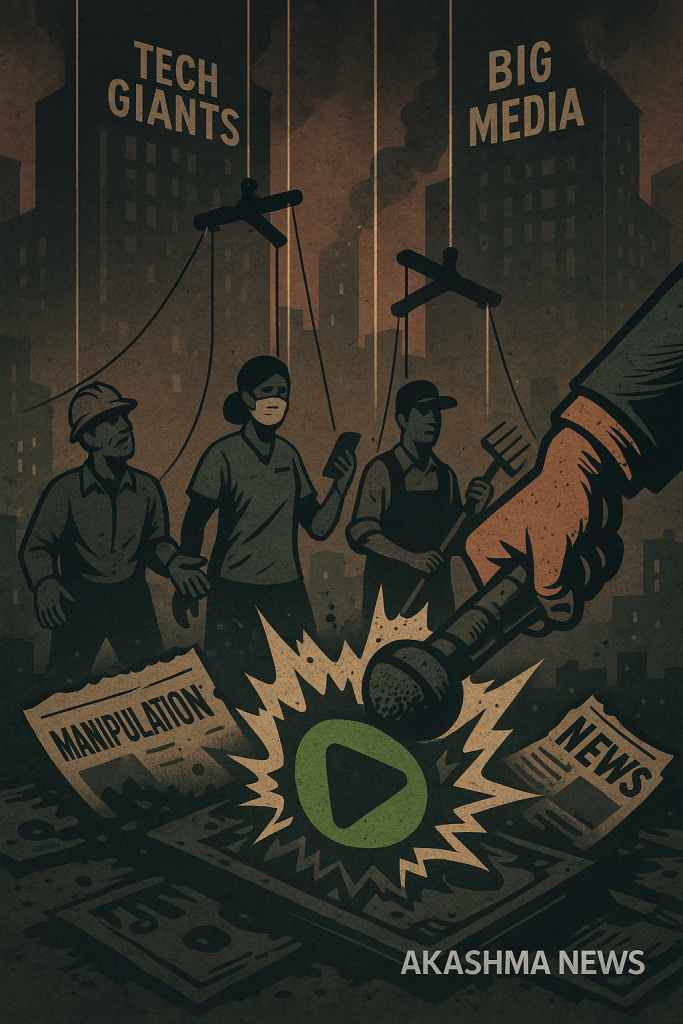
In a world where platforms rise not just by innovation but by the enemies they make, Rumble has become both a media battleground and a stock market pawn. As corporate media churns narratives to suit their sponsors and Big Tech suppresses dissent behind euphemisms like “safety” and “policy compliance,” the investing class plays its own theater of manipulation—hyping freedom platforms like Rumble to lure in the working class, only to dump shares and cash out when the scent of rebellion fades. While the public believes they’re funding a revolution, Wall Street’s shadow players are staging an exit. Beneath the noise lies a deeper war—one over digital sovereignty, ideological control, and the manufactured illusion of choice.
Background:
Justice Alexandre de Moraes of Brazil’s Supreme Court ordered Rumble to comply with Brazilian law—by appointing a legal representative in Brazil and removing content—under threat of daily fines or suspension. Rumble refused and instead blocked access for Brazilian users, sparking a high-stakes legal showdown.
Legal & Ideological Stakes:
The case isn’t simply about compliance—it’s about ideological warfare. TechPolicy Press argues the lawsuit is less about free speech protection and more a symbolic clash against Brazilian judicial power, especially as the court prepares for sensitive domestic political cases including one involving former President Bolsonaro.
Strategic Implications for Rumble:
Jurisdictional Precedent: If foreign courts successfully enforce censorship on U.S. platforms, it would establish a dangerous extraterritorial precedent threatening free‑speech norms worldwide.
Symbolic Capital: Rumble positions itself as a bulwark of free speech, appealing politically to audiences skeptical of mainstream tech’s moderation.
Global Risks: Continued resistance may come at the cost of access in key markets, raising legal exposure and reputational risk.
Trump’s Free Speech Rhetoric vs. Reality
Executive Rhetoric vs. Enforcement:
President Trump’s early 2025 Executive Order promised to “restore freedom of speech” and end “federal censorship.”
But critics argue the true impact hasn’t matched the rhetoric—experts warn that the order may encourage disinformation and erode accountability.
Empirical Actions Undermining Free Speech:
Press Crackdowns: The administration barred AP from briefings over a trivial naming dispute (“Gulf of America”) and fostered a broader environment of media suppression.
De-funding Public Media: NPR and PBS faced sweeping funding cuts and a $1.1 billion defamation lawsuit, weakening independent journalism.
Academic Suppression: Universities like UCLA and Stanford have faced punitive funding freezes or lawsuits tied to protests and speech, reminiscent of censorship not far removed from Brazil’s hard‑line approach.
Targeting Legal & Civil Society Actors: Through executive orders and DOJ actions, the administration intimidated media, professors, lawyers, and human rights actors—suggesting tools of the state being used against dissent.
Comparative Perspective: Brazil vs. U.S.
Feature Brazil (Rumble Case) U.S. (Trump Administration)
Legal Mechanism Supreme Court orders suspension, fines Executive orders, de‑funding, DOJ weaponization
Primary Focus Jurisdictional assertion over U.S. platforms Domestic control over media, academia, dissent
Free Speech Impact Limits U.S. platforms on foreign soil Chills domestic journalism, education, legal discourse
Ideological Tone Freedom vs. judicial authority; Bolsonaro tensions Free speech rhetoric masking consolidation of power and retribution
What’s “Cooking” in the Background?
Ideological Warfare: Rumble’s Brazil conflict thrusts it into a broader ideological battleground—right‑wing free speech warrior vs. perceived judicial censorship.
Regulatory Blowback: Trump’s aggressive posture may embolden U.S. regulatory suspicion towards Rumble as an ideological actor rather than a neutral platform.
Polarized Perceptions: Public sentiment may align it with politically charged causes, affecting advertiser sentiment and investor confidence.
Symbolic Leverage: Rumble could become a geopolitical symbol—either a beacon for digital free expression or a destabilizing force in the techno‑political landscape.
Implications for Rumble’s Future Growth
1. Brand Strength with Risk
Rumble’s ideological alignment creates deep loyalty among specific user groups—but may also limit mainstream adoption or commercial partnerships wary of controversy.
2. Geopolitical Exposure
Markets like Brazil may remain off-limits. Similar pushbacks could arise in Europe or other jurisdictions, posing market-scale challenges.
3. U.S. Support vs. Backlash
If Trump’s administration remains in power, Rumble could gain structural support—especially if painted as an ideological ally. But regulatory or litigious escalation remains a constant threat.
4. Investor Caveats
Investors must weigh ideological momentum with unpredictable legal and regulatory risk—not purely growth potential.
Final Thoughts
This is not only a legal or financial battle—it’s a front line in the ideological struggle over digital speech, sovereignty, and institutional power. Rumble’s trajectory hinges not just on user growth or ad dollars, but its evolving role as either a digital dissident or a political lightning rod. That duality could either fuel explosive growth or spark crippling backlash.
🖋️ Editor’s Note
This article is part of an ongoing investigative series by Akashma News examining digital sovereignty, media influence, and free speech in the age of ideological warfare. As of publication, Rumble Inc. has been contacted for official comment regarding the Brazil Supreme Court litigation, its evolving market identity, and investor dynamics. We will update this piece accordingly should Rumble’s communications team or legal representatives provide a response.
— Marivel R. Guzman, Editor-in-Chief, Akashma News

 Akashma Online News