Archive
The Oil Connection to Afghanistan: Condoleezza Rice and Hamid Karzai
By Marivel Guzman | Akashma News
Originally published July 1, 2010 | Updated May 17, 2025|
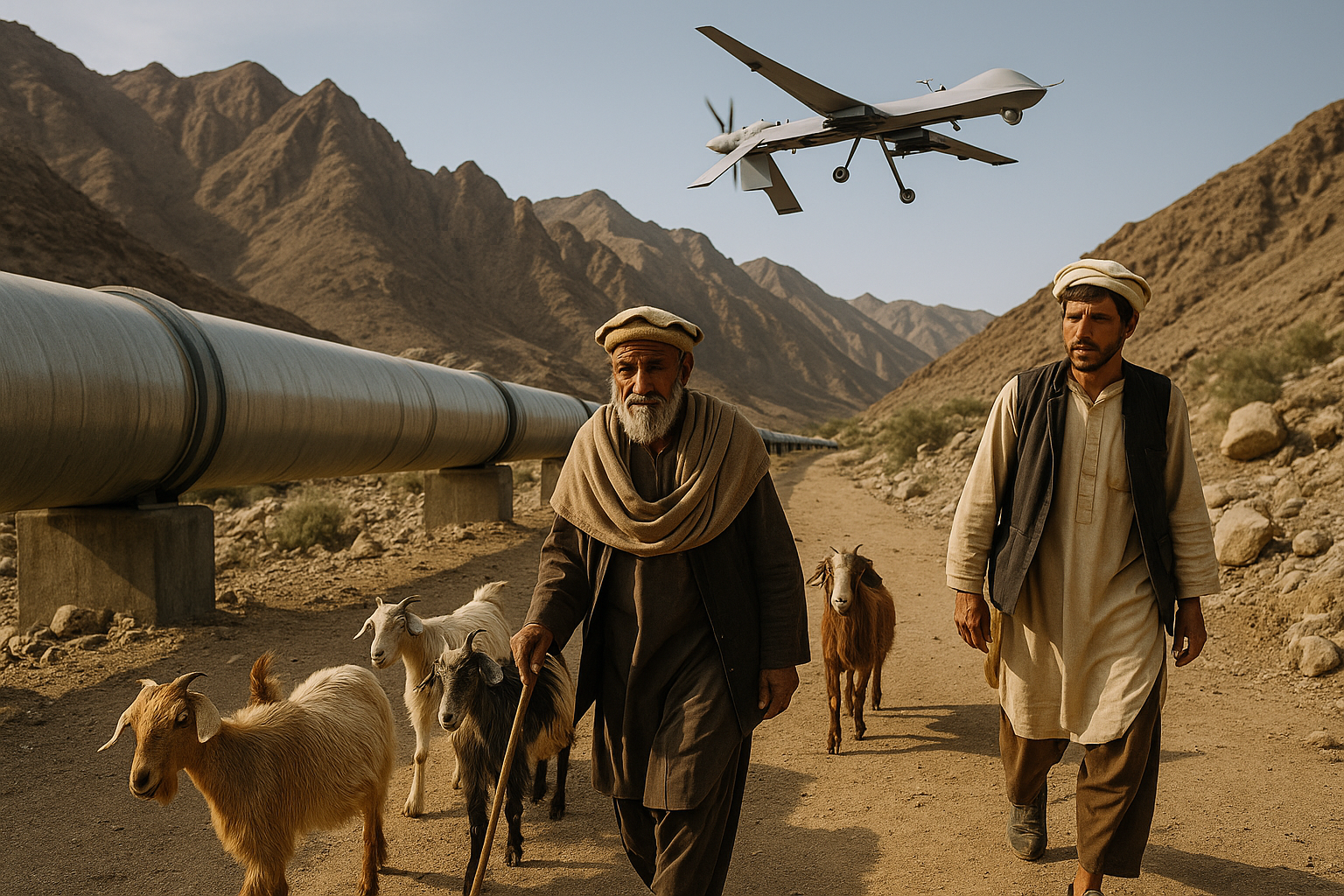
Beneath the silent gaze of drones and the shadow of a pipeline, Afghan herders walk a land claimed by empires but kept alive by their goats. The mountains remember everything.
Chevron Corporation, one of the world’s six “supermajor” oil companies, is headquartered in San Ramon, California. Operating in more than 180 countries, Chevron is involved in nearly every aspect of the energy industry: oil and gas exploration, refining, marketing, transportation, chemicals manufacturing, and power generation.
Chevron’s Environmental Footprint
In Ecuador, from 1965 to 1993, Chevron (then operating as Texaco) managed the Lago Agrio oil field. The company has faced long-standing legal action for widespread environmental destruction in the Amazon. A class action lawsuit filed on behalf of Amazonian communities resulted in a landmark $9.5 billion judgment by Ecuadorian courts—though Chevron has refused to pay, citing a previous agreement with the Ecuadorian government.
Read more on the Ecuador case.
In Richmond, California, Chevron’s refinery operations have been controversial due to over 304 industrial accidents and the release of more than 11 million pounds of toxic materials. In 1998, Chevron paid $540,000 in fines for bypassing wastewater treatments and failing to notify the public about toxic discharges. The company is also listed as potentially liable for 95 Superfund sites designated by the U.S. Environmental Protection Agency.
EPA Superfund Program.
In Angola, Chevron’s environmental practices led to the country levying its first-ever environmental fine on a multinational corporation. In 2002, the Angolan government fined Chevron $2 million for oil spills off its coast.
Chevron fined in Angola.
In California, Chevron also settled a federal Clean Air Act violation in 2003. As part of a consent decree, the company paid a $6 million fine and agreed to spend $275 million on emissions controls to reduce nitrogen and sulfur dioxide pollutants.
DOJ press release on Chevron settlement
Rice, Chevron, and the Bush Administration
Former Secretary of State Condoleezza Rice served on Chevron’s board of directors from 1991 until January 15, 2001, when she left to join the Bush administration. During her tenure, she chaired the company’s public policy committee. Her connection to Chevron was so prominent that the company named a 129,000-ton oil tanker the Condoleezza Rice. The ship was later renamed Altair amid public backlash over oil ties in the Bush Cabinet.
Chevron removes Rice’s name from tanker.
Who Is Hamid Karzai?
Who Is Hamid Karzai?
Before rising to power in post-Taliban Afghanistan, Hamid Karzai worked as a consultant for UNOCAL Corporation, a California-based petroleum company negotiating with the Taliban during the 1990s to construct the Central Asia Gas Pipeline (CentGas). The proposed pipeline would have run from Turkmenistan through western Afghanistan into Pakistan.
UNOCAL pipeline history.
Karzai, a member of the Durrani Pashtun tribe and long-time CIA contact, was seen as a key liaison between the Taliban and U.S. oil interests. He worked closely with top CIA officials and Pakistani intelligence (ISI), and eventually relocated to the United States under CIA protection.
Despite UNOCAL’s official claim to have abandoned the project in 1998, reports indicate that the pipeline remained a high strategic priority. Meetings between U.S., Pakistani, and Taliban officials continued into the early 2000s. U.S. Ambassador to Pakistan Wendy Chamberlain, with known ties to the Saudi ambassador (a financial backer of the Taliban), advocated aggressively for the construction of a Pakistani oil terminus on the Arabian Sea.
Washington Post coverage.
Meanwhile, President George W. Bush asserted that U.S. troops would remain in Afghanistan indefinitely. While NATO allies handled peacekeeping, U.S. forces were often assigned to guard pipeline construction corridors.
The Haq Assassination and CIA Strategy
Karzai’s loyalty to U.S. energy interests was a key reason why the CIA backed him over rivals like Abdul Haq, a respected mujahideen commander from Jalalabad and member of the Northern Alliance. Haq was popular among various Afghan ethnic groups, but he lacked ties to the oil industry.
In October 2001, Haq reentered Afghanistan but was quickly captured and executed by Taliban forces. Some observers in Pakistan believe the CIA, through the ISI, may have tipped off the Taliban. Former Reagan adviser Robert McFarlane, who attempted to coordinate a rescue, later said the agency’s response was too slow to be effective.
Time Magazine: The Betrayal of Abdul Haq.
Ambushed with his small escort in a high mountain pass south of Kabul, Haq had called McFarlane for help. McFarlane said he had alerted the CIA. “The CIA did not perform,” McFarlane went on, although administration officials said that the agency had sent an unmanned Predator drone aircraft that fired a missile at a nearby Taliban convoy.
Khalilzad, Enron, and Cheney’s Grand Oil Plan
Karzai worked closely with Zalmay Khalilzad, a fellow Pashtun and former UNOCAL consultant, who served as a special liaison to the Taliban regime. Khalilzad conducted risk analysis for CentGas and worked for RAND Corporation and the Bush administration.
Meanwhile, Enron Corporation, one of the Bush campaign’s biggest contributors, conducted the feasibility study for the CentGas project. Vice President Dick Cheney held multiple closed-door meetings with Enron executives, including CEO Kenneth Lay, as part of his now-infamous Energy Task Force.

 Akashma Online News