Archive
Part V: Blood Money and Broken Oaths —Naming the War Lords – Profiles of Power, Profit, and Permanent War
by Marivel Guzman | Akashma News

There are men who sell wars. And there are men who build the weapons. Often, they are the same.”
— Akashma News, 2025
Patriots. Strategists. Innovators.
That’s how they are introduced on television. But behind every press release and campaign ad is a ledger. And that ledger shows profit made from pain, shares lifted by war, and a cast of powerful individuals who walk between Washington, Wall Street, and war zones—unchallenged, unelected, and unaccountable.
I. The Men Who Sold the Wars
Dick Cheney
CEO of Halliburton before becoming VP.
His company gained $39.5 billion in Iraq War contracts.
Personally retained stock options while architecting war policy.
Donald Rumsfeld
Sat on the board of Gilead Sciences during the planning of biosecurity policy.
Championed a war doctrine that transformed defense into private enterprise.
Zalmay Khalilzad
U.S. Ambassador to Afghanistan and Iraq.
Later became a consultant for oil and defense interests in the very regions he helped “liberate.”
II. The Generals and Officials Who Became Investors – or Were Always Connected
Gen. James Mattis
Joined General Dynamics board shortly after retiring.
Benefited from a firm that supplies key components to both U.S. and NATO operations.
Gen. Stanley McChrystal
Advisor to Palantir, the CIA-funded predictive warfare and surveillance firm.
Former top commander in Afghanistan.
Gen. Michael Hayden
After leading both the NSA and CIA, became a private intelligence consultant.
Affiliated with Booz Allen Hamilton, same firm Edward Snowden worked for before exposing global surveillance.
Lt. Gen. William Hartman
Currently head of U.S. Cyber Command and NSA (acting).
Central figure in the next-gen war theater: data and cyber control.
Condoleezza Rice
National Security Advisor (2001–2005) and Secretary of State (2005–2009).
Former board member of Chevron, which honored her by naming an oil tanker “Condoleezza Rice” in the late 1990s.
Advocated aggressively for regime change in Iraq, despite evidence contradicting the WMD narrative.
Her influence over Afghanistan policy is deeply tied to pipeline geopolitics—not democracy.
As reported in Akashma News (2012), Rice’s connections to energy giants and Hamid Karzai—Afghanistan’s U.S.-installed president and former Unocal pipeline advisor—reveal that “freedom” in Afghanistan may have always been code for oil transit routes and corporate access to Central Asian reserves.
III. Trojan Chips and Phantom Circuits: The Hidden Frontline of Betrayal
“We build our weapons in the name of security—while outsourcing their soul.”
Every F-35. Every smart missile. Every drone or comms satellite in the U.S. arsenal carries inside it parts from foreign nations.
And some of those nations don’t share American values—only American contracts.
Microchips from Taiwan and Israel.
Rare-earth magnets from China.
Optical components from Germany.
Coding subcontractors in India, the UAE, and beyond.
These components are:
Untraceable once installed.
Unverifiable by visual inspection.
Vulnerable to backdoors, malware, timed failure, or embedded surveillance.
In short: weapons may now come pre-compromised.
Israel’s Case: A Known Precedent
In the 1990s, Israeli-manufactured pagers were discovered to be covert surveillance devices, transmitting user location and message metadata without consent. These pagers were sold across Latin America, Europe, and Asia—including to government officials and journalists.
Today’s equivalent?
Cellebrite, Pegasus, NSO Group—all accused of spying on allies and dissidents.
Yet these firms maintain privileged access to U.S. markets and intelligence networks.
What About China?
In 2018, a Bloomberg investigation alleged that Chinese microchips were covertly installed on server motherboards used by Apple, Amazon, and Pentagon contractors.
Even if unconfirmed, the possibility is the threat.
And if Raytheon, Lockheed, or General Dynamics can’t verify every circuit, the entire system is compromised.
IV. The Tech Titans and the Spy Market
Peter Thiel (Palantir)
Created software that maps populations, predicts insurgency, and profiles suspects.
Palantir is funded by In-Q-Tel, the CIA’s venture capital arm.
Jeff Bezos (Amazon)
Bid on the $10B JEDI cloud war contract, and won major DOD deals via AWS.
Amazon’s infrastructure now supports U.S. intelligence, ICE, and military data.
Eric Schmidt (Google/Alphabet)
Served on the Defense Innovation Board.
Helped bridge Silicon Valley with the Pentagon.
Bill Gates (Microsoft)
Indirectly involved in Iraq reconstruction and humanitarian tech expansion.
Microsoft still maintains defense partnerships and cloud servicing for secure military communications.
Lord of War (2005) – Fiction Based on Too Many Facts
In Lord of War, Nicolas Cage plays Yuri Orlov, a smooth-talking arms dealer who thrives in the chaos left behind by collapsing governments and constant conflict. Based loosely on real-life figures like Viktor Bout, the film peels back the curtain on the global weapons trade—legal and illegal—and shows how war is less about ideology, and more about inventory management.
Yuri sells to dictators, rebels, and “freedom fighters”—often in the same country, often with weapons traced back to U.S. or Russian stockpiles. He helps stage rebel uprisings, fuels civil wars, and arms child soldiers, all while living comfortably under the protection of great powers who need people like him to do the dirty work off the books.
The film’s final punchline comes in the credits:
“There are over 550 million firearms in worldwide circulation—one for every 12 people on the planet. The only question is: How do we arm the other 11?”
That’s not a line from the movie. It’s the film’s closing warning—and one of the most honest summations of the modern arms economy ever put on screen.
The real difference between Yuri Orlov and the Pentagon’s preferred contractors?
Orlov was honest about being a merchant of death.
V. Conclusion: These Are the Lords of War
They don’t fight on battlefields. They don’t wear medals. But they profit on every bullet, bomb, and biometric scan.
They rotate from command posts to boardrooms, from political office to private consultancy.
And while veterans die waiting for care, while families mourn from Kabul to Kansas, these war lords cash checks, win contracts, and rewrite policy in their image.
They are the hidden government.
And they’ve sold the republic for stock options and subcontracting fees.
“The difference between Yuri Orlov and real war lords? Orlov was fictional—and slightly more honest.”
The Oil Connection to Afghanistan: Condoleezza Rice and Hamid Karzai
By Marivel Guzman | Akashma News
Originally published July 1, 2010 | Updated May 17, 2025|
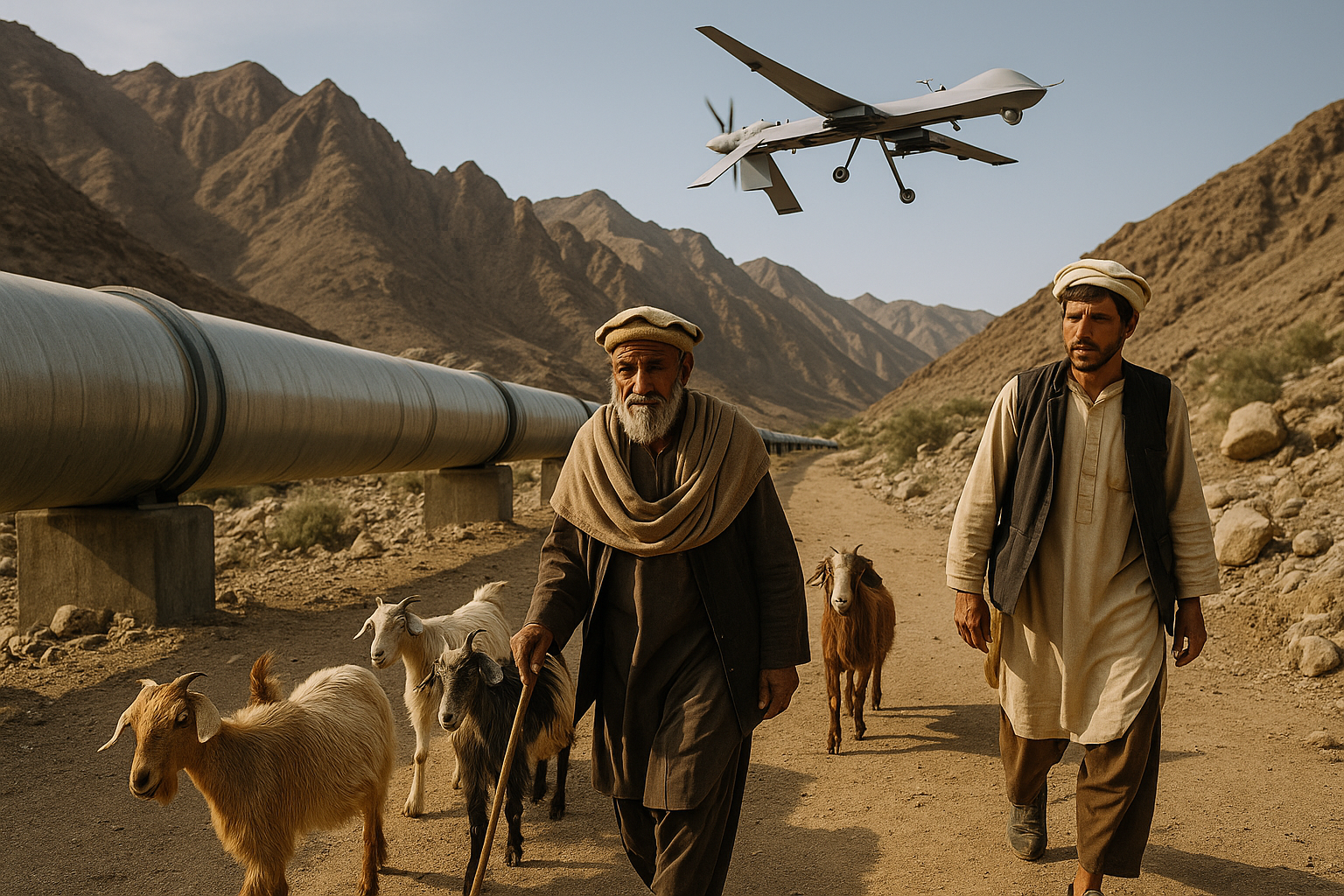
Beneath the silent gaze of drones and the shadow of a pipeline, Afghan herders walk a land claimed by empires but kept alive by their goats. The mountains remember everything.
Chevron Corporation, one of the world’s six “supermajor” oil companies, is headquartered in San Ramon, California. Operating in more than 180 countries, Chevron is involved in nearly every aspect of the energy industry: oil and gas exploration, refining, marketing, transportation, chemicals manufacturing, and power generation.
Chevron’s Environmental Footprint
In Ecuador, from 1965 to 1993, Chevron (then operating as Texaco) managed the Lago Agrio oil field. The company has faced long-standing legal action for widespread environmental destruction in the Amazon. A class action lawsuit filed on behalf of Amazonian communities resulted in a landmark $9.5 billion judgment by Ecuadorian courts—though Chevron has refused to pay, citing a previous agreement with the Ecuadorian government.
Read more on the Ecuador case.
In Richmond, California, Chevron’s refinery operations have been controversial due to over 304 industrial accidents and the release of more than 11 million pounds of toxic materials. In 1998, Chevron paid $540,000 in fines for bypassing wastewater treatments and failing to notify the public about toxic discharges. The company is also listed as potentially liable for 95 Superfund sites designated by the U.S. Environmental Protection Agency.
EPA Superfund Program.
In Angola, Chevron’s environmental practices led to the country levying its first-ever environmental fine on a multinational corporation. In 2002, the Angolan government fined Chevron $2 million for oil spills off its coast.
Chevron fined in Angola.
In California, Chevron also settled a federal Clean Air Act violation in 2003. As part of a consent decree, the company paid a $6 million fine and agreed to spend $275 million on emissions controls to reduce nitrogen and sulfur dioxide pollutants.
DOJ press release on Chevron settlement
Rice, Chevron, and the Bush Administration
Former Secretary of State Condoleezza Rice served on Chevron’s board of directors from 1991 until January 15, 2001, when she left to join the Bush administration. During her tenure, she chaired the company’s public policy committee. Her connection to Chevron was so prominent that the company named a 129,000-ton oil tanker the Condoleezza Rice. The ship was later renamed Altair amid public backlash over oil ties in the Bush Cabinet.
Chevron removes Rice’s name from tanker.
Who Is Hamid Karzai?
Who Is Hamid Karzai?
Before rising to power in post-Taliban Afghanistan, Hamid Karzai worked as a consultant for UNOCAL Corporation, a California-based petroleum company negotiating with the Taliban during the 1990s to construct the Central Asia Gas Pipeline (CentGas). The proposed pipeline would have run from Turkmenistan through western Afghanistan into Pakistan.
UNOCAL pipeline history.
Karzai, a member of the Durrani Pashtun tribe and long-time CIA contact, was seen as a key liaison between the Taliban and U.S. oil interests. He worked closely with top CIA officials and Pakistani intelligence (ISI), and eventually relocated to the United States under CIA protection.
Despite UNOCAL’s official claim to have abandoned the project in 1998, reports indicate that the pipeline remained a high strategic priority. Meetings between U.S., Pakistani, and Taliban officials continued into the early 2000s. U.S. Ambassador to Pakistan Wendy Chamberlain, with known ties to the Saudi ambassador (a financial backer of the Taliban), advocated aggressively for the construction of a Pakistani oil terminus on the Arabian Sea.
Washington Post coverage.
Meanwhile, President George W. Bush asserted that U.S. troops would remain in Afghanistan indefinitely. While NATO allies handled peacekeeping, U.S. forces were often assigned to guard pipeline construction corridors.
The Haq Assassination and CIA Strategy
Karzai’s loyalty to U.S. energy interests was a key reason why the CIA backed him over rivals like Abdul Haq, a respected mujahideen commander from Jalalabad and member of the Northern Alliance. Haq was popular among various Afghan ethnic groups, but he lacked ties to the oil industry.
In October 2001, Haq reentered Afghanistan but was quickly captured and executed by Taliban forces. Some observers in Pakistan believe the CIA, through the ISI, may have tipped off the Taliban. Former Reagan adviser Robert McFarlane, who attempted to coordinate a rescue, later said the agency’s response was too slow to be effective.
Time Magazine: The Betrayal of Abdul Haq.
Ambushed with his small escort in a high mountain pass south of Kabul, Haq had called McFarlane for help. McFarlane said he had alerted the CIA. “The CIA did not perform,” McFarlane went on, although administration officials said that the agency had sent an unmanned Predator drone aircraft that fired a missile at a nearby Taliban convoy.
Khalilzad, Enron, and Cheney’s Grand Oil Plan
Karzai worked closely with Zalmay Khalilzad, a fellow Pashtun and former UNOCAL consultant, who served as a special liaison to the Taliban regime. Khalilzad conducted risk analysis for CentGas and worked for RAND Corporation and the Bush administration.
Meanwhile, Enron Corporation, one of the Bush campaign’s biggest contributors, conducted the feasibility study for the CentGas project. Vice President Dick Cheney held multiple closed-door meetings with Enron executives, including CEO Kenneth Lay, as part of his now-infamous Energy Task Force.

 Akashma Online News