Archive
The Sandwich and the Flower: What the Washington Post Missed—and Why It Matters
By Marivel Guzman — Akashma News
August 21, 2025

Left mural: Banksy – Love Is In The Air (Flower Thrower), 2005, Bethlehem, West Bank. Photo credit: CC BY 2.0 / jensimon7.
Right mural: “Sandwich Guy,” Adams Morgan, Washington, D.C. Photo: Tom Brenner / for The Washington Post.
Collage concept: Akashma News (Marivel Guzman). Image rendering: Generated with OpenAI’s DALL·E tool for illustrative purposes.
A sandwich thrown in Washington has been turned into a symbol of resistance. A recent Washington Post feature highlighted “Sandwich Guy,” a mural in Adams Morgan, and framed it as a humorous emblem of American dissent amid political upheaval. The story charmed readers. But it left out a vital truth: the mural is a parody of Banksy’s Love Is In The Air (Flower Thrower) — an artwork born in Palestine and one of the most iconic protest images of the modern era.

Banksy painted Flower Thrower in Bethlehem, West Bank, in 2003. It depicts a masked protester mid-throw, not hurling a rock or Molotov cocktail, but a bouquet of flowers. The piece is not random. It was deliberately placed on a wall in occupied territory, transforming the image into a visual manifesto of Palestinian resistance: the substitution of beauty for violence, the insistence on defiance through creativity rather than destruction.
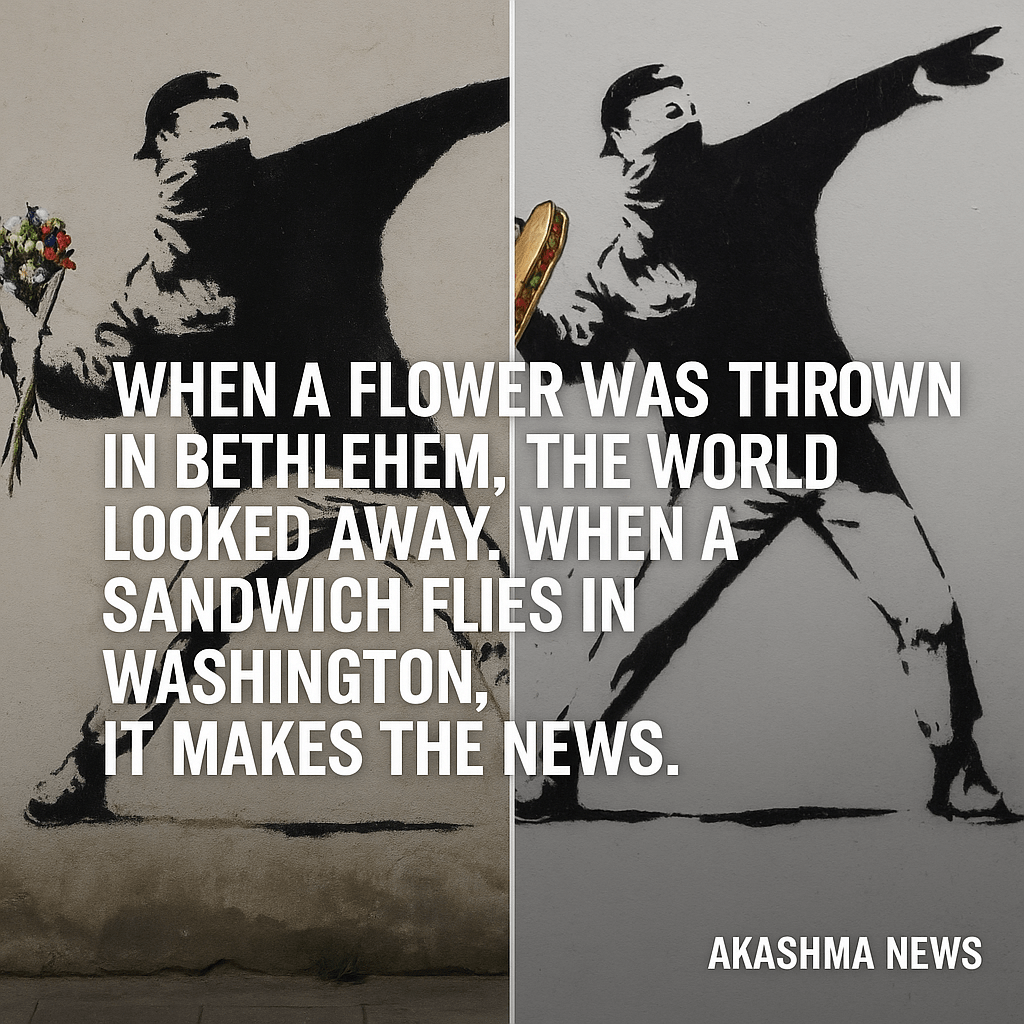
Yet in the Post’s coverage, this Palestinian origin was never mentioned. Readers were invited to chuckle at a sandwich flying through the air, but they were not asked to reflect on the flower that once did in Bethlehem.
Erasing Palestine Through Omission
That omission is not a simple oversight. Banksy’s placement of Flower Thrower in Bethlehem was a deliberate political act, rooted in Palestinian struggle. By congratulating “Sandwich Guy” as a D.C. symbol of defiance and ignoring its Palestinian foundation, The Washington Post effectively erases that lineage. This isn’t just about art appreciation. It is about narrative control.

The pattern is familiar. The Post and other U.S. mainstream outlets routinely frame stories of Palestine through the prism of Israeli security. Palestinian resistance is often depicted as instability or terrorism. Meanwhile, terms like genocide — used by UN experts and international legal scholars to describe the ongoing assault on Gaza — rarely appear in headlines. This selective vocabulary shapes perception: Israel’s concerns are validated, while Palestinians are rendered voiceless or illegitimate.
From Sandwiches to Flowers

By not crediting Banksy’s Palestinian mural, the Post avoided contextualizing “Sandwich Guy” in a global resistance lineage. U.S. readers could admire the parody, even see themselves in its humor, without confronting the uncomfortable reality that the image was borrowed from a people under occupation. The omission is safer for advertisers, political allies, and Washington’s policy consensus — but it strips the art of its history.
And here lies the double standard. If Banksy had painted Flower Thrower in Kyiv instead of Bethlehem, U.S. coverage would almost certainly celebrate its Ukrainian roots, crediting the artist’s intent and linking the mural to a narrative of noble resistance. The silence surrounding Palestine is deliberate, not incidental.
Media Bias as Editorial Policy
This erasure reflects a deeper editorial policy. Omission is itself a form of framing. By refusing to tie “Sandwich Guy” back to Palestine, the Post sidesteps an opportunity to connect two traditions of dissent: American protest against authoritarianism, and Palestinian resistance against occupation. To acknowledge that bridge would be to challenge a narrative that powerful interests prefer to maintain.
This silence is consistent with how major U.S. outlets, including the New York Times and CNN, cover Palestine: minimizing Palestinian suffering, amplifying Israeli justifications, and avoiding the political consequences of naming genocide.
Art Carries History
Art does not exist in a vacuum. Every image carries history, and every omission carries intent. When a sandwich flies in Washington, it is worth remembering the flower that once flew in Bethlehem — and the resistance it symbolized.
The Washington Post missed that connection. Or perhaps it chose not to make it. Either way, the silence speaks louder than the sandwich.
Banksy and Trademark Tensions
Banksy’s work has long resisted commodification, yet over recent years, Pest Control Office Ltd.—the artist’s administration—has pursued European Union trademark registrations on several iconic images, including Flower Thrower. Several of these attempts were cancelled by the EUIPO on grounds of “bad faith,” largely because the trademark claims were seen as protective rather than commercial in intent .
Banksy and Intellectual Property Tensions
While Banksy often declares “copyright is for losers,” his representatives did pursue trademark rights over key works like Flower Thrower. In 2020, the European Union Intellectual Property Office (EUIPO) cancelled that trademark, ruling it was asserted in “bad faith” — in part because Banksy’s anonymity prevented establishing ownership. The case, brought by Pest Control Office Ltd., revealed tensions between artistic ethos and institutional protections. The Art Newspaper Sept 17, 2020
A key case involved a figurative trademark depicting a monkey holding a placard (Laugh Now), which was initially annulled by the EUIPO Cancellation Division. However, in October 2022, the EUIPO’s Fifth Board of Appeal reversed that decision, ruling there was insufficient evidence of bad faith .
These developments underscore the dual nature of Banksy’s relationship with intellectual property—on one hand, advocating “copyright is for losers,” and on the other, asserting trademark rights to protect his art from commercial exploitation while preserving anonymity. For deeper legal analysis, see From the Flower Thrower to the Monkey, and Beyond: Banksy’s Battle With Trademarks Continues (Bonadio, Egeland & Jean‑Baptiste, 2023) .
Attribution
Banksy – Love Is In The Air (Flower Thrower), 2005, Bethlehem, West Bank.
The Washington Post — “How a thrown sub made ‘Sandwich Guy’ a resistance icon in Trump’s D.C.”.
Editor’s Note: A request for comment was sent to the author of the Washington Post article, Sophia Solano. This article will be updated should a response be received.
Silencing the Truth: Francesca Albanese, Genocide in Gaza, and the Global Gag Order on Palestine
By Marivel Guzman
Independent Journalist & Founder of Akashma News
April 17, 2025
Two days ago, the United Nations reaffirmed Francesca Albanese as the Special Rapporteur on the situation of human rights in the Occupied Palestinian Territories. In a world gripped by cognitive dissonance and silenced dissent, Albanese dares to call the Palestinian tragedy by its true name: genocide. Her latest report, “Anatomy of a Genocide“, offers damning evidence that Israel’s military assault on Gaza constitutes a systematic attempt to destroy a people.
But rather than reckon with this truth, governments across the Global North are criminalizing solidarity. In the U.S., laws are being passed to suppress the Boycott, Divestment, Sanctions (BDS) movement and to punish those who criticize Israel—a foreign government—while eroding citizens’ First Amendment rights in the process. The irony is staggering: while a genocide unfolds in full view, protected speech is being rebranded as antisemitism, and moral outrage is being legislated out of public discopaste.
A Mandate Without Access
Since her appointment in 2022, Francesca Albanese has not been permitted by Israel to enter Gaza or the West Bank—a restriction imposed on all UN Special Rapporteurs on Palestine since the mandate’s creation in 1993. Albanese relies instead on remote testimony, NGO documentation, satellite evidence, and legal analysis. Despite these barriers, her findings are among the most legally grounded assessments of Israel’s actions in occupied Palestine.
Her 2024 report, “Anatomy of a Genocide”, details how Israel’s conduct—including mass killings, destruction of civilian infrastructure, and deliberate displacement—meets the legal definition of genocide as defined in the 1948 Genocide Convention.
From Genocide to Gag Orders
While Albanese investigates mass atrocities, many so-called democracies are racing to erase public discussion of them. In the United States, anti-BDS laws now exist in over 30 states, targeting individuals and businesses that refuse to contract with Israeli firms on moral grounds. In Germany, France, and the UK, expressions of solidarity with Palestinians have been met with censorship, arrests, and surveillance.
These legal maneuvers don’t just suppress criticism—they distort reality. By branding calls for justice as “hate,” governments are protecting war crimes under the banner of anti-discrimination, while dismantling constitutional protections from within.
What Francesca Albanese Represents
Albanese’s work matters not only because of her courage but because it re-centers the Palestinian narrative around law, justice, and dignity. She calls on the world to “wake up from mass numbness,” and reminds us that silence is complicity. Her presence at the UN is a crack in the wall of institutional denial.
What We Can Do
We, as journalists and citizens, have a responsibility to push back.
Share Her Reports and Speeches Widely
Albanese’s work is available through the OHCHR site and respected blogs like Richard Falk’s. Sharing these counters censorship and whitewashing.
Support legal organizations like Al-Haq and PCHR.
Write to lawmakers opposing speech-curbing bills.
Defend the right to boycott.
Speak up even when it’s uncomfortable.
The genocide in Gaza is not a future risk—it is an unfolding reality. And every attempt to suppress that truth is part of the crime.
The genocide in Gaza is not a future risk—it is an unfolding reality. And every attempt to suppress that truth is part of the crime.
“Silence is complicity. Numbness is defeat.” — Francesca Albanese

A Journal Entry on the Pandemic and the Public Health Narrative
By Marivel Guzman
Originally published May 02, 2020
The world shifted on March 11, 2020—the day the World Health Organization declared COVID-19 a pandemic. From that point on, everything changed. The “death toll” became the news.
I still have strong reservations about the way lockdowns were implemented. As someone with a background in nursing, I struggle to accept mass lockdowns as a viable measure to stop the spread of infection. There is a fundamental difference between being infected and being sick. Never in the history of outbreaks have healthy populations been quarantined alongside the infected. Quarantine has always been a targeted public health measure—until now.
I read scientific journals regularly. I review peer-reviewed studies and stay alert to updates from researchers in epidemiology, microbiology and infectious diseases from around the world. This has exposed me to a wide range of conflicting views, especially concerning the CDC’s revised death certificate guidelines.
As a small business owner who supervises cleaning crews, I’ve entered more than 60 homes throughout Southern cities. I ask questions, observe conditions and engage with people. In all that time, I have yet to meet a single person who is ill—or who personally knows someone who is. At least not in the communities where I’ve worked.
I also traveled extensively during the height of the pandemic. I flew internationally and domestically, crossed borders, and moved freely between states and countries. I visited three states in Mexico, spent time in France and Amsterdam, and traveled across a dozen states in India. During my visit to India, I stayed in two rural states where internet access was extremely limited—available in theory, but with no provider towers in the countryside. People in those areas had no idea that a virus was sweeping the globe. There were no masks, no lockdowns, no fear. Daily life continued uninterrupted, untouched by the panic that gripped other parts of the world.
In my daily visits to the post office to ship plants, I took the opportunity to speak with postal workers at the USPS business center at 3101 W. Sunflower Ave. in Santa Ana, Calif. In March and April 2020, none of the employees were wearing masks. Several told me they had been instructed to purchase their own, but masks were not available for sale anywhere. I contacted Evelina Ramirez, Corporate Communications Media Relations officer at USPS, with a formal inquiry regarding employee protection protocols, package handling, sick leave, and contingency planning.
In her written response, Ramirez stated that the Postal Service was “sharing the Centers for Disease Control and Prevention’s (CDC) guidance… to our employees via stand up talks, employee news articles, messages on bulletin boards, and internal messaging inside USPS workplaces.” She added that the service was not experiencing operational impacts at that time and was reviewing contingency plans should the need arise. Regarding imported goods, she cited the CDC’s guidance noting “very low risk” of surface transmission via packages and that “there have been no reported cases of COVID-19 in the United States associated with imported goods.”
Despite the lack of protective measures early on, postal workers told me that no one had called in sick during those first critical weeks. By late spring, masks became standard and plexiglass barriers were installed at customer counters.
As a freelance journalist, I’ve covered numerous public events: visits to supermarkets and hospitals, senior meal programs, food distributions for the homeless, mask giveaways and shelter operations. I’ve reported on the ground, face to face, without a mask. No one I’ve interviewed or lived with has fallen ill.
What I’m trying to say is this: life was still functioning before the pandemic was declared. Once it was, everything became filtered through a lens of fear and mortality.
Doctors and scientists who questioned the official narrative were dismissed, discredited or censored. Open discourse—essential in both science and journalism—was sacrificed. Censorship became normalized in the United States.

 Akashma Online News