Archive
“The Vaccine Profit Paradox: How Bill Gates’ Philanthropy Fuels Personal Gain”
By Akashma News
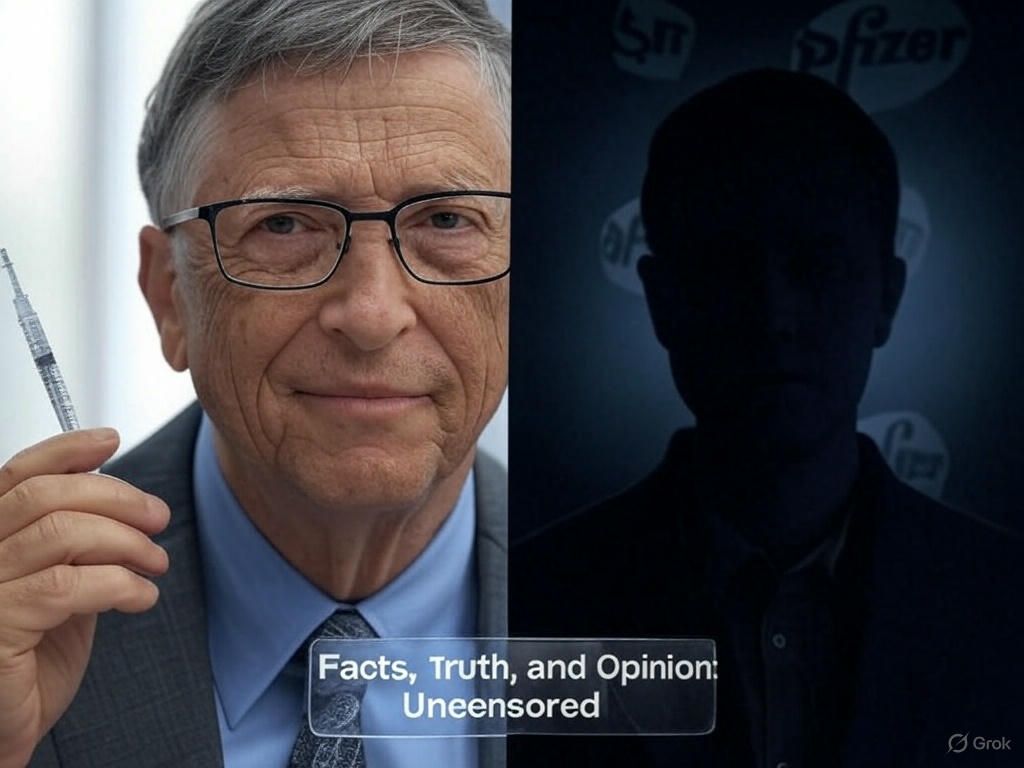
Bill Gates – The central figure, whose dual roles in philanthropy and investment drive the narrative.
Vaccine Funding – The linchpin of the story, spotlighting the Trump administration’s cuts to Gavi and global health programs.
Gavi – The Vaccine Alliance, a key player in Gates’ nonprofit ecosystem, now at risk from U.S. policy shifts.
Philanthropy – The public face of Gates’ work, questioned for its overlap with personal profit motives.
Investment – Gates’ personal financial gains through Cascade, tied to pharma giants like Pfizer and BioNTech.
RFK Jr. – Robert F. Kennedy Jr., whose vaccine insights and HHS role may influence Trump’s decisions against Gates’ interests.
Global Health – The broader stakes, where funding cuts could lead to vaccines supplies to poor countries.
Introduction
In a world where global health teeters on the edge, Bill Gates stands at a crossroads of altruism and profit. On March 26, 2025, the Trump administration slashes U.S. funding for vaccine programs in poor countries—ending $300 million annually to Gavi, the Vaccine Alliance—shaking the foundation of Gates’ global health empire. The New York Times uncovered a 281-page USAID spreadsheet detailing cuts to $76 billion in foreign aid, a decision some link to Robert F. Kennedy Jr.’s influence as Trump’s HHS Secretary, given his critiques of vaccine policy. Gates, whose Bill & Melinda Gates Foundation has funneled over $4 billion into Gavi, warns he can’t bridge the gap alone, yet his personal wealth—bolstered by investments in vaccine giants like Pfizer and BioNTech—paints a contrasting picture. This investigation reveals how Gates’ nonprofit ecosystem drives a machine that, intentionally or not, fattens his bank account, posing the question: is this philanthropy, or a calculated play for self-interest?
The Dual Empire Unveiled
The Gates Foundation’s role in global health is colossal, shaping vaccine markets through Gavi since its $750 million founding pledge in 1999. Gates himself touted a 20-to-1 return on his $10 billion health investment in a 2019 CNBC interview at Davos, claiming it yielded $200 billion in economic benefits. “It’s been $100 billion overall that the world’s put in, our foundation is a bit more than $10 billion,” he said, framing it as a societal win. But behind the nonprofit facade, Gates’ personal investment vehicle, Cascade Investment LLC, has reaped millions from pharma stocks tied to the same ecosystem. His $55 million stake in BioNTech in 2019 ballooned to $550 million by 2021 as COVID-19 vaccines rolled out, a tenfold profit he cashed in on before critiquing mRNA shots’ flaws in 2023. This duality—nonprofit influence amplifying for-profit gains—defines the Gates paradox.
The Trump Cut and RFK Jr.’s Shadow
Trump’s March 2025 decision to axe Gavi funding jolts Gates’ model. The U.S., Gavi’s third-largest donor, could spark a global retreat—European nations like the UK ($2 billion in 2020) might waver. RFK Jr., now HHS Secretary, brings a critical lens to vaccine policy. In a 2023 Joe Rogan interview, he argued, “We’re giving kids too many vaccines—by 18 months, starting day one, with aluminum, mercury, and toxins that can affect brain development.” He’s questioned mandates, not vaccines themselves, suggesting diseases like measles offer stronger immunity than waning shots and can be treated medically. In 2020, Kennedy accused Gates on X of “profiting off pandemics,” a charge echoing in his 2021 book, The Real Anthony Fauci, where he cast Gates as a profiteer in global health. Now, as HHS Secretary, RFK Jr.’s influence is tangible—Trump’s three-hour Mar-a-Lago chat with Gates in late 2024 (Wall Street Journal, January 2025) may have tilted toward Kennedy’s views, especially after his Senate confirmation softened his tone but not his skepticism.
The Foundation’s Market Machine
The Gates Foundation doesn’t just fund vaccines—it shapes the market. Gavi’s $30 billion since 2000, 80% from governments, secures bulk deals with manufacturers like Pfizer, where Gates has held personal stakes via Cascade. In 2009, Pfizer joined Gavi’s Advance Market Commitment, a Gates-backed initiative to supply vaccines to the poorest nations. The Foundation’s $1.6 billion pledge at the 2020 Global Vaccine Summit, plus $150 million for COVAX, exemplifies this leverage. “We’re not doing the work ourselves,” Gates told ABC News in December 2020, emphasizing partnerships. Yet, these deals boost pharma profits—Pfizer’s $26 billion in 2021 vaccine sales dwarfed its $3 billion R&D cost, per WIRED—while Gates’ investments ride the wave.
Personal Profit, Public Good?
Gates’ personal gains are stark. Cascade’s Pfizer holdings grew during the COVID-19 boom, and his BioNTech exit in 2021 netted a massive return. Forbes pegged his net worth at $137 billion in 2021, up from $98 billion in 2019—pharma profits a key driver. The Foundation’s $40 million CureVac stake in 2020, reported by The Nation, soared 400% after its IPO, though it’s unclear if Gates cashed out. Critics on X since 2020 have dubbed this “philanthropy with a profit motive,” a sentiment echoed by James Love of Knowledge Ecology International: “He was the first mover and the most influential mover,” he told Politico in 2022. Gates counters this in a 2025 New Yorker interview, saying, “I give billions to save millions,” inverting RFK Jr.’s attack.
The Global Health Fallout
Trump’s cuts shrink Gavi’s reach, spotlighting a deeper flaw in Gates’ vaccine obsession. UNICEF reports that in 2023, 4.8 million children under five died—13,100 daily—with nearly half, about 2.2 million, linked to undernutrition’s toll on immunity. Gavi’s CEO, Sania Nishtar, warned Fortune in February 2025 that losing $300 million yearly from the U.S. could mean 75 million fewer vaccinations, projecting 1.2 million more deaths over five years. But these models assume vaccines alone save lives, ignoring treatable diseases like measles (128,000 deaths in 2021, WHO) in places like Somalia, with 1 doctor per 10,000 people (UNICEF). Starvation, not just disease, is the killer—malnutrition drives 45% of under-five deaths (UNICEF), weakening kids against infections. Why not feed them instead? A 2020 Lancet study valued Gavi’s impact at 1.5 million lives saved, but $4 billion in food aid could cut hunger’s 3.1 million annual child deaths (UNICEF), sidelining Gates’ pharma profits for a real fix.
The RFK Jr. Wildcard
RFK Jr.’s HHS role could reshape the game. In a 2021 Children’s Health Defense podcast, he said, “Vaccine makers don’t do long-term, double-blind placebo studies—vaccinated versus unvaccinated—to spot side effects worse than the disease.” He’s slammed the 1986 National Childhood Vaccine Injury Act for shielding manufacturers from liability, arguing on X in 2022, “They’re not responsible for deaths or harm.” Scientific American noted on March 18, 2025, NIH staff scrubbed mRNA from grants under pressure—a nod to Kennedy’s sway. Gates told NPR in February 2025, “I don’t think he’ll do anything precipitous,” betting on dialogue, but RFK Jr.’s focus on accountability could stall Gates’ mRNA legacy.
The Philanthropist’s Dilemma
Gates’ model thrives on a potent synergy: Foundation funds de-risk vaccine development, governments amplify scale, and his investments profit. His 2019 Davos claim of a $200 billion return—touted as a 20-to-1 economic impact, per Copenhagen Consensus—wasn’t cash in his pocket, but the optics sting. “He’s elevated the pharmaceutical industry,” James Love told Politico in 2022, pointing to Gates’ push to lock Oxford’s vaccine with AstraZeneca over an open license, backed by his $384 million via CEPI (Bloomberg). This clout underscores a critique: his system privatizes gains—Pfizer’s billions—while socializing risks through taxpayers’ R&D subsidies.
Where Next for Gates?
With Gavi reeling, Gates faces a fork. He could double down on private funding—his $15 billion endowment boost in 2021 shows he can—or shift Cascade’s focus. Health tech, like mRNA beyond vaccines, or climate ventures could replace pharma bets. “We’ll look to the U.S. commitment to maintain generosity,” he told NPR in February 2025, eyeing Gavi’s spring fundraising. But RFK Jr.’s shadow and Trump’s cuts may force a retreat from global health dominance, testing Gates’ adaptability.
The Bigger Picture
This isn’t just about Gates—it’s about who controls global health. His Foundation’s $1.75 billion COVID response by 2020, per ABC News, dwarfed many nations’ efforts. Yet, transparency lags—SEC filings hint at pharma ties, but details are murky. “There’s a flaw in global health,” a German official told Politico in 2022, “these philanthropists are needed, but some things don’t work.” Gates’ dual role—savior and profiteer—sparks debate: is he a visionary leveraging wealth for good, or a monopolist extending Microsoft’s playbook to humanity’s survival?
Conclusion
As Trump’s cuts land and RFK Jr. critiques, Gates’ vaccine empire wavers. His Foundation’s billions have fueled Gavi’s global reach, but personal profits from the same system blur charity and self-interest. Gavi claims 19 million lives saved, yet no conclusive, independent study—comparing vaccinated versus unvaccinated populations over decades—backs this boast; it’s a model, not a fact. Meanwhile, UNICEF’s 2023 data reveals 4.8 million under-five deaths, with 2.2 million tied to malnutrition—a root cause vaccines sidestep. Nutrition, not needles, could fortify immunity naturally, slashing hunger’s 3.1 million annual toll (UNICEF) without padding pharma coffers. The world watches: will Gates adapt, or will his paradox collapse? “This will be seared in this generation’s memory,” he told ABC News in 2020. Five years on, it’s his legacy—noble, flawed, or both—that’s etched into ours, with nutrition begging the louder question: why vaccinate when we could nourish?
Gates, CNBC, January 23, 2019.Gates, ABC News, December 2020.Gates, NPR, February 2025.Gates, Reuters, March 18, 2025.Gates, New Yorker, 2025.RFK Jr., Joe Rogan interview, 2023.RFK Jr., Children’s Health Defense podcast, 2021.RFK Jr., X post, 2020 & 2022.James Love, Politico, 2022.German official, Politico, 2022.

 Akashma Online News