Archive
Part VI: Blood Money and Broken Oaths — Collateral Profits – How War Built Empires, Crushed Nations, and Reshaped the Global Order
By Marivel Guzman | Akashma News
“The bombs fell. The stocks rose. The borders collapsed. And the billionaires were born.”
— Akashma News, 2025
Wars are not just about weapons and soldiers. They’re about markets, monopolies, and restructuring. In the 21st century, war has become a reset mechanism—used not to resolve conflict, but to liquidate sovereign assets, privatize economies, and rewire global power dynamics.
I. Empires Built on Rubble
The U.S. and its allies didn’t just defeat regimes. They harvested nations.
Iraq’s oil infrastructure, once state-controlled, was handed over to international oil corporations. Contracts were funneled to ExxonMobil, BP, Chevron, and Shell.
Afghanistan’s mineral rights, including lithium, rare earth elements, and copper, were quietly targeted by Chinese and Western firms even before the last U.S. troops left.
The Syrian conflict allowed Turkey, Russia, and U.S. oil contractors to carve out control zones—under the banner of fighting terrorism.
These “liberations” led to permanent military installations, surveillance zones, and debt-based rebuilding programs overseen by U.S. allies and transnational lenders like the IMF and World Bank.
II. Economic Colonization via Aid and Arms
Once the bombs stopped falling, another weapon took over: economic dependency.
USAID, World Bank, and Western NGOs offered “rebuilding packages” tied to:
Privatization of water, electricity, and public health systems.
Favorable trade terms for Western investors.
Long-term IMF loans with austerity requirements.
Countries once resistant to Western banking hegemony—Iraq, Libya, Ukraine—were dragged into global finance’s orbit by war. Their local industries were crushed. Their sovereignty rewritten in the fine print of investment treaties and oil concessions.
III. Ghost Nations: Sovereignty Replaced by Security Zones
Today, entire countries function as forward-operating platforms:
Iraq still hosts thousands of foreign contractors and intel personnel.
Afghanistan—though abandoned—remains surveilled by satellites and drones, its airspace monitored by regional proxies.
Ukraine, while fighting for national identity, has become a testbed for weapons systems and NATO coordination.
These are no longer nations. These are geo-strategic laboratories, run by private contractors, IMF enforcers, and embassy advisors.
, while fighting for national identity, has become a testbed for weapons systems and NATO coordination.
These are no longer nations. These are geo-strategic laboratories, run by private contr
IV. Global Order Reshaped by Chaos
The post-9/11 wars were not random.
They neutralized regional challengers, fractured continental blocs, and opened up trade lanes:
The EU became weakened by the refugee crisis.
The Arab world was shattered into client states, war zones, and economic vassals.
Africa’s Sahel region, flooded with weapons from Libya, became a permanent proxy battlefield.
Asia was reoriented toward “security alliances” built to contain China—with Japan, India, Philippines, and South Korea under expanded U.S. influence.
Meanwhile, the U.S. dollar, Western surveillance tech, and American defense contractors entrenched themselves as permanent tools of soft (and hard) control.
Part VII: Blood Money and Broken Oaths — Resistance Rising – The Return of the Unbought Voice
V. Who Benefited? Follow the Bank Accounts
BlackRock and Vanguard own major shares in defense, surveillance, and fossil fuel companies.
JP Morgan Chase helped finance contracts for Iraq and Afghanistan reconstruction.
McKinsey & Co. advised both governments and war profiteers—sometimes on opposite sides of the conflict.
And let’s not forget the Carlyle Group, whose war investments were so profitable they sparked Congressional inquiries in the early 2000s—then disappeared from the headlines.
War isn’t random. It’s structured liquidation.
VI. The “Failed State” Playbook
To control a region:
1. Destabilize the state (via war, sanctions, or color revolution).
2. Flood with aid and arms—contracted to Western firms.
3. Offer rebuilding contracts tied to private control.
4. Redesign the legal system to benefit global finance and tech monopolies.
5. Maintain a permanent intelligence presence via embassies, drone bases, and “training missions.”
The result? A failed state on paper, but a high-yield portfolio for the war elite.
VII. Conclusion: War Is the New Infrastructure Deal
It builds fortunes. It demolishes resistance. It rewires markets.
The average American sees rising gas prices and a VA backlog.
The average Afghan sees rubble and surveillance towers.
But the war lords see stock options, new markets, and privatized borders.
The world was not remade by diplomacy.
It was shattered by design—then leased back to the highest bidder.
Part VII: Blood Money and Broken Oaths — Resistance Rising – The Return of the Unbought Voice
The Real Killers: Hunger, Dirty Water, and the Philanthropy Profit Game
By Akashma News
In 2023, 4.8 million children under five died—13,100 daily—according to UNICEF. Nearly half, 2.2 million, succumbed because their bodies, ravaged by hunger, couldn’t fight off infections. Meanwhile, 2.2 billion people drank unsafe water, and 3.6 billion lacked basic toilets, unleashing a waterborne death toll of 2-2.5 million yearly—1.5 million from diarrhea alone, including 525,000 kids (WHO, 2023). These are the monsters stalking humanity: starvation and shit-filled rivers, not just the viruses philanthropists love to jab away. Yet, Gavi, the Vaccine Alliance—bankrolled by the U.S., the Gates Foundation, and Big Pharma—warns that a $300 million U.S. funding cut will kill 1.2 million over five years by skipping 75 million vaccines. The math’s slick, but it’s a scare tactic masking a deeper rot: profit over people.
Vaccines: A Profitable Half-Measure
Gavi’s CEO, Sania Nishtar, told Fortune in February 2025 that losing $300 million yearly means 240,000 deaths annually—$1,250 per life saved. Measles (144,000 of that toll), malaria (36,000), HIV (28,800), COVID-19 (60,000), and polio (19,200) dominate their models. But these numbers assume vaccines work like magic across starving, dehydrated bodies. They don’t. Measles shots drop from 95% efficacy to 60% in malnourished kids (2019 Frontiers in Immunology). Malaria’s RTS,S falls from 35% to 25% (WHO, 2021). Rotavirus, a diarrhea fighter, dips from 70% to 50% (2016 Vaccine). Adjust for 40% of kids and 20% of adults in Gavi’s 75 million being malnourished—20 million kids, 5 million adults—and effective vaccinations shrink to 61 million. Deaths? Maybe 864,000 over five years, not 1.2 million—28% less.Worse, hunger and dirty water claim lives vaccines can’t touch. Of Gavi’s 240,000 yearly deaths, 40% (96,000) overlap with hunger’s 9 million annual toll (2.2 million kids, 5.9 million adults, Global Nutrition Report, 2021) or diarrhea’s 1.5 million—kids too weak to survive, jabbed or not. Net impact: 172,800 lives at $1,736 per life. Gavi’s 1.2 million is a donor-friendly mirage, ignoring the real killers.
Nutrition and Water: The Ignored Lifelines
What if that $300 million fed the starving instead? UNICEF’s 3.1 million annual child hunger deaths could halve with $4 billion—1.55 million lives. Scale it: $300 million saves 232,500 at $1,290 per life—cheaper and broader than Gavi’s adjusted haul. In Somalia, where 40-60% of kids are malnourished and 1 doctor serves 10,000 (UNICEF), a full belly boosts immunity more than a shaky measles shot. Or take water: $300 million in wells and latrines could save 300,000-500,000 yearly (UN Water, 2023)—$600-$1,000 per life—crushing Gavi’s numbers while slashing diarrhea’s 1.5 million toll.
These aren’t hypotheticals. A 2020 Lancet study valued Gavi at 1.5 million lives saved over years—impressive, until you see hunger’s 3.1 million kids yearly dwarf it. Waterborne deaths—cholera (95,000), typhoid (135,000), dysentery (165,000 kids)—add a 2-2.5 million body count Gavi barely touches. Rotavirus shots help, but without clean water, kids keep dying. The fix is obvious: feed them, hydrate them, stop the shit-flow. So why doesn’t Gavi pivot?
Philanthropy’s Profit Engine
Gavi’s a machine built by power, not compassion. The Gates Foundation’s $750 million kickoff in 2000, alongside Pfizer and GSK’s board seats, steers it toward pharma profits—$21-per-child subsidies (MSF, 2015) for vaccines like GSK’s $100 rotavirus dose, not wells at $50 a pop. Donors—U.S. ($1.5 billion pledged through 2030), UK, Norway—love measurable shots over messy sanitation projects. Trump’s $1 billion aid cut (AP News, March 2025) threatens Gavi’s $300 million slice, cueing Nishtar’s 1.2 million death cry—a perfect scare to lock in grants, never mind the malnutrition-water overlap gutting its math.
This isn’t aid; it’s a business. Gavi’s 1.1 billion kids vaccinated (Gavi.org, 2025) is real, but its politics—donor-heavy, industry-tied—shun the Alma-Ata dream of health as a social fight. Africa begs for local manufacturing (post-COVAX snubs), yet Gavi sticks to Big Pharma’s supply chains. Why? Profit trumps humanity. Gates’ “results-driven” ethos—critiqued in 2014 PMC—picks tech over people, vaccines over villages.
Humanity First
Imagine redirecting $300 million to Somalia’s starving, waterless kids—232,500 fed, 300,000 hydrated, millions spared dysentery’s agony. Compare that to Gavi’s 172,800 adjusted lives, tethered to pharma’s bottom line. The choice is stark: humanity demands nutrition and clean water—cheap, systemic, life-saving—over a profit-soaked needle. Philanthropists peddling 1.2 million deaths as a funding plea aren’t saviors; they’re salesmen. The real monsters—hunger, dirty water—don’t care about their pitch. Neither should we.

“The Vaccine Profit Paradox: How Bill Gates’ Philanthropy Fuels Personal Gain”
By Akashma News
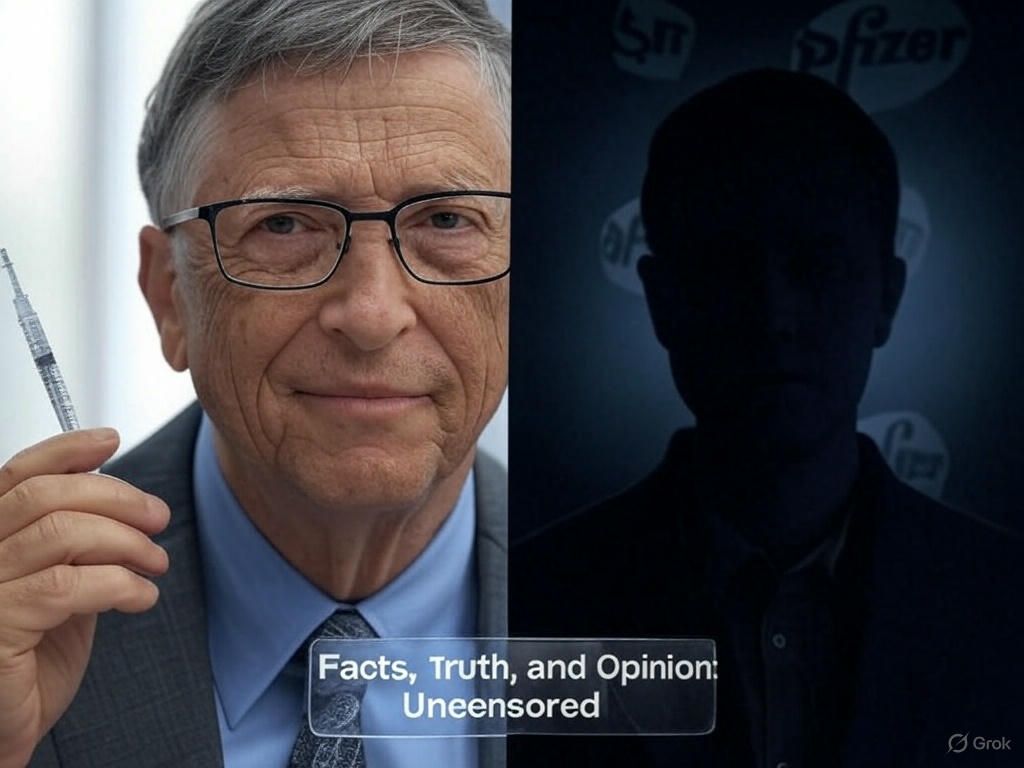
Bill Gates – The central figure, whose dual roles in philanthropy and investment drive the narrative.
Vaccine Funding – The linchpin of the story, spotlighting the Trump administration’s cuts to Gavi and global health programs.
Gavi – The Vaccine Alliance, a key player in Gates’ nonprofit ecosystem, now at risk from U.S. policy shifts.
Philanthropy – The public face of Gates’ work, questioned for its overlap with personal profit motives.
Investment – Gates’ personal financial gains through Cascade, tied to pharma giants like Pfizer and BioNTech.
RFK Jr. – Robert F. Kennedy Jr., whose vaccine insights and HHS role may influence Trump’s decisions against Gates’ interests.
Global Health – The broader stakes, where funding cuts could lead to vaccines supplies to poor countries.
Introduction
In a world where global health teeters on the edge, Bill Gates stands at a crossroads of altruism and profit. On March 26, 2025, the Trump administration slashes U.S. funding for vaccine programs in poor countries—ending $300 million annually to Gavi, the Vaccine Alliance—shaking the foundation of Gates’ global health empire. The New York Times uncovered a 281-page USAID spreadsheet detailing cuts to $76 billion in foreign aid, a decision some link to Robert F. Kennedy Jr.’s influence as Trump’s HHS Secretary, given his critiques of vaccine policy. Gates, whose Bill & Melinda Gates Foundation has funneled over $4 billion into Gavi, warns he can’t bridge the gap alone, yet his personal wealth—bolstered by investments in vaccine giants like Pfizer and BioNTech—paints a contrasting picture. This investigation reveals how Gates’ nonprofit ecosystem drives a machine that, intentionally or not, fattens his bank account, posing the question: is this philanthropy, or a calculated play for self-interest?
The Dual Empire Unveiled
The Gates Foundation’s role in global health is colossal, shaping vaccine markets through Gavi since its $750 million founding pledge in 1999. Gates himself touted a 20-to-1 return on his $10 billion health investment in a 2019 CNBC interview at Davos, claiming it yielded $200 billion in economic benefits. “It’s been $100 billion overall that the world’s put in, our foundation is a bit more than $10 billion,” he said, framing it as a societal win. But behind the nonprofit facade, Gates’ personal investment vehicle, Cascade Investment LLC, has reaped millions from pharma stocks tied to the same ecosystem. His $55 million stake in BioNTech in 2019 ballooned to $550 million by 2021 as COVID-19 vaccines rolled out, a tenfold profit he cashed in on before critiquing mRNA shots’ flaws in 2023. This duality—nonprofit influence amplifying for-profit gains—defines the Gates paradox.
The Trump Cut and RFK Jr.’s Shadow
Trump’s March 2025 decision to axe Gavi funding jolts Gates’ model. The U.S., Gavi’s third-largest donor, could spark a global retreat—European nations like the UK ($2 billion in 2020) might waver. RFK Jr., now HHS Secretary, brings a critical lens to vaccine policy. In a 2023 Joe Rogan interview, he argued, “We’re giving kids too many vaccines—by 18 months, starting day one, with aluminum, mercury, and toxins that can affect brain development.” He’s questioned mandates, not vaccines themselves, suggesting diseases like measles offer stronger immunity than waning shots and can be treated medically. In 2020, Kennedy accused Gates on X of “profiting off pandemics,” a charge echoing in his 2021 book, The Real Anthony Fauci, where he cast Gates as a profiteer in global health. Now, as HHS Secretary, RFK Jr.’s influence is tangible—Trump’s three-hour Mar-a-Lago chat with Gates in late 2024 (Wall Street Journal, January 2025) may have tilted toward Kennedy’s views, especially after his Senate confirmation softened his tone but not his skepticism.
The Foundation’s Market Machine
The Gates Foundation doesn’t just fund vaccines—it shapes the market. Gavi’s $30 billion since 2000, 80% from governments, secures bulk deals with manufacturers like Pfizer, where Gates has held personal stakes via Cascade. In 2009, Pfizer joined Gavi’s Advance Market Commitment, a Gates-backed initiative to supply vaccines to the poorest nations. The Foundation’s $1.6 billion pledge at the 2020 Global Vaccine Summit, plus $150 million for COVAX, exemplifies this leverage. “We’re not doing the work ourselves,” Gates told ABC News in December 2020, emphasizing partnerships. Yet, these deals boost pharma profits—Pfizer’s $26 billion in 2021 vaccine sales dwarfed its $3 billion R&D cost, per WIRED—while Gates’ investments ride the wave.
Personal Profit, Public Good?
Gates’ personal gains are stark. Cascade’s Pfizer holdings grew during the COVID-19 boom, and his BioNTech exit in 2021 netted a massive return. Forbes pegged his net worth at $137 billion in 2021, up from $98 billion in 2019—pharma profits a key driver. The Foundation’s $40 million CureVac stake in 2020, reported by The Nation, soared 400% after its IPO, though it’s unclear if Gates cashed out. Critics on X since 2020 have dubbed this “philanthropy with a profit motive,” a sentiment echoed by James Love of Knowledge Ecology International: “He was the first mover and the most influential mover,” he told Politico in 2022. Gates counters this in a 2025 New Yorker interview, saying, “I give billions to save millions,” inverting RFK Jr.’s attack.
The Global Health Fallout
Trump’s cuts shrink Gavi’s reach, spotlighting a deeper flaw in Gates’ vaccine obsession. UNICEF reports that in 2023, 4.8 million children under five died—13,100 daily—with nearly half, about 2.2 million, linked to undernutrition’s toll on immunity. Gavi’s CEO, Sania Nishtar, warned Fortune in February 2025 that losing $300 million yearly from the U.S. could mean 75 million fewer vaccinations, projecting 1.2 million more deaths over five years. But these models assume vaccines alone save lives, ignoring treatable diseases like measles (128,000 deaths in 2021, WHO) in places like Somalia, with 1 doctor per 10,000 people (UNICEF). Starvation, not just disease, is the killer—malnutrition drives 45% of under-five deaths (UNICEF), weakening kids against infections. Why not feed them instead? A 2020 Lancet study valued Gavi’s impact at 1.5 million lives saved, but $4 billion in food aid could cut hunger’s 3.1 million annual child deaths (UNICEF), sidelining Gates’ pharma profits for a real fix.
The RFK Jr. Wildcard
RFK Jr.’s HHS role could reshape the game. In a 2021 Children’s Health Defense podcast, he said, “Vaccine makers don’t do long-term, double-blind placebo studies—vaccinated versus unvaccinated—to spot side effects worse than the disease.” He’s slammed the 1986 National Childhood Vaccine Injury Act for shielding manufacturers from liability, arguing on X in 2022, “They’re not responsible for deaths or harm.” Scientific American noted on March 18, 2025, NIH staff scrubbed mRNA from grants under pressure—a nod to Kennedy’s sway. Gates told NPR in February 2025, “I don’t think he’ll do anything precipitous,” betting on dialogue, but RFK Jr.’s focus on accountability could stall Gates’ mRNA legacy.
The Philanthropist’s Dilemma
Gates’ model thrives on a potent synergy: Foundation funds de-risk vaccine development, governments amplify scale, and his investments profit. His 2019 Davos claim of a $200 billion return—touted as a 20-to-1 economic impact, per Copenhagen Consensus—wasn’t cash in his pocket, but the optics sting. “He’s elevated the pharmaceutical industry,” James Love told Politico in 2022, pointing to Gates’ push to lock Oxford’s vaccine with AstraZeneca over an open license, backed by his $384 million via CEPI (Bloomberg). This clout underscores a critique: his system privatizes gains—Pfizer’s billions—while socializing risks through taxpayers’ R&D subsidies.
Where Next for Gates?
With Gavi reeling, Gates faces a fork. He could double down on private funding—his $15 billion endowment boost in 2021 shows he can—or shift Cascade’s focus. Health tech, like mRNA beyond vaccines, or climate ventures could replace pharma bets. “We’ll look to the U.S. commitment to maintain generosity,” he told NPR in February 2025, eyeing Gavi’s spring fundraising. But RFK Jr.’s shadow and Trump’s cuts may force a retreat from global health dominance, testing Gates’ adaptability.
The Bigger Picture
This isn’t just about Gates—it’s about who controls global health. His Foundation’s $1.75 billion COVID response by 2020, per ABC News, dwarfed many nations’ efforts. Yet, transparency lags—SEC filings hint at pharma ties, but details are murky. “There’s a flaw in global health,” a German official told Politico in 2022, “these philanthropists are needed, but some things don’t work.” Gates’ dual role—savior and profiteer—sparks debate: is he a visionary leveraging wealth for good, or a monopolist extending Microsoft’s playbook to humanity’s survival?
Conclusion
As Trump’s cuts land and RFK Jr. critiques, Gates’ vaccine empire wavers. His Foundation’s billions have fueled Gavi’s global reach, but personal profits from the same system blur charity and self-interest. Gavi claims 19 million lives saved, yet no conclusive, independent study—comparing vaccinated versus unvaccinated populations over decades—backs this boast; it’s a model, not a fact. Meanwhile, UNICEF’s 2023 data reveals 4.8 million under-five deaths, with 2.2 million tied to malnutrition—a root cause vaccines sidestep. Nutrition, not needles, could fortify immunity naturally, slashing hunger’s 3.1 million annual toll (UNICEF) without padding pharma coffers. The world watches: will Gates adapt, or will his paradox collapse? “This will be seared in this generation’s memory,” he told ABC News in 2020. Five years on, it’s his legacy—noble, flawed, or both—that’s etched into ours, with nutrition begging the louder question: why vaccinate when we could nourish?
Gates, CNBC, January 23, 2019.Gates, ABC News, December 2020.Gates, NPR, February 2025.Gates, Reuters, March 18, 2025.Gates, New Yorker, 2025.RFK Jr., Joe Rogan interview, 2023.RFK Jr., Children’s Health Defense podcast, 2021.RFK Jr., X post, 2020 & 2022.James Love, Politico, 2022.German official, Politico, 2022.
Kenya Bans All GMO’s
Posted on December 10, 2012 by Akashma Online News

Nairobi is the capital city of Kenya and East Africa’s most populous city (3.5 million).
The ministry of health has undertaken to commission a study to determine whether or not genetically modified foods are harmful to human beings. The ministry was tasked by the cabinet about two weeks ago to provide scientific proof over the safety of GMOs. Speaking at a press briefing at Afya House , the minister for public health and sanitation Beth Mugo said that the ban on importation of GMOs remains until conclusive studies are complete.
In a surprising act of courage , Public Health Minister Beth Mugo of the Kenyan government has announced on National Television that Kenya has completely banned the importation of all genetically modified (GMO) food into the country, until exhaustive tests on health effects are complete.
This study does not include Animal feed which it is Genetically Modified. And does not include the GMO’s produced in Kenya.
Will this mean that Monsanto Kenya is out of business?
According to Monsanto Kenya 2011 report: “In 2011, we made great progress to our goals around sustainability, engaging with many stakeholders and working in partnership with organizations around the world. I’m pleased to present you with Monsanto’s 2011 Corporate Social Responsibility and Sustainability Report which outlines recent work in this area” Really nothing in concrete can be seen on the country where poverty and starvation is one of the highest in Africa.

“As the population continues to increase, so does the demand for valuable resources. Monsanto is working for a better tomorrow by putting the right tools in the hands of farmers today. By equipping growers with better seeds, we can help protect our natural resources, fight hunger, improve nutrition and provide economic benefits to everyone involved in an improved system of agriculture.” Monsanto 2110 Report
What we are talking about here is that Monsanto measure Kenya agriculture growth solely on its sales of Modified Seeds, and their biotechnology which acording to the New Law in Kenya will be banned immediately. Well not so fast, this Law is clear on announcing the “All imports of GMO’s are banned”. This is double mirror news, because most of the GMO’s are not imported to Kenya, they are produced in Kenya. Monsanto Kenya is responsible for the production of Millions of Genetically Modified Seeds that will produce tons of GMO’s in the country.
Monsanto goes on to say in their report that part of thier continuous journey is also exemplified through their commitment to the UN Global Compact and The Ten Principles relating to the areas of human rights, labor practices, environmental protection and combating corruption. According to their 2011 report that includes the second installment of their actions supporting the Global Compact and a special update on their human rights activities. But then we the Poverty.org assuring us that Kenya is child labor it is a social problem.
Child labor – Obstacle to education
Child labor was introduced in Kenya during the colonial era. Too many issues currently fuel child labor to solve it overnight: poverty in rural areas and city slums; HIV/AIDS, which orphaned over 1 million children; conflicts; domestic violence; and traditional practices such as sending children to herd cattle or to be married at an early age.
Not to mention the kids who are forced by adults to either break into houses or smuggle illegal goods. Or those who are simply forced into prostitution.
Raising awareness about child poverty in Kenya
It’s only recently that people have become more aware of the importance of sending children to school as a long term investment. This is true for the media, policy makers, parents and … children themselves!
For the past 20 years successive governments have been implementing national policies and economic measures to tackle child labor via reducing poverty in Kenya and especially adult unemployment.
The current government has also created a system of grants and development funds in order to support children from poor families. This will nonetheless depend on how well the country does economically in the years to come if it is to sustain such public expenses. Poverty. org
Monsanto operates in 444 facilities in 66 countries. Not only Kenya has a Monsanto facility, but Kenya headquarters Monsanto Africa.
Monsanto Kenya
Tuskys head office complex
Mombasa Road
P.O. Box 47686, 00100 Nairobi
Tel: +254 20 2060922/44, 020 3574301-4
Fax: +254 20 823086
Cell: +254 722 205294/529, +254 733 600 468/629 414
Monsanto Vegetable Seeds Division
P.O. Box 47686, 00100
Nairobi, Kenya
T. +254 20 2060922/44 3574301-4
So what is it in reality what the Minister of Health banned?
Here is a list of crops Monsanto invests in day after day in Africa and around the world.
- Alfalfa: Genuity® Roundup Ready® Alfalfa provides in-plant tolerance to Roundup® agricultural herbicide. Fewer weeds means it provides high-quality forage and hay.
- Canola: Genuity offers the Roundup Ready® trait in both spring and winter canola. This trait is a tool for farmers to help manage weeds and increase yield potential, creating a win-win on their farm.
- Corn: For farmers today, it’s all about getting the most yield out of every acre of corn, while using as few inputs as possible. Monsanto’s corn traits help farmers do this by providing cutting-edge technology that protects the plant’s yield.
- Cotton: Today, cotton growers are benefiting from second-generation and stacked trait technologies, which provide more levels of protection. Genuity® Bollgard II® with Roundup Ready® Flex represents Monsanto’s newest wave of innovation with two second-generation traits stacked into one seed.
- Sorghum: Sorghum is an efficient crop in the conversion of solar energy and more drought-tolerant than other crops such as corn and soybeans. Monsanto continues to research and develop new hybrids to fit growers’ needs.
- Soybeans: Whether it’s a higher yielding soybean that provides a broad spectrum of weed control with the Roundup Ready® system or a soybean plant that helps reduce trans-fatty acids, Monsanto has a lot to offer soybean farmers.
- Sugarbeets: Fewer herbicide applications, increased yields and more sugar content all make Genuity Roundup Ready® sugarbeets attractive to many farmers.
- Wheat: Since acquiring the WestBred brand in 2009, Monsanto has initiated an intensive effort to incorporate breakthrough breeding technologies – developed and deployed with notable success in other row crops – in wheat.
There is another side of the story developing in Kenya Feed The Future it is a US Organization under the umbrella of US Government’s Global Hunger and Food Security Initiative that help local farmers to increase their yield.
“Through a five-year project under Feed the Future, the company helps smallholder farmers access improved varieties of crops, increase their use of fertilizer, and learn improved soil and water management techniques” Feed the Future
How will the US government help the farmers to access “improved varieties of crops”?, there is only one way, thru the use of Genetically Modified Seeds obtained under the license of Monsanto. So if the US government has the ability to deliver Seeds to Kenya under the guise of Aids, it means also that the import of GMO’s will enter Kenya regardless of the Ban.
The US government is not an entity but a conglomerate of individuals working for their own agendas. Why will congress will allocate millions of dollars into a foreign programs? Unless these foreign programs are funded by corporations operating in those countries that will be benefit by the infusion of capital.
Take for example World Bank that it is associated with policies that work against the well being of the citizens of the country that will take the loan. Loans usually attached to conditions well beyond the control of the third world country government once the loan is taken.
If a third world country is forced to buy grains as a conditions to get the loan, it is because the Agribusiness in the US are behind the policies that will lead to the Aid to this country. It does not takes a genius to figure out the outcome of this condition. US agribusiness are giants subsidized by the Federal Government producing tons of grains per harvest, versus third world countries yielding small crops.
Another important aspect to take in consideration in Kenya is the level of government corruption. Politicians in Kenya are among the highest paid on earth, despite the fact that many of their constituents are poor, unemployed and undernourished. Corruption is one of the country’s most serious problems, with both taxes and international aid often lining private pockets instead of filling public coffers. If the importers of GMO’s are big Traders with big packets, there is little chance that this Ban will be successful.
We have to see the positive side of the News. This Ban is the culmination of the effort of concerned citizens seeking accountability from Monsanto practices. We could expect that this Ban follow other studies on GMO. Food is just one tiny aspect of Monsanto business. Soil Modification, Water treatment, Fertilizers, Herbicides are just few of Monsanto intrusive technology.
Read More on Monsanto…..
Monsanto have been modifying genes for 30 years, that we know. There is a short list known to the scientific community, and to the governmental agencies in charge of controlling its activities. But really Monsanto have been honest to the world? Does it planned since the beginning the seize of life on Earth. Did it do it with all premeditation and advantage to control and monopoly the seeds production and/or the food supply?
This are not easy questions to answer without being being puzzled by worry and grieve for our future. The farmers that have suffered already the unfair practices of Monsanto and the controversial rulings of the courts around the world, know better. Monsanto more dangerous than war itself
There is more that United Nations Control, the World Bank and the International Monetary fund, two weapons of war that makes the poorer countries pry of the Rich Global Corporations that in agreement with the United Nations get their pawns into the national resources of the countries and manage their internal sociology-economical and political policies, keeping the entire population subject to poverty and addicted to public welfare that it is at the same time another Corporate strategy to control the population.
For over 50 years The Men Behind the curtain or Elite, have been working diligently to establish a One Central Office of Power where they can manage the Affairs of Earth.
For years the use of the New World Order wording was sounding more like conspiracy theory than any other thing, because the propaganda machine that controls whats gets out to the people had the Project Under Wraps. By now the Centralized Office of the United Nations is at full control of Earth and little can be say that is have not being said before regarding their aims for the human race. Centralized Government

 Akashma Online News