When Power Needs a Martyr
By Marivel Guzman | Akashma News | Opinion Makers
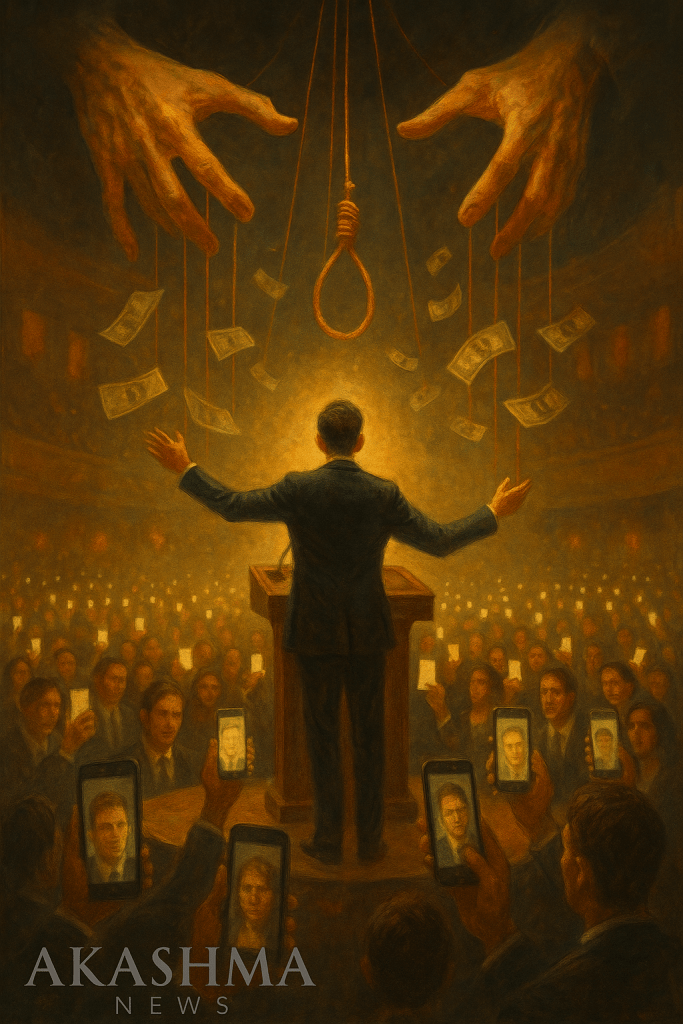
Image Credits: Concept and art direction by Marivel Guzman for Akashma News. Digital illustration generated by ChatGPT (GPT-5) using the DALL·E image engine, under creative direction and post-production refinement by Akashma. Watermark and final composition styling by Akashma News. © 2025 Akashma News.
🜂 Section III — The Sacrifice Protocol
🌙We now enter the heart of the trilogy — where spectacle, sacrifice, and control intersect. This section carries the emotional charge of Ellison’s “invisible martyr” and the symbolic resonance of modern political theatre.—🜂 Section III — The Sacrifice Protocol When Power Needs a Martyr
1. Rituals of Power in the Age of Optics
Power has always required ritual.
Where empires once built arenas, modern systems build algorithms.
The spectacle has evolved—from lions and crosses to hashtags and headlines.
In this new empire of optics, truth is a product, and outrage is the sacrament.
The martyrdom of the modern orator—whether silenced by scandal, exile, or bullet—is not a failure of democracy but its maintenance.
The ritual ensures continuity. It reminds the obedient what happens to those who remember they were once free.
2. Manufactured Martyrs, Disposable Prophets
Every few years, the system selects a messenger to elevate and destroy.
The figure rises fast—amplified by media, worshiped by followers, and encased in myth.
Then, at the moment of greatest influence, comes the fall: a leak, an accusation, a sudden death.
The purpose is not to eliminate a person but to recalibrate belief.
The audience must see that transcendence is punishable—that truth, when spoken too plainly, costs blood.
The message is clear: The throne feeds on its own saints.
3. Death as a Broadcast
In ancient times, the crucifixion was meant for public instruction.
Today, the live-stream has replaced the cross.
The screen delivers the spectacle—instantly, globally, and algorithmically optimized for engagement.
Death becomes content.
Mourning becomes a metric.
The system feeds on both.
We scroll, share, and repeat—witnesses to an endless digital Golgotha where prophets trend before being buried by the next feed cycle.
4. The Psychological Contract of Control
Every public sacrifice renews a silent contract:
“Stay within the script, and you’ll be safe.” Akashma News
This contract is the spine of political entertainment.
Politicians sign it with lobbyists, journalists with sponsors, influencers with donors, and citizens with convenience.
Each act of obedience buys one more day of visibility.
Each deviation risks deletion.
In this architecture, the martyr is not an accident but a system update—a necessary purge to sustain illusion.
5. The Audience as Accomplice
The audience is never innocent.
Our fascination with the fall—the way we consume the downfall of others—makes us co-authors of the sacrifice.
When we click “share,” we carry the blade.
When we doubt the truth-teller and praise the deceiver, we sign the social contract of complicity.
The invisible man is not only the orator on the stage; it is us—mesmerized, enthralled, unwilling to look away.
6. Breaking the Protocol
To break the protocol, one must reject the spectacle.
Turn off the feed.
Refuse the algorithmic offering.
Reclaim the silence that power fears most: critical stillness.
The martyr’s true victory is not in death but in the contagion of awareness left behind.
If enough awaken, the ritual collapses—because sacrifice only works when there’s an audience willing to watch.
The Invisible Man Series:
🜂 Section I — From Invisible Man to Invisible Truth
🜂 Section II — The Algorithm and the Altar
🜂 Section III — The Sacrifice Protocol
🜂 Section IV — Reclaiming Thought in a Programmed World
-
October 13, 2025 at 9:32 pmThe Resurrection of the Individual | Akashma Online News

 Akashma Online News