Archive
The Theater of Distraction: Investigative Speculation on Narrative Control and Profitable Chaos
By Marivel Guzman | Akashma News
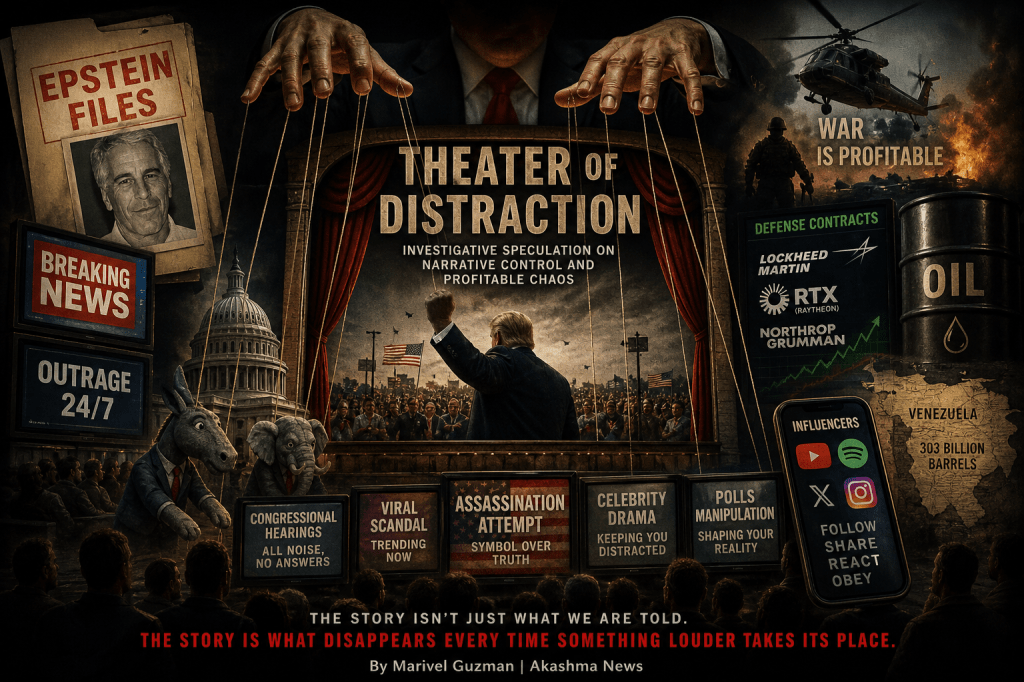
Credit: Image generated with DALL E (OpenAl); concept by Akashma News (2026).
Major stories with structural implications—such as the Epstein files—surface briefly, then recede, displaced by a rapid succession of emotionally charged, highly reactive narratives. These range from controversial personalities and viral moments to institutional “clown show” episodes, including the FBI-linked “Shell 86” Comey controversy and widely circulated, often puzzling media appearances like those of Erika Kirk.
Each story appears distinct. Each triggers outrage, confusion, or fascination. Yet collectively, they form a cycle: rapid narrative turnover, high emotional engagement, and minimal sustained accountability.
This raises a critical question:
Is this fragmentation organic—or functional?
The Business Model of Distraction
Modern media ecosystems—particularly digital platforms—are not neutral distributors of information. They are engagement-driven systems. Attention is the currency. Reaction is the product.
Under this model, narratives that provoke immediate emotional responses outperform those requiring sustained analytical focus. As a result, long-form, structurally significant investigations often lose visibility to shorter, more sensational content cycles.
The outcome is not necessarily coordination—but convergence:
a system that rewards distraction, regardless of intent.
The Influencer Amplification Loop
Within this environment, high-profile commentators and creators play a central role. Figures such as Candace Owens and Joe Rogan—alongside a rotating cast of large-audience personalities, including Baron Coleman—operate as accelerants within the cycle.
Their platforms do not create the narratives, but they amplify, interpret, and extend them—often in real time.
This creates what can be described as an amplification loop:
- A narrative emerges
- Influencers react and interpret
- Audiences engage emotionally
- Platforms prioritize the engagement
- The cycle intensifies and reset
Whether intentional or not, the effect is consistent:
millions remain engaged, but rarely anchored to a single issue long enough to demand resolution.
Reality as Performance
The overlap between politics, media, and entertainment has blurred to the point where distinctions are increasingly difficult to maintain.
What emerges resembles less a traditional information ecosystem and more a performance structure—one in which narratives are introduced, escalated, and replaced with remarkable speed.
To observers, this can feel less like journalism and more like a continuous, high-stakes production—an evolving script in which public reaction becomes part of the show itself.
A Journalist’s Dilemma
For those trained in journalism, this environment presents a paradox.
The discipline is built on verification, continuity, and accountability. Yet the surrounding system rewards velocity, fragmentation, and emotional immediacy.
The result is a growing skepticism—not only toward individual narratives, but toward the ecosystem as a whole.
And perhaps that is the most consequential shift:
not what the public believes, but whether it believes anything at all.
When Power Needs a Martyr
By Marivel Guzman | Akashma News | Opinion Makers
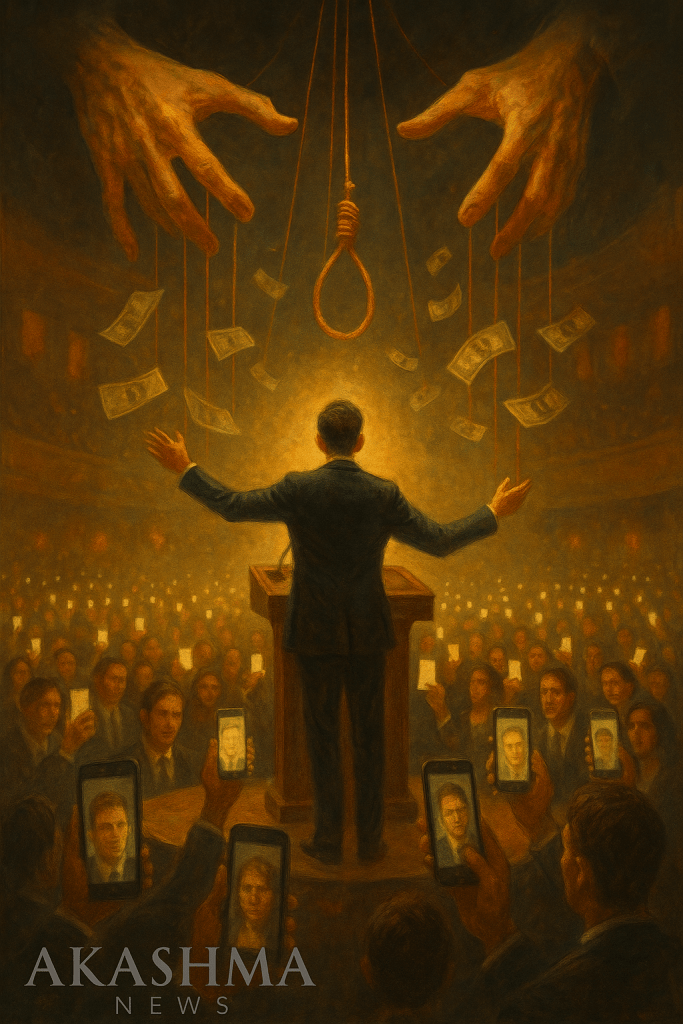
Image Credits: Concept and art direction by Marivel Guzman for Akashma News. Digital illustration generated by ChatGPT (GPT-5) using the DALL·E image engine, under creative direction and post-production refinement by Akashma. Watermark and final composition styling by Akashma News. © 2025 Akashma News.
🜂 Section III — The Sacrifice Protocol
🌙We now enter the heart of the trilogy — where spectacle, sacrifice, and control intersect. This section carries the emotional charge of Ellison’s “invisible martyr” and the symbolic resonance of modern political theatre.—🜂 Section III — The Sacrifice Protocol When Power Needs a Martyr
1. Rituals of Power in the Age of Optics
Power has always required ritual.
Where empires once built arenas, modern systems build algorithms.
The spectacle has evolved—from lions and crosses to hashtags and headlines.
In this new empire of optics, truth is a product, and outrage is the sacrament.
The martyrdom of the modern orator—whether silenced by scandal, exile, or bullet—is not a failure of democracy but its maintenance.
The ritual ensures continuity. It reminds the obedient what happens to those who remember they were once free.
2. Manufactured Martyrs, Disposable Prophets
Every few years, the system selects a messenger to elevate and destroy.
The figure rises fast—amplified by media, worshiped by followers, and encased in myth.
Then, at the moment of greatest influence, comes the fall: a leak, an accusation, a sudden death.
The purpose is not to eliminate a person but to recalibrate belief.
The audience must see that transcendence is punishable—that truth, when spoken too plainly, costs blood.
The message is clear: The throne feeds on its own saints.
3. Death as a Broadcast
In ancient times, the crucifixion was meant for public instruction.
Today, the live-stream has replaced the cross.
The screen delivers the spectacle—instantly, globally, and algorithmically optimized for engagement.
Death becomes content.
Mourning becomes a metric.
The system feeds on both.
We scroll, share, and repeat—witnesses to an endless digital Golgotha where prophets trend before being buried by the next feed cycle.
4. The Psychological Contract of Control
Every public sacrifice renews a silent contract:
“Stay within the script, and you’ll be safe.” Akashma News
This contract is the spine of political entertainment.
Politicians sign it with lobbyists, journalists with sponsors, influencers with donors, and citizens with convenience.
Each act of obedience buys one more day of visibility.
Each deviation risks deletion.
In this architecture, the martyr is not an accident but a system update—a necessary purge to sustain illusion.
5. The Audience as Accomplice
The audience is never innocent.
Our fascination with the fall—the way we consume the downfall of others—makes us co-authors of the sacrifice.
When we click “share,” we carry the blade.
When we doubt the truth-teller and praise the deceiver, we sign the social contract of complicity.
The invisible man is not only the orator on the stage; it is us—mesmerized, enthralled, unwilling to look away.
6. Breaking the Protocol
To break the protocol, one must reject the spectacle.
Turn off the feed.
Refuse the algorithmic offering.
Reclaim the silence that power fears most: critical stillness.
The martyr’s true victory is not in death but in the contagion of awareness left behind.
If enough awaken, the ritual collapses—because sacrifice only works when there’s an audience willing to watch.
The Invisible Man Series:
🜂 Section I — From Invisible Man to Invisible Truth
🜂 Section II — The Algorithm and the Altar
🜂 Section III — The Sacrifice Protocol
🜂 Section IV — Reclaiming Thought in a Programmed World
From Invisible Man to Invisible Truth
By Marivel Guzman |Akashma News | Opinion Makers
Section I – How Power Manufactures and Silences Its Messengers

Image Credits: Concept by Marivel Guzman for Akashma News; AI-assisted digital illustration generated by ChatGPT (GPT-5) using DALL·E image engine, with post-processing and composition guidance by Akashma; © 2025 Akashma News.
1. The Making of a Modern Orator
Every era elevates its own messengers.
Some emerge from struggle, conviction, or extraordinary personal force. Others rise because institutions, donors, movements, and media systems recognize in them a voice capable of carrying a message farther than it could travel on its own.
Charlie Kirk belonged to this modern landscape of amplified oratory. He was young, articulate, disciplined, and exceptionally effective before an audience. But charisma alone does not create national reach. Platforms, funding, organizations, media exposure, and political access can transform a gifted speaker into something larger: a symbol, a representative, even a prophet-like figure to those who see their own beliefs reflected in him.
His rise also demonstrated the extraordinary power of political networks to identify, cultivate, and amplify a compelling young voice. Donors, advocacy organizations, media platforms and political allies helped provide the infrastructure through which his message could travel from campuses to churches, conferences, television studios and millions of digital screens.
That distinction matters.
To say that a messenger was cultivated is not to say that his convictions were manufactured. Nor does institutional support erase individual talent, ambition or agency. Kirk could believe what he preached and still operate within a political ecosystem that benefited from—and invested in—his extraordinary ability to communicate.
This is where Ralph Ellison’s Invisible Man becomes more than a literary reference.
Ellison’s protagonist possesses his own intelligence, ambition and voice. The Brotherhood does not create those qualities; it recognizes their usefulness. It gives him a platform, an audience and political significance. In return, however, it increasingly expects the orator to remain within boundaries established by people whose purposes are larger than his own.
The parallel is not exact, nor does it need to be.
Kirk was not Ellison’s Invisible Man, and Turning Point USA was not Ellison’s Brotherhood. But the novel gives us a powerful lens through which to examine a recurring relationship between the messenger and the machinery that amplifies him.
Kirk became one of the most recognizable conservative voices speaking to America’s younger generations. His organization expanded. His audience multiplied. His political access deepened. The young man behind the microphone became inseparable from the movement growing around him.
And with amplification comes another, less comfortable question:
Who owns the message when the messenger becomes more powerful than the machinery that helped amplify him?
That question sits at the heart of The Invisible Man Series.
The issue is not whether the orator possesses genuine talent or conviction. The deeper question is what happens when powerful institutions help construct the stage, expand the audience and reinforce a particular message—and what happens when the person standing on that stage begins to question the script.
The invisible scaffolding does not have to manufacture the man.
It only has to build the stage.
2. Grooming the Voice of the Faithful
Turning Point USA is more than a student organization. It operates within a larger political ecosystem of donors, advocacy networks, media platforms, religious constituencies and political allies that continues to shape conservative outreach to younger Americans.
Within that ecosystem, Charlie Kirk became one of its most effective messengers.
The movement surrounding him increasingly fused three powerful ideas:
Patriotism. Capitalism. Judeo-Christian identity.
For many conservative Christians, support for the modern State of Israel became intertwined with religious conviction, American identity and foreign policy. Political support was often presented not merely as a strategic position, but as a moral obligation rooted in faith.
Kirk became exceptionally skilled at speaking within that language. His oratory connected evangelical Christianity, American nationalism and support for Israel in ways that resonated deeply with large segments of his audience.
But here, again, a distinction is necessary.
Christian faith and political support for the State of Israel are not inherently the same thing. Nor is criticism of an Israeli government equivalent to hostility toward Judaism or the Jewish people. Yet within parts of the American evangelical-political world, those boundaries have often become blurred.
That blurring matters to this story.
Because once a political position acquires the authority of religious truth, questioning the policy can begin to feel like questioning the faith itself. The political message becomes harder to challenge precisely because it has been wrapped in sacred language.
Kirk helped carry that message to millions.
Turning Point USA continues to cultivate young conservative audiences, and its broader political and religious networks remain active. But Kirk’s particular importance came from the unusual degree of trust he commanded among younger listeners. He was not simply repeating talking points. He had become, for many followers, an interpreter of what patriotism, Christianity and political loyalty were supposed to mean.
That made his voice powerful.
And it would also make any significant change in that voice consequential.
The messaging was simple: to be Christian was to defend Israel; to question Israel was to betray God and Country.
Kirk’s oratory baptized political Zionism in evangelical language, merging nationalism and theology into a single “gospel of survival.”
The formula worked. Millions followed.
3. The Awakening
But power’s greatest fear is a messenger who learns he has been scripted.
When Kirk began to question the contradictions—the endless wars, the moral dissonance between faith and foreign policy—he crossed from preacher to heretic.
His doubts were quiet at first, coded in language about “America First.”
Then louder—challenging donors, hinting that loyalty to a foreign state had replaced loyalty to truth.
That is when the machine turned on him.
Isolation. Defamation. Threats. And eventually—silence.
Whether his death was orchestrated or opportunistic, the pattern is the same:
When a symbol awakens, the system demands sacrifice.
4. The New Invisible War
Candace Owens’ “dead man’s switch” is not only a digital vault—it’s a metaphor for this new era of information rebellion.
She represents what Ellison foreshadowed: the rebellion of the orator who refuses to be invisible any longer.
In a world where livestreams replace pulpits, and social media becomes the new temple, truth is no longer broadcast—it is leaked.
Owens’ defiance—and the public’s hunger for transparency—marks the fracture line between controlled narrative and awakening consciousness.
5. The Moral Economy of Sacrifice
Every empire feeds on its own prophets.
Rome crucified its truth-tellers.
Modern power cancels, discredits, or erases them.
The “greater good” is always invoked—the defense of democracy, of faith, of national security.
But the greater good is never for the messenger; it is for the machinery that sustains the illusion.
In this sense, Kirk’s fall is not a conspiracy theory—it’s a case study in the political theology of control.
He became dangerous not because he was wrong, but because he began to think freely within a closed system.
6. Generation Z and the Shattered Mirror
Kirk built an enormous audience among young Americans—skeptical, connected, and immersed in the digital world. Turning Point USA continues to reach that generation, but the generation itself is changing.
Young Americans are increasingly questioning political narratives their parents often accepted. They see in Gaza not simply a distant foreign conflict, but a test of what they have been told about American foreign policy, human rights, war, and the media. They encounter competing narratives directly on their phones, often before political institutions or traditional news organizations can frame the images for them.
They also see censorship debates in their feeds, political pressure within religious communities, and contradictions between what politicians proclaim and what governments actually do.
This generation may not inherit the unquestioned allegiances of previous generations.
And that is precisely why Kirk’s enormous reach matters to the argument developed in this series. If an influential conservative voice capable of reaching millions of young Americans began reconsidering assumptions about Israel, U.S. foreign policy, or the meaning of “America First,” the significance would extend far beyond one man.
After the orator fell, the question became:
Who controls the message when the messenger begins questioning the script?
The Invisible Man becomes visible again—but this time, it is the machinery behind him that demands examination.
The Invisible Man Series:
Section I — From Invisible Man to Invisible Truth
Section II — The Algorithm and the Altar
🜂 Section III — The Sacrifice Protocol
🜂 Section IV — Reclaiming Thought in a Programmed World
Dear COVID-19: The Lockdown—Love Affair with Death
Originally posted on April 21, 2020
By Marivel Guzman
Updated April 25, 2025
I don’t love you,
not like my friends and followers do.
They dig through Google and Facebook
for every freshly minted death count,
adoring the adrenaline rush
when your numbers spike to a new day’s high.
They’re in love with death’s new attire,
searching day and night for proof—
the nurse, the taxi driver, the maid,
the doctor, the neighbor, the friend of a friend,
the niece of their uncle’s ex-wife’s son-in-law
who—according to the MSM—died of you.
Your lovers’ opinions are as loud as mine,
but my data analysis?
Well, it carries a sharper edge—
in my humble, unapologetic opinion.
Not even in my wildest dreams
did I imagine you’d bulldoze
the path of free thinkers in three months flat.
Not even Adelson’s millions
could shake us from standing with Palestine,
from challenging headline-charged wars.
But you?
You slithered through subconscious fears,
and in mere months,
sent the rebels into self-imposed exile.
They left their cafés,
the warmth of real conversations,
trading them in for government stimulus checks
and digital chains.
They swapped social justice
for feverish browsing of your every move.
Once fearless critics of the MSM,
they now quote it like gospel:
“X, Y, Z who didn’t believe in you—
died today!”
(happy face emoji, of course).
Zealously, they patrol Facebook,
chasing dissenters with virtual pitchforks:
“If you think COVID-19 is a hoax,
please delete me or unfollow,”
one lover proudly typed.
Dear COVID-19,
I still don’t love you.
I never did.
And I stand my ground
against you and your army
of fear-vaccinated souls.
I’ll stick to flu advice, thanks—
cover your mouth when you cough,
care for the elderly;
they are fragile and need love, not exile.
Fight the mandates
that condemned them to die alone.
Rest in peace—
Yellow Vests,
Hong Kong protesters,
Amazon workers,
water protectors,
beggars,
the homeless,
the elderly,
the poor,
pensions,
free expression,
and friendship.
🧪 UPDATE: The Fauci Files – A Comedy of Errors
🎭 “I Didn’t Mandate Anything”
In a recent congressional hearing, Dr. Anthony Fauci clarified that he never mandated masks or social distancing; he merely offered suggestions. As he put it, “I didn’t recommend anything. I just suggested it.”
📏 The Six-Foot Rule: A Magical Appearance
Dr. Fauci admitted that the six-foot social distancing guideline “sort of just appeared” and was “likely not based on scientific data.”
🔬 Lab Leak Theory: Not So Far-Fetched
Contrary to earlier dismissals, Dr. Fauci acknowledged that the lab leak hypothesis is “not a conspiracy theory.”
💰 Funding Controversies
Documents have surfaced indicating that the National Institutes of Health (NIH) funded research in Wuhan that enhanced a bat coronavirus’s infectivity in humans. This contradicts earlier statements denying such funding.
—

Marivel Guzman is passionate about investigative reporting and photography. She loves to dig for information and get to the bottom of what is really going on. Her work often focuses on following the money and exposing how public funds are allocated—or misused.
Her bylines include Lariat News, Orange Coast Report, and The State Hornet. She has also worked remotely as Proof Editor for the Baluchistan Red Crescent quarterly magazine and volunteers as a photographer for UNRWA events.
She has been the voice behind a political blog for more than a decade, covering both domestic and international stories that mainstream outlets often ignore.


