Invisible Operators
By Marivel Guzman |Akashma News
May 15, 2026
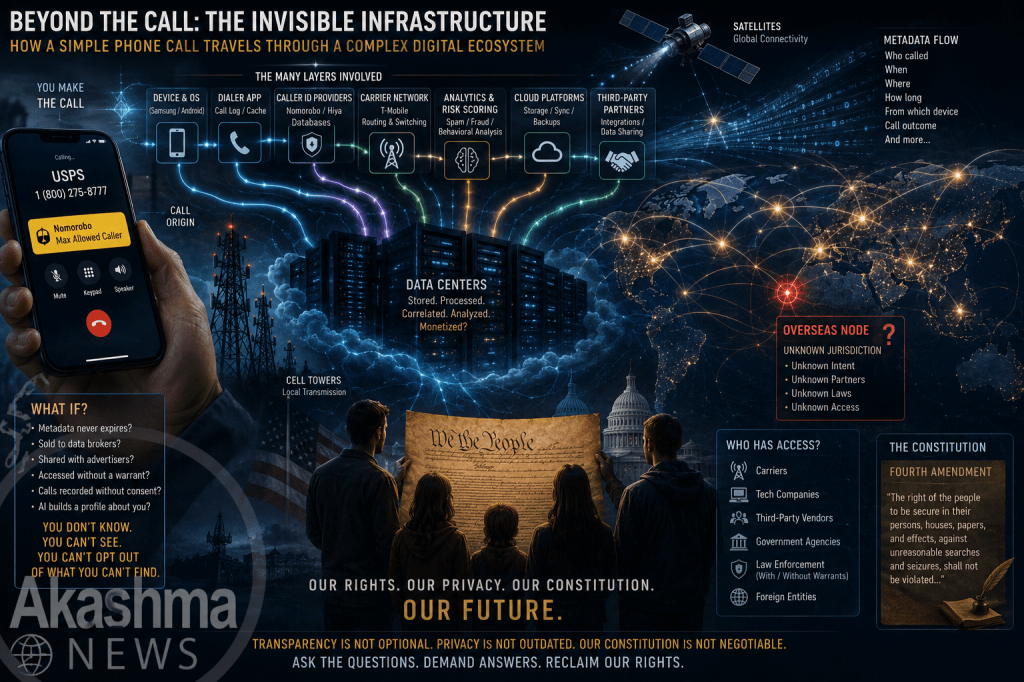
Image Credit:
Conceptual illustration created by OpenAI DALL·E under the direction of Marivel Guzman | Akashma News.
Convenience Infrastructure
The Rise of “Helpful” Telecom Services
Modern smartphones are marketed as tools of convenience. They promise protection from spam callers, automatic business identification, fraud prevention, robocall blocking, and “smart” communication features designed to make life easier and safer. On the surface, these systems appear beneficial. Few people enjoy answering endless spam calls or fraudulent robocalls pretending to be banks, hospitals, government agencies, or insurance companies.
Over the last decade, an entire industry emerged around solving that problem.
Companies such as Nomorobo, Hiya, and carrier-operated systems like T-Mobile Scam Shield market themselves as protective barriers between consumers and unwanted calls. Smartphone manufacturers and operating systems have integrated these services directly into the communication infrastructure of modern devices. Samsung phones, for example, incorporate caller-identification and spam-detection features through systems commonly branded as “Smart Call,” while Android itself provides frameworks allowing call-screening and caller-ID services to interact with phone activity.
The selling point is simple:
| convenience through automation.
The phone identifies businesses before they speak.
Spam calls are flagged automatically.
Unknown callers are classified.
Potential scams are filtered in real time.
To the average user, these features feel almost invisible — until the machinery accidentally exposes itself.
That is what happened when the bright yellow Nomorobo label appeared during my USPS call.
The experience raised a larger question: How many entities now participate in the simple act of placing a phone call?
In the past, calling a business involved a direct exchange between the caller, the telecom carrier, and the recipient. Today, that same interaction may involve a web of interconnected systems:
browser click-to-call frameworks, Android telecom APIs, dialer metadata services,
carrier-level spam analytics, third-party caller-ID databases, business verification platforms, and behavioral reputation scoring systems.
Most consumers never consciously agree to this ecosystem in any meaningful sense. The permissions are buried inside lengthy terms-of-service agreements, device setup screens, carrier bundles, or default operating-system settings activated long before a user fully understands what is being enabled.
What makes the situation particularly complex is that these systems often operate under the language of security. Fraud prevention and anti-spam protections are legitimate concerns. Robocalls remain a massive problem in the United States, costing consumers billions of dollars annually in scams and financial losses. Telecom companies and technology firms present these services as necessary defenses in an increasingly hostile digital environment.
Yet convenience and protection also create new layers of dependency and data exposure.
Because for a system to classify, verify, label, filter, or “protect” a call, it must first interact with the metadata surrounding that communication. And metadata — while often dismissed as harmless — can reveal a tremendous amount about a person’s habits, relationships, routines, institutions, and behavioral patterns.
The issue is not necessarily that a company listens to the content of conversations. In many cases, the far more valuable asset is the surrounding behavioral data:
who calls whom, when, how frequently,
from what device, through what carrier,
under what classifications, and attached to what behavioral patterns.
Convenience infrastructure rarely presents itself as surveillance. It presents itself as assistance.
And perhaps that is what makes it so difficult for most users to notice the invisible architecture quietly forming around their everyday communications.
Continue reading
Part I—The Yellow Label
Part II— The Strange Layer Between Caller and Recipient
PART III — If the Service Is Free, What Is the Product?
PART IV — Android’s Hidden Telecom Layers
PART V — The Psychological Architecture of “Safety”
PART VI — The Experiment
PART VII — The Real Discovery
PART VIII — Questions for the Industry
PART IX — Constitutional and Legal Questions
Metadata and Modern Privacy
Et w1 a


