The Theater of Distraction: Investigative Speculation on Narrative Control and Profitable Chaos
By Marivel Guzman | Akashma News
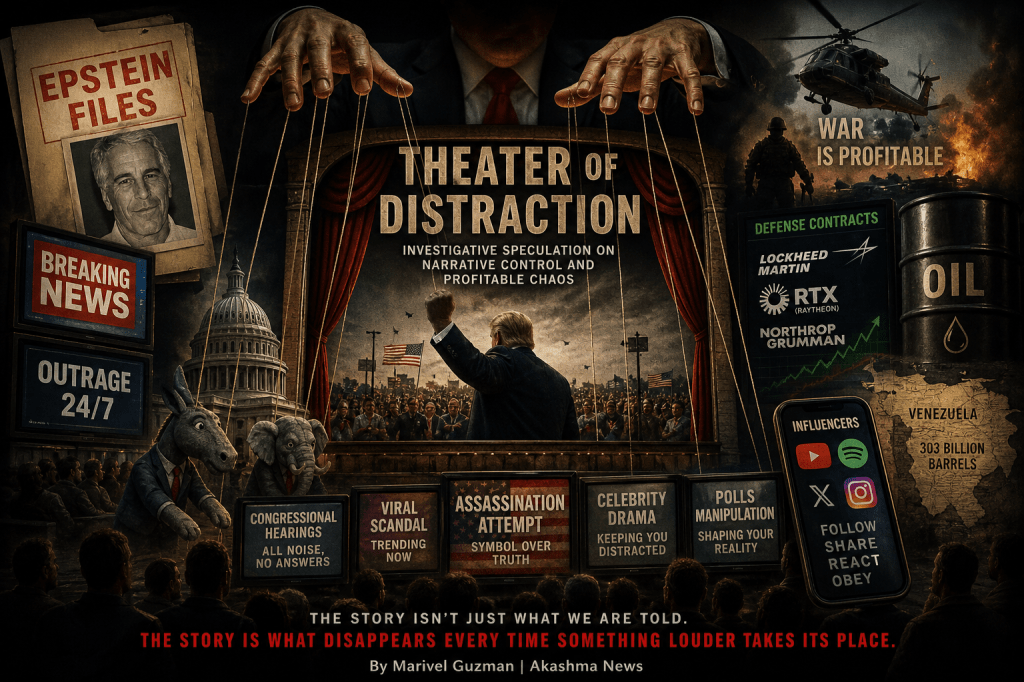
Credit: Image generated with DALL E (OpenAl); concept by Akashma News (2026).
Major stories with structural implications—such as the Epstein files—surface briefly, then recede, displaced by a rapid succession of emotionally charged, highly reactive narratives. These range from controversial personalities and viral moments to institutional “clown show” episodes, including the FBI-linked “Shell 86” Comey controversy and widely circulated, often puzzling media appearances like those of Erika Kirk.
Each story appears distinct. Each triggers outrage, confusion, or fascination. Yet collectively, they form a cycle: rapid narrative turnover, high emotional engagement, and minimal sustained accountability.
This raises a critical question:
Is this fragmentation organic—or functional?
The Business Model of Distraction
Modern media ecosystems—particularly digital platforms—are not neutral distributors of information. They are engagement-driven systems. Attention is the currency. Reaction is the product.
Under this model, narratives that provoke immediate emotional responses outperform those requiring sustained analytical focus. As a result, long-form, structurally significant investigations often lose visibility to shorter, more sensational content cycles.
The outcome is not necessarily coordination—but convergence:
a system that rewards distraction, regardless of intent.
The Influencer Amplification Loop
Within this environment, high-profile commentators and creators play a central role. Figures such as Candace Owens and Joe Rogan—alongside a rotating cast of large-audience personalities, including Baron Coleman—operate as accelerants within the cycle.
Their platforms do not create the narratives, but they amplify, interpret, and extend them—often in real time.
This creates what can be described as an amplification loop:
- A narrative emerges
- Influencers react and interpret
- Audiences engage emotionally
- Platforms prioritize the engagement
- The cycle intensifies and reset
Whether intentional or not, the effect is consistent:
millions remain engaged, but rarely anchored to a single issue long enough to demand resolution.
Reality as Performance
The overlap between politics, media, and entertainment has blurred to the point where distinctions are increasingly difficult to maintain.
What emerges resembles less a traditional information ecosystem and more a performance structure—one in which narratives are introduced, escalated, and replaced with remarkable speed.
To observers, this can feel less like journalism and more like a continuous, high-stakes production—an evolving script in which public reaction becomes part of the show itself.
A Journalist’s Dilemma
For those trained in journalism, this environment presents a paradox.
The discipline is built on verification, continuity, and accountability. Yet the surrounding system rewards velocity, fragmentation, and emotional immediacy.
The result is a growing skepticism—not only toward individual narratives, but toward the ecosystem as a whole.
And perhaps that is the most consequential shift:
not what the public believes, but whether it believes anything at all.


