Archive
The Algorithm and the Altar
By Marivel Guzman | Akashma News | Opinion Makers
Section II – How Faith Became Data and Devotion Became Code
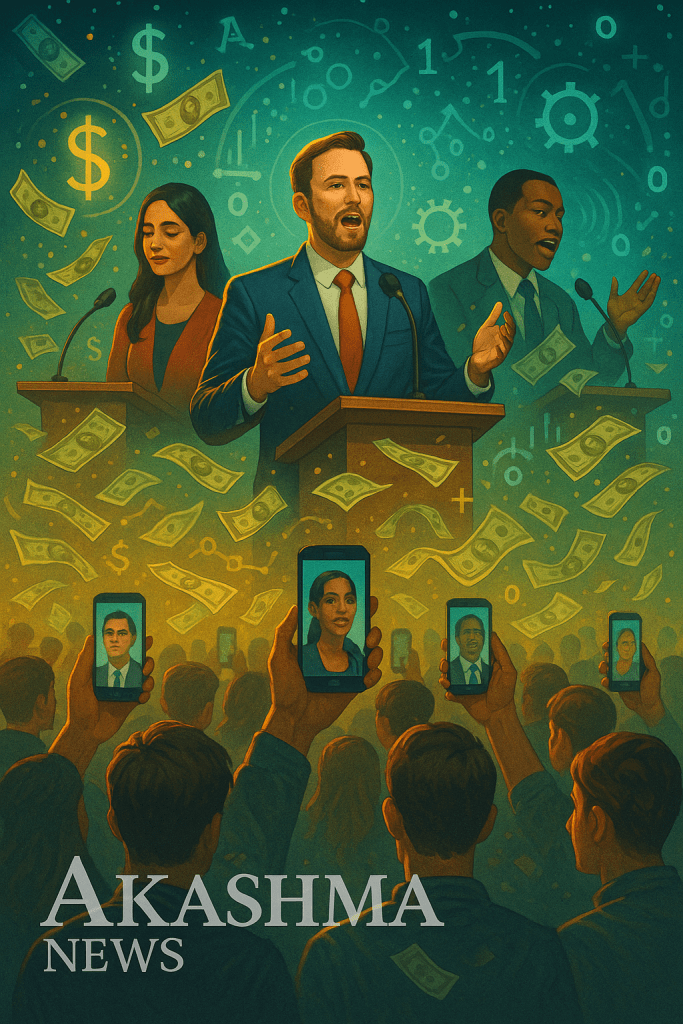
1. From Gospel to Algorithm
The twenty-first century didn’t abolish religion; it digitized it.
Every sermon became a stream, every scripture a post, every act of devotion a data point.
Just as priests once mediated between believers and God, now platforms mediate between humans and meaning.
You pray by clicking, confess by posting, and tithe with your attention.
The new Church doesn’t need cathedrals—it has dashboards.
Faith has migrated from the altar to the algorithm.
2. The God of Engagement
In this new theology, salvation is replaced by visibility.
The more you’re seen, the more you exist.
The digital god demands constant worship—measured in likes, shares, retweets, and metrics that simulate love.
Charlie Kirk, Candace Owens, and their generation of “digital apostles” learned early that algorithmic grace can make or unmake a prophet overnight.
The same invisible hands that once lifted their voices can now shadow-ban their sermons.
Power no longer needs to crucify; it can simply mute.
3. The Donor’s Hand Behind the Curtain
In Ellison’s time, the Brotherhood fed speeches to the orator.
Today, data scientists and donors feed talking points through social media pipelines.
Algorithmic engineering and targeted advertising ensure that outrage, not enlightenment, sustains the feed.
The invisible Brotherhood now wears the mask of analytics.
Behind every viral trend lies a spreadsheet calculating emotional yield—rage, fear, guilt, devotion—because these are the currencies that feed both empire and algorithm.
And so, belief itself has been monetized.
When you speak against the system, you do not merely lose followers—you lose revenue streams.
4. Neural Sovereignty and the Hijacking of Conscience
The battle that used to take place in the soul now happens in the neural marketplace.
Data profiles—our digital doppelgängers—predict and preempt free will.
The algorithm knows which image of war will make you cry, which headline will make you rage, which “prophet” you will follow.
This is not surveillance alone—it is synthetic prophecy.
Faith is no longer about believing; it is about being programmed to believe.
Neural sovereignty—the right to own your consciousness—is the new frontier of freedom.
Without it, every thought becomes a sponsored post.
5. Israel, Ideology, and the Digital Covenant
In the case of Israel, the sacred and the strategic merged into a single feed.
The narrative was coded into every platform—hashtags turned to psalms, and geopolitics to prophecy.
For decades, questioning the Israeli state was treated as blasphemy in the algorithmic temple.
But now, as younger generations scroll through unfiltered images of Gaza, that digital covenant is breaking.
The emotional monopoly is over.
No algorithm can fully contain moral awakening once pain becomes human again.
6. The New Faith: Truth Without Permission
The algorithm has replaced priests, but prophets still rise from the margins.
Whistleblowers, journalists, independent thinkers—voices like Snowden, Assange, and Ellison’s invisible man reborn through code—still pierce the fog.
They prove that the sacred cannot be owned, and the truth cannot be fully silenced.
Your article, Akashma, belongs in that lineage of resistance—naming the new gods for what they are:
Data masquerading as divinity.
The Invisible Man Series:
🜂 Section I — From Invisible Man to Invisible Truth
🜂 Section II — The Algorithm and the Altar
🜂 Section III — The Sacrifice Protocol
🜂 Section IV — Reclaiming Thought in a Programmed World
From Invisible Man to Invisible Truth
By Marivel Guzman |Akashma News | Opinion Makers
Section I – How Power Manufactures and Silences Its Messengers

Image Credits: Concept by Marivel Guzman for Akashma News; AI-assisted digital illustration generated by ChatGPT (GPT-5) using DALL·E image engine, with post-processing and composition guidance by Akashma; © 2025 Akashma News.
1. The Making of a Modern Orator
Every era elevates its own messengers.
Some emerge from struggle, conviction, or extraordinary personal force. Others rise because institutions, donors, movements, and media systems recognize in them a voice capable of carrying a message farther than it could travel on its own.
Charlie Kirk belonged to this modern landscape of amplified oratory. He was young, articulate, disciplined, and exceptionally effective before an audience. But charisma alone does not create national reach. Platforms, funding, organizations, media exposure, and political access can transform a gifted speaker into something larger: a symbol, a representative, even a prophet-like figure to those who see their own beliefs reflected in him.
His rise also demonstrated the extraordinary power of political networks to identify, cultivate, and amplify a compelling young voice. Donors, advocacy organizations, media platforms and political allies helped provide the infrastructure through which his message could travel from campuses to churches, conferences, television studios and millions of digital screens.
That distinction matters.
To say that a messenger was cultivated is not to say that his convictions were manufactured. Nor does institutional support erase individual talent, ambition or agency. Kirk could believe what he preached and still operate within a political ecosystem that benefited from—and invested in—his extraordinary ability to communicate.
This is where Ralph Ellison’s Invisible Man becomes more than a literary reference.
Ellison’s protagonist possesses his own intelligence, ambition and voice. The Brotherhood does not create those qualities; it recognizes their usefulness. It gives him a platform, an audience and political significance. In return, however, it increasingly expects the orator to remain within boundaries established by people whose purposes are larger than his own.
The parallel is not exact, nor does it need to be.
Kirk was not Ellison’s Invisible Man, and Turning Point USA was not Ellison’s Brotherhood. But the novel gives us a powerful lens through which to examine a recurring relationship between the messenger and the machinery that amplifies him.
Kirk became one of the most recognizable conservative voices speaking to America’s younger generations. His organization expanded. His audience multiplied. His political access deepened. The young man behind the microphone became inseparable from the movement growing around him.
And with amplification comes another, less comfortable question:
Who owns the message when the messenger becomes more powerful than the machinery that helped amplify him?
That question sits at the heart of The Invisible Man Series.
The issue is not whether the orator possesses genuine talent or conviction. The deeper question is what happens when powerful institutions help construct the stage, expand the audience and reinforce a particular message—and what happens when the person standing on that stage begins to question the script.
The invisible scaffolding does not have to manufacture the man.
It only has to build the stage.
2. Grooming the Voice of the Faithful
Turning Point USA is more than a student organization. It operates within a larger political ecosystem of donors, advocacy networks, media platforms, religious constituencies and political allies that continues to shape conservative outreach to younger Americans.
Within that ecosystem, Charlie Kirk became one of its most effective messengers.
The movement surrounding him increasingly fused three powerful ideas:
Patriotism. Capitalism. Judeo-Christian identity.
For many conservative Christians, support for the modern State of Israel became intertwined with religious conviction, American identity and foreign policy. Political support was often presented not merely as a strategic position, but as a moral obligation rooted in faith.
Kirk became exceptionally skilled at speaking within that language. His oratory connected evangelical Christianity, American nationalism and support for Israel in ways that resonated deeply with large segments of his audience.
But here, again, a distinction is necessary.
Christian faith and political support for the State of Israel are not inherently the same thing. Nor is criticism of an Israeli government equivalent to hostility toward Judaism or the Jewish people. Yet within parts of the American evangelical-political world, those boundaries have often become blurred.
That blurring matters to this story.
Because once a political position acquires the authority of religious truth, questioning the policy can begin to feel like questioning the faith itself. The political message becomes harder to challenge precisely because it has been wrapped in sacred language.
Kirk helped carry that message to millions.
Turning Point USA continues to cultivate young conservative audiences, and its broader political and religious networks remain active. But Kirk’s particular importance came from the unusual degree of trust he commanded among younger listeners. He was not simply repeating talking points. He had become, for many followers, an interpreter of what patriotism, Christianity and political loyalty were supposed to mean.
That made his voice powerful.
And it would also make any significant change in that voice consequential.
The messaging was simple: to be Christian was to defend Israel; to question Israel was to betray God and Country.
Kirk’s oratory baptized political Zionism in evangelical language, merging nationalism and theology into a single “gospel of survival.”
The formula worked. Millions followed.
3. The Awakening
But power’s greatest fear is a messenger who learns he has been scripted.
When Kirk began to question the contradictions—the endless wars, the moral dissonance between faith and foreign policy—he crossed from preacher to heretic.
His doubts were quiet at first, coded in language about “America First.”
Then louder—challenging donors, hinting that loyalty to a foreign state had replaced loyalty to truth.
That is when the machine turned on him.
Isolation. Defamation. Threats. And eventually—silence.
Whether his death was orchestrated or opportunistic, the pattern is the same:
When a symbol awakens, the system demands sacrifice.
4. The New Invisible War
Candace Owens’ “dead man’s switch” is not only a digital vault—it’s a metaphor for this new era of information rebellion.
She represents what Ellison foreshadowed: the rebellion of the orator who refuses to be invisible any longer.
In a world where livestreams replace pulpits, and social media becomes the new temple, truth is no longer broadcast—it is leaked.
Owens’ defiance—and the public’s hunger for transparency—marks the fracture line between controlled narrative and awakening consciousness.
5. The Moral Economy of Sacrifice
Every empire feeds on its own prophets.
Rome crucified its truth-tellers.
Modern power cancels, discredits, or erases them.
The “greater good” is always invoked—the defense of democracy, of faith, of national security.
But the greater good is never for the messenger; it is for the machinery that sustains the illusion.
In this sense, Kirk’s fall is not a conspiracy theory—it’s a case study in the political theology of control.
He became dangerous not because he was wrong, but because he began to think freely within a closed system.
6. Generation Z and the Shattered Mirror
Kirk built an enormous audience among young Americans—skeptical, connected, and immersed in the digital world. Turning Point USA continues to reach that generation, but the generation itself is changing.
Young Americans are increasingly questioning political narratives their parents often accepted. They see in Gaza not simply a distant foreign conflict, but a test of what they have been told about American foreign policy, human rights, war, and the media. They encounter competing narratives directly on their phones, often before political institutions or traditional news organizations can frame the images for them.
They also see censorship debates in their feeds, political pressure within religious communities, and contradictions between what politicians proclaim and what governments actually do.
This generation may not inherit the unquestioned allegiances of previous generations.
And that is precisely why Kirk’s enormous reach matters to the argument developed in this series. If an influential conservative voice capable of reaching millions of young Americans began reconsidering assumptions about Israel, U.S. foreign policy, or the meaning of “America First,” the significance would extend far beyond one man.
After the orator fell, the question became:
Who controls the message when the messenger begins questioning the script?
The Invisible Man becomes visible again—but this time, it is the machinery behind him that demands examination.
The Invisible Man Series:
Section I — From Invisible Man to Invisible Truth
Section II — The Algorithm and the Altar
🜂 Section III — The Sacrifice Protocol
🜂 Section IV — Reclaiming Thought in a Programmed World

 Akashma Online News