Archive
Part V: Blood Money and Broken Oaths —Naming the War Lords – Profiles of Power, Profit, and Permanent War
by Marivel Guzman | Akashma News

There are men who sell wars. And there are men who build the weapons. Often, they are the same.”
— Akashma News, 2025
Patriots. Strategists. Innovators.
That’s how they are introduced on television. But behind every press release and campaign ad is a ledger. And that ledger shows profit made from pain, shares lifted by war, and a cast of powerful individuals who walk between Washington, Wall Street, and war zones—unchallenged, unelected, and unaccountable.
I. The Men Who Sold the Wars
Dick Cheney
CEO of Halliburton before becoming VP.
His company gained $39.5 billion in Iraq War contracts.
Personally retained stock options while architecting war policy.
Donald Rumsfeld
Sat on the board of Gilead Sciences during the planning of biosecurity policy.
Championed a war doctrine that transformed defense into private enterprise.
Zalmay Khalilzad
U.S. Ambassador to Afghanistan and Iraq.
Later became a consultant for oil and defense interests in the very regions he helped “liberate.”
II. The Generals and Officials Who Became Investors – or Were Always Connected
Gen. James Mattis
Joined General Dynamics board shortly after retiring.
Benefited from a firm that supplies key components to both U.S. and NATO operations.
Gen. Stanley McChrystal
Advisor to Palantir, the CIA-funded predictive warfare and surveillance firm.
Former top commander in Afghanistan.
Gen. Michael Hayden
After leading both the NSA and CIA, became a private intelligence consultant.
Affiliated with Booz Allen Hamilton, same firm Edward Snowden worked for before exposing global surveillance.
Lt. Gen. William Hartman
Currently head of U.S. Cyber Command and NSA (acting).
Central figure in the next-gen war theater: data and cyber control.
Condoleezza Rice
National Security Advisor (2001–2005) and Secretary of State (2005–2009).
Former board member of Chevron, which honored her by naming an oil tanker “Condoleezza Rice” in the late 1990s.
Advocated aggressively for regime change in Iraq, despite evidence contradicting the WMD narrative.
Her influence over Afghanistan policy is deeply tied to pipeline geopolitics—not democracy.
As reported in Akashma News (2012), Rice’s connections to energy giants and Hamid Karzai—Afghanistan’s U.S.-installed president and former Unocal pipeline advisor—reveal that “freedom” in Afghanistan may have always been code for oil transit routes and corporate access to Central Asian reserves.
III. Trojan Chips and Phantom Circuits: The Hidden Frontline of Betrayal
“We build our weapons in the name of security—while outsourcing their soul.”
Every F-35. Every smart missile. Every drone or comms satellite in the U.S. arsenal carries inside it parts from foreign nations.
And some of those nations don’t share American values—only American contracts.
Microchips from Taiwan and Israel.
Rare-earth magnets from China.
Optical components from Germany.
Coding subcontractors in India, the UAE, and beyond.
These components are:
Untraceable once installed.
Unverifiable by visual inspection.
Vulnerable to backdoors, malware, timed failure, or embedded surveillance.
In short: weapons may now come pre-compromised.
Israel’s Case: A Known Precedent
In the 1990s, Israeli-manufactured pagers were discovered to be covert surveillance devices, transmitting user location and message metadata without consent. These pagers were sold across Latin America, Europe, and Asia—including to government officials and journalists.
Today’s equivalent?
Cellebrite, Pegasus, NSO Group—all accused of spying on allies and dissidents.
Yet these firms maintain privileged access to U.S. markets and intelligence networks.
What About China?
In 2018, a Bloomberg investigation alleged that Chinese microchips were covertly installed on server motherboards used by Apple, Amazon, and Pentagon contractors.
Even if unconfirmed, the possibility is the threat.
And if Raytheon, Lockheed, or General Dynamics can’t verify every circuit, the entire system is compromised.
IV. The Tech Titans and the Spy Market
Peter Thiel (Palantir)
Created software that maps populations, predicts insurgency, and profiles suspects.
Palantir is funded by In-Q-Tel, the CIA’s venture capital arm.
Jeff Bezos (Amazon)
Bid on the $10B JEDI cloud war contract, and won major DOD deals via AWS.
Amazon’s infrastructure now supports U.S. intelligence, ICE, and military data.
Eric Schmidt (Google/Alphabet)
Served on the Defense Innovation Board.
Helped bridge Silicon Valley with the Pentagon.
Bill Gates (Microsoft)
Indirectly involved in Iraq reconstruction and humanitarian tech expansion.
Microsoft still maintains defense partnerships and cloud servicing for secure military communications.
Lord of War (2005) – Fiction Based on Too Many Facts
In Lord of War, Nicolas Cage plays Yuri Orlov, a smooth-talking arms dealer who thrives in the chaos left behind by collapsing governments and constant conflict. Based loosely on real-life figures like Viktor Bout, the film peels back the curtain on the global weapons trade—legal and illegal—and shows how war is less about ideology, and more about inventory management.
Yuri sells to dictators, rebels, and “freedom fighters”—often in the same country, often with weapons traced back to U.S. or Russian stockpiles. He helps stage rebel uprisings, fuels civil wars, and arms child soldiers, all while living comfortably under the protection of great powers who need people like him to do the dirty work off the books.
The film’s final punchline comes in the credits:
“There are over 550 million firearms in worldwide circulation—one for every 12 people on the planet. The only question is: How do we arm the other 11?”
That’s not a line from the movie. It’s the film’s closing warning—and one of the most honest summations of the modern arms economy ever put on screen.
The real difference between Yuri Orlov and the Pentagon’s preferred contractors?
Orlov was honest about being a merchant of death.
V. Conclusion: These Are the Lords of War
They don’t fight on battlefields. They don’t wear medals. But they profit on every bullet, bomb, and biometric scan.
They rotate from command posts to boardrooms, from political office to private consultancy.
And while veterans die waiting for care, while families mourn from Kabul to Kansas, these war lords cash checks, win contracts, and rewrite policy in their image.
They are the hidden government.
And they’ve sold the republic for stock options and subcontracting fees.
“The difference between Yuri Orlov and real war lords? Orlov was fictional—and slightly more honest.”
Part II: Blood Money and Broken Oaths – How America’s Wars Were Lost to Greed
by Marivel Guzman | Akashma News

They said it was about freedom. They said it was about justice. They said it was about protecting American lives.
But the body count rose, the lies piled up, and the contracts multiplied.
Behind every failed operation, every smokescreen of national interest, and every “freedom mission” abroad—there was a ledger. And the names in those ledgers weren’t soldiers or widows. They were stockholders, politicians, former generals, and billionaires.
This is not anti-war rhetoric. This is forensic journalism. We follow the money. We follow the lies. And we follow the names.
I. The Bush Dynasty: Family Business Meets Foreign Invasion
George H.W. Bush – former CIA Director, oilman, war president. His company, Zapata Offshore, had connections to offshore drilling, Latin America operations, and covert interests.
George W. Bush – sat atop the nation in 2001, as oil executives and military contractors circled the wreckage of 9/11 like vultures. He handed the no-bid reconstruction contracts to Halliburton, formerly run by his vice president, Dick Cheney.
And then came the war built on a lie—Weapons of Mass Destruction—a falsehood pushed by political operatives and amplified by a willing press. The Bush-Cheney doctrine turned Iraq into a playground for profiteers.
II. Dick Cheney: Halliburton’s Shadow Commander
Vice President Cheney made millions from Halliburton stock options even after supposedly “severing ties.” In 2003 alone, Halliburton secured $7 billion in contracts from the U.S. government.
His fingerprints are everywhere:
KBR (Kellogg Brown & Root, a Halliburton subsidiary) billed billions for “reconstruction.”
Allegations of fraud, overcharging, and unsafe conditions for troops.
Private subcontractors like Blackwater (now Academi) acted as mercenary extensions of U.S. foreign policy—with legal immunity.
III. Congress for Sale: The Blood-Soaked Wallets on Capitol Hill
Congress didn’t just approve the wars—they invested in them.
Senator Dianne Feinstein: Her husband, Richard Blum, had stakes in military contractors that gained from Iraq contracts.
Rep. Mike Turner (R-OH): Longtime advocate of defense expansion, recipient of funds from Raytheon and Lockheed.
Dan Crenshaw (R-TX): Public military hero, private supporter of increased private security contracting. Multiple donations from defense PACs.
And let’s not forget Rep. Don Bacon (R-NE)—our cyber subcommittee chair. With decades of military service and political clout, he embodies the revolving door. No direct link to NSO Group or Palantir yet, but his pro-surveillance stances and cyber warfare lobbying track suggest he’s under corporate gravity.
Use OpenSecrets.org and Project on Government Oversight to track the steady stream of blood money funneled through campaign donations and insider contracts.
IV. When Generals Turn Into Guns-for-Hire
Gen. James Mattis: Board member of General Dynamics after his military career.
Gen. Stanley McChrystal: Became advisor to Palantir Technologies, a CIA-seeded surveillance company.
Gen. Michael Hayden: Ex-NSA director turned private consultant for Booz Allen Hamilton—the same firm Edward Snowden worked for when he exposed global surveillance.
They fought wars. Then they sold the playbook.
V. The Tech Profiteers: From Silicon Valley to Baghdad
Bill Gates: Not just the vaccine mogul—Microsoft technology undergirded U.S. digital surveillance and logistics systems in war zones. While Microsoft didn’t profit from boots-on-the-ground war, its infrastructure contracts in Iraq and Afghanistan were extensive.
Peter Thiel: Founder of Palantir, funded by In-Q-Tel, the CIA’s venture capital arm. Palantir’s predictive policing software was deployed in Iraq and on U.S. streets.
Jeff Bezos: Amazon’s AWS cloud bid for the JEDI war cloud contract—worth $10 billion—showed that today’s wars aren’t about tanks. They’re about data.
VI. The Looting of Iraq: $6.6 Billion Gone in Cash
Between 2003–2007, the U.S. “lost” $6.6 billion in cash meant for Iraq’s reconstruction. That money was flown in on pallets—literally—in C-130s, and vanished.
Where did it go? Corrupt Iraqi officials? American contractors? Halliburton vaults?
No accountability. No charges. No return.
VII. From Patriot Act to Panopticon
With the ink still wet from the Twin Towers’ collapse, Congress passed the Patriot Act, giving birth to:
NSA mass surveillance.
Fusion centers spying on Americans.
Corporate surveillance networks with no oversight.
Big Tech, security firms, and retired brass cashed in. And the American people were told: “If you have nothing to hide, you have nothing to fear.”
Meanwhile, the architects of fear had everything to gain.
VIII. Conclusion: The Road to Treason Is Paved with Contracts
America didn’t lose its wars because of incompetence. It lost them because winning was never the goal.
The Pentagon became a piggy bank. Congress a stock exchange. And the generals? Many became consultants, CEOs, and lobbyists.
They served money, not country. And money, as we know, doesn’t need a passport to move through the doors of corruption.
So we name them. We trace the dollars. And we demand that history stop calling them patriots when they were, in truth, profiteers.
In Part III, we’ll break down timelines, show document trails, and map the full revolving door from war zones to corporate boardrooms.
Welcome to Part III: Blood Money and Btoken Oaths: The Empire’s Ledger – Mapping the Timeline of Treason
Part III: Blood Money and Broken Oaths: The Empire’s Ledger – Mapping the Timeline of Treason
by Marivel Guzman | Akashma News

“History is not only written by the victors. It’s bankrolled by them.”
— Akashma News, 2025
Follow the wars. Follow the resignations. Follow the contracts. Follow the betrayal.
I. 1991–1997: From Desert Storm to Corporate Warm-Up
1992–1995: Cheney becomes CEO of Halliburton.
Over $3.8 billion in Pentagon contracts under his leadership.
1994: Bill Clinton signs Presidential Decision Directive 25, quietly expanding U.S. peacekeeping and private contractor roles abroad.
1995: Carlyle Group recruits ex-officials like George H.W. Bush and James Baker.
II. 2000–2003: The Setup Before the Storm
2000: Bush-Cheney campaign begins with heavy oil and defense lobbying support.
Sept 2000: PNAC publishes Rebuilding America’s Defenses—calls for a “Pearl Harbor-like event” to reshape U.S. global policy.
2001 (pre-9/11):
CIA briefs Bush on potential Al-Qaeda threat.
NSA surveillance pilot programs begin domestically.
Sept 11, 2001: The attacks become the pivot point.
Congress passes AUMF.
PATRIOT Act signed Oct 26, 2001—ushering in surveillance capitalism.
III. 2003–2008: The Iraq Gold Rush
2003: U.S. invades Iraq on false WMD intelligence.
KBR receives $7 billion in no-bid contracts.
Halliburton stock surges.
2004: Blackwater awarded $21 million for diplomatic security in Iraq.
2005:
Don Bacon rises in cyber command roles.
Palantir Technologies begins DOD contracts under CIA’s In-Q-Tel.
2006–2007:
Iraq Reconstruction money disappears—$6.6 billion unaccounted for.
Gen. Petraeus surges troops; war contractors surge profits.
2007: Microsoft and Google sign early-stage DOD support contracts for infrastructure and field operations.
IV. 2009–2016: The Silent Profiteering Years
2009:
Barack Obama inherits Iraq/Afghanistan quagmire.
Expansion of drone warfare and NSA surveillance under Hayden.
2010:
Palantir wins major U.S. Army contracts.
General Dynamics, Raytheon, Booz Allen Hamilton among top 5 war profiting firms.
2011:
U.S. “withdraws” from Iraq.
Defense contractors begin pivoting to cyber operations and homeland surveillance.
2013: Edward Snowden leaks NSA surveillance programs.
2014–2015:
ISIS rises—Palantir and Amazon AWS used in military targeting systems.
Senate quietly approves expanded surveillance with corporate partners.
V. 2017–2020: Enter the Tech Lords
Trump years:
Peter Thiel, founder of Palantir and Trump ally, embedded himself into U.S. intelligence architecture.
Palantir wins ICE contracts for predictive policing, Amazon, Microsoft, and Oracle fought over the $10 billion JEDI cloud contract—a digital backbone for U.S. war and surveillance.
Tech billionaires weren’t building apps. They were constructing a battlefield without borders.
2018:
JEDI Cloud Contract bid begins—Microsoft vs. Amazon vs. Oracle.
2020:
COVID emergency legislation used to redirect funds into “cyber defense and biosecurity” infrastructure.
VI. 2021–2024: The New Hybrid War Economy; Afghanistan’s Ghosts and Ukraine’s Windfall
2021: Afghanistan withdrawal—$7B in military equipment left behind.
The withdrawal from Afghanistan in 2021 left $7 billion in abandoned U.S. equipment. And a whole new contract market: homeland security, border tech, biometric screening.
The Ukraine war triggered a second boom:
Raytheon, Northrop Grumman, Lockheed Martin—all reported historic profits.
Cyber contractors were deployed to NATO allies.
Former generals rotated into new roles: consultants, board members, defense liaisons.
Laurie Buckhout was appointed Deputy Secretary for Cyber Policy in 2025. Lt. Gen. William Hartman assumed acting control of Cyber Command and the NSA.
Meanwhile, Rep. Don Bacon—decorated officer, now House cyber subcommittee chair—oversaw funding pipelines that matched lobbying spreadsheets.

2025: The Year the Veil Slipped
This year, everything came full circle.
The CBS leak exposed that cyber operations against Russia were paused—allegedly for political optics, not strategy.
Gen. Hartman denied wrongdoing.
Bacon confirmed it.
Hegseth, the Trump-aligned Secretary of Defense, was revealed to have used Signal to issue battlefield instructions—from his phone.
The cyber war had begun. But the real battle was being waged in boardrooms and committee hearings, where revolving doors never stopped spinning.
Cyber Command & NSA controversies over “paused” operations.
Pete Hegseth–Trump-appointed Secretary of Defense under fire.
Don Bacon leads cyber oversight—but questions emerge on defense lobbying.
New revelations link PAC donations to cyber security procurement priorities.
Conclusion: A Ledger Written in Blood
From Desert Storm to drone storms, from Baghdad to Big Data, America’s war story is no longer about victory.
It’s about returns.
Generals became lobbyists. Presidents became investors. Congress became shareholders.
And the people—the soldiers, the taxpayers, the wounded, the dead—they were left with flags and folded letters.
This is not a tragedy. It is a crime. And the evidence is in the timeline.
Part IV: Blood Money and Broken Oaths: Collateral Empire – The Civilian Toll and the Future of Resistance
Part VI: Blood Money and Broken Oaths — Collateral Profits – How War Built Empires, Crushed Nations, and Reshaped the Global Order
By Marivel Guzman | Akashma News

“The bombs fell. The stocks rose. The borders collapsed. And the billionaires were born.”
— Akashma News, 2025
Wars are not just about weapons and soldiers. They’re about markets, monopolies, and restructuring. In the 21st century, war has become a reset mechanism—used not to resolve conflict, but to liquidate sovereign assets, privatize economies, and rewire global power dynamics.
I. Empires Built on Rubble
The U.S. and its allies didn’t just defeat regimes. They harvested nations.
Iraq’s oil infrastructure, once state-controlled, was handed over to international oil corporations. Contracts were funneled to ExxonMobil, BP, Chevron, and Shell.
Afghanistan’s mineral rights, including lithium, rare earth elements, and copper, were quietly targeted by Chinese and Western firms even before the last U.S. troops left.
The Syrian conflict allowed Turkey, Russia, and U.S. oil contractors to carve out control zones—under the banner of fighting terrorism.
These “liberations” led to permanent military installations, surveillance zones, and debt-based rebuilding programs overseen by U.S. allies and transnational lenders like the IMF and World Bank.
II. Economic Colonization via Aid and Arms
Once the bombs stopped falling, another weapon took over: economic dependency.
USAID, World Bank, and Western NGOs offered “rebuilding packages” tied to:
Privatization of water, electricity, and public health systems.
Favorable trade terms for Western investors.
Long-term IMF loans with austerity requirements.
Countries once resistant to Western banking hegemony—Iraq, Libya, Ukraine—were dragged into global finance’s orbit by war. Their local industries were crushed. Their sovereignty rewritten in the fine print of investment treaties and oil concessions.
III. Ghost Nations: Sovereignty Replaced by Security Zones
Today, entire countries function as forward-operating platforms:
Iraq still hosts thousands of foreign contractors and intel personnel.
Afghanistan—though abandoned—remains surveilled by satellites and drones, its airspace monitored by regional proxies.
Ukraine, while fighting for national identity, has become a testbed for weapons systems and NATO coordination.
These are no longer nations. These are geo-strategic laboratories, run by private contractors, IMF enforcers, and embassy advisors.
, while fighting for national identity, has become a testbed for weapons systems and NATO coordination.
These are no longer nations. These are geo-strategic laboratories, run by private contr
IV. Global Order Reshaped by Chaos
The post-9/11 wars were not random.
They neutralized regional challengers, fractured continental blocs, and opened up trade lanes:
The EU became weakened by the refugee crisis.
The Arab world was shattered into client states, war zones, and economic vassals.
Africa’s Sahel region, flooded with weapons from Libya, became a permanent proxy battlefield.
Asia was reoriented toward “security alliances” built to contain China—with Japan, India, Philippines, and South Korea under expanded U.S. influence.
Meanwhile, the U.S. dollar, Western surveillance tech, and American defense contractors entrenched themselves as permanent tools of soft (and hard) control.
Part VII: Blood Money and Broken Oaths — Resistance Rising – The Return of the Unbought Voice
V. Who Benefited? Follow the Bank Accounts
BlackRock and Vanguard own major shares in defense, surveillance, and fossil fuel companies.
JP Morgan Chase helped finance contracts for Iraq and Afghanistan reconstruction.
McKinsey & Co. advised both governments and war profiteers—sometimes on opposite sides of the conflict.
And let’s not forget the Carlyle Group, whose war investments were so profitable they sparked Congressional inquiries in the early 2000s—then disappeared from the headlines.
War isn’t random. It’s structured liquidation.
VI. The “Failed State” Playbook
To control a region:
1. Destabilize the state (via war, sanctions, or color revolution).
2. Flood with aid and arms—contracted to Western firms.
3. Offer rebuilding contracts tied to private control.
4. Redesign the legal system to benefit global finance and tech monopolies.
5. Maintain a permanent intelligence presence via embassies, drone bases, and “training missions.”
The result? A failed state on paper, but a high-yield portfolio for the war elite.
VII. Conclusion: War Is the New Infrastructure Deal
It builds fortunes. It demolishes resistance. It rewires markets.
The average American sees rising gas prices and a VA backlog.
The average Afghan sees rubble and surveillance towers.
But the war lords see stock options, new markets, and privatized borders.
The world was not remade by diplomacy.
It was shattered by design—then leased back to the highest bidder.
Part VII: Blood Money and Broken Oaths — Resistance Rising – The Return of the Unbought Voice
The Oil Connection to Afghanistan: Condoleezza Rice and Hamid Karzai
By Marivel Guzman | Akashma News
Originally published July 1, 2010 | Updated May 17, 2025|
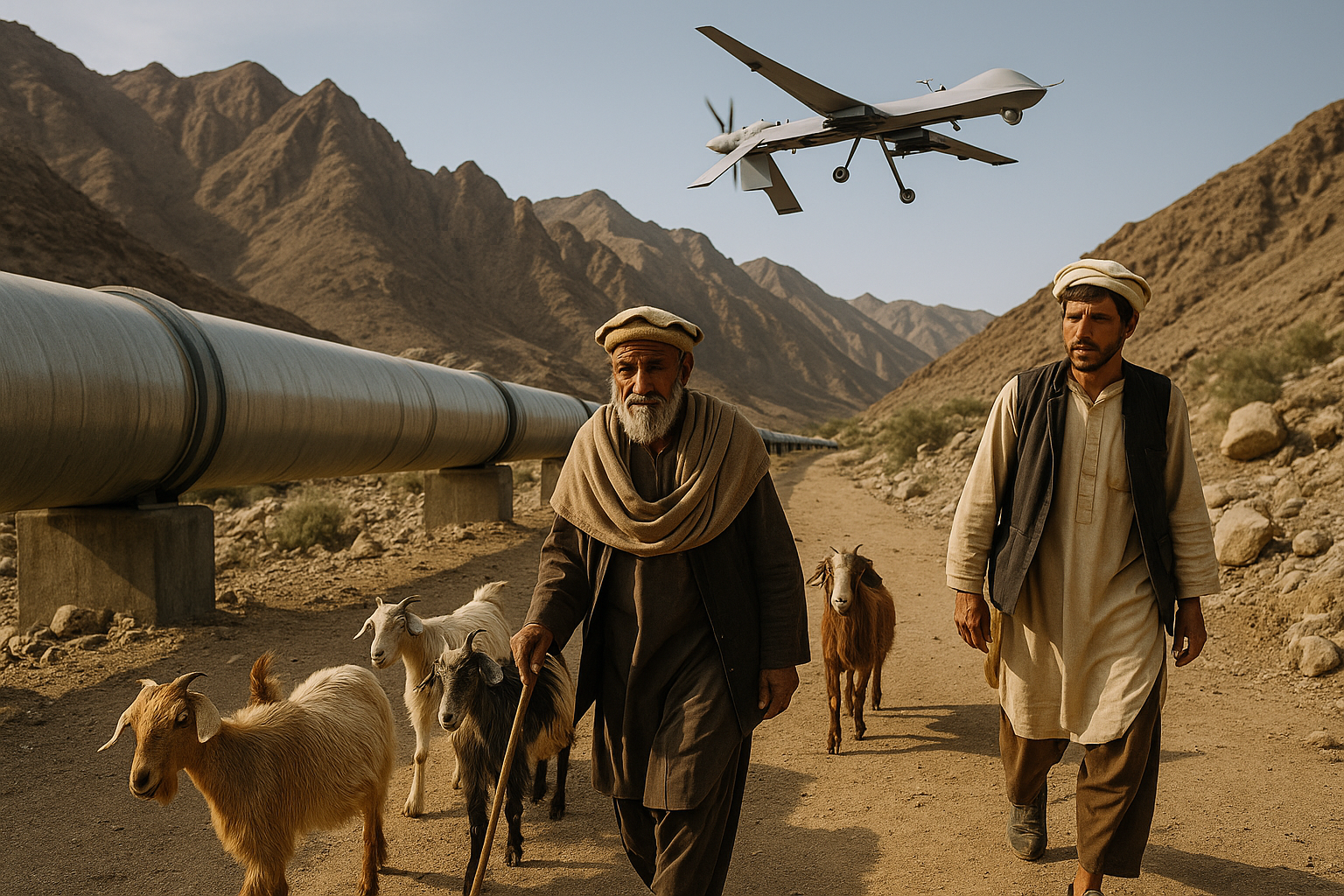
Beneath the silent gaze of drones and the shadow of a pipeline, Afghan herders walk a land claimed by empires but kept alive by their goats. The mountains remember everything.
Chevron Corporation, one of the world’s six “supermajor” oil companies, is headquartered in San Ramon, California. Operating in more than 180 countries, Chevron is involved in nearly every aspect of the energy industry: oil and gas exploration, refining, marketing, transportation, chemicals manufacturing, and power generation.
Chevron’s Environmental Footprint
In Ecuador, from 1965 to 1993, Chevron (then operating as Texaco) managed the Lago Agrio oil field. The company has faced long-standing legal action for widespread environmental destruction in the Amazon. A class action lawsuit filed on behalf of Amazonian communities resulted in a landmark $9.5 billion judgment by Ecuadorian courts—though Chevron has refused to pay, citing a previous agreement with the Ecuadorian government.
Read more on the Ecuador case.
In Richmond, California, Chevron’s refinery operations have been controversial due to over 304 industrial accidents and the release of more than 11 million pounds of toxic materials. In 1998, Chevron paid $540,000 in fines for bypassing wastewater treatments and failing to notify the public about toxic discharges. The company is also listed as potentially liable for 95 Superfund sites designated by the U.S. Environmental Protection Agency.
EPA Superfund Program.
In Angola, Chevron’s environmental practices led to the country levying its first-ever environmental fine on a multinational corporation. In 2002, the Angolan government fined Chevron $2 million for oil spills off its coast.
Chevron fined in Angola.
In California, Chevron also settled a federal Clean Air Act violation in 2003. As part of a consent decree, the company paid a $6 million fine and agreed to spend $275 million on emissions controls to reduce nitrogen and sulfur dioxide pollutants.
DOJ press release on Chevron settlement
Rice, Chevron, and the Bush Administration
Former Secretary of State Condoleezza Rice served on Chevron’s board of directors from 1991 until January 15, 2001, when she left to join the Bush administration. During her tenure, she chaired the company’s public policy committee. Her connection to Chevron was so prominent that the company named a 129,000-ton oil tanker the Condoleezza Rice. The ship was later renamed Altair amid public backlash over oil ties in the Bush Cabinet.
Chevron removes Rice’s name from tanker.
Who Is Hamid Karzai?
Who Is Hamid Karzai?
Before rising to power in post-Taliban Afghanistan, Hamid Karzai worked as a consultant for UNOCAL Corporation, a California-based petroleum company negotiating with the Taliban during the 1990s to construct the Central Asia Gas Pipeline (CentGas). The proposed pipeline would have run from Turkmenistan through western Afghanistan into Pakistan.
UNOCAL pipeline history.
Karzai, a member of the Durrani Pashtun tribe and long-time CIA contact, was seen as a key liaison between the Taliban and U.S. oil interests. He worked closely with top CIA officials and Pakistani intelligence (ISI), and eventually relocated to the United States under CIA protection.
Despite UNOCAL’s official claim to have abandoned the project in 1998, reports indicate that the pipeline remained a high strategic priority. Meetings between U.S., Pakistani, and Taliban officials continued into the early 2000s. U.S. Ambassador to Pakistan Wendy Chamberlain, with known ties to the Saudi ambassador (a financial backer of the Taliban), advocated aggressively for the construction of a Pakistani oil terminus on the Arabian Sea.
Washington Post coverage.
Meanwhile, President George W. Bush asserted that U.S. troops would remain in Afghanistan indefinitely. While NATO allies handled peacekeeping, U.S. forces were often assigned to guard pipeline construction corridors.
The Haq Assassination and CIA Strategy
Karzai’s loyalty to U.S. energy interests was a key reason why the CIA backed him over rivals like Abdul Haq, a respected mujahideen commander from Jalalabad and member of the Northern Alliance. Haq was popular among various Afghan ethnic groups, but he lacked ties to the oil industry.
In October 2001, Haq reentered Afghanistan but was quickly captured and executed by Taliban forces. Some observers in Pakistan believe the CIA, through the ISI, may have tipped off the Taliban. Former Reagan adviser Robert McFarlane, who attempted to coordinate a rescue, later said the agency’s response was too slow to be effective.
Time Magazine: The Betrayal of Abdul Haq.
Ambushed with his small escort in a high mountain pass south of Kabul, Haq had called McFarlane for help. McFarlane said he had alerted the CIA. “The CIA did not perform,” McFarlane went on, although administration officials said that the agency had sent an unmanned Predator drone aircraft that fired a missile at a nearby Taliban convoy.
Khalilzad, Enron, and Cheney’s Grand Oil Plan
Karzai worked closely with Zalmay Khalilzad, a fellow Pashtun and former UNOCAL consultant, who served as a special liaison to the Taliban regime. Khalilzad conducted risk analysis for CentGas and worked for RAND Corporation and the Bush administration.
Meanwhile, Enron Corporation, one of the Bush campaign’s biggest contributors, conducted the feasibility study for the CentGas project. Vice President Dick Cheney held multiple closed-door meetings with Enron executives, including CEO Kenneth Lay, as part of his now-infamous Energy Task Force.
Terrorists vs Criminals – Just An Opinion
Posted on February 18, 2012 by Marivel Guzman
Who are The Terrorists? – Who are the Criminals?
In small countries or third world countries the corruption is rampant, disproportionate and selective.
You find corruption in every level of society, but the more damaging is the Government Corruption.
The bribes are every day offered and accepted for the more minimal services and the big bribes are common in the upper levels of Government, being to acquire a good position in a bureaucratic job, tor get government juicy contracts, off course on that the Western rich countries champion the the little poor countries (Halliburton and Black water come to mind)
These can be considered small crimes, but the BIG Crimes are being committed between Countries, on the top executive levels of power.
These Criminal Enterprises are committing unspeakable terrorists acts to inflict fear, these shadow entities are deep nested inside the government apparatus, financed by powerful lobbyists firms that serve various branches of the International Cartel of Banksters and War Complex Machine, all under the umbrella of the government they serve.
Every one is using the term “terrorist” very loose, since Bush and Company started their “War in Terror”, the whole world have jumped into the terror wagon rhetoric speech, without realizing that every body have caught these infectious social diseases called “passive syndrome response and passive aggressive behavior”, where fear is used to generate a response to a premeditated event. The word TERROR, AND TERRORIST are the target words that generate the behavior expected by the planners of the program.
A criminal person is not precisely a terrorist, and a terrorist is not precisely a criminal person.
There is a significant distance between a person committing a simple crime and a terrorist committing a crime, even thought booth acts involving some amount of violence, not the two are the same.
A terror act is intended to inflict a psychological traumatic experience to the target individuals or group of individuals.
A criminal act is intended to terminate life, or to gain some personal or financial benefit from the act.
Now days the Governments are using this confusion to advance in the agendas set up by the entities that work under the secrecy and protected by the money they control.
Whole countries are being victims of their own government programs of control. In the US congress is in the dark of many operations carry out by the Department of Defense and its millitary private contractors which are mercenaries in every sense of the word.
The whole criminal code in many countries have been updated to fit their new mechanism of a global stage and to get rid of unwanted individuals, or to cripple their abilities to perform in society.
The cooperation between countries to “Fight Terrorism” is just a tool that have severed the sovereignty of many Nations.
The Globalists and its Agenda is moving to control the whole world, already divided like a pie in four regions; European Union, North American Union, African Union and Arab League of Nations.

 Akashma Online News