Archive
The Oil Connection to Afghanistan: Condoleezza Rice and Hamid Karzai
By Marivel Guzman | Akashma News
Originally published July 1, 2010 | Updated May 17, 2025|
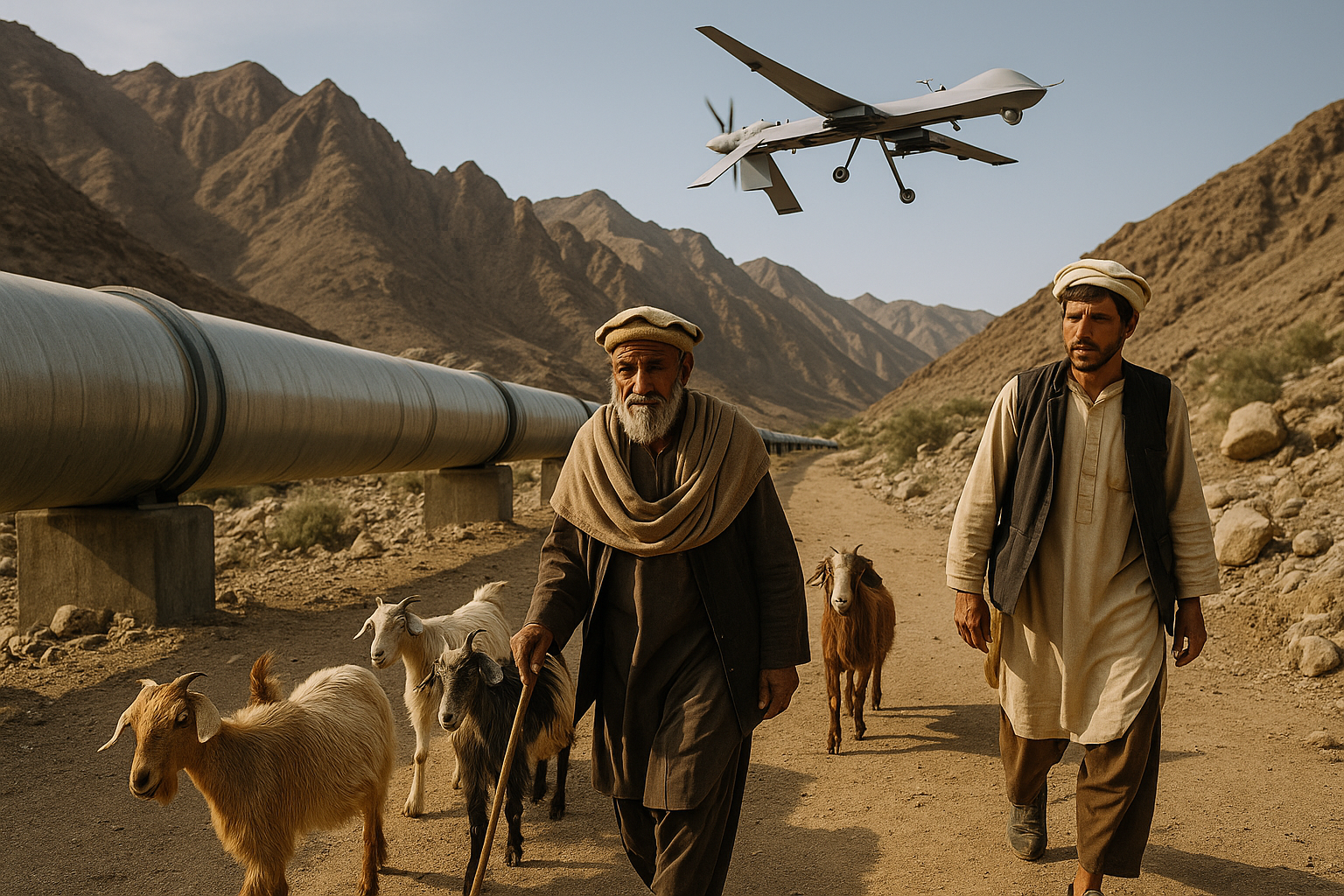
Beneath the silent gaze of drones and the shadow of a pipeline, Afghan herders walk a land claimed by empires but kept alive by their goats. The mountains remember everything.
Chevron Corporation, one of the world’s six “supermajor” oil companies, is headquartered in San Ramon, California. Operating in more than 180 countries, Chevron is involved in nearly every aspect of the energy industry: oil and gas exploration, refining, marketing, transportation, chemicals manufacturing, and power generation.
Chevron’s Environmental Footprint
In Ecuador, from 1965 to 1993, Chevron (then operating as Texaco) managed the Lago Agrio oil field. The company has faced long-standing legal action for widespread environmental destruction in the Amazon. A class action lawsuit filed on behalf of Amazonian communities resulted in a landmark $9.5 billion judgment by Ecuadorian courts—though Chevron has refused to pay, citing a previous agreement with the Ecuadorian government.
Read more on the Ecuador case.
In Richmond, California, Chevron’s refinery operations have been controversial due to over 304 industrial accidents and the release of more than 11 million pounds of toxic materials. In 1998, Chevron paid $540,000 in fines for bypassing wastewater treatments and failing to notify the public about toxic discharges. The company is also listed as potentially liable for 95 Superfund sites designated by the U.S. Environmental Protection Agency.
EPA Superfund Program.
In Angola, Chevron’s environmental practices led to the country levying its first-ever environmental fine on a multinational corporation. In 2002, the Angolan government fined Chevron $2 million for oil spills off its coast.
Chevron fined in Angola.
In California, Chevron also settled a federal Clean Air Act violation in 2003. As part of a consent decree, the company paid a $6 million fine and agreed to spend $275 million on emissions controls to reduce nitrogen and sulfur dioxide pollutants.
DOJ press release on Chevron settlement
Rice, Chevron, and the Bush Administration
Former Secretary of State Condoleezza Rice served on Chevron’s board of directors from 1991 until January 15, 2001, when she left to join the Bush administration. During her tenure, she chaired the company’s public policy committee. Her connection to Chevron was so prominent that the company named a 129,000-ton oil tanker the Condoleezza Rice. The ship was later renamed Altair amid public backlash over oil ties in the Bush Cabinet.
Chevron removes Rice’s name from tanker.
Who Is Hamid Karzai?
Who Is Hamid Karzai?
Before rising to power in post-Taliban Afghanistan, Hamid Karzai worked as a consultant for UNOCAL Corporation, a California-based petroleum company negotiating with the Taliban during the 1990s to construct the Central Asia Gas Pipeline (CentGas). The proposed pipeline would have run from Turkmenistan through western Afghanistan into Pakistan.
UNOCAL pipeline history.
Karzai, a member of the Durrani Pashtun tribe and long-time CIA contact, was seen as a key liaison between the Taliban and U.S. oil interests. He worked closely with top CIA officials and Pakistani intelligence (ISI), and eventually relocated to the United States under CIA protection.
Despite UNOCAL’s official claim to have abandoned the project in 1998, reports indicate that the pipeline remained a high strategic priority. Meetings between U.S., Pakistani, and Taliban officials continued into the early 2000s. U.S. Ambassador to Pakistan Wendy Chamberlain, with known ties to the Saudi ambassador (a financial backer of the Taliban), advocated aggressively for the construction of a Pakistani oil terminus on the Arabian Sea.
Washington Post coverage.
Meanwhile, President George W. Bush asserted that U.S. troops would remain in Afghanistan indefinitely. While NATO allies handled peacekeeping, U.S. forces were often assigned to guard pipeline construction corridors.
The Haq Assassination and CIA Strategy
Karzai’s loyalty to U.S. energy interests was a key reason why the CIA backed him over rivals like Abdul Haq, a respected mujahideen commander from Jalalabad and member of the Northern Alliance. Haq was popular among various Afghan ethnic groups, but he lacked ties to the oil industry.
In October 2001, Haq reentered Afghanistan but was quickly captured and executed by Taliban forces. Some observers in Pakistan believe the CIA, through the ISI, may have tipped off the Taliban. Former Reagan adviser Robert McFarlane, who attempted to coordinate a rescue, later said the agency’s response was too slow to be effective.
Time Magazine: The Betrayal of Abdul Haq.
Ambushed with his small escort in a high mountain pass south of Kabul, Haq had called McFarlane for help. McFarlane said he had alerted the CIA. “The CIA did not perform,” McFarlane went on, although administration officials said that the agency had sent an unmanned Predator drone aircraft that fired a missile at a nearby Taliban convoy.
Khalilzad, Enron, and Cheney’s Grand Oil Plan
Karzai worked closely with Zalmay Khalilzad, a fellow Pashtun and former UNOCAL consultant, who served as a special liaison to the Taliban regime. Khalilzad conducted risk analysis for CentGas and worked for RAND Corporation and the Bush administration.
Meanwhile, Enron Corporation, one of the Bush campaign’s biggest contributors, conducted the feasibility study for the CentGas project. Vice President Dick Cheney held multiple closed-door meetings with Enron executives, including CEO Kenneth Lay, as part of his now-infamous Energy Task Force.
Can Floods Lead to Taliban Resurgence
Can Floods Lead to Taliban Resurgence
By Sajjad Shaukat On the onset, let me correct it that there are no Taliban in Pakistan, all that we are facing are criminals and terrorists pushed in here by Indo-Israeli network operating in Afghanistan. The western media who are under Zionist control have labeled them as Taliban only to defame this name that we use for students. It is highly objectionable to brand the criminals as Taliban. If this be the case then every student would be taken to be a terrorist then where would we educate our children and what would we call them? But for the sake of this paper I will refer them to as Taliban though they are not.
Pakistan has made numerous protests to the US and NATO command in Afghanistan to reign them in but to no avail.
The recent floods in Pakistan have provided a new level of devastation, especially in the province of Khyber Pakhtunkhwa where more than 4 million people have been affected by this natural disaster. The emerging landscape in areas where the water has receded is one in which bridges, roads, schools, health clinics, power facilities and sewage systems have been ruined or seriously damaged.
While Pakistan’s high officials and foreign media said that overall impact of the floods now exceeds that of the 2005 Kashmir earthquake, but at the same time some foreign media has started a propaganda campaign that by availing the opportunity, the Taliban can again return and organise themselves. They are likely to get the sympathies of the flood-affected people.
In this connection, under the caption, ‘Flooding’s devastation in Pakistan is seen as opportunity for Taliban’, The Washington Post reported on August 9, 2010: “The slow-motion disaster underway in Pakistan as floodwaters seep into virtually every corner of the nation has devastated basic infrastructure and could open the door to a Taliban resurgence.”
The Post further elaborated, “Over the past year, Pakistan’s army has succeeded in driving Taliban fighters
out of key
sanctuaries in South Waziristan and the Swat Valley. But the damage from the floods could jeopardize those gains, unless infrastructure is quickly rebuilt—an undertaking that will cost billions of dollars and will probably take years.”
However, it is misperception of The Washington Post including other western media as the fact of the matter is that the flood in Pakistan cannot lead to the Taliban resurgence. In this context, army officials are of the opinion that they are aware that the Taliban could try to seize the opportunity but they will not let that happen. Brig. Gen. Tippu Karim, who is overseeing relief efforts for Swat and other northwestern areas made it clear saying: “We have not let down our guard. The safeguards are still in place… reconstruction will be the top priority as soon as Pakistan can get past the immediate challenge of rescuing stranded residents and providing them with food and shelter.”
These floods have diminished the propaganda of the west and the militants against Pakistan, because Pakistan’s armed forces which are helping the flood victims round the clock and have visited various camps—focusing on evacuating people from flood affected areas, distributing food, water, medicine and conveying dead bodies. The relief efforts particularly addressed the Northern Areas, evacuating hundreds of stranded people every day. In this respect, Pak Army has been performing excellent services in the flood-affected areas, which include more water bottles, ready-to-eat meals and cartons of dry rations and boats. Apart from army, Pakistan Air Force helicopters besides evacuation and distribution also delivered medical staff and medicine. PAF has continued the relief operations in the flood affected areas of the country. The entire C-130 fleet along with helicopters is engaged in flood relief operations.
Pakistani navy boats spread across miles of flood waters as the military took a lead role in rescuing survivors from a devastating disaster
It is mentionable that the Pakistan military which had played a dominant role during natural disasters such as in the earthquake of 2005 has come to the fore during the present floods.
It is notable that our army which has already broken the backbone of the Taliban in Buner, Swat, Dir, South Waziristan and other tribal agencies through successful military operations is now busy in fighting Taliban insurgents in some areas. Despite its engagement in a different war, Pak Army has been performing a remarkable job in the regions which have been affected by the floods.
The women and men from troubled areas have highly appreciated all Pakistan’s armed forces, saying that they are saving them. Besides, various leaders of the civil society, political parties and media of our country including the general masses have also immensely praised the positive role of Pak Army in connection with the areas affected by the floods.
Islamic charities including ones that are known fronts for banned militant groups have also begun distributing assistance in some areas, as have western nongovernmental organizations. But for the most part, residents said they are receiving no aid at all from these entities.
It is of particular attention that more than 10 million people have been affected by the present floods. And billions of dollars are needed to rehabilitate the homeless people, reconstruction of roads, bridges, schools, hospitals and other infrastructure, while being a developing country, Pakistan government lacks resources in this regard. This fact has also been realized by the United Nations Organisation which recently revealed that destruction caused by the floods in Pakistan is more than that of the tsunami.
There is no doubt that although some countries, particularly the United States have provided aid to Pakistan in relation to the flood-affected areas, yet it is not enough and they have only fulfilled formality in this respect. For example, the US military has sent six helicopters, 91 troops and hundreds of thousands of meals from neighboring Afghanistan to help with relief efforts in Swat. In fact, each district which was cut off from the others, where the communications networks were jammed and where local roads were destroyed needs much help. Thousands of displaced villagers are still waiting for aid.
As regards the resurgence of the Taliban, the current army leadership is very clear that there is a war that needs to be waged. If Pakistan’s armed forces leave the flood victims to their fate and if the only saviors for them are charity funds of terrorist organisations then there could be chances of Talibans’ return. And sooner than later, these organisations can start recruiting some of them into their ranks. But quick action by our defence forces has diminished the prospects of Talibans’ resurgence. Besides, people of the affected areas know very well that criminal activities of the Taliban militants such as kidnappings, beheadings, car-snatchings etc. had made life miserable. They wanted to impose their own self-style system of Shariah which was quite opposite to the real Islamic values. Hence, people have no sympathy for the Taliban and they do not favour return of these militants.
Now the right hour has come that setting asides politics and without waiting for foreign aid—by recognising the scale of disaster and suffering which is so huge, we must donate and help the flood victims.
Sajjad Shaukat writes on international affairs and is author of the book: US vs Islamic Militants, Invisible Balance of Power: Dangerous Shift in International Relations

 Akashma Online News