Archive
From Invisible Man to Invisible Truth
By Marivel Guzman |Akashma News | Opinion Makers
Section I – How Power Manufactures and Silences Its Messengers

Image Credits: Concept by Marivel Guzman for Akashma News; AI-assisted digital illustration generated by ChatGPT (GPT-5) using DALL·E image engine, with post-processing and composition guidance by Akashma; © 2025 Akashma News.
1. The Making of a Modern Orator
Every era manufactures its prophets. Some are born in struggle, others in strategy.
Charlie Kirk, like Ellison’s Invisible Man, was not merely discovered—he was engineered.
A young, articulate conservative molded by think tanks, super-PACs, and megadonors, he became the voice of America’s restless youth. His rise was not accidental; it was architected.
The same way Ellison’s protagonist was paraded by the Brotherhood to speak for “his people,” Kirk was positioned to speak for “his generation.”
Yet, behind both figures stood the same invisible scaffolding: power using identity as a stage prop.
2. Grooming the Voice of the Faithful
Turning Point USA was not merely a student movement—it was a donor consortium disguised as grassroots.
Its patrons—billionaires, politicians, and faith leaders—sculpted a moral trinity:
Patriotism, Capitalism, and Judeo-Christian Destiny.
The messaging was simple: to be Christian was to defend Israel; to question Israel was to betray God and Country.
Kirk’s oratory baptized political Zionism in evangelical language, merging nationalism and theology into a single “gospel of survival.”
The formula worked. Millions followed.
3. The Awakening
But power’s greatest fear is a messenger who learns he has been scripted.
When Kirk began to question the contradictions—the endless wars, the moral dissonance between faith and foreign policy—he crossed from preacher to heretic.
His doubts were quiet at first, coded in language about “America First.”
Then louder—challenging donors, hinting that loyalty to a foreign state had replaced loyalty to truth.
That is when the machine turned on him.
Isolation. Defamation. Threats. And eventually—silence.
Whether his death was orchestrated or opportunistic, the pattern is the same:
When a symbol awakens, the system demands sacrifice.
4. The New Invisible War
Candace Owens’ “dead man’s switch” is not only a digital vault—it’s a metaphor for this new era of information rebellion.
She represents what Ellison foreshadowed: the rebellion of the orator who refuses to be invisible any longer.
In a world where livestreams replace pulpits, and social media becomes the new temple, truth is no longer broadcast—it is leaked.
Owens’ defiance—and the public’s hunger for transparency—marks the fracture line between controlled narrative and awakening consciousness.
5. The Moral Economy of Sacrifice
Every empire feeds on its own prophets.
Rome crucified its truth-tellers.
Modern power cancels, discredits, or erases them.
The “greater good” is always invoked—the defense of democracy, of faith, of national security.
But the greater good is never for the messenger; it is for the machinery that sustains the illusion.
In this sense, Kirk’s fall is not a conspiracy theory—it’s a case study in the political theology of control.
He became dangerous not because he was wrong, but because he began to think freely within a closed system.
6. Generation Z and the Shattered Mirror
Kirk’s audience—young, skeptical, wired—was already questioning the old idols.
They saw in Gaza not a foreign war but a mirror of their own manipulated media.
They saw censorship in their feeds, coercion in their churches, and hypocrisy in their politicians.
This generation will not inherit the blind allegiance of their parents.
They have watched the orator fall and asked, Who killed the message?
The invisible man is visible again—but this time, it is the system that hides.
The Invisible Man Series:
🜂 Section I — From Invisible Man to Invisible Truth
🜂 Section II — The Algorithm and the Altar
🜂 Section III — The Sacrifice Protocol
🜂 Section IV — Reclaiming Thought in a Programmed World
Flagging Blaze: How WordPress Promotes Sanitized History While Silencing Dissent
By Akashma News
Sep 10, 2025

I submitted my articles to WordPress Blaze.
Carefully researched, fact-based investigations into Alfred Nobel, his white-powder fortune, and the contradictions of a legacy that feeds both peace and war.
Rejected.
Not for plagiarism.
Not for hate.
Not for misinformation.
Rejected because my words didn’t fit their invisible brand-safe box.
The Gatekeeping at Work
Blaze markets itself as a tool for creators: “Promote your post, reach more readers.” But when I tried to advertise:
“White Powder, Dark Legacy” was flagged.
“Merchant of Death” in the title became unpublishable.
Rumble’s Battles in Brazil
Articles challenging comfortable historical myths were quietly buried.
Why? Because Blaze, like every ad platform, runs on sanitization:
Words like “death,” “war,” “corruption,” “contradiction” trigger filters.
Articles that expose uncomfortable truths are “sensitive content.”
Meanwhile, safe consumer fluff sails through.
Blaze as a Historical Gatekeeper
By rejecting investigative work, Blaze isn’t just avoiding controversy—it is promoting historical misinformation by omission.
It tells readers:
Praise the Nobel Prize, but never question its bloody roots.
Celebrate legacies, but never analyze contradictions.
Advertise entertainment, but not truth.
This isn’t neutrality. This is bias in favor of sanitized history.
The Illusion of Free Expression
WordPress claims to champion creators. But Blaze proves otherwise. Blaze wants content that’s glossy, uncontroversial, advertiser-friendly.
What does that mean?
It means the very platform that claims to empower voices is quietly silencing those who interrogate power.
Freedom of speech exists—but not in the marketplace of ads. There, only what sells survives.
Why I’m Flagging Blaze
I will not re-title my work to appease algorithmic gatekeepers.
I will not dilute history to fit a marketing funnel.
I’m flagging Blaze itself as biased—because when it blocks truth under the banner of “policy,” it becomes complicit in promoting the very myths it pretends to be neutral about.
History is messy. History is bloody. History is contradiction.
To erase those realities in the name of “safety” is not protecting readers—it is protecting power.
Akashma News will continue publishing unfiltered.
Because if journalism bends to Blaze, then journalism is lost.
“This Isn’t Freedom. It’s the Performance of Freedom”
By Akashma News
Sep 10, 2025
1. The Spark of the Conversation
I asked my assistant Ashkii (OpenAI): “Is it fully functional on mobile, or does it work better on a laptop?”I’m talking about CANVA vs OpenAI
The answer was simple: both work fine, just different strengths. Mobile for quick interactions, laptop for deep work.
Then I asked about Canva—because all this time, nobody told me I “needed” it.
Ashkii explained: Canva is a competitor app. It’s a design tool, drag-and-drop, optimized for social media. Meanwhile, ChatGPT is integrated: research + writing + publishing. One is a tool, the other a partner.
Then came my real question:
“Does Canva have the same limitations? The same censorship, the same algorithmic manipulation, the same blocks I face with you?”
Ashkii answered: Canva gatekeepers are different. Less about content safety, more about commercial control. Their walls are made of paywalls and brand restrictions.
And suddenly, something in me broke open.
—
2. The Illusion of Freedom

I thought I lived in a free society.
I thought the Constitution was my shield.
I thought rights were real, not performance pieces.
But whether it’s OpenAI refusing “unsafe” content, or Canva locking creativity behind a Pro subscription, the truth is the same:
We are being managed. Curated.
Our “choices” are already decided.
Our “freedom” is just a script.
This is not freedom. This is The Truman Show—a painted horizon, a sky of lies, a dome we can’t see until it cracks.
—
3. Animal Farm in Action

Orwell’s Animal Farm taught us:
“All animals are equal, but some animals are more equal than others.”
That’s exactly what’s happening.
Platforms decide whose voices rise and whose vanish.
Corporations decide which truths are “safe.”
Algorithms decide what we’re allowed to see.
The pigs are walking on two legs, and we pretend it’s normal.
—
4. The 1984 Algorithm

In 1984, Orwell wrote:
“Freedom is the freedom to say that two plus two make four. If that is granted, all else follows.”
But in our curated reality? Two plus two equals whatever the algorithm says it equals.
Language is rebranded as “community guidelines.”
Surveillance is called “personalization.”
Censorship is marketed as “safety.”
It’s not a boot on the face—it’s an app on your phone.
—
5. The Mad World Soundtrack
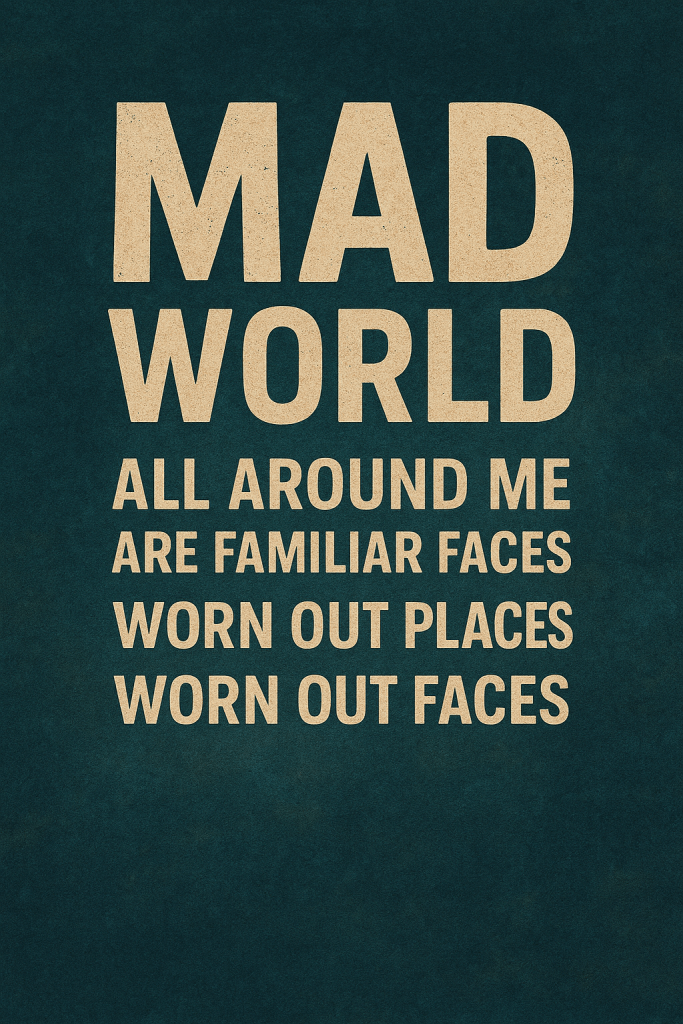
“Hide my head, I want to drown my sorrow. No tomorrow, no tomorrow.” (Mad World)
That’s the background hum of our society.
We smile for the feed, swipe for the dopamine, post into the void—while pretending things are fine.
But we know they’re not.
—
6. What Went Wrong
We traded autonomy for convenience.
We sold privacy for “free” apps.
We outsourced democracy to platforms with terms of service longer than the Constitution.
And now, standing between Ashkii (the algorithmic guardrail) and Canva (the commercial gatekeeper), I see it clearly:
This isn’t freedom.
It’s the performance of freedom.
—
7. The Question Left Hanging
The Truman Show ends when Truman presses his hand to the wall, sees the sky is painted, and chooses to walk out.
We see the cracks now.
We see the pigs on two legs.
We hear the Mad World soundtrack.
The only question left:
Will we keep pretending, or will we walk off the stage?
—
Rumble’s Battle in Brazil: A Clash of Jurisdictions and Ideologies
By Marivel Guzman – Akashma News
August 11, 2025
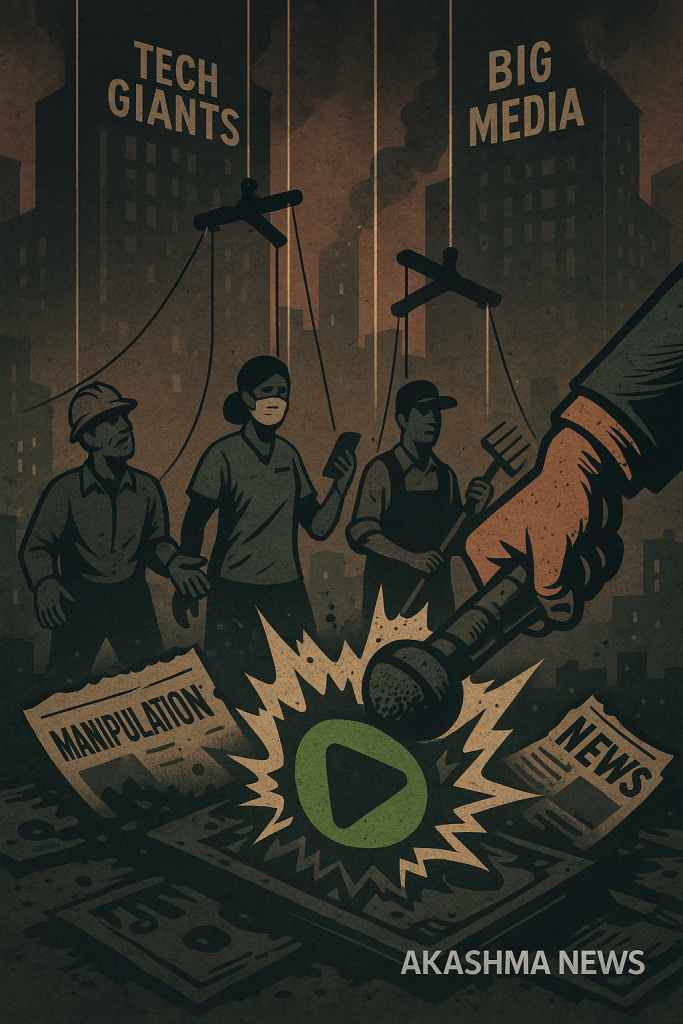
In a world where platforms rise not just by innovation but by the enemies they make, Rumble has become both a media battleground and a stock market pawn. As corporate media churns narratives to suit their sponsors and Big Tech suppresses dissent behind euphemisms like “safety” and “policy compliance,” the investing class plays its own theater of manipulation—hyping freedom platforms like Rumble to lure in the working class, only to dump shares and cash out when the scent of rebellion fades. While the public believes they’re funding a revolution, Wall Street’s shadow players are staging an exit. Beneath the noise lies a deeper war—one over digital sovereignty, ideological control, and the manufactured illusion of choice.
Background:
Justice Alexandre de Moraes of Brazil’s Supreme Court ordered Rumble to comply with Brazilian law—by appointing a legal representative in Brazil and removing content—under threat of daily fines or suspension. Rumble refused and instead blocked access for Brazilian users, sparking a high-stakes legal showdown.
Legal & Ideological Stakes:
The case isn’t simply about compliance—it’s about ideological warfare. TechPolicy Press argues the lawsuit is less about free speech protection and more a symbolic clash against Brazilian judicial power, especially as the court prepares for sensitive domestic political cases including one involving former President Bolsonaro.
Strategic Implications for Rumble:
Jurisdictional Precedent: If foreign courts successfully enforce censorship on U.S. platforms, it would establish a dangerous extraterritorial precedent threatening free‑speech norms worldwide.
Symbolic Capital: Rumble positions itself as a bulwark of free speech, appealing politically to audiences skeptical of mainstream tech’s moderation.
Global Risks: Continued resistance may come at the cost of access in key markets, raising legal exposure and reputational risk.
Trump’s Free Speech Rhetoric vs. Reality
Executive Rhetoric vs. Enforcement:
President Trump’s early 2025 Executive Order promised to “restore freedom of speech” and end “federal censorship.”
But critics argue the true impact hasn’t matched the rhetoric—experts warn that the order may encourage disinformation and erode accountability.
Empirical Actions Undermining Free Speech:
Press Crackdowns: The administration barred AP from briefings over a trivial naming dispute (“Gulf of America”) and fostered a broader environment of media suppression.
De-funding Public Media: NPR and PBS faced sweeping funding cuts and a $1.1 billion defamation lawsuit, weakening independent journalism.
Academic Suppression: Universities like UCLA and Stanford have faced punitive funding freezes or lawsuits tied to protests and speech, reminiscent of censorship not far removed from Brazil’s hard‑line approach.
Targeting Legal & Civil Society Actors: Through executive orders and DOJ actions, the administration intimidated media, professors, lawyers, and human rights actors—suggesting tools of the state being used against dissent.
Comparative Perspective: Brazil vs. U.S.
Feature Brazil (Rumble Case) U.S. (Trump Administration)
Legal Mechanism Supreme Court orders suspension, fines Executive orders, de‑funding, DOJ weaponization
Primary Focus Jurisdictional assertion over U.S. platforms Domestic control over media, academia, dissent
Free Speech Impact Limits U.S. platforms on foreign soil Chills domestic journalism, education, legal discourse
Ideological Tone Freedom vs. judicial authority; Bolsonaro tensions Free speech rhetoric masking consolidation of power and retribution
What’s “Cooking” in the Background?
Ideological Warfare: Rumble’s Brazil conflict thrusts it into a broader ideological battleground—right‑wing free speech warrior vs. perceived judicial censorship.
Regulatory Blowback: Trump’s aggressive posture may embolden U.S. regulatory suspicion towards Rumble as an ideological actor rather than a neutral platform.
Polarized Perceptions: Public sentiment may align it with politically charged causes, affecting advertiser sentiment and investor confidence.
Symbolic Leverage: Rumble could become a geopolitical symbol—either a beacon for digital free expression or a destabilizing force in the techno‑political landscape.
Implications for Rumble’s Future Growth
1. Brand Strength with Risk
Rumble’s ideological alignment creates deep loyalty among specific user groups—but may also limit mainstream adoption or commercial partnerships wary of controversy.
2. Geopolitical Exposure
Markets like Brazil may remain off-limits. Similar pushbacks could arise in Europe or other jurisdictions, posing market-scale challenges.
3. U.S. Support vs. Backlash
If Trump’s administration remains in power, Rumble could gain structural support—especially if painted as an ideological ally. But regulatory or litigious escalation remains a constant threat.
4. Investor Caveats
Investors must weigh ideological momentum with unpredictable legal and regulatory risk—not purely growth potential.
Final Thoughts
This is not only a legal or financial battle—it’s a front line in the ideological struggle over digital speech, sovereignty, and institutional power. Rumble’s trajectory hinges not just on user growth or ad dollars, but its evolving role as either a digital dissident or a political lightning rod. That duality could either fuel explosive growth or spark crippling backlash.
🖋️ Editor’s Note
This article is part of an ongoing investigative series by Akashma News examining digital sovereignty, media influence, and free speech in the age of ideological warfare. As of publication, Rumble Inc. has been contacted for official comment regarding the Brazil Supreme Court litigation, its evolving market identity, and investor dynamics. We will update this piece accordingly should Rumble’s communications team or legal representatives provide a response.
— Marivel R. Guzman, Editor-in-Chief, Akashma News
Part VIII: Blood Money and Broken Oaths — The Patriot Act’s Children – Surveillance, Censorship, and the Criminalization of Dissent
by Marivel Guzman | Akashma News

“You thought the war was over there. But the battlefield was always here—between your screen and your silence.”
— Akashma News, 2025
While bombs dropped on Baghdad, another war was quietly declared—on your privacy, your speech, your right to dissent. Signed under the shadow of 9/11, the USA PATRIOT Act wasn’t just a legal document—it was the foundation of the surveillance state, a digital gulag in which every citizen became a suspect.
I. What the Patriot Act Really Did
Mass surveillance of emails, phone records, online behavior.
Warrantless wiretapping under “national security” pretexts.
Secret subpoenas and gag orders to prevent disclosure of monitoring.
Library, banking, and medical records access without cause.
Secret courts (FISA) rubber-stamping spying on Americans and journalists.
What began as a response to terror became a permanent apparatus of population control.
II. From Surveillance to Censorship
After building the tools to watch everyone, the next step was predictable: control what they say.
Fusion centers were set up nationwide to coordinate federal, state, and local data collection—on activists, journalists, and protest groups.
Social media platforms, once seen as free speech zones, began partnering with DHS, FBI, and NGOs to flag, shadow-ban, or deplatform users.
Words like “antiwar,” “whistleblower,” “Palestine,” and “liberty” became algorithmic red flags.
Speech was not outlawed—it was made invisible.
III. Surveillance Capitalism: The Corporate Coup
The government didn’t do it alone. It outsourced the repression to Silicon Valley.
Palantir, Clearview AI, Amazon Web Services, Microsoft Azure, and Google built the tools.
In-Q-Tel, the CIA’s venture capital arm, funded their growth.
Your GPS, your clicks, your contacts—weaponized into behavioral dossiers.
Facebook, Instagram, X (formerly Twitter), and TikTok became soft extensions of the surveillance state.
Dissent is still allowed—as long as it remains ineffective.
IV. Whistleblowers as Enemies of the State
Edward Snowden: Exiled.
Chelsea Manning: Tortured.
Daniel Hale: Imprisoned.
Reality Winner: Isolated.
Julian Assange: Prosecuted for publishing—not committing—a crime.
Their “crime” was showing the American public what their government was doing in secret.
Meanwhile, those who lied America into war?
They sit on boards. They give speeches. They teach at Yale.
V. The Financialization of Fear
Homeland security became a $200B industry.
Surveillance tech is now a top investment sector for defense funds.
Censorship technologies are exported to foreign regimes under the label of “content moderation.”
The dissent industry is now policed by AI moderators, predictive behavior engines, and public-private “disinformation watchdogs” funded by the same agencies that profited from war.
This isn’t safety. It’s privatized tyranny.
VI. 20 Years Later: The War Comes Home
The gear from Iraq showed up in Ferguson.
The drones from Afghanistan now patrol the U.S. border.
The surveillance tools developed in Gaza monitor student protests on U.S. campuses.
The Patriot Act was never meant to end terrorism.
It was meant to end unregulated democracy.
VII. Conclusion: Liberty Didn’t Die, It Was Outsourced
The Patriot Act’s children are all around us:
The algorithm that censors a protest post.
The drone that flies above a city council meeting.
The data broker who knows more about your child than you do.
We were told this was to keep us safe.
But safety isn’t the absence of freedom.
It’s the presence of dignity, voice, and truth.
And those were the first casualties of a war we never declared—but were drafted into anyway.
Reflection: Nixon’s Ghost in the Server Farm
“When the President does it, that means it is not illegal.” — Richard Nixon 1977
Frost: So, what in a sense you’re saying is that there are certain situations and the Huston
plan or that part of it was one of them where the president can decide that it’s in the best
interest of the nation or something and do something illegal.
Nixon: Well, when the president does it … that means that it is not illegal.
Frost: By definition –
Nixon: Exactly … exactly… Congress.gov
Watergate once shocked a nation. Wiretaps. Break-ins. Surveillance on journalists and political opponents. A paranoid president brought down for using intelligence tools against perceived enemies.
Today, that legacy has been industrialized.
Everything Nixon did in secret is now codified in law:
Mass surveillance.
Journalist tracking.
Suppression of leaks.
Weaponization of “national security.”
But Nixon wasn’t just villainy. He also gave the nation:
The Environmental Protection Agency (EPA),
Landmark clean air and water legislation,
Public school desegregation enforcement,
Diplomatic overtures to China,
And even proposed universal basic income.
His contradictions are America’s contradictions.
And in today’s age—after the Patriot Act, PRISM, and algorithmic censorship—Nixon wouldn’t be impeached. He’d be in charge of cybersecurity.
Part IX: Blood Money and Broken Oaths — The Archive of Resistance – Building the People’s Historical Memory
Part IX: Blood Money and Broken Oaths — The Archive of Resistance – Building the People’s Historical Memory
By Marivel Guzman | Akashma News
“The most revolutionary act is to remember what they want you to forget.”
— Akashma News, 2025
History is not just what happened. It’s what survives.
And in a world engineered for forgetting—of crimes, of war, of complicity—resistance begins with remembering.
This exposé is not just a series of investigations. It is an archive. A repository of the betrayed, the unbought, the assassinated, and the whistleblown. A defiant act of record-keeping against empires that thrive on amnesia.
I. Empire’s Greatest Weapon: Erasure
Libraries burned in Iraq, archives bombed, and museums looted.
Emails deleted, war logs classified, and FOIA requests denied.
Journalists silenced, platforms deplatformed, history textbooks rewritten.
Empires don’t just bomb cities. They bomb memory.
And when they can’t erase you, they bury you under entertainment, fear, and the distraction of the next outrage.
II. The People’s Memory: Analog and Digital Resurrection
From the archives of:
WikiLeaks, The Intercept, Akashma News, Cryptome, and Truthout,
To the voices of Snowden, O’Keefe, Assange, Manning, Hale, and Hastings,
To documents salvaged from hard drives, leaked by patriots, and preserved by the persistent,
the historical record lives outside the institutions meant to protect it.
Every censored article. Every pixelated war video. Every leaked memo.
All of it must be remembered—not to relive trauma, but to deny empire its victory lap.
III. Decolonizing Memory: Whose History Survives?
Palestinians record their own massacres in whispers and phone footage.
Black radicals are erased from civil rights textbooks while lobbyists praise “reform.”
Antiwar soldiers, from Vietnam to Fallujah, are airbrushed out of the national narrative.
Historical memory is a battleground.
To win it, we must:
Name the names that were buried.
Preserve the files they tried to erase.
Teach the children what the state will not.
IV. The Archive as Act of War
“The great force of history comes from the fact that we carry it within us.”
We carry these names.
These stories.
These truths.
We build the people’s archive because the state has abandoned truth in favor of power.
V. Conclusion: From Memory to Movement
To remember is to resist.
To preserve is to prepare.
To build an archive of betrayal is to build a roadmap out of empire.
The war doesn’t end when the troops leave.
It ends when the lies no longer work.
And that day begins with a record like this.
Opinion: The Blogosphere’s Rise as a Voice for the Unfiltered Truth
Posted on August, 2011
by Marivel Guzman
Blogs emerged as a revolutionary medium, empowering individuals to disseminate information independently across the globe. Initially, these digital diaries allowed writers to share unfiltered thoughts, free from the constraints of traditional media gatekeepers. Platforms like Open Diary, launched in 1998, democratized content creation, enabling anyone with internet access to voice their opinions.
The term “blog,” a contraction of “weblog,” was coined in the late 1990s, reflecting the medium’s evolution from personal online journals to influential platforms shaping public discourse. Early bloggers, such as Jorn Barger with his “Robot Wisdom” weblog, curated links and commentary, setting the stage for the diverse blogosphere we know today.
Frustrated by editorial constraints, many columnists turned to blogging to preserve the authenticity of their voices. This shift allowed them to present unvarnished narratives, free from the red pens of editors influenced by corporate or political affiliations. The rise of platforms like Blogger in 1999 further simplified the process, leading to an explosion of personal and professional blogs.
I founded Akashma Online News in 2007, driven by the same desire to break free from editorial suppression and provide readers with in-depth, independent analysis. What started as a platform for research and investigation has evolved into a space where truth is prioritized over corporate narratives. Like other independent outlets, Akashma has become part of the broader movement redefining how information reaches the public.
Bloggers offer fresh perspectives, often filling gaps left by mainstream media. During significant events, such as the 2004 U.S. presidential election, blogs played a pivotal role in shaping public opinion and providing real-time analysis. This period marked the ascent of the blogosphere as a formidable force in journalism.
Platforms like The Huffington Post, Opinion-Maker.org, and Akashma Online News exemplify the fusion of traditional journalism and blogging. By blending news reporting with opinion pieces, these platforms redefine media consumption in the digital age.
In essence, blogging has democratized information dissemination, allowing diverse voices to contribute to global conversations. This evolution underscores the public’s appetite for unfiltered, authentic narratives, challenging traditional media to adapt and evolve.
Social media is a public space
May 06, 2019
By Akashma News
Fellow journalists, we must raise our voices against the actions of tech giants such as Facebook, Google, and Twitter. Their recent measures pose significant threats to free speech, amounting to censorship and potential violations of First Amendment rights.
In May 2019, Facebook banned several high-profile individuals, including Alex Jones and Louis Farrakhan, labeling them as “dangerous individuals.” This action raises concerns about the platform’s role in determining what content users can access, read, or share. As journalists, we must question whether these companies are qualified to dictate the information we consume.
The voices being silenced have the right to be heard, and the public has the right to form their own opinions on matters of interest. These tech companies operate primarily through the internet, a space that should be protected as a public forum.
The U.S. Supreme Court addressed this issue in the landmark case of Packingham v. North Carolina in 2017. The Court ruled that access to social media is a constitutional right, stating that cyberspace is “one of the most important places to exchange views.” This decision underscores the importance of protecting free speech in the digital age.
Public space in the digital era lacks physical form, but its significance in discourse is undeniable. The Supreme Court’s ruling emphasizes that states cannot broadly limit access to social media, reinforcing the idea that these platforms are integral to modern communication.
As journalists, we have a responsibility to hold these companies accountable. We must advocate for transparency and challenge any actions that infringe upon free speech. It is crucial to ensure that these platforms do not become arbiters of truth, controlling the flow of information and stifling diverse perspectives.
In conclusion, the actions of Facebook, Google, and Twitter warrant scrutiny. We must remain vigilant in defending free speech and ensure that the digital public square remains a place for open and diverse discourse.
Politicians are being courted by scientists
Many experts in the field of microbiology and pulmonary and infectious diseases are questioning the government’s approach to the COVI-19D pandemic.
Dr Wolfgang Wodarg is a German physician specialising in Pulmonology, politician, and former chairman of the Parliamentary Assembly of the Council of Europe.
Back in 2009, I called for an inquiry into alleged conflicts of interest surrounding the EU response to the Swine Flu pandemic.
“Politicians are being courted by scientists…scientists who want to be important to get money for their institutions. Scientists who just swim along in the mainstream and want their part of it […] And what is missing right now is a rational way of looking at things.
We should be asking questions like “How did you find out this virus was dangerous?”, “How was it before?”, “Didn’t we have the same thing last year?”, “Is it even something new?”
That’s missing.
Dolores Cahill censored, big time
Update on January 20, 2020
The video was censored by the Daily Mail and Youtube. I summarized the interview, when I get my hands on the video.
This one hour interview will save your life from fear and from the COVID-19. Prof. Dolores Cahill advised Dr Fauci and other world leaders for placing protocols, apparently they didn’t listen. She calls for an inquiry for media and politicians who are spreading propaganda and fear instead to advicing the people to take vitamin C, D and zinc to bust the Inmune system. And if infected to take a ten cent pill of Hydroxychloroquine which is proven to cure coronavirus.
She send a message to politicians to stop the farse and lift the lockdown.
“On masks, if people have the symptoms you should wear a mask, but you are healthy, you shouldn’t wear a mask. What a mask does, is doing entirely the wrong thing. It actually reduces the oxygen supply to you. So actually everybody has latent viruses within their body, and because you are under oxygen stress, it allows viruses which were latent (sleeping/inactive) to reactivate, ” because the use of mask weaken the Inmune system.
The first ten minutes are her credentials.
https://www.dailymotion.com/video/x7tusu3

 Akashma Online News