Archive
Aboriginal Tribes in Canada wins an historical Landmark Supreme Court case
Canada: native won a historic victory for their rights
Montreal – The Supreme Court of Canada has recognized for the first time Thursday that indigenous aboriginal people had an aboriginal title of occupation and management of a territory of nearly 2,000 km2 in the province of British Columbia
The decision in favor of some 3,000 members of the semi-nomadic First Nation Chilcotin (Tsilhqot’in) may weigh on similar Amerindian outstanding claims and affect many projects exploitation of raw materials (mining, forestry, petroleum, pipelines, etc..) over large swathes of territory.
This Supreme Court ruling could affect the mining rights that Cameco holds in Canada. According to Cameco.com Cameco Corporation is the world’s largest publicly traded uranium company, based in Saskatoon, Saskatchewan. Also Cameco Sk-Canada is the major supplier of Uranium for Nuclear Weapons
In 2012, a Court of Appeal of that province had refused to recognize aboriginal title claimed by the Chilcotin in that territory at the center of British Columbia because they had not proved that the arrival of settlers their European ancestors used a specific tract of land.
The Supreme Court reversed this decision by pointing out that the existence of aboriginal title is not restricted to specific places of establishment but territories used for hunting or fishing, for example, where these people exercised effective control at the time of the assertion of European sovereignty.
The decision brings to an end a legal saga of twenty years which started when the government of the province in 1983 was granted a business license to cut timber on lands Chilcotin considered part of their ancestral territory .
The federal government in Ottawa and the province had contested the claim of title, but on Thursday the Supreme Court held that British Columbia has failed at the time, with its constitutional obligation consultation to the community.
This recognition does not grant provided absolute rights over their ancestral indigenous territory. But the province will not allow economic or other projects without their consent, unless they can demonstrate the existence of a real and compelling public purpose, and consistent way to compensate them.
This decision certainly go down in history as one of the most important and most fundamental judgments ever rendered by the Supreme Court of Canada, said the spokesman for the Assembly of First Nations of Canada, Chief Ghislain Picard , the main organization representing 1.4 million native country.
Source: romandie.com (French)
Translated by Akashma Online News using Google, Bing and
(©AFP / 27 juin 2014 07h09)
Israel needs Palestinian Authority but not Hamas

Hamas and Fatah signs unity deal. Israel don’t agree and make the possible to destroy the unity deal.
Israel is not looking to get rid of the Palestinian Authority, Israel needs the PA, but what they do not need is a united Palestinian government, that would hurts Israel’s business greatly.
See, there is a reason Israel left Gaza and dismantled the outpost. It was not because Israel wanted to gives them peace or return the land, not NO, Israel couldn’t control Gaza, the militias inside Gaza are out of the control of the central government and it was a pain in the a** to keep an eye on the militias and protect the settlers so, they did a “painful decision” as they called it in the news.
They dismantled the settlements (we know Israel does not care about people being Jews, Christian or Muslims) they only care about their agenda, which is Control of the Middle East.
Gaza was resulting very expensive to maintain and exhausting. Also controlling the Rafah border, Sinai, Golan Heights really their hands were too busy.
Israel always wanted to give Gaza to Egypt, they knew that the rude military junta will kept Gazawans at bay, Egypt had resulted a good partner for Israel, as long as US pay them, they happily humiliate Palestinians and close the border on their noses every time they want to.
So Israel retrieved outside of Gaza borders and put a security belt around it, close thigh the crossing points, leaving just for UN face the few crossing to pass products to Gaza, of course this is business, the Israel’s business are making millions of dollars selling products to Gaza, just the gasoline alone is a booming business.
It is about strategy, money and Face for the International community.
Now, with the unity deal Hamas would have to taken out of the “terrorist list” which is the leash that keep Palestinian from conforming a real .
Government.
Israel saw a dangerous pattern of acceptability from the world leaders, everybody was accepting this unity deal between Hamas and PA..so it was time to act, and they came with the great great idea of “kidnapping” the “Three boys” after all the world knows that Hamas had a history of kidnapping soldiers, well we know of one Gilad Shalit , so the story was easily to be sold to the media and ti the gullible people.
So they kidnapped the two soldiers and one civilian and making sure one was American citizens, off course that was the easiest part, Israel is composed of double nationality citizens, but it has to be from the US, the sacrosanct Israel friend.
This way, there is a motive for US to drop the support for the Unity Deal and to publicly condemn the kidnap, but what Israel wasn’t counting was that the world knows well the tricks they play, the opps the red flags are Israel specialty .
Now, the PA is strategically important for Israel, Israel can not control the West Bank, no, that is worse that controlling Gaza, besides would be very expensive, but Israel count with the money that it is infused in the PA for security, and they knew that Abbas was going to be forced to look for the “boys” making him with this a persona no grata for the Palestinians, but Israel does not want to get rid of the PA only want the people to repudiate the unity deal and keep the PA apart from Hams and to have the excuse to keep the siege in Gaza, after all the old strategy works every time.
DIVIDE AND CONQUER AND IS EXACTLY WHAT ISRAEL DID.
What will be very sad is that if Israel find it convenient to kill the boys, it will do without thinking twice, and if find it convenient to give it to the militias will serve the boys in silver plate, and the Palestinians militias could not wast an opportunity.
Samer Issawi arrested again
Source International Middle East Media Center
UPDATED 2:34 p.m
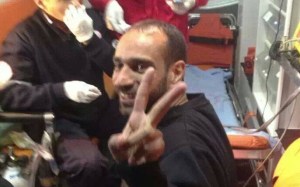
Samer Al_Issawi re-arrested today June 23, 2014 by Israel Occupation Forces. Isawi spent 10 years in jail prior to been released with another 1027 Palestinians, he was re-arrested without charged, Al-Issawi spent 8 months in hunger strike and was released in Jerusalem. His home was demolished on January 2013.
Samer Tarik Issawi (Al-Issawi) served 10 years in Israeli jails and became an internationally recognized icon for the prioners’ movement after spending 9 months on hunger strike last year.
The Palestinian News Network (PNN) reports that Samer was released, along with 1027 Palestinian prisoners, as a result of an Egypt-brokered deal between Hamas and the Israeli government for the return of Gilad Shalit.
In July of 2012, however, he was re-arrested for violating the terms of his release when he left Jerusalem into the West Bank.
Convicted for 8 months, to possibly include a reinstatement of the rest of his original 26 year sentence, Essawi began a hunger strike in August, 2012.
In April of last year, when a deal was finally reached where he was to serve 8 months for violating his bail, and then be released to Jerusalem, Samer announced the end of his strike.
Today, Israeli forces raided al-Essawi’s village, where clashes broke out with residents before they broke into Samer’s house and arrested him again.
According to Ma’an, military forces detained 37 Palestinians in the occupied West Bank, earlier, as Israel’s massive arrest campaign continued for the 11th day.
Israel accuses Hamas of kidnapping three Israeli teenagers from the illegal Israeli settlement of Gush Etzion, near Bethlehem, though no evidence has actually been presented to determine that a kidnapping took place, let alone by Hamas.
Israeli military spokesman General Motti Almoz said, on Sunday, that all information indicates that the teenagers “are alive”.
Samer’s sister Shireen was arrested with their brothers Medhat and Shadi in March. They were not charged, but Israel has refused to release any details about their arrest, in line with behavior typical of the Administrative Detention policy.
Shireen’s detention has been extended by the Israeli court system three times, now, according to the PNN.
In January of 2013, brother Ahmad Issawi’s home was bulldozed.
Under the pretext of searching for the missing teenagers, Israeli forces have detained 471 Palestinians, including 11 parliamentarians, in over 400 targeted raids on homes, civil society institutions, universities and media outlets, according to the PLO. Ma’an News Agency
Leaving the Holy Land
I see few truths on the development of the Palestinian resistance.
1.- Israel is making sure to kill the militants in Gaza, West Bank and Jerusalem.
Israel would not be questioned because the international community – I mean the leaders, the organizations in charge to record human rights abuses, and the Institutions that have direct or indirect relations with Israel – will not raise public outrage because according to international treaties Israel has the right to defend itself from attacks, or in the case of Palestine, future attacks.
2.- Israel is making easy for the intellectuals to leave the territories to go abroad to “study” knowing that these bright minds will not come back to Palestine.
The people that leave Palestine to study they do with the idea of not coming back. We can not blame them, they have the right to dream a better future.
Seven years ago that I started being very active in the Palestinian Solidarity Movement I started with hundreds of friends from the territories and now I look back and look for them and I’m finding out that many of them had moved on with their lives. They left Palestine to study and they never came back.
Was this part of Israel plan to get rid of them?
I do not know but I m happy for them that had made it out. Out of the danger of the bombs, the uncertainty of a secure job, the difficulties that the occupation brings to the people.
On the other hand, I m sad because they left their land, the land that their grandparents died for, that land that they themselves fought so hard to keep but at the end they left following their dreams.
Few years ago when I noticed this phenomenon in the Palestinian community I commented with some Palestinian friends and they just nodded their heads saying that Palestine does not offer anything, the ones that fight are the passionate, the idealist but the realists only looking to feed their families and end the violence that had taken their sons for too long.
A big smile and hug for my Palestinians friends that left Palestine for a better future
I wish them good luck and hope they keep the fight for their land. Now they had become Internationals like the rest of the Palestinian Solidarity Movement.
I originally wrote this poem Inseparable Twins for a dear friend from Gaza (over the years I adopted him as virtual son), but now I expand the dedication to all Palestinians that leave Palestine following their dreams.
Inseparable Twins -Read more in Palestinian Poetry
US Presbyterian Church Divest from companies doing business with Israel

Presbyterian Church Logo
In another victory for Palestine today the General Assembly of the United State Presbyterian Church in its 221st GA (2014) voted 310-303 in favor to divest from companies that don’t comply with the church policies of “peace making” adding today another triumph to Boycott and Divestment and Sanctions, the Palestinian non-violent civil movement pressuring Israel to comply with its international obligations as an occupier force according to the statutes of the Geneva Convention and United Nations resolutions adopted against Israel.
The GA of Presbyterian Church (U.S.A) urges divestment from corporations involve in military-related production, tobacco and human rights violations. See list of companies
.
In March 2002, General Assembly Clerk Clifton Kilpatrick sent a letter to Israeli prime minister Ariel Sharon stating in part, “While we do not condone the acts of violence by certain Palestinian extremists, we are appalled that Israel, in response, has continued to punish the entire Palestinian population and its leaders who have been your government’s partners in the peace process.”
In its web side the Presbyterian Church announced on January 13 of this year to put in the agenda for Detroit 221st Assembly the vote to divest from companies not in compliance with the church General Assembly that since 2004 have directed Mission Responsibility Through Investment (MRTI) to use the church’s customary corporate engagement process to ensure that church investments are made only in companies engaged in peaceful pursuits in Israel, the West Bank, Gaza and East Jerusalem.
“After years of corporate engagement through 2013 and utilizing all tools that we had available to us, these three companies remain entrenched in their involvement in non-peaceful pursuits, and regrettably show no signs of their behavior changing. If anything, since the 2012 General Assembly these companies have deepened their involvement with non-peaceful pursuits that make the General Assembly’s goal of a just peace even more remote,” said Elizabeth Terry Dunning, MRTI committee chair.
The General Assembly military-related divestment policy was first adopted in 1982, and has been revised three times since then.The most recent revision was made by the 1998 General Assembly. This policy is an outgrowth of the General Assembly’s adoption of Peacemaking: A Believer’s Calling, which asked the entire church to review its witness and seek additional ways to promote peacemaking.
At its 221st General Assembly minutes the church voted 310-303 in favor to divest from Caterpillar, which provides heavy equipment that has been used by Israel to demolish Palestinians’ homes and build roads for illegal settlements on occupied land; and Motorola Solutions and Hewlett Packard, both of which provide high-technology products and services such as surveillance systems and biometric scanners at checkpoints.BD
I am an American Jew that has witnessed first-hand the oppression of the Palestinian people. I spent three months in Nablus in the West Bank. While I was there, I experienced the humiliation these people go through every day just to get to work or visit family in the villages. They have no freedom of movement. There are hundreds of checkpoints scattered between cities in the West Bank, making what should be half hour commutes take up to two hours. This has nothing to do with protection and security for Israel. Most of the check points are not even on the border with Israel. What is happening is an apartheid state where one ethnicity is allowed more rights and Boycott Divestment and Sanctions worked during apartheid in South Africa and we can make it work now! Abby Harms comment on Presbyterian Church forum at Docket 221st General Assembly
The Presbyterian Church through its transformational Investment project in Palestine seeks to support collaboration, minimize Palestinian dependence on others investing in West Bank.
The investment objective is to increase the potential viability of a Palestinian State at peace with Israel……Read more
BDS logo
The global movement for a campaign of Boycott, Divestment and Sanctions (BDS) against Israel until it complies with international law and Palestinian rights was initiated by Palestinian civil society in 2005, and is coordinated by the Palestinian BDS National Committee (BNC), established in 2007. BDS is a strategy that allows people of conscience to play an effective role in the Palestinian struggle for justice
Mohammed Assaf dedicate his song to UNRAWA
Source UNRAWA Give For Food Project
If you’re eager to hear Mohammed Assaf’s new song, so are we! United Nations Relief and Works Agency for Palestine ambassador has dedicated this special song to UNRWA, helping kick off an important campaign that needs your support. Because of crises like the blockade of Gaza and the devastation of Syria, or due toyears of chronic poverty, today over 1 million Palestine refugees need help to meet their basic food requirements. This summer, join UNRWA: Give for Food. From June 2 to July 28, we hope to raise US$ 100,000 to provide food for those in need. With your support, UNRWA can red card hunger this World Cup season.

DONATE
ENGAGE
SONG
WIN
Give for food today and help feed Palestine refugees.
Join our campaign and spread the word! Click here to download the #redcardhunger selfie templates & visit us on Facebook (link is external), Twitter (link is external) & Instagram (link is external).Assaf’s World Cup single Assaf360 (link is external) is out! Proceeds go to UNRWA to help us #redcardhunger. Download from iTunes (link is external) or Anghami+ (link is external) now.Check out some prizes for our supporters and find out how to win.
Mohammed Assaf -UNRWA is unique among UN agencies, both for its long-standing commitment to one group of refugees – the Palestine refugees – and for its direct provision of services including education, health care and relief to those refugees. But being unique doesn’t mean that UNRWA can act alone: We have always depended on our partners, including our hosts and donors, to help us best serve Palestine refugees. Now, we are proud also to work with individuals who can add their voice to ours, spreading the word about Palestine refugees and reminding people who may be far away that they are not just a regional concern or a relic of the past.
 Mohammad Assaf is UNRWA’s first ever Regional Youth Ambassador As a “child of UNRWA,” Mohammed Assaf is the ideal individual to be the first goodwill ambassador in the more than six decades of our history. A Palestine refugee himself, he grew up in the Khan Younis camp in Gaza. Not long ago, he was one of the over 220,000 students attending the Agency’s 245 schools in Gaza. For him, the connection continued at home: His mother, too, was an UNRWA teacher. Throughout his childhood – at school, at the doctor’s, at community centres – he saw firsthand the work that UNRWA does for Palestine refugees.Since his appointment in June 2013, by Commissioner-General Filippo Grandi, as the Agency’s Regional Youth Ambassador for Palestine Refugees, the 23-year-old Arab Idol winner has used his voice and his talent to help UNRWA give other young people the same support it gave him. With the universal language of his music, he carries the message of UNRWA and young Palestine refugees to new audiences, including in the region – to Dubai and Kuwait – and even further. In November 2013, he took that message to the United States, bringing the voice of Palestine refugee youth to the United Nations in New York City.
MohammEd Assaf in the News
UNRWA Arab Idol Serenades World Cup Audiences with Unprecedented ‘Fan-written’ Song
Assaf visits the Danish Royal LibraryMohammed Assaf – Arab Idol winner, Palestine refugee and UNRWA Regional Youth Ambassador for the has created World Cup history by creating the competition’s first ever ‘fan-written’ song. It was recorded in Dubai on 3 June. Assaf will perform the song ‘Assaf360’, live for the first time on 10 June in São Paulo, Brazil, at the opening ceremony of the sixty-fourth FIFA Congress. ‘Assaf360’ will also be the anthem for the UNRWA Give for Food campaign. All proceeds from the download of the song, via iTunes (link is external) or Anghami+ (link is external), will support the UNRWA campaign, helping “red card” hunger for food-insecure Palestine refugees.Read MoreJoin our campiagn, help #redcardhunger4 June 2014
Launch of Siblin Training Centre Football Pitch
Assaf visits the Danish Royal LibraryUnder the patronage of the Head of the Delegation of the European Union to #Lebanon Ambassador, Angelina Eichhorst, and the Director of UNRWA Affairs in Lebanon, Ann Dismorr, UNRWA organized the launch ceremony of the football pitch of Siblin Training Centre (South Campus), upgraded by UNRWA through the EU-funded project, ‘Improving the living conditions of Palestine refugees in Lebanon’. Ambassador of the State of Palestine, H.E. Mr. Ashraf Dabbour, and UNRWA Goodwill Ambassador Mohammed Assaf were present at the event.16 April 2014
Assaf Dubai International Humanitarian Aid and Development Conference and Exhibition
Assaf visits the Danish Royal LibraryUNRWA and its Goodwill Ambassador Mohammad Assaf participated last week in the 2014 Dubai International Humanitarian Aid and Development Conference and Exhibition, which highlighted women in times of conflict and war. The conference was opened by HRH Princess Haya Bint al Hussein, wife of HH Sheikh Mohammed Bin Rashid Al Maktoum. She visited an exhibit of photos from the historic UNRWA archives that celebrated the long journey of Palestine refugee women, and expressed her appreciation for the Agency’s work in supporting Palestine refugees in the region. Her Highness also visited an UNRWA exhibit highlighting the plight of Palestine refugees in #Syria, particularly in Yarmouk camp, Damascus, where humanitarian conditions have grown desperate following months of siege and limited access for relief efforts.9 April 2014
Singer and UNRWA Goodwill Ambassador Mohammed Assaf visits the Danish Royal Library
Assaf visits the Danish Royal LibraryArab Idol winning singer Mohammed Assaf visited this week the Danish Royal Library where the UNRWA Archive is being digitized by a team of professional experts thanks to a generous contribution from the Danish Government. The Danish Royal Library started the work in May last year and have completed the digitalization of over 150,000 photos up to date they plan to organize a special exhibition in 2015 upon competition of the works.Read More27 February 2014
Mohammed Assaf’s visit to the Gaza Strip
Assaf visit to GazaUNRWA Goodwill Ambassador Mohammed Assaf visited a number UNRWA operations in Khan Younis, in the southern Gaza Strip, including an elementary school, where he took a seat at a desk with the other students. He spent some time at the UNRWA training centre in Khan Younis, where he spoke to students and encouraged them to study and work hard.Read More12 February 2014
New York Times: An ‘Arab Idol’ Wows His Fans in America
Assaf performing in ChicagoArab Idol, Mohammed Assaf, is trying to conquer North America, or at least its people of Arab descent. He has been on a nine-week tour of cities that have large Arab immigrant populations, ending in Charlotte, N.C., on Dec. 28 and including performances in Ottawa on Thursday and Friday. From Detroit to Tampa, every show has been packed, with entire extended families paying up to $350 a ticket.Read More (link is external)18 December 2013
United Nations Department of Public Information : From Camp to Camp: A Refugee StoryVisiting United Nations Headquarters in New York, Mohammed Assaf met with eight Palestinian journalists attending a training programme held by the Department of Public Information. Four of the journalists had chosen Palestine refugees as the central theme of their final project. In this interview, they ask Mr. Assaf about his life as a Palestine refugee in the Gaza Strip – from daily obstacles to major, life-threatening dangers and the persistence that encouraged him to follow his dreams, bringing hope to millions of young people across the region.Watch the video (link is external)5 December 2013
Al Arabiya: Mohammed Assaf celebrates ‘Palestine Day’ at U.N. headquarters
Mohammad Assaf with Secretary GeneralPalestinian vocalist Mohammed Assaf, this year’s winner of “Arab Idol,” celebrated Monday the International Day of Solidarity with the Palestinian People together with high profile U.N. officials in New York… “In Gaza, children like me grow in an environment laden with challenges and in an unbelievable way. Many of our parents suffer to find job opportunities or strive hard to put some food on the table,” Assaf said in his U.N. address.Read More (link is external)26 November 2013
UN News Service: Youth envoy for UN Palestine refugee agency says goals can be achieved with hope, determination
Mohammad Assaf at press conference in UN HeadquartersFrom a “tougher than tough” life in a Gaza refugee camp to winning the title of this year’s “Arab Idol”, Mohammed Assaf told reporters at United Nations Headquarters today that he will “never forget his roots” and, as a beacon of hope for all Palestinian people, he will continue to promote peace, security and other universal values.Read More (link is external)26 November 2013Watch (link is external) the video of Assaf’s press briefing in New York
From Mohammed Assaf, A Song for Solidarity
Mohammad Assaf named UNRWA regional youth ambassadorThe United Nations Relief and Works Agency for Palestine Refugees (UNRWA) is proud to welcome its Regional Youth Ambassador, Mohammed Assaf, to United Nations Headquarters in New York. As the first goodwill ambassador in UNRWA history, he will join the Agency, the United Nations and Member States as they mark the thirty-fifth International Day of Solidarity with the Palestinian People, on 25 November… Currently on tour in the United States, Mr. Assaf will perform for hundreds of delegates and civil society at the UN, bringing the sounds and rhythms of Palestine to New York with a song for solidarity.Read More25 November 2013
Mohammed Assaf recieves donation on behalf of UNRWA
Mohammad Assaf recieves donation on behalf of unrwaDr. Majd Naji, the Director of Liberty Dental Clinic hands UNRWA Regional Youth Ambassador Mohammed Assaf 100,000 UAE Dirhams in support of Palestine refugees. The ceremony was attended by Margot Ellis, Deputy Commissioner-General of UNRWA, and Mr. Peter Ford, Representative of the Commissioner-General in the Arab world.Read More5 November 2013
Mohammed Assaf Visits UNRWA Students in Am’ari
Mohammad Assaf visits UNRWA school in Am’ari campA visit by Arab Idol and Regional Youth Ambassador Mohammed Assaf to a girls’ school in the Palestine refugee camp of Am’ari, near Ramallah, helped the United Nations Relief and Works Agency (UNRWA) emphasize the message of its Back to School campaign. Launched in August, the campaign highlighted important messages about education for Palestine refugee students, including those threatened by displacement and movement restrictions in the West Bank or suffering under the blockade in the Gaza Strip.See Our Photo Gallery10 September 2013
UNRWA LAUNCHES FUNDRAISING CAMPAIGN FOR SYRIA AND GAZA
Mohammad AssafThe United Nations Relief and Works Agency for Palestine Refugees in the Near East (UNRWA) is proud to announce the launch of a fundraising and awareness campaign for Palestine refugees in Syria and the Gaza Strip during the holy month of Ramadan. Working with Arab Idol Mohammed Assaf, the Agency’s Regional Youth Ambassador, UNRWA hopes to highlight the struggles and needs of these vulnerable Palestine refugees.Read More22 July 2013Watch the video and join Muhammed Assaf in supporting UNRWA
UNRWA COMMISSIONER-GENERAL WELCOMES SINGER, MUHAMMED ASSAF, TO UNRWA HEADQUARTERS IN GAZA
Commissioner General welcomes Mohammad AssafThe Commissioner General of UNRWA, Filippo Grandi, welcomed Arab Idol winner, Mohammed Assaf, to UNRWA headquarters in Gaza, and thanked him for accepting the role of UNRWA’s first ever “Regional Youth Ambassador for Palestine Refugees”. Speaking in front of hundreds of UNRWA staff, Grandi said Mohammed “had brought us all together in a rare moment of celebration”.Read More26 June 2013Watch the video of Arab Idol winner Muhammad Assaf meeting UNRWA Commissioner-General Filippo Grandi
“ARAB IDOL” WINNER MOHAMMeD ASSAF NAMED UNRWA REGIONAL YOUTH AMBASSADOR FOR PALESTINE REFUGEES
Mohammad Assaf named UNRWA regional youth ambassadorFilippo Grandi, Commissioner General of the United Nations Relief and Works Agency (UNRWA), has named 23-year-old Mohammed Assaf as the first UNRWA Regional Youth Ambassador for Palestine Refugees. This follows Mohammed winning the Arab Idol crown and reflects his personal commitment to Palestinian refugees and to UNRWA. “On behalf of everybody at UNRWA, I send warmest congratulations to Mohammed and his family”, said Grandi. “All Palestinians share in his success. Mohammed’s music is a universal language and speaks to all of us. How fantastic that a Palestine refugee from Gaza should bring us all together in this way.”Read More22 June 2013Watch (link is external) the video of Assaf accepting his appointment as the first ever UNRWA Regional Youth Ambassador (in Arabic)But other areas are suffering, too. The Gaza Strip, home to 1.3 million Palestine refugees, is nearing a crisis. Its economy has been ruined by the long-standing closure and isolation, increasing ten-fold the number of Palestine refugees who need help to meet their basic needs. Restrictions on agriculture, fishing and trade have also had an impact on food availability.In Jordan, the West Bank and especially Lebanon, the situation is different. For some Palestine refugees there, the inability to afford enough of the food they require is a problem that generations have struggled with. Their food insecurity is brought about by an invisible, long-running crisis: years of chronic abject poverty and barriers to the very tools – education, employment, health care – that could help them break free.Abject poverty isn’t a problem for one day or one person. It affects every aspect of life for 700,000 Palestine refugees. Mothers suffering from food insecurity disadvantage their babies; children who go hungry to school struggle more than their peers; young men and women who must constantly worry about being able to afford food today can’t focus on tomorrow. For these Palestine refugees, the impact of abject poverty on their food security, their education, their health care and their employment makes it even harder for them to break the cycle.When we began operations in 1950, a lot of our work involved immediate relief and support for Palestine refugees facing a terrible crisis. Things have changed since then, but whenever Palestine refugees have faced an emergency, UNRWA has been there to help with cash assistance, food assistance and other items. We also support nearly 300,000 refugees across the region with quarterly distributions through our social-safety net. With this support and with other efforts – such as school feeding, a priority for the poor in shelter rehabilitation or technical and vocationaleducation for young men and women – UNRWA tries to help the poorest Palestine refugees both for today and for the future.This summer, we ask you to help us help those who need it most. Whether caused by a headline-grabbing crisis or years of abject poverty, food insecurity is atrap. With your support, we can help Palestine refugees find their way out. It’s time to red card hunger.The European Union has played a vital role in helping UNRWA deliver human-development services, including those that help relieve, alleviate and tackle food insecurity, through its contributions to the Agency’s General Fund.
Breaking the Silence: Israel Soldiers Speak
Stories from an occupation: the Israelis who broke silence
412 comments
A group called Breaking the Silence has spent 10 years collecting accounts from Israeli soldiers who served in the Palestinian territories. To mark the milestone, 10 hours’ worth of testimony was read to an audience in Tel Aviv. Here we print some extracts
Children of the occupation: growing up in Palestine
Israeli soldiers arrest Palestinian protest against Jewish settlement
Israeli soldiers arrest a Palestinian after clashes at a protest against a Jewish settlement in the West Bank near Ramallah, January 2014. Photograph: Mohamad Torokman/Reuters
Peter Beaumont Tel Aviv
Sunday 8 June 2014 04.00 EDT
The young soldier stopped to listen to the man reading on the stage in Tel Aviv’s Habima Square, outside the tall façade of Charles Bronfman Auditorium. The reader was Yossi Sarid, a former education and environment minister. His text is the testimony of a soldier in the Israel Defence Forces, one of 350 soldiers, politicians, journalists and activists who on Friday – the anniversary of Israel’s occupation of Palestinian land in 1967 – recited first-hand soldiers’ accounts for 10 hours straight in Habima Square, all of them collected by the Israeli NGO Breaking the Silence.
When one of the group’s researchers approached the soldier, they chatted politely out of earshot and then phone numbers were exchanged. Perhaps in the future this young man will give his own account to join the 950 testimonies collected by Breaking the Silence since it was founded 10 years ago.
In that decade, Breaking the Silence has collected a formidable oral history of Israeli soldiers’ highly critical assessments of the world of conflict and occupation. The stories may be specific to Israel and its occupation of the Palestinian territories but they have a wider meaning, providing an invaluable resource that describes not just the nature of Israel’s occupation but of how occupying soldiers behave more generally. They describe how abuses come from boredom; from the orders of ambitious officers keen to advance in their careers; or from the institutional demands of occupation itself, which desensitises and dehumanises as it creates a distance from the “other”.
In granular detail, the tens of thousands of words narrated on Friday told of the humdrum and the terrible: the humiliating treatment of Palestinians at checkpoints, shootings and random assaults. Over the years the Israeli military’s response has been that these stories are the exceptions, not the rule, accounts of a few bad apples’ actions.
“What we wanted to show by reading for 10 hours is that the things described in the testimonies we have collected are not exceptional, rather they are unexceptional,” says Yehuda Shaul, one of the founders of the group and a former soldier himself.
Shaul breaks off to greet the European Union ambassador and a woman soldier who served in his own unit whom he has not seen for years. We talk about the solitary soldier in the square, now talking to the researcher. “We’ll get in contact. See if he wants to talk. Perhaps meet for coffee. Then, when we interview people, we ask them to recommend us to their friends. We might get 10 phone numbers, of whom three will talk to us.”
It is not only word of mouth that produces Breaking the Silence’s interviews. At the annual conferences that soldiers leaving the army attend to prepare them for the return to civilian life, researchers will try to talk to soldiers outside. Shaul explains why he and his colleagues have dedicated themselves to this project, why he believes it is as necessary today as when he first spoke out a decade ago about his own experience as a soldier in Hebron. “In Israeli politics today the occupation is absent. It’s not an issue for the public. It has become normal – not second nature; the occupation has become part of our nature. The object of events like today is for us to occupy the public space with the occupation.”
His sentiments are reflected by the Israeli novelist and playwright AB Yehoshua, who gets on the stage to read a comment piece he had written the day before to mark the event. “The great danger to Israeli society,” Yehoshua explains, “is the danger of weariness and repression. We no longer have the energy and patience to hear about another act of injustice.”
A man appears holding a handwritten sign that condemns Breaking the Silence as “traitors”. Some of those attending try to usher him away while others try to engage him in conversation. A journalist asks Shaul if the man is “pro-army”. “I’m pro-army,” Shaul answers immediately. “I’m not a pacifist, although some of our members have become pacifists. I’m not anti-army, I am anti-occupation.”
ISRAELI SOLDIERS’ OWN WORDS
Nadav Weiman Nadav Weiman. Photograph: Quique Kierszenbaum
SERGEANT NADAV WEIMAN
2005-08, Nachal Reconnaissance Unit, Jenin
We’d spread out above Jenin on “the stage”, which is a tiny mountain top. That evening an arrest mission was in progress, there were riots inside the refugee camp, and we sat above and provided sniper cover for the operation. Things got rolling and there were arrests, some rioting began in the city.
There was random peripheral fire so there were generally no people on rooftops. Some time in the middle of the night, we detected someone on a roof. We focused our sights on him, not knowing for sure whether or not he was a scout. But we targeted him and got an OK to fire because he was on a rooftop very close to one of our forces.
We were several snipers, and we took him down … Later when we got back to Jalame, it started: “Was he armed or not?” But we’d got our OK from the battalion commander. He was also the one to come and speak with us when we got back to the base in Jalame. We were with the guys with whom we sat to debrief after the action, and it was wall-to-wall, “You don’t realise how lucky you are to have actually fired in an operation. That hardly ever happens, you are so lucky.”
And according to the way we implemented the rules of engagement, we declared him a target by documenting him. We thought the Palestinian had been speaking on the phone, he seemed to be raising his hand to his head, looking sideways, going back and forth, just like a person scouting and sending information back. You could see the angles of his body, his whole conduct facing the soldiers who were north of him, in the alley below, a few metres away.
SERGEANT, ANONYMOUS
Undisclosed Reservist unit, Gaza Strip 2009, Operation Cast Lead
The actual objective remained rather vague. We were told our objective was to fragment the Strip, in fact we were told that while we were there, not knowing how long, we would have to raze the area as much as possible. Razing is a euphemism for systematic destruction. Two reasons were given for house demolitions. One reason was operational. That’s when a house is suspected to contain explosive, tunnels, when all kinds of wires are seen, or digging. Or we have intelligence information making it suspect. Or it’s a source of fire, whether light arms or mortars, missiles, Grads [rockets], all that stuff. Those are houses we demolish.
Then we’re told some will be destroyed for “the day after”. The rationale is to leave a sterile area behind us and the best way to do that is by razing it. In practical terms, it means you take a house that’s not suspect, its only transgression is that it stands on a hill in Gaza. I can even say that in a talk with my battalion commander, he mentioned this and said half smiling, half sad, that this is something to add to his list of war crimes. So he himself understood there was a problem.
Tal Wasser Tal Wasser. Photograph: Quique Kierszenbaum
SERGEANT TAL WASSER
2006-09, Oketz (canine special forces), Nablus
Standing at the roadblock for eight hours a day puts everyone under this endless pressure. Everyone’s constantly yelling, constantly nervous, impatient … venting on the first Palestinian to cross your path. If a Palestinian annoys one of the soldiers, one of the things they’d do is throw him in the Jora, which is a small cell, like a clothing store dressing room. They close the metal door on him and that would be his punishment for annoying, for being bad.
Within all the pressure and the stress of the roadblock, the Palestinian would often be forgotten there. No one would remember that he put a Palestinian there, further emphasising the irrelevance and insignificance of the reason he was put there in the first place. Sometimes it was only after hours that they’d suddenly remember to let him out and continue the inspection at the roadblock.
SERGEANT, ANONYMOUS
Nablus Regional Brigade, Nablus, 2014
“Provocation and reaction” is the act of entering a village, making a lot of noise, waiting for the stones to be thrown at you and then you arrest them, saying: “There, they’re throwing stones.”
Lots of vehicles move inside the whole village, barriers. A barrier seems to be the army’s legitimate means to stop terrorists. We’re talking about Area B [under civilian Palestinian control and Israeli security control], but the army goes in there every day, practically, provoking stone throwings. Just as any Palestinian is suspect, this is the same idea. It could be a kid’s first time ever throwing a stone, but as far as the army is concerned, we’ve caught the stone thrower.
Avner Gvaryahu former Israeli soldier Avner Gvaryahu. Photograph: Quique Kierszenbaum
SERGEANT AVNER GVARYAHU
2004-07 Orev (special anti-tank unit), Nablus
It was when I was a sergeant, after we had finished training. 200 [the number of the commander] said to us unequivocally: “That’s how you’re ranked. With Xs. Every night I want you to be looking for ‘contact’ [an exchange of fire] and that’s how you’ll be ranked.”
At some point I realised that someone who wants to succeed has to bring him dead people. There’s no point in bringing him arrests. [The message was:] “Arrests are routine, the battalions are making arrests. You’re the spearhead, the army has invested years in you, now I want you to bring me dead terrorists.”
And that’s what pushed us, I believe. What we’d do was go out night after night, drawing fire, go into alleys that we knew were dangerous. There were arrests, there were all kinds of arrests. But the high point of the night was drawing fire, creating a situation where they fired at us.
It’s a situation, totally insane, you’re in it, it’s hard to explain. You’re looking through the binoculars and searching for someone to kill. That’s what you want to do. And you want to kill him. But do you want to kill him? But that’s your job.
And you’re still looking through the binoculars and you’re starting to get confused. Do I want to? Don’t I want to? Maybe I actually want them to miss.
SERGEANT, ANONYMOUS
Kfir Brigade, Tul Karem, 2008
There was one checkpoint that was divided into three lanes: there’s a settlement, a checkpoint, and then Israeli territory. In the middle, there’s a Palestinian village, so they just split the checkpoint into three lanes. Three lanes, and the brigade commander ordered that Jews should only wait at the checkpoint for 10 minutes. Because of that we had to have a special lane for them, and everyone else, the Palestinians and Israeli Arabs, had to wait in the other two lanes. I remember that settlers would come, go around the Arabs, and just did it naturally. I went over to a settler and said: “Why are you going around? There’s a line here, sir.” He said: “You really think I’m going to wait behind an Arab?” He began to raise his voice at me. “You’re going to hear from your brigade commander.”
Gil Hillel Gil Hillel. Photograph: Quique Kierszenbaum
GIL HILLEL
2001-03, Sachlav (military police), Hebron
On my first or second day in Hebron, my commanders asked me to go on a “doll”, a foot patrol that we conduct in the casbah and Jewish settlement. I agreed, it seemed cool. It was my first time in the field, come on, let’s do it. We went on patrol, into the casbah, and I think that was the first time I sensed the existential fear of living under constant threat.
We started the doll and I started feeling bad. The first time in the field is not simple. One of my commanders, the veteran among them, took an old Palestinian man, just took him aside to some alley and started beating him up. And I … it wasfine by all the others … I sort of looked at them and said: “What is he doing? Why is he doing that? What happened? Did he do anything? Is he a threat? A terrorist? Did we find something?” So they said: “No, it’s OK.” I then approached my commander, the [one] who trained me, and asked: “What are you doing?” He said: “Gil, stop it.”
And that really scared me. I was scared of their reactions, of the situation we were in. I felt bad with what went on there, but I kept quiet. I mean, what can I do? My commander told me to shut up. We left there and went back to the company and I went to my commander and said: “What are you doing? Why did you do that?” So he said: “That’s the way it is. It’s either him or me and it’s me and …”
They took him aside and just beat him up. They beat him up, they punched him. And slapped him, all for no reason. I mean, he just happened to walk by there, by mistake.
SERGEANT, ANONYMOUS
Nachal Brigade, 50th Battalion, Hebron, 2010
The Jewish settlers of Hebron constantly curse the Arabs. An Arab who passes by too closely gets cursed: “May you burn, die.”
On Shuhada Street there’s a very short section where Arabs may walk as well, which leads to Tel Rumeida neighbourhood. Once I was sent there and we found three Jewish kids hitting an old Arab woman. Another man from the Jewish settlement happened along and also joined them in yelling at the woman: “May you die!” When we got there they were mainly yelling, but there had clearly been blows dealt as well. I think they even threw stones at her.
I believe the [policeman] was called but ended up not doing anything. The general atmosphere was that there was no point in summoning the police – the policeman is a local settler from Kiryat Arba who comes to pray with the Hebron settlers at the Tomb of the Patriarchs on Fridays.
Nadav Bigelman former Israeli soldier Nadav Bigelman. Photograph: Quique Kierszenbaum
SERGEANT NADAV BIGELMAN
2007-10, Nachal Brigade, 50th Battalion, Hebron
During patrols inside the casbah we’d do many “mappings”. Mappings mean going into a house we have no intelligence on. We go in to see what’s inside, who lives there. We didn’t search for weapons or things like that. The mappings were designed to make the Palestinians feel that we are there all the time.
We go in, walk around, look around. The commander takes a piece of paper and … makes a drawing of the house, what it looks like inside, and I had a camera. I was told to bring it. They said: “You take all the people, stand them against the wall and take their picture.” Then [the pictures are] transferred to, I don’t know, the General Security Service, the battalion or brigade intelligence unit, so they have information on what the people look like. What the residents look like. I’m a young soldier, I do as they say. I take their pictures, a horrible experience in itself, because taking people’s pictures at 3am, I … it humiliated them, I just can’t describe it.
And the interesting thing? I had the pictures for around a month. No one came to get them. No commander asked about them, no intelligence officer took them. I realised it was all for nothing. It was just to be there. It was like a game.
SERGEANT, ANONYMOUS
Paratrooper, 2002, Nablus
We took over a central house, set up positions, and one of the sharpshooters identified a man on a roof, two roofs away, I think he was between 50 and 70 metres away, not armed. I looked at the man through the night vision – he wasn’t armed. It was two in the morning. A man without arms, walking on the roof, just walking around. We reported it to the company commander. The company commander said: “Take him down.” [The sharpshooter] fired, took him down. The company commander basically ordered, decided via radio, the death sentence for that man. A man who wasn’t armed.
I saw with my own eyes that the guy wasn’t armed. The report also said: “A man without arms on the roof.” The company commander declared him a lookout, meaning he understood that the guy was no threat to us, and he gave the order to kill him and we shot him. I myself didn’t shoot, my friend shot and killed him. And basically you think, you see in the United States there’s the death penalty, for every death sentence there are like a thousand appeals and convictions, and they take it very seriously, and there are judges and learned people, and there are protests and whatever. And here a 26-year-old guy, my company commander, sentenced an unarmed man to death.
Tags:
Israel,
Palestinian territories,
Middle East and North Africa,
Protest,
War crimes,
I read the comments of those offended by the IDF conduct, I read the replies of the IDF apologists. As an American I say were done with supporting Israel, Obama stay out of their disputes, let the chips fall where they may.
We should not be providing the financial aid or the weapons that assists in this conduct.
2
Taliban swapped for Bergdahl could be drone targets, Kerry indicates
4
Israel’s soldiers speak out about brutality of Palestinian occupation
© 2014 Guardian News and Media Limited or its affiliated companies. All rights reserved.
Snowden a year later-message to ACLU’s supporters
A Message From Edward Snowden, One Year Later

Below is an email ACLU supporters received from Edward Snowden this morning, one year to the day since The Guardian broke the first in a series of revelations exposing the breathtaking scope of U.S. government surveillance. Click here for a new video documenting the incredible events of the last year, along with a timeline and the ACLU’s guide to privacy reform.
It’s been one year.
Technology has been a liberating force in our lives. It allows us to create and share the experiences that make us human, effortlessly. But in secret, our very own government — one bound by the Constitution and its Bill of Rights — has reverse-engineered something beautiful into a tool of mass surveillance and oppression. The government right now can easily monitor whom you call, whom you associate with, what you read, what you buy, and where you go online and offline, and they do it to all of us, all the time.
Today, our most intimate private records are being indiscriminately seized in secret, without regard for whether we are actually suspected of wrongdoing. When these capabilities fall into the wrong hands, they can destroy the very freedoms that technology should be nurturing, not extinguishing. Surveillance, without regard to the rule of law or our basic human dignity, creates societies that fear free expression and dissent, the very values that make America strong.
In the long, dark shadow cast by the security state, a free society cannot thrive.
That’s why one year ago I brought evidence of these irresponsible activities to the public — to spark the very discussion the U.S. government didn’t want the American people to have. With every revelation, more and more light coursed through a National Security Agency that had grown too comfortable operating in the dark and without public consent. Soon incredible things began occurring that would have been unimaginable years ago. A federal judge in open court called an NSA mass surveillance program likely unconstitutional and “almost Orwellian.” Congress and President Obama have called for an end to the dragnet collection of the intimate details of our lives. Today legislation to begin rolling back the surveillance state is moving in Congress after more than a decade of impasse.
I am humbled by our collective successes so far. When the Guardian and The Washington Post began reporting on the NSA’s project to make privacy a thing of the past, I worried the risks I took to get the public the information it deserved would be met with collective indifference.
One year later, I realize that my fears were unwarranted.
Americans, like you, still believe the Constitution is the highest law of the land, which cannot be violated in secret in the name of a false security. Some say I’m a man without a country, but that’s not true. America has always been an ideal, and though I’m far away, I’ve never felt as connected to it as I do now, watching the necessary debate unfold as I hoped it would. America, after all, is always at our fingertips; that is the power of the Internet.
But now it’s time to keep the momentum for serious reform going so the conversation does not die prematurely.
Only then will we get the legislative reform that truly reins in the NSA and puts the government back in its constitutional place. Only then will we get the secure technologies we need to communicate without fear that silently in the background, our very own government is collecting, collating, and crunching the data that allows unelected bureaucrats to intrude into our most private spaces, analyzing our hopes and fears. Until then, every American who jealously guards their rights must do their best to engage in digital self-defense and proactively protect their electronic devices and communications. Every step we can take to secure ourselves from a government that no longer respects our privacy is a patriotic act.
We’ve come a long way, but there’s more to be done.
— Edward J. Snowden, American
Watch the Video

 Akashma Online News