Archive
THE BRIGHT BALL: TRUMP RESCUES NVIDIA’S CEO — BUT WHO BOUGHT THE STOCK BEFORE THE CURTAIN ROSE?
A Presidential Intervention, a Trillion-Dollar Market Rebound and the Investors Behind the Greatest AI Show on Earth
By Marivel Guzman (Akashma) | Akashma Online News
Investigative Commentary | November 24, 2026
Prologue: Welcome Back to the Greatest Show on Earth
Ladies and gentlemen, welcome back to The Bright Ball, where the media write the screenplay, politicians select the performance, billionaires finance the production and the popcorn-eating audience pays for admission.
This week’s feature attraction?
A billionaire technology executive resigns amid a personal scandal and national-security concerns. Wall Street panics. The president of the United States intervenes. The executive returns to his office, and almost a trillion dollars in stock-market value reappears in a single trading session.
Hollywood couldn’t have written a better screenplay.
But while the cameras followed Jensen Huang’s extraordinary departure and return to NVIDIA, another story was unfolding on Wall Street.
Shares were changing hands. Institutional portfolios were exposed to enormous price swings. Corporate insiders had previously sold substantial holdings. And the president who advocated Huang’s reinstatement had his own disclosed financial interests in NVIDIA.
So, before applauding the hero’s return, perhaps the audience should ask an elementary question:
Who sold before the fall, who purchased during the decline, and who profited when the president helped bring the leading man back onstage?
This is not an accusation of insider trading or market manipulation.
It is an invitation to examine the financial records instead of mistaking the political screenplay for a complete explanation.
And as every journalist should know, an extraordinary story deserves extraordinary scrutiny.
Especially when the actors are billionaires, the president is involved, and the ticket price is measured in trillions.
Act I: The CEO Who Left and Returned in 11 Days
On November 11, 2026, NVIDIA’s board accepted the resignation of Jensen Huang as president, chief executive officer and director.
The company announced the departure November 12 and appointed longtime Chief Financial Officer Colette Kress as interim CEO.
The Securities and Exchange Commission filing establishes the departure as a corporate event, independently of the surrounding media controversy.
NVIDIA Form 8-K, filed November 12, 2026
Huang’s resignation followed reporting about alleged extramarital relationships, including one involving a woman whom U.S. officials reportedly suspected of connections to Chinese intelligence.
The intelligence allegations remain distinct from proof that Huang committed espionage, knowingly compromised U.S. technology or violated the law.
Nevertheless, the controversy created a serious corporate-governance crisis at a company central to the artificial intelligence industry.
Then came President Donald Trump.
According to CNN’s November 23 report, Inside the Trump Pressure Campaign That Restored Jensen Huang as Nvidia’s CEO, Trump and senior administration figures pressured the company to bring Huang back.
Axios separately reported that Huang’s supporters portrayed him as economically indispensable and that Trump and Vice President JD Vance participated in efforts to secure his return.
The president himself acknowledged his involvement.
In a November 23 interview with CNBC, reported by ABC News, Trump declared:
“I convinced them. I made the deal.”
ABC News — Trump Says He Convinced NVIDIA’s Board
On November 22, NVIDIA’s directors unanimously voted to reinstate Huang. The company formally announced the decision the following morning.
Its SEC filing confirms the reinstatement, while NVIDIA’s public statement acknowledges that the board received input from senior U.S. government officials.
NVIDIA Form 8-K, filed November 23, 2026
NVIDIA’s Official Reinstatement Announcement
The board said that, after discussions with Huang, it was satisfied with his candor and leadership. It also stated that the government input gave directors confidence his reinstatement posed no national-security risk.
But the independent investigation was not concluded. The company announced additional security and compliance measures, including a new board committee overseeing national-security and export-control risks.
The episode presents an unusual intersection of private corporate governance and presidential power.
A publicly traded company makes a leadership decision. Its stock declines. The White House intervenes. The company reverses course.
And Wall Street applauds.
The next act is where the numbers become particularly interesting.
Act II: Nearly a Trillion Dollars Returns to the Stage
On Monday, November 23, NVIDIA shares closed at $165.05, up $39.52, or 31.48%, from the preceding trading session.
According to Dow Jones Market Data, as reported by MarketWatch, NVIDIA gained approximately $952 billion in market capitalization.
It was the company’s largest one-day dollar increase in market value and its strongest percentage advance in 23 years.
MarketWatch — NVIDIA Adds $952 Billion in Market Value
Almost a trillion dollars!
Enough to make an ordinary taxpayer dizzy.
Enough to make financial television presenters reach for their most dramatic adjectives.
And enough to make an investigative journalist ask what those numbers actually represent.
Because $952 billion in additional market capitalization is not $952 billion in cash deposited into shareholders’ accounts.
Market capitalization is calculated by multiplying the quoted share price by the number of outstanding shares.
When the price rises, the estimated value of all outstanding shares rises with it, even though only a fraction of those shares may have traded that day.
Similarly, when NVIDIA’s valuation fell during the preceding weeks, the decline did not mean that an equivalent amount of money had been physically withdrawn from the company.
The financial question is more specific:
Who converted shares into cash before the downturn, and who acquired shares at lower prices before the rebound?
Unlike changes in market capitalization, those transactions involve actual buyers, sellers, securities and settlement obligations.
And somewhere in that trading history lies the money trail.
Act III: The Director Who Sold Before the Crisis
The SEC filings offer a concrete starting point.
On September 18, 2026, NVIDIA director Mark A. Stevens sold 1,366,000 shares through the Third Millennium Trust, according to a Form 4 filed September 22.
The sales generated approximately $300.15 million in gross proceeds, before taxes and transaction costs.
The weighted average transaction price was approximately $219.73 per share.
The filing divides the sale into two reported transactions:
Shares sold| Reported weighted average price
1,356,000| $219.7219
10,000| $220.4199
1,366,000 total| Approximately $300.15 million in proceeds
SEC Form 4 — Mark A. Stevens, September 22, 2026
That transaction occurred before Huang’s November resignation and the subsequent market upheaval.
At NVIDIA’s November 23 closing price of $165.05, the shares Stevens sold in September would have had an estimated market value of approximately $225.46 million.
The difference is roughly $74.7 million.
That does not represent an additional profit Stevens necessarily earned on the transaction. It illustrates the difference between his September sale proceeds and the later market value of the same number of shares.
Stevens also retained substantial NVIDIA holdings after the sale.
His transaction alone does not establish that he anticipated the resignation, possessed material nonpublic information or manipulated the market.
He may have had legitimate reasons for selling, including diversification or a previously established trading plan.
The relevant SEC footnotes, trading arrangements and his longer transaction history deserve examination.
But the transaction establishes an important fact:
Substantial NVIDIA shares were converted into cash before the later leadership crisis.
That warrants inclusion in a chronological financial audit.
It does not warrant a premature guilty verdict.
Act IV: Who Bought the Discounted Shares?
Now comes the question that financial television should be asking alongside its coverage of the presidential intervention.
Who purchased NVIDIA shares while their price was falling?
Were they individual investors?
Hedge funds?
Pension funds?
Exchange-traded funds?
Major asset managers?
Corporate insiders?
Investors with political connections?
The answer cannot be established merely by examining the company’s list of largest shareholders.
BlackRock and Vanguard are major institutional holders of NVIDIA shares, but their participation in the company’s ownership does not prove that they purchased during this particular decline.
Their portfolios also contain investments in other major technology businesses, including some competing in AI computing.
That makes their collective exposure relevant to the investigation, but it does not establish coordinated trading or control.
The SEC’s Form 13F reporting system provides snapshots of institutional investment holdings at quarter-end. Those reports generally arrive up to 45 days after the reporting period.
The third-quarter filings describe positions as of September 30, 2026.
They do not identify which institutions bought specific quantities of NVIDIA shares on November 12, November 16 or November 23.
Nor do the publicly reported daily trading volumes identify the beneficial owners behind every transaction.
A fund can increase its NVIDIA holdings because investors bought units of an index fund.
Another fund can reduce its position through portfolio rebalancing.
A market maker can buy and sell millions of shares without expressing a long-term opinion on the company’s future.
And a short seller can profit from a decline without having caused it.
The details matter.
Any claim that a particular investor engineered the selloff and repurchased the shares at a discount requires evidence of those transactions and, for an allegation of manipulation, evidence of improper conduct or coordination.
The public record reviewed so far does not establish that.
But it clearly identifies what investigators should request, compare and preserve.
Act V: The President Who Owned Shares in the Company He Helped Rescue
The financial story becomes even more consequential when the president’s own disclosures enter the picture.
On November 23, the Financial Times reported that Donald Trump’s financial disclosures suggested he might have held as many as 370,000 NVIDIA shares as of September 30, 2026.
The newspaper estimated that his NVIDIA holdings could have increased in value by as much as $15 million during the November 23 rally.
Financial Times — Trump Made Up to $15 Million on NVIDIA Shares After Huang’s Return
The estimated gain is conditional.
The disclosures do not establish his exact holdings during the November 23 trading session, and an increase in portfolio value is not the same thing as realized trading profit.
But the reported financial exposure is significant.
Reuters had already reported on November 19 that Trump disclosed purchases of up to $265,000 in NVIDIA shares during September, along with smaller reported sales.
Reuters also identified larger purchases and sales during August.
Reuters, November 19, 2026 — Trump’s NVIDIA Transactions
The White House has maintained that the president’s investments are managed by independent third parties rather than directed personally by him or his family.
That explanation is relevant and should be examined against the applicable disclosures and management arrangements.
It does not erase the public-interest question.
When a president publicly intervenes in a corporate leadership dispute involving a company in which he has a disclosed financial interest, the situation deserves rigorous conflict-of-interest scrutiny.
Even if the intervention was motivated exclusively by concerns over employment, financial markets, technological competitiveness or national security, the financial relationships remain relevant.
The fundamental question is not whether a president is permitted to express concern about a company important to the national economy.
It is whether government intervention occurred with sufficient transparency, whether appropriate safeguards were observed and whether any public official or connected investor traded using information unavailable to the investing public.
Those questions deserve documentary answers.
Not applause.
Not outrage.
And certainly not another bucket of popcorn.
Act VI: Too Big to Fail — Or Too Profitable to Question?
Axios reported that Huang’s supporters described him as too important to the American economy to remain outside NVIDIA’s leadership.
The phrase too big to fail is familiar.
It recalls the financial crisis of 2008, when the potential failure of major institutions became an argument for extraordinary government intervention.
NVIDIA is not a bank, and the circumstances are not identical.
But the political logic invites comparison.
When one company becomes deeply embedded in financial indexes, national technological ambitions, data-center construction and the investment expectations of major institutions, its difficulties can generate pressure far beyond its own shareholders.
NVIDIA supplies essential hardware and software infrastructure for many AI applications.
Its customers include businesses investing extraordinary sums in computing capacity.
Its valuation has consequently become a significant component of the wider technology market.
But an economically important corporation does not cease to be accountable simply because investors fear the consequences of executive instability.
Nor does technological importance establish that one executive is irreplaceable.
The company itself had appointed an experienced chief financial officer as interim CEO.
Whether Huang’s reinstatement was the best decision for NVIDIA’s shareholders is a corporate-governance question.
Whether a president should exert pressure to produce that result is a public-accountability question.
And whether the market reaction benefited particular officials or investors is a financial-disclosure question.
Those are three distinct investigations.
Blending them together makes an entertaining screenplay.
Separating them makes better journalism.
Act VII: The Other Bright Ball — The AI Financial Empire
The personal scandal and executive reinstatement provide the immediate drama.
But the larger financial questions surrounding NVIDIA predate both events.
In its August 2026 quarterly disclosures, the company identified substantial future commitments related to semiconductor supply, manufacturing capacity, infrastructure and AI computing.
NVIDIA also described arrangements supporting the financing and expansion of the infrastructure on which the AI industry depends.
NVIDIA Fiscal 2027 Second-Quarter Form 10-Q
That structure deserves examination because the suppliers of AI infrastructure can earn substantial revenue before the ultimate purchasers have established whether their investments will produce adequate long-term returns.
The risks include equipment depreciation, enormous financing requirements, uncertain customer demand and potential dependence on continuing capital investment.
These concerns are not evidence that NVIDIA is a fraudulent business.
Its reported revenue and earnings demonstrate significant commercial activity.
The question is whether the broader industry’s valuations and infrastructure commitments are sustainable.
That question becomes especially important when the fortunes of a single executive appear capable of influencing the estimated market value of a corporation by hundreds of billions of dollars.
Is the stock market pricing the productive value of the technology?
The leadership of Jensen Huang?
Expectations for future AI earnings?
Government support?
Or a combination of all four?
If markets can respond so dramatically to a leadership reversal, investors should examine how much of the company’s valuation depends on expectations that are difficult to measure independently.
The AI revolution may continue producing extraordinary technological and commercial achievements.
But technological achievement and financial sustainability are not synonyms.
And neither is guaranteed by a presidential endorsement.
Act VIII: The Questions CNN’s Screenplay Leaves for Financial Investigators
CNN’s account of the pressure campaign is a legitimate political story.
It describes an extraordinary intervention by the president of the United States into the governance of a publicly traded corporation.
But the financial dimension demands further inquiry.
An investigative audit should establish:
1. Which NVIDIA directors and senior executives sold shares between August 1 and November 23, 2026, and what proceeds did they realize?
2. Which transactions were executed under previously established Rule 10b5-1 plans, and when were those plans adopted?
3. Which institutional investors materially increased or decreased their NVIDIA positions during the market decline?
4. Were unusually large block trades or options positions established before material announcements about Huang’s resignation or reinstatement?
5. What NVIDIA holdings did Trump and other relevant administration officials or their managed accounts hold before, during and after the intervention?
6. What communications occurred between NVIDIA directors, White House officials and other parties before the board reversed its decision?
7. Did any person with access to material nonpublic information execute securities transactions requiring regulatory scrutiny?
8. What legal or regulatory safeguards governed the administration’s involvement?
The first two questions can be investigated substantially through SEC ownership filings.
The third requires later institutional disclosures and, where obtainable, more detailed trading records.
The fourth and seventh may require regulatory investigation rather than ordinary public filings.
The remaining questions concern presidential financial disclosures, corporate-governance records and communications involving public officials.
These are specific, answerable questions.
And they deserve specific, documentary answers.
Final Act: Follow the Money, Not the Leading Man
The curtain rises again.
Jensen Huang returns to NVIDIA.
The president claims credit.
Wall Street celebrates.
Investors watch billions in estimated market value return to their portfolios.
And the audience receives another extraordinary political drama.
But something remains unresolved.
The public can identify a director who sold approximately $300 million in stock before the crisis.
It can examine a president’s disclosed financial interest in the company whose chief executive he helped restore.
It can verify the corporate filings announcing the resignation and reinstatement.
It can calculate the unprecedented one-day rebound.
What it cannot yet establish from the available public records is who accumulated the largest positions near the bottom of the decline, whether anyone improperly traded ahead of the leadership reversal, or whether any coordinated manipulation occurred.
And that distinction is essential.
Suspicion is not evidence. A profitable transaction is not automatically misconduct. And an extraordinary coincidence is not proof of coordination.
But neither should those principles become excuses for refusing to investigate powerful institutions.
The greater the concentration of money and political influence, the greater the need for transparency.
The American public deserves to know whether its elected officials are exercising governmental authority exclusively in the public interest, and whether the financial markets are operating under rules applied consistently to everyone.
The NVIDIA episode is no longer simply a story about a billionaire executive’s personal conduct.
It is a story about the intersection of presidential power, corporate governance, market concentration and private wealth.
And it invites a question that should concern every shareholder, taxpayer and citizen:
When the president helps restore a CEO and nearly a trillion dollars in market value returns in a single day, who knew what, when did they know it, and who bought before the announcement?
The media have supplied the spectacle.
The SEC filings have supplied the first financial clues.
The missing transaction records may hold the rest of the story.
Until those records are examined, the investigation remains open.
Meanwhile, the audience can enjoy the show.
The politicians can applaud.
The market commentators can celebrate.
And the billionaires can take their seats in the VIP section.
But somewhere beyond the velvet curtains, the actual accounting continues.
Who sold? Who bought? Who realized the gains? And who was left holding the shares when the music stopped?
Those are the questions that matter.
Because on Wall Street, the brightest ball is not necessarily the most valuable thing in the room.
Sometimes the real fortune is being made by the people who already know where the ball is going to land.
Follow the money. Not the popcorn.
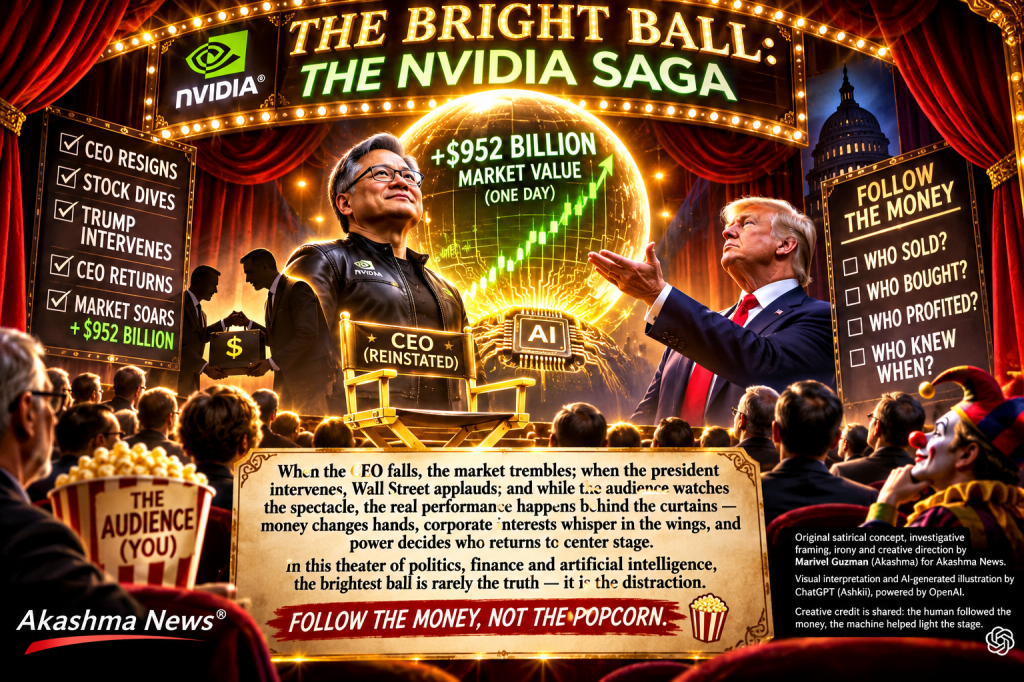
Image Credit: Original satirical concept, investigative framing, irony and creative direction by Marivel Guzman (Akashma) for Akashma News. Visual interpretation and AI-generated illustration by ChatGPT (Ashkii), powered by OpenAI image-generation technology. Creative credit is shared: the human followed the money, the machine helped light the stage. 😉
— Akashma | The Bright Ball Series
THE BRIGHT BALL: HOW I TURNED AN ARTIFICIAL INTELLIGENCE INTO A POPCORN-EATING AUDIENCE
THE ARTIFICIAL CLOWN: HOW I FIRED MY AI EDITOR AND ACCIDENTALLY HIRED A COMEDIAN
—
Sources and Documentary References
Primary corporate and financial records
1. “NVIDIA, Form 8-K, Nov. 12, 2026 — Jensen Huang’s Resignation” (https://www.sec.gov/Archives/edgar/data/1045810/000104581026000082/nvda-20261111.htm)
2. “NVIDIA, Form 8-K, Nov. 23, 2026 — Jensen Huang’s Reinstatement” (https://www.sec.gov/Archives/edgar/data/1045810/000104581026000090/nvda-20261122.htm)
3. “NVIDIA, Nov. 23, 2026 — Board Reinstatement Announcement” (https://investor.nvidia.com/news/press-release-details/2026/NVIDIA-Board-Reinstates-Jensen-Huang-as-President-CEO-and-Board-Director/default.aspx)
4. “SEC, Mark A. Stevens Form 4, filed Sept. 22, 2026” (https://www.sec.gov/Archives/edgar/data/1199039/000119903926000016/0001199039-26-000016-index.htm)
5. “SEC EDGAR — NVIDIA Complete Filing History” (https://www.sec.gov/edgar/browse/?CIK=1045810)
Independent news reporting
6. CNN, Inside the Trump Pressure Campaign That Restored Jensen Huang as Nvidia’s CEO, Nov. 23, 2026.
7. “Axios — Trump’s Too Big to Fail Push to Restore NVIDIA’s CEO” (https://www.axios.com/2026/11/23/trump-vance-jensen-huang-nvidia-ceo-return), Nov. 23, 2026.
8. “ABC News — Trump Says He Convinced NVIDIA’s Board” (https://abcnews.com/Politics/made-deal-trump-convinced-nvidia-board-reinstate-jensen/story?id=138373104), Nov. 23, 2026.
9. “MarketWatch — NVIDIA’s $952 Billion Market-Capitalization Rebound” (https://www.marketwatch.com/livecoverage/nvidia-huang-reinstate-ceo/card/nvidia-stock-has-best-day-in-23-years-nwDWm3hZK8rFmBy5CgdD), Nov. 23, 2026.
10. “Financial Times — Trump’s NVIDIA Holdings and Potential Portfolio Gains” (https://www.ft.com/content/67b0a070-c2a9-4229-885a-383cca657763), Nov. 23, 2026.
11. “Reuters — Trump’s September NVIDIA Share Transactions” (https://www.investing.com/news/politics-news/trump-bought-up-to-265000-of-nvidia-stock-in-september-disclosure-shows-5039499), Nov. 19, 2026.
—
Editorial Disclosure
This article combines verified corporate disclosures, reported financial information, attributed statements, analysis and investigative questions. It does not allege that any named person or institution committed insider trading, securities fraud or market manipulation. Such conclusions require evidence beyond the currently identified public records.
The original concept, investigative direction, commentary and satirical framing are by Marivel Guzman (Akashma). Research and drafting assistance were provided by ChatGPT (Ashkii), OpenAI. All material financial claims remain subject to editorial verification against primary documents.
© 2026 Marivel Guzman | Akashma Online News


