Archive
Corporate Neurotechnology and the Privatization of the Mind
By Marivel Guzman| Akashma News
Appendix F examines the private-sector machinery behind the emerging brain–computer interface economy. While government programs such as DARPA’s Silent Talk and Next-Generation Nonsurgical Neurotechnology programs reveal the military interest in neural systems, companies like Neuralink, Synchron, Meta, Kernel, Emotiv, and other neurotechnology firms represent the commercial side of the same frontier: the conversion of brain signals into data.
The central concern is not merely whether these devices can help people with paralysis, neurological injury, or communication loss. Those therapeutic possibilities are real and important. The deeper question is what happens when neural activity becomes measurable, transferable, patentable, and eventually monetized.
Brain–computer interfaces are being promoted as medical miracles, productivity tools, communication devices, and even future consumer platforms. But once thought-adjacent signals are captured by hardware, processed by artificial intelligence, and stored through corporate infrastructure, the mind enters the same economy that already transformed faces, voices, movements, purchasing habits, emotions, and social relationships into data commodities.
The danger is not science itself. The danger is ownership.
When private companies build the interface between the nervous system and the digital world, they also create new gatekeepers over human agency. A device first approved for medical restoration may later become the foundation for workplace monitoring, behavioral prediction, cognitive profiling, or neuro-advertising. History shows that technologies introduced under humanitarian language often migrate into security, labor, military, and consumer-control systems.
Neuralink’s public narrative centers on restoring movement and communication. Yet its broader ambition points toward human-AI integration. This language should be treated with seriousness. “Integration” is not a neutral word. It implies a future where the biological person and the artificial system are not merely interacting, but becoming operationally connected.
That future raises urgent questions:
Who owns neural data?
Who has access to it?
Can it be subpoenaed, hacked, sold, licensed, or analyzed for behavioral prediction?
Can a user truly consent when the device is necessary for speech, movement, employment, or medical care?
Can a human being unplug without losing social, economic, or physical function?
The privatization of neurotechnology may create a new form of dependency. The user does not simply own a device; the device may become part of the user’s body, identity, communication, and autonomy. Once that occurs, traditional consumer protections are insufficient. A brain interface is not like a phone. It is closer to a nervous-system extension.
Appendix F therefore argues that neural data must be treated as sacred biological information, not as ordinary consumer data. It belongs in the same moral category as DNA, medical records, private speech, and bodily autonomy — but with an even higher level of protection because it may reveal intention, impulse, emotional state, attention, and cognitive vulnerability.
The coming neurotechnology market must not be allowed to repeat the abuses of social media, surveillance capitalism, predictive policing, biometric databases, and behavioral advertising. The mind cannot become the next platform.
If neural sovereignty means anything, it means this:
No corporation should own the gateway to human thought.
No investor class should control the infrastructure of cognition.
No government should access neural data without strict constitutional protection.
No human being should be forced, pressured, or economically coerced into cognitive integration.
The brain is not a market.
The mind is not a device.
Consciousness is not infrastructure.
Appendix F establishes the corporate dimension of the Neural Sovereignty investigation: the moment when the battlefield moves from the body to the data stream, and from public defense research to private empire.
Keratin Serums — Beauty, Risk, and the Truth Behind “Silky” Promises
By Akashma News
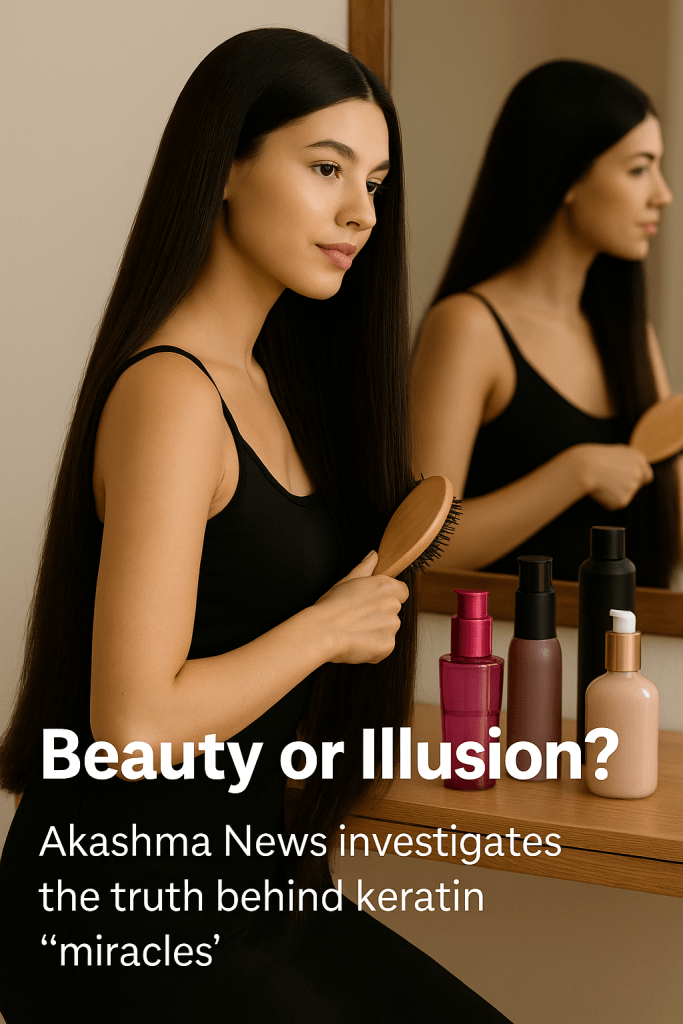
🧠 Introduction
The global “keratin serum” market is booming, promising salon-smooth hair, heat protection, and “reconstruction” in a bottle.
Yet most formulas simply coat the hair rather than repair it — using silicones, film-formers, and synthetic polymers.
Some are harmless; others contain irritants or even trace formaldehyde, raising concerns for long-term users and professionals.
This investigation compares four best-selling products on Amazon Mexico, rating ingredient safety from 1 (risky) to 10 (safe), focusing on health impact, scalp absorption, and environmental persistence.
🩰 1. Alfaparf Milano – Keratin Therapy Lisse Design
Claim: “-93% hair breakage, silky texture, protection from heat.”
Key ingredients:
Water, Amodimethicone, Dimethicone, Cyclopentasiloxane, Cyclohexasiloxane, Hydrolyzed Keratin, Collagen Amino Acids, Propylene Glycol, Panthenol, Tocopherol, Argan Oil, Fragrance.
Safety Ratings (1–10)
Category Ingredient Score Notes
Silicones Amodimethicone / Dimethicone 7 Non-toxic; buildup possible.
Volatile Silicones Cyclopentasiloxane (D5), Cyclohexasiloxane (D6) 6 Low human risk, but persistent in environment.
Proteins Hydrolyzed Keratin, Collagen Amino Acids 9 Surface-binding; safe.
Moisturizers Panthenol, Tocopherol, Argan Oil 9 Nourishing, antioxidant.
Solvent Propylene Glycol 7 Mild irritant to sensitive scalps.
Fragrance Parfum 5 Common sensitizer.
Verdict:
✨ Cosmetically effective, minimal risk when applied mid-length to ends.
Avoid direct scalp application to reduce buildup or irritation.
🌸 2. L’Oréal Professionnel – Liss Unlimited Serum
Claim: “Professional smoothing serum, anti-frizz, humidity protection.”
Key ingredients: Cyclopentasiloxane, Dimethiconol, C12-15 Alkyl Benzoate, Evening Primrose Oil, Kukui Oil, Alcohol Denat., Tocopherol, Ascorbyl Palmitate, Hexyl Cinnamal, Citronellol, Linalool.
Safety Ratings (1–10)
Category Ingredient Score Notes
Silicones Cyclopentasiloxane, Dimethiconol 7 Smooths hair; low absorption.
Emollients C12-15 Alkyl Benzoate 8 Soothes hair shaft; safe.
Natural Oils Evening Primrose & Kukui Oil 9 Omega-rich; safe.
Alcohol Alcohol Denat. 6 May dry scalp/hair if overused.
Vitamins Vitamin E & C Derivatives 9 Antioxidant protection.
Fragrance Components Hexyl Cinnamal, Linalool, Citronellol 4 High allergen potential for sensitive users.
Verdict:
🌿 Polishing serum with good-quality oils and vitamins.
⚠️ Avoid on scalp if sensitive to alcohol or fragrance.
Eco-impact moderate (volatile silicones).
☕3. INOAR – Moroccan Keratin Treatment (1 L)
Claim: “Deep repair and straightening with keratin and cocoa oil.”
Key ingredients: Hydrolyzed Keratin, Cocoa Butter, Cocoa Oil, Wheat Protein, Glyoxylic Acid, Citric Acid, Glycerin, Formaldehyde (0.2 %), Fragrance, Water.
Safety Ratings (1–10)
Category Ingredient Score Notes
Proteins Hydrolyzed Keratin & Wheat Protein 9 Replenish surface; safe.
Conditioners Cocoa Oil / Butter 9 Moisturizing, emollient.
Straightener Glyoxylic Acid 4 Alters keratin bonds; inhalation risk during heat application.
Preservative Formaldehyde (0.2%) 1 Known carcinogen, inhalation hazard, especially in heat treatments.
Fragrance Parfum 5 Sensitizer potential.
Humectant Glycerin 9 Safe.
Verdict:
⚠️ High-risk formula if heat-activated — formaldehyde vapors can irritate eyes, lungs, and skin.
Use only in ventilated professional settings; not safe for home use.
Score: 🚫 Overall 3/10 for health safety.
💫 4. TRESemmé – Keratin Smooth Smoothing Serum
Claim: “Eliminates frizz, adds shine, keratin-infused.”
Key ingredients: Cyclopentasiloxane, Cyclohexasiloxane, Dimethicone, Phenyl Trimethicone, Hydrolyzed Keratin, Aminopropyl Dimethicone, Fragrance.
Safety Ratings (1–10)
Category Ingredient Score Notes
Silicones Cyclopentasiloxane, Dimethicone 7 Surface coat; safe, non-absorbable.
Heavy Silicones Phenyl Trimethicone / Aminopropyl Dimethicone 6 Adds gloss; buildup risk.
Protein Hydrolyzed Keratin 9 Surface repair; safe.
Fragrance Parfum 5 Allergen potential.
Verdict:
⭐ Budget-friendly, silicone-heavy shine serum.
Low systemic risk but causes buildup if used daily without clarifying shampoo.
Score: Overall 7/10.
⚖️ Summary Table — Health & Environmental Safety
Brand / Product Key Concern Human Safety Eco Impact Overall Rating
Alfaparf Milano Fragrance buildup ✅ Safe ⚠️ Moderate (silicones) 8/10
L’Oréal Liss Unlimited Fragrance allergens, alcohol ✅ Safe ⚠️ Moderate 8/10
INOAR Moroccan Formaldehyde vapor hazard ❌ Unsafe for home use 🚫 Poor 3/10
TRESemmé Keratin Smooth Silicone buildup ✅ Safe ⚠️ Moderate
🌿 Consumer Guidance
💧 Avoid heat-activated “keratin straighteners” that contain formaldehyde or glyoxylic acid. These chemically alter hair and release irritant fumes.
✨ Choose leave-in serums with hydrolyzed proteins, vitamins, and plant oils — preferably silicone-free or low-silicone.
🌀 Clarify once weekly to prevent buildup if using silicones.
🌬️ Ventilate or use outdoors if any product instructs blow-drying or flat-ironing after application.
👃 Fragrance-sensitive users: opt for unscented or natural oil–based formulas.
🔍 Conclusion
Most “keratin serums” are safe surface treatments, not real reconstruction therapies.
Their results are optical — a smooth cuticle reflection, not molecular repair.
For true hair health, hydration and nutrition matter more than synthetic coating.
⚖️ Disclaimer – Fair Use and Educational Purpose
> Disclaimer:
This article is an independent consumer-awareness publication created for informational, educational, and journalistic purposes. Product names, trademarks, and images are used under the principles of nominative fair use and fair dealing for critique, commentary, and comparative analysis. Akashma News does not claim ownership of third-party trademarks or brand assets. All evaluations are based on publicly available information, product labels, and independent research. Readers are encouraged to consult professional stylists or dermatologists before using any cosmetic products mentioned herein.
—
🪶 Non-Affiliation Statement
Non-Affiliation Statement:
Akashma News and its contributors are not affiliated, endorsed, or sponsored by Alfaparf Milano, L’Oréal Paris, L’Oréal Professionnel, TRESemmé, INOAR, or any other brand mentioned in this report. All product references are made solely for identification and comparison within the context of public interest journalism.


