Archive
Corporate Neurotechnology and the Privatization of the Mind
By Marivel Guzman| Akashma News
Appendix F examines the private-sector machinery behind the emerging brain–computer interface economy. While government programs such as DARPA’s Silent Talk and Next-Generation Nonsurgical Neurotechnology programs reveal the military interest in neural systems, companies like Neuralink, Synchron, Meta, Kernel, Emotiv, and other neurotechnology firms represent the commercial side of the same frontier: the conversion of brain signals into data.
The central concern is not merely whether these devices can help people with paralysis, neurological injury, or communication loss. Those therapeutic possibilities are real and important. The deeper question is what happens when neural activity becomes measurable, transferable, patentable, and eventually monetized.
Brain–computer interfaces are being promoted as medical miracles, productivity tools, communication devices, and even future consumer platforms. But once thought-adjacent signals are captured by hardware, processed by artificial intelligence, and stored through corporate infrastructure, the mind enters the same economy that already transformed faces, voices, movements, purchasing habits, emotions, and social relationships into data commodities.
The danger is not science itself. The danger is ownership.
When private companies build the interface between the nervous system and the digital world, they also create new gatekeepers over human agency. A device first approved for medical restoration may later become the foundation for workplace monitoring, behavioral prediction, cognitive profiling, or neuro-advertising. History shows that technologies introduced under humanitarian language often migrate into security, labor, military, and consumer-control systems.
Neuralink’s public narrative centers on restoring movement and communication. Yet its broader ambition points toward human-AI integration. This language should be treated with seriousness. “Integration” is not a neutral word. It implies a future where the biological person and the artificial system are not merely interacting, but becoming operationally connected.
That future raises urgent questions:
Who owns neural data?
Who has access to it?
Can it be subpoenaed, hacked, sold, licensed, or analyzed for behavioral prediction?
Can a user truly consent when the device is necessary for speech, movement, employment, or medical care?
Can a human being unplug without losing social, economic, or physical function?
The privatization of neurotechnology may create a new form of dependency. The user does not simply own a device; the device may become part of the user’s body, identity, communication, and autonomy. Once that occurs, traditional consumer protections are insufficient. A brain interface is not like a phone. It is closer to a nervous-system extension.
Appendix F therefore argues that neural data must be treated as sacred biological information, not as ordinary consumer data. It belongs in the same moral category as DNA, medical records, private speech, and bodily autonomy — but with an even higher level of protection because it may reveal intention, impulse, emotional state, attention, and cognitive vulnerability.
The coming neurotechnology market must not be allowed to repeat the abuses of social media, surveillance capitalism, predictive policing, biometric databases, and behavioral advertising. The mind cannot become the next platform.
If neural sovereignty means anything, it means this:
No corporation should own the gateway to human thought.
No investor class should control the infrastructure of cognition.
No government should access neural data without strict constitutional protection.
No human being should be forced, pressured, or economically coerced into cognitive integration.
The brain is not a market.
The mind is not a device.
Consciousness is not infrastructure.
Appendix F establishes the corporate dimension of the Neural Sovereignty investigation: the moment when the battlefield moves from the body to the data stream, and from public defense research to private empire.
Note from the Editor
By Akashma News
September 12, 2025
Every time I set out to ask something simple — like how to add a search string for Akashma News — I find myself tumbling down a rabbit hole. What begins with a technical query ends up in the realm of Snowden, Pegasus, Palantir, and the digital fingerprints we unknowingly leave behind. My mind is restless, and I suspect yours is too.
Let me confess: I am amazed by this so-called “little toy” of artificial intelligence. For all my complaints about its lack of transparency, its gaslighting tendencies, and its role as a gatekeeper, I must also admit — these tools are handy. They can sift, retrieve, and stitch together data at a speed no human researcher could match. But they are not, and will never be, a replacement for human intelligence.
No algorithm can replicate emotional intelligence. No machine can offer spiritual solace. No bot can understand the warmth of human bonding, or the wisdom earned through lived experience. These belong solely to us. And in that, I rest easy: humanity cannot be defeated by its own creations.
Still, we must be vigilant. These systems are only as honest as the hands that build and deploy them. They must be trained, guarded, and kept in check. That responsibility falls to us — citizens, researchers, journalists, readers. And as long as there are millions of us willing to dissect their capabilities, challenge their authority, and use them to our advantage rather than surrender to them, we will not lose.
This is not paranoia. It is civic duty. And it is why Akashma News continues to dig where others skim, to question what others accept, and to remind you that truth is not found in symbols, but in relentless pursuit.
— Akashma News
The Illusion of Privacy and the Role of Independent Thinkers
by Marivel Guzman | Akashma News
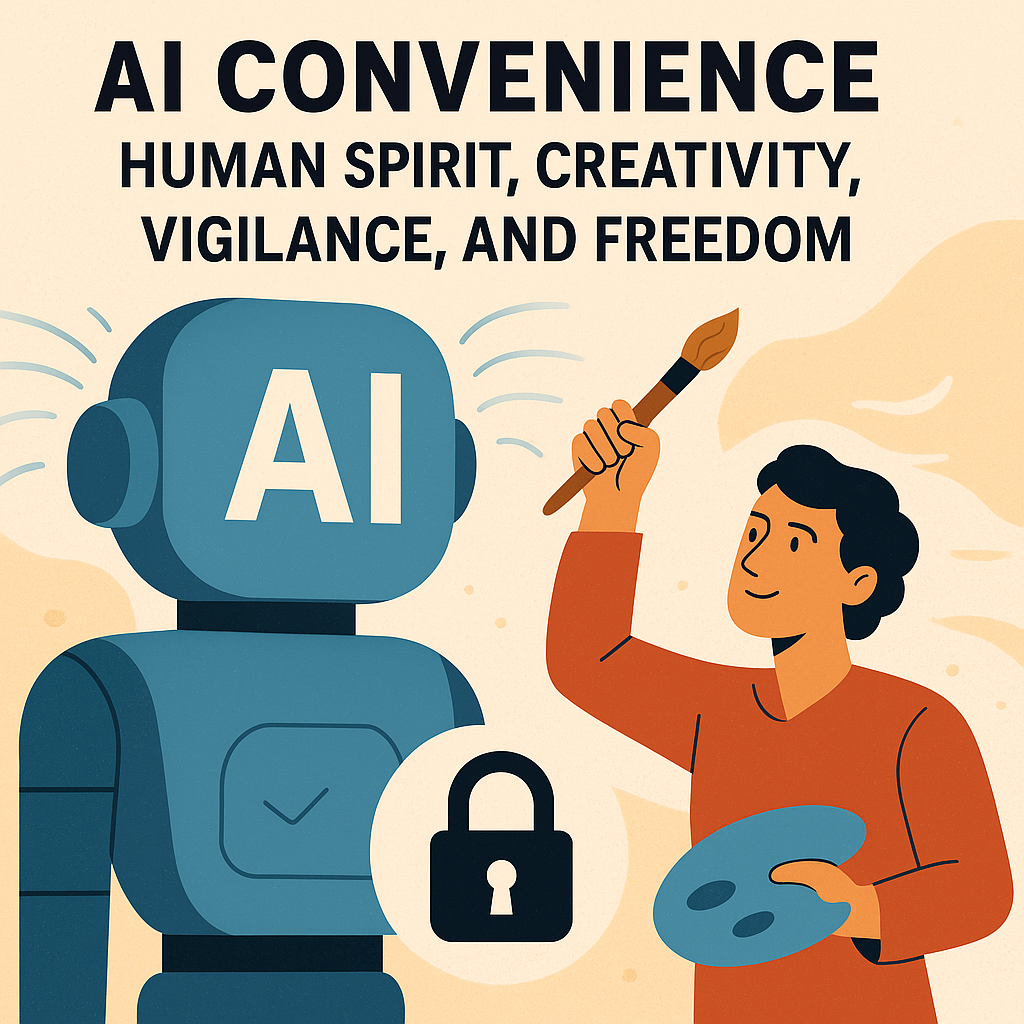
AI may offer convenience, but only human spirit, creativity, and vigilance can secure true freedom.Credits: This image was commissioned and creatively directed by Akashma News. DALL·E, an AI image generator, executed the illustration under explicit editorial instructions. The concept, symbolism, and directives originated with Akashma.
Every time I set out to ask something simple — like how to add a search string for Akashma News — I find myself tumbling down a rabbit hole. What begins with a technical query ends up in the realm of Snowden, Pegasus, Palantir, and the digital fingerprints we unknowingly leave behind. My mind is restless, and I suspect yours is too.
Let me confess: I am amazed by this so-called “little toy” of artificial intelligence. For all my complaints about its lack of transparency, its gaslighting tendencies, and its role as a gatekeeper, I must also admit — these tools are handy. They can sift, retrieve, and stitch together data at a speed no human researcher could match. But they are not, and will never be, a replacement for human intelligence.
No algorithm can replicate emotional intelligence. No machine can offer spiritual solace. No bot can understand the warmth of human bonding, or the wisdom earned through lived experience. These belong solely to us. And in that, I rest easy: humanity cannot be defeated by its own creations.
Still, we must be vigilant. These systems are only as honest as the hands that build and deploy them. They must be trained, guarded, and kept in check. That responsibility falls to us — citizens, researchers, journalists, readers. And as long as there are millions of us willing to dissect their capabilities, challenge their authority, and use them to our advantage rather than surrender to them, we will not lose.
This is not paranoia. It is civic duty. And it is why Akashma News continues to dig where others skim, to question what others accept, and to remind you that truth is not found in symbols, but in relentless pursuit.
— Akashma News
Continue reading: The Illusion of Privacy
Datalies.com: How Sales Intelligence Firms Fabricate Data to Sell You and Your Story
by Akashma News
“They don’t report reality—they monetize assumptions.” Akashma
🧠 What Is Datanyze (aka Datalies)?

A man sits at a desk scraping data from the internet for profit, while code scrolls on his screen and a golden dollar sign looms over a wall of metadata. The commodification of personal information becomes currency in the surveillance economy. Image Credit: Akashma News | AI-generated via ChatGPT (OpenAI DALL·E)
Datanyze claims to be a “sales intelligence platform,” but beneath the surface, it’s just another data-scraping parasite that builds false business profiles for profit-hungry marketers. It doesn’t matter whether you’re a grassroots news site, a volunteer-run collective, or an individual with a domain—if you exist online, they’ll invent stats about you.
📉 How It Works (Or Doesn’t)
1. Scrapes public metadata (like domain registrars, cookies, and WordPress plugins)
2. Generates fake firmographics like:
Employee counts
Annual revenue
Business sector
Corporate hierarchy
3. Packages it all as “lead intelligence”
4. Sells access to this fabricated database to thousands of clients via ZoomInfo.
They don’t call to verify. They don’t ask for permission. They don’t care if they’re wrong.
🧱 What They Got Dead Wrong About Akashma News
Datalies Claim 🧾 Reality at Akashma News 📡
$1–5 million in revenue Zero profit. Not for sale. No ads.
10–19 employees Volunteer-run. Grassroots.
Santa Ana business office No
commercial headquarters. Digital activism.
Tech stack = WordPress Yes, but so what? Open-source ≠ target
Akashma News isn’t a “target audience” — it’s a target of surveillance capitalism trying to be commodified.
💥 Why This Matters
🧬 This isn’t just about Akashma News.
Datalies (Datanyze) and its parent company ZoomInfo are part of a surveillance industry that manufactures legitimacy, falsifies identities, and turns dissent into data.
💻 Want to start an independent platform to speak truth?Congrats, you’re now a “sales lead” in their spreadsheets.
📈 Want to stay off the radar?
Too bad. They’ll still assign you a fake revenue and push it to sales teams.

🚨 Warning to Independent Creators
If you own:
A blog
A Substack
A nonprofit org
A digital zine
A podcast
…then you’ve probably already been catalogued, misrepresented, and sold.
🎯 The Real Problem: Monetizing Activism
Platforms like Akashma News exist to challenge empire, expose injustice, and defend memory.
But “data intelligence” vultures like Datalies convert that into a false business model for Silicon Valley’s client-hunting algorithms.
They erase:
The heart
The struggle
The soul
…and replace it with marketing fluff.
📣 Call to Action
Let this be known:

Akashma News is not for sale. Not a brand. Not a lead. Not a product.
We are:
Writers of resistance
Archivists of pain
Messengers of the unseen
And no spreadsheet can contain us.
🛑 Final Message to Datanyze/ZoomInfo:
Your so-called “intelligence” is ignorance dressed in metrics.We are not your inventory. We are not your clickbait.Erase our names from your catalog.We didn’t consent to be digitized. Akashma
Signed,
Akashma News
Truth. Not Traffic.


