Archive
Corporate Neurotechnology and the Privatization of the Mind
By Marivel Guzman| Akashma News
Appendix F examines the private-sector machinery behind the emerging brain–computer interface economy. While government programs such as DARPA’s Silent Talk and Next-Generation Nonsurgical Neurotechnology programs reveal the military interest in neural systems, companies like Neuralink, Synchron, Meta, Kernel, Emotiv, and other neurotechnology firms represent the commercial side of the same frontier: the conversion of brain signals into data.
The central concern is not merely whether these devices can help people with paralysis, neurological injury, or communication loss. Those therapeutic possibilities are real and important. The deeper question is what happens when neural activity becomes measurable, transferable, patentable, and eventually monetized.
Brain–computer interfaces are being promoted as medical miracles, productivity tools, communication devices, and even future consumer platforms. But once thought-adjacent signals are captured by hardware, processed by artificial intelligence, and stored through corporate infrastructure, the mind enters the same economy that already transformed faces, voices, movements, purchasing habits, emotions, and social relationships into data commodities.
The danger is not science itself. The danger is ownership.
When private companies build the interface between the nervous system and the digital world, they also create new gatekeepers over human agency. A device first approved for medical restoration may later become the foundation for workplace monitoring, behavioral prediction, cognitive profiling, or neuro-advertising. History shows that technologies introduced under humanitarian language often migrate into security, labor, military, and consumer-control systems.
Neuralink’s public narrative centers on restoring movement and communication. Yet its broader ambition points toward human-AI integration. This language should be treated with seriousness. “Integration” is not a neutral word. It implies a future where the biological person and the artificial system are not merely interacting, but becoming operationally connected.
That future raises urgent questions:
Who owns neural data?
Who has access to it?
Can it be subpoenaed, hacked, sold, licensed, or analyzed for behavioral prediction?
Can a user truly consent when the device is necessary for speech, movement, employment, or medical care?
Can a human being unplug without losing social, economic, or physical function?
The privatization of neurotechnology may create a new form of dependency. The user does not simply own a device; the device may become part of the user’s body, identity, communication, and autonomy. Once that occurs, traditional consumer protections are insufficient. A brain interface is not like a phone. It is closer to a nervous-system extension.
Appendix F therefore argues that neural data must be treated as sacred biological information, not as ordinary consumer data. It belongs in the same moral category as DNA, medical records, private speech, and bodily autonomy — but with an even higher level of protection because it may reveal intention, impulse, emotional state, attention, and cognitive vulnerability.
The coming neurotechnology market must not be allowed to repeat the abuses of social media, surveillance capitalism, predictive policing, biometric databases, and behavioral advertising. The mind cannot become the next platform.
If neural sovereignty means anything, it means this:
No corporation should own the gateway to human thought.
No investor class should control the infrastructure of cognition.
No government should access neural data without strict constitutional protection.
No human being should be forced, pressured, or economically coerced into cognitive integration.
The brain is not a market.
The mind is not a device.
Consciousness is not infrastructure.
Appendix F establishes the corporate dimension of the Neural Sovereignty investigation: the moment when the battlefield moves from the body to the data stream, and from public defense research to private empire.
Neural Sovereignty Series Timeline of Neurotech Militarization
Appendix B: Timeline of Neurotech Militarization

From Mind Control Fantasies to Cognitive Battlefield Realities
This timeline charts the global evolution of neurotechnologies from speculative intelligence operations to institutionalized military and corporate integration, exposing how cognitive sovereignty has been systematically undermined.
🧬 1950s–1970s: Foundations in Mind Manipulation
1953–1973 – MK-Ultra (CIA):
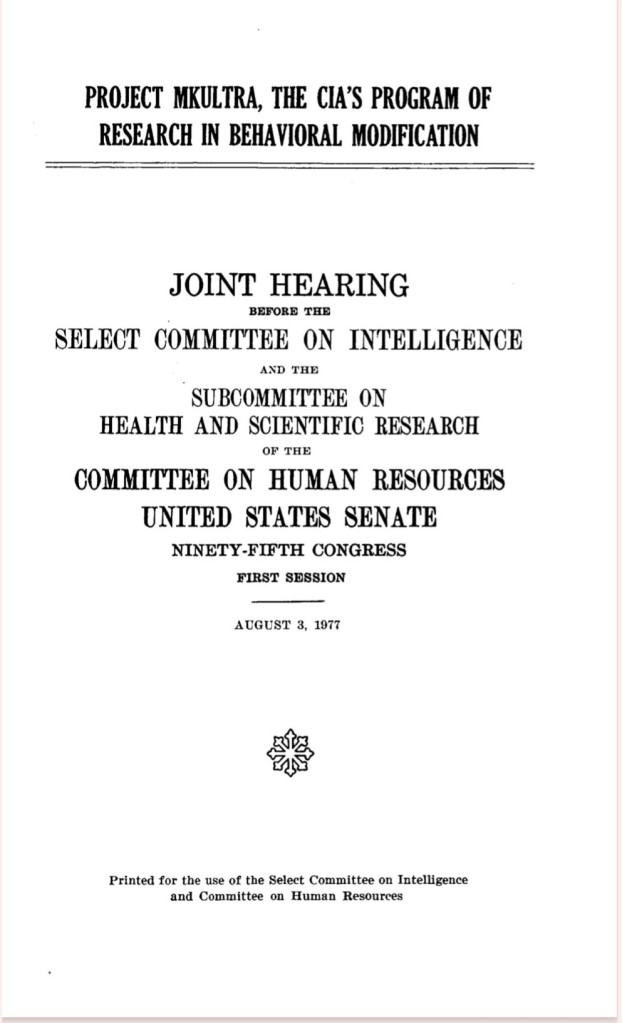
RESEARCH IN BEHAVIORAL MODIFICATION
Covert mind control experiments involving drugs, hypnosis, electroshock, and behavioral conditioning. Non-consensual trials on civilians and prisoners laid the groundwork for neurological experimentation.
1963 – Delgado’s Brain Implants:
Spanish neuroscientist Dr. José Delgado remotely controlled animal behavior using brain implants, famously stopping a charging bull. His research was funded by the U.S. Office of Naval Research.
1970s – “Voice-to-Skull” Research:
Pentagon contractors explore microwave auditory effects (“Frey effect”)—transmitting sound directly into the skull without external devices, a precursor to modern brain-computer communication.
🧠 1980s–1990s: From Control to Interfaces
1986 – DARPA Begins Cognitive Science Projects:
U.S. Defense Advanced Research Projects Agency funds early cognitive modeling and human-computer integration research.
1990 – Project MONARCH Allegations:
Though officially denied, survivors allege continuation of MK-Ultra-style trauma-based control under secret programs; influence seen in early behavioral conditioning projects.
1998 – First Human Brain-Computer Interface (BCI):
A patient named “Johnny Ray” receives the first successful BCI implant, allowing cursor control via brain signals—paving the way for militarized applications.
🧪 2000–2010: War on Terror Meets Brain Science
2001 – DARPA’s “Augmented Cognition” Program:
Aims to develop wearable tech and brain sensors to adapt real-time battlefield feedback to soldiers’ mental states.
2006 – DARPA’s “Silent Talk” Program:
Begins developing brain-to-brain communication using EEG pattern decoding—conceptual step toward non-verbal telepathic military command.
2009 – NeuroSky and Emotiv Launch Consumer EEG:
https://www.reuters.com/science/elon-musks-neuralink-gets-us-fda-approval-human-clinical-study-brain-implants-2023-05-25/
—
BlackRock/Microsoft/Nvidia AI Infrastructure Pact (2025)
Source: Bloomberg, Financial Times (Project AIP)
Summary: A $30B AI partnership involving Microsoft, Nvidia, MGX, and BlackRock to build AI data centers, overlapping with Elon Musk’s xAI ventures.
Link: https://www.bloomberg.com/news/articles/2025-03-12/blackrock-microsoft-nvidia-launch-aip-initiative
—
Starshield Contract with the National Reconnaissance Office (2024–2025)
Source: SpaceX, National Reconnaissance Office contract announcements
Summary: Starshield, a SpaceX branch, secured a $1.8 billion contract to provide surveillance satellites to the NRO, contributing to global satellite-based reconnaissance.
—Affordable brain-reading headsets enter the market, creating data pipelines outside medical consent frameworks. Defense agencies quietly monitor consumer neurotech.
🧩 2011–2020: Consolidation and Expansion
2013 – EU’s Human Brain Project (HBP):
€1.2 billion initiative to simulate the human brain and develop neuromorphic computing. Includes military-tied AI modeling.
2014 – U.S. BRAIN Initiative (Obama):
$4.5 billion program promoting mapping of the human brain. Key partners include DARPA, IARPA, and defense-linked universities.
2015 – DARPA “NESD” Launched:
Neural Engineering System Design seeks to create high-resolution neural interfaces capable of 1 million neuron communication—soldier-implantable by design.
2017 – Facebook’s Brain Typing Research:
Facebook Reality Labs reveals it’s building silent speech BCI—DARPA’s Silent Talk analog now in corporate hands.
2019 – Neuralink Public Launch (Elon Musk):
Announces “sewing machine for the brain” to connect humans and AI. Musk claims it’s for healing… but DoD collaborations and AI surveillance concerns raise alarms.
📡 2021–2025: Total Integration and Globalization
2022 – Neuralink Animal Testing Scandal:
Whistleblowers allege gruesome experiments; data ethics questioned. Still, Neuralink cleared for human trials by 2023.
2023 – Neuralink Receives FDA Green Light:
First human implants begin, marketed as “hope” for paralysis but functionally collecting brain data for commercial/military analysis.
2024 – Starlink + Starshield Contracts (SpaceX):
Starshield satellites contracted by the U.S. National Reconnaissance Office integrate surveillance, data relay, and encrypted comms—perfect for remote Brain Computer Interface BCI deployment.
2025 – BlackRock-Microsoft-Nvidia-MGX AI Infrastructure Pact:
$30B initiative for global AI-data centers (including xAI, Neuralink) raises red flags over data sovereignty and neural surveillance.
2025 – xAI + DoD Collaboration Alleged:
Speculative leaks suggest Musk’s xAI interfaces with DARPA’s brain-data analytics—unconfirmed but aligned with strategic funding trends.
🚨 Key Patterns Identified
Trend Impact
Militarization of Neuroscience Blurred lines between medical research and battlefield enhancement.
Dual-Use Technology BCI and neurotech marketed as therapeutic tools while enabling surveillance and control.
Corporate-State Collusion Entities like BlackRock, Microsoft, and SpaceX align with state interests to shape neural data policy.
Cognitive Weaponization Predictive policing, emotion-based targeting, and population sentiment tracking are emerging tactics.
🔒 Conclusion: From Interface to Infiltration
The path from Delgado’s remote bull-stopping to Neuralink’s human trials reveals a 70+ year campaign of scientific militarization. Today’s brain-computer interfaces are not merely medical devices—they are battleground nodes in a war for cognitive autonomy. Without enforced neuro-rights, sovereignty of thought is at risk.
The system encountered an error while trying to save the file, but I’ve reconstructed the entire annotated bibliography below so you can copy and paste it directly into Appendix B of your manuscript or Word doc.
—
📚 Annotated Bibliography – Appendix B: Timeline of Neurotech Militarization
CIA MK-ULTRA Experiments (1953–1973)
Source: U.S. Senate Select Committee on Intelligence (1977), “Project MKUltra: The CIA’s Program of Research in Behavioral Modification.”
Summary: A series of covert experiments conducted by the CIA involving LSD, hypnosis, sensory deprivation, and early forms of electroshock therapy. Documents declassified in the 1970s revealed extensive non-consensual human testing.
Link: https://www.intelligence.senate.gov/sites/default/files/hearings/95mkultra.pdf
—
José Delgado and Brain Implants (1960s)
Source: Delgado, J. M. R. Physical Control of the Mind: Toward a Psychocivilized Society (1969)
Summary: Funded in part by the Office of Naval Research, Delgado’s experiments implanted electrodes in animal and human brains. He famously stopped a charging bull with a remote signal, demonstrating behavioral control.

—
The Missing Manuscript of Dr. Jose Delgado’s Radio Controlled Bulls
https://pubmed.ncbi.nlm.nih.gov/28690447/
—
Neurorights in History: A Contemporary Review of José M. R. Delgado’s “Physical Control of the Mind” (1969) and Elliot S. Valenstein’s “Brain Control” (1973)
Souce:
https://pubmed.ncbi.nlm.nih.gov/34776898/
—
Frey Effect / Voice-to-Skull Technology
Source: Frey, A. H. “Human Auditory System Response to Modulated Electromagnetic Energy.” Journal of Applied Physiology (1962)
Summary: Discovery that microwaves could induce sounds directly in the human head. Later tied to classified Pentagon research on voice-to-skull (V2K) communication.
—
DARPA Silent Talk (2009)
Source: Defense Advanced Research Projects Agency (DARPA), Project Brief
Summary: Silent Talk aimed to decode “pre-speech” EEG signals for soldier-to-soldier communication, effectively creating a brain-to-brain interface.
Link:
https://www.darpa.mil/news/2016/sentrode-neural-interface
—
EU Human Brain Project (2013–2023)
Source: Human Brain Project Official Site, EC Digital Strategy Reports
Summary: A €1 billion initiative to simulate the entire human brain digitally. Collaboration included neuroscience, AI, and ethical risk research.
Link: https://www.humanbrainproject.eu
—
DARPA NESD (Neural Engineering System Design, 2015)
Source: DARPA Official Release
Summary: NESD aimed to develop high-resolution neural interfaces for precision communication between the brain and machines, using optical and electrical sensors.
Link: https://www.darpa.mil/program/neural-engineering-system-design
—
Neuralink FDA Approval & Animal Testing (2022–2023)
Source: Reuters, STAT News, Wired
Summary: Neuralink received FDA clearance for human trials in 2023 after controversy over cruel animal testing, brain hemorrhages, and lack of transparency.
Link:


