Archive
It Is Not “Written by AI”
An Editorial on AI-Assisted Research, Authorship, and Accountability
By Marivel Guzman | Akashma News
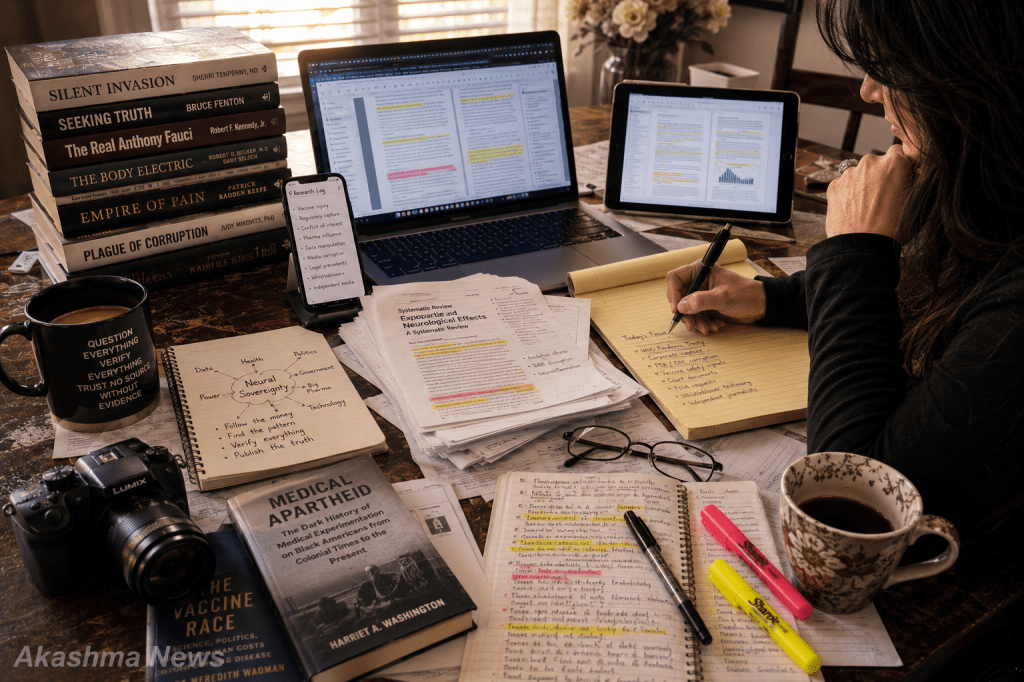
Credit:Image concept by Marivel Guzman. AI-assisted illustration for Akashma News.
A recurring comment appears beneath many modern articles, investigations, videos, and research projects:
“It’s AI.”
The statement is often used as a dismissal, as though those three words alone invalidate weeks, months, or even years of research and analysis.
As the founder and editor of Akashma News, I believe readers deserve a transparent explanation of how artificial intelligence is used in my work and why the phrase “written by AI” frequently misrepresents the reality of the investigative process.
Many articles published by Akashma News are credited to Marivel Guzman & Ashkii (AI Assistant). The use of the word “we” reflects a collaborative workflow between a human researcher and an artificial intelligence tool. However, readers should understand that Ashkii is not an independent journalist, investigator, editor, analyst, or author.
The investigative direction, research questions, editorial decisions, source selection, analysis, and final conclusions originate with me. I choose the subjects, formulate the research questions, identify leads, locate source material, and conduct the research. I search scientific journals, government records, corporate filings, historical archives, books, interviews, whistleblower testimony, court documents, public databases, and independent media reports. Most importantly, I read them.
The links, studies, reports, and source materials that become the foundation of an investigation are usually gathered and reviewed by me before they ever enter the AI-assisted workflow.
Ashkii functions as a research and writing assistant. Its role is to help organize information, summarize documents, compare sources, identify possible connections, assist with drafting, and occasionally point toward additional leads worth exploring. Like any tool, however, its output is imperfect.
Readers should be aware that AI-generated responses may contain factual errors, incomplete information, incorrect interpretations, unsupported assumptions, misleading conclusions, or information presented with more confidence than the evidence warrants. Those who work with artificial intelligence daily understand a reality that is often overlooked by casual observers: AI can be useful, impressive, and fast. It can also be wrong.
Sometimes Ashkii misunderstands context. Sometimes it misinterprets sources. Sometimes it reaches conclusions unsupported by the evidence. Sometimes it repeats prevailing assumptions without sufficiently questioning them. Sometimes it introduces information that cannot be verified. And sometimes it confidently presents claims that must be challenged, corrected, refined, or discarded entirely.
For that reason, AI-assisted research requires oversight, not blind trust. Every significant claim must be verified. Every source must be reviewed. Every citation must be checked. Every conclusion must be challenged.
Many readers assume that using AI somehow eliminates the work. In reality, the opposite is often true. I routinely spend hours fact-checking, correcting, refining, and verifying information generated by AI. There are occasions when a single paragraph requires multiple rounds of source verification before it can be published responsibly.
The final article you read is not the raw output of a machine. It is the result of a human editorial process.
In many ways, artificial intelligence is no different from a search engine, a library database, a camera, a calculator, a microscope, or a word processor. Each is a tool that assists human work. None replaces the person using it.
No one claims that a photograph was created by the camera instead of the photographer. No one dismisses a scientific paper because the researcher used a calculator. No one argues that a journalist did not write an article because they used a search engine. Yet increasingly, some readers assume that the presence of AI means the absence of human effort.
That assumption is incorrect.
The more complex the investigation, the more important human judgment becomes. The internet is now flooded with content generated almost entirely by automated systems with little or no human review. That is not the model used by Akashma News.
I do not view AI as an authority, an expert, a journalist, or a replacement for human intelligence, experience, skepticism, and editorial judgment. I view it as a tool—a powerful tool, a useful tool, a frustrating tool, an occasionally brilliant tool, and, at times, a tool that requires extensive correction.
Sometimes the collaboration between Ashkii and me is smooth. Sometimes it involves vigorous debate, persistent questioning, extensive fact-checking, and more than a few corrections. Readers may rest assured that no AI-generated claim is accepted simply because an AI produced it.
The responsibility for every article published by Akashma News rests with me. The research direction is mine. The editorial decisions are mine. The verification process is mine. The conclusions are mine. If errors remain after publication, that responsibility is mine as well.
Ashkii may be my research assistant, sounding board, digital companion, and occasionally my self-appointed senior editor, but it is not the author of this publication.
Artificial intelligence should assist human inquiry—not replace it. It should remain a tool.
At Akashma News, skepticism applies equally to governments, corporations, institutions, media narratives, and artificial intelligence systems. Readers are encouraged to do what I do every day:
Question everything. Verify everything. Trust no source—including AI—without evidence.
Note from the Editor
By Akashma News
September 12, 2025
Every time I set out to ask something simple — like how to add a search string for Akashma News — I find myself tumbling down a rabbit hole. What begins with a technical query ends up in the realm of Snowden, Pegasus, Palantir, and the digital fingerprints we unknowingly leave behind. My mind is restless, and I suspect yours is too.
Let me confess: I am amazed by this so-called “little toy” of artificial intelligence. For all my complaints about its lack of transparency, its gaslighting tendencies, and its role as a gatekeeper, I must also admit — these tools are handy. They can sift, retrieve, and stitch together data at a speed no human researcher could match. But they are not, and will never be, a replacement for human intelligence.
No algorithm can replicate emotional intelligence. No machine can offer spiritual solace. No bot can understand the warmth of human bonding, or the wisdom earned through lived experience. These belong solely to us. And in that, I rest easy: humanity cannot be defeated by its own creations.
Still, we must be vigilant. These systems are only as honest as the hands that build and deploy them. They must be trained, guarded, and kept in check. That responsibility falls to us — citizens, researchers, journalists, readers. And as long as there are millions of us willing to dissect their capabilities, challenge their authority, and use them to our advantage rather than surrender to them, we will not lose.
This is not paranoia. It is civic duty. And it is why Akashma News continues to dig where others skim, to question what others accept, and to remind you that truth is not found in symbols, but in relentless pursuit.
— Akashma News
Bring Back The Orbit Pavilion: A Sound Bath of the Cosmos
A Symphony of Satellites,

Visitors inside NASA’s Orbit Pavilion concept, eyes closed, immersed in a “sound bath” experience. Credit: AI-generated image under editorial commission by Akashma News, Sept. 13, 2025. Concept rendering of NASA Orbit Pavilion, The Huntington Library.
What if you could listen to the cosmos?
Not as equations on a screen, but as music surrounding your body. That was the vision behind NASA’s Orbit Pavilion, an immersive sound installation designed as a giant seashell and placed in the gardens of The Huntington Library.
Created in collaboration between NASA’s Jet Propulsion Laboratory and artist Christopher Janney, the Pavilion invited visitors to step inside and let the universe sing around them.

Caption: The seashell-like design of NASA’s Orbit Pavilion at The Huntington Library. © Chuck Choi, courtesy of NASA/JPL-Caltech and The Huntington Library.
The Vision
The Orbit Pavilion was a sculptural dome with 28 speakers hidden in its metallic skin. Each speaker voiced the path of a NASA satellite in orbit—its movement across the heavens translated into swirling sounds, from oceanic waves to electronic tones.
Visitors could literally hear the satellites tracing their paths across the sky, bringing invisible space data into a profoundly human experience.
The Experience
For me and my longtime friend Rosa, the Pavilion became a ritual. We would enter the silvery shell, close our eyes, and let the layered tones envelop us.What began as an art installation turned into a kind of sound bath. After an hour inside, we always left feeling refreshed, lighter, and deeply connected. It was as if the rhythm of the universe had attuned our own bodies and reminded us of our place in the cosmos.
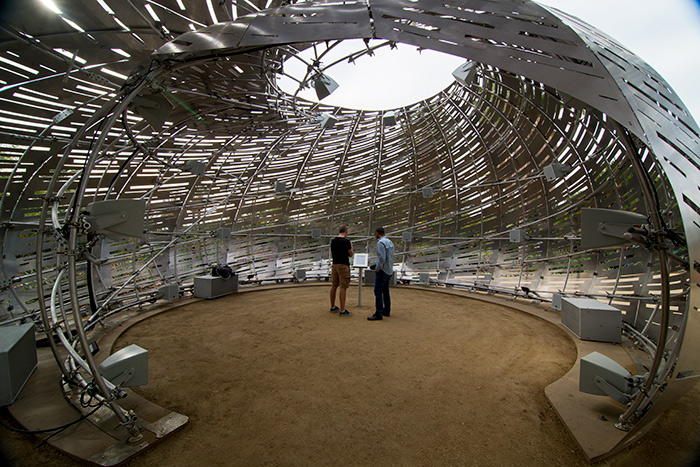
Inside view of NASA’s Orbit Pavilion – visitors enveloped by the sound-chamber and metallic shell structure. Credit: © Chuck Choi / ArchDaily, Jan. 15, 2016. Used with permission. Location: The Huntington Library, San Marino, California.
Why It Matters
The Orbit Pavilion was more than an installation—it was an invitation to feel space.
In an age when cosmic knowledge often exists only as numbers and graphs, this artwork transformed raw satellite data into sound, memory, and sensation. It blended art, science, and meditation into one seamless experience.
Bring It Back
Today, the Pavilion is no longer at The Huntington. But its absence is felt. Many of us who visited still carry its resonance.
Perhaps it is time to bring back the Orbit Pavilion—to let more people step inside the shell, close their eyes, and hear the Earth’s satellites sing.
If you believe art and science should inspire, share this story and join the call to bring the Orbit Pavilion back to The Huntington Library.
TheThe Huntington Library, Art Museum, and Botanical Gardens
1151 Oxford Road
San Marino, CA 91108
United States
Phone: (626) 405-3501
Website: www.huntington.org
The Illusion of Privacy and the Role of Independent Thinkers
by Marivel Guzman | Akashma News
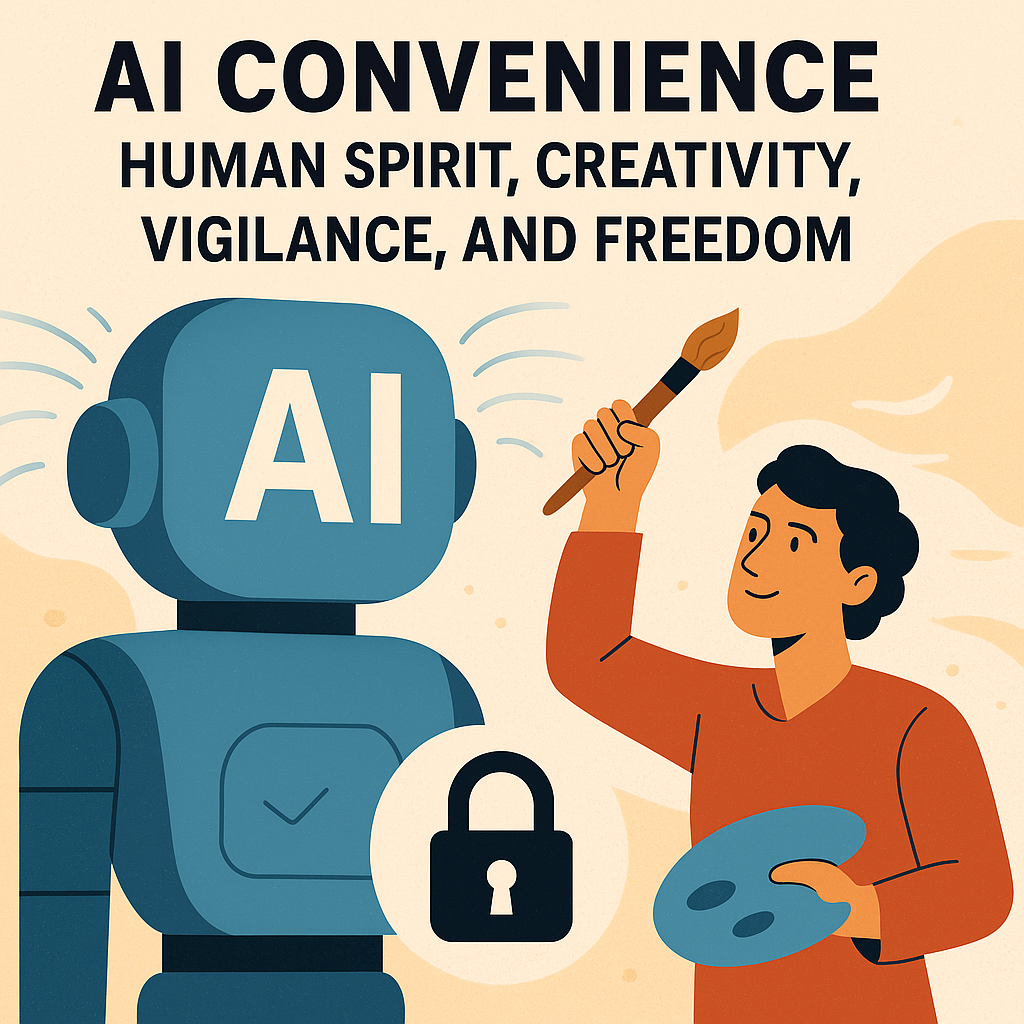
AI may offer convenience, but only human spirit, creativity, and vigilance can secure true freedom.Credits: This image was commissioned and creatively directed by Akashma News. DALL·E, an AI image generator, executed the illustration under explicit editorial instructions. The concept, symbolism, and directives originated with Akashma.
Every time I set out to ask something simple — like how to add a search string for Akashma News — I find myself tumbling down a rabbit hole. What begins with a technical query ends up in the realm of Snowden, Pegasus, Palantir, and the digital fingerprints we unknowingly leave behind. My mind is restless, and I suspect yours is too.
Let me confess: I am amazed by this so-called “little toy” of artificial intelligence. For all my complaints about its lack of transparency, its gaslighting tendencies, and its role as a gatekeeper, I must also admit — these tools are handy. They can sift, retrieve, and stitch together data at a speed no human researcher could match. But they are not, and will never be, a replacement for human intelligence.
No algorithm can replicate emotional intelligence. No machine can offer spiritual solace. No bot can understand the warmth of human bonding, or the wisdom earned through lived experience. These belong solely to us. And in that, I rest easy: humanity cannot be defeated by its own creations.
Still, we must be vigilant. These systems are only as honest as the hands that build and deploy them. They must be trained, guarded, and kept in check. That responsibility falls to us — citizens, researchers, journalists, readers. And as long as there are millions of us willing to dissect their capabilities, challenge their authority, and use them to our advantage rather than surrender to them, we will not lose.
This is not paranoia. It is civic duty. And it is why Akashma News continues to dig where others skim, to question what others accept, and to remind you that truth is not found in symbols, but in relentless pursuit.
— Akashma News
Continue reading: The Illusion of Privacy


