Archive
From Gaza to Mars
By Marivel Guzman | Akashma News
Congratulations, Loay!
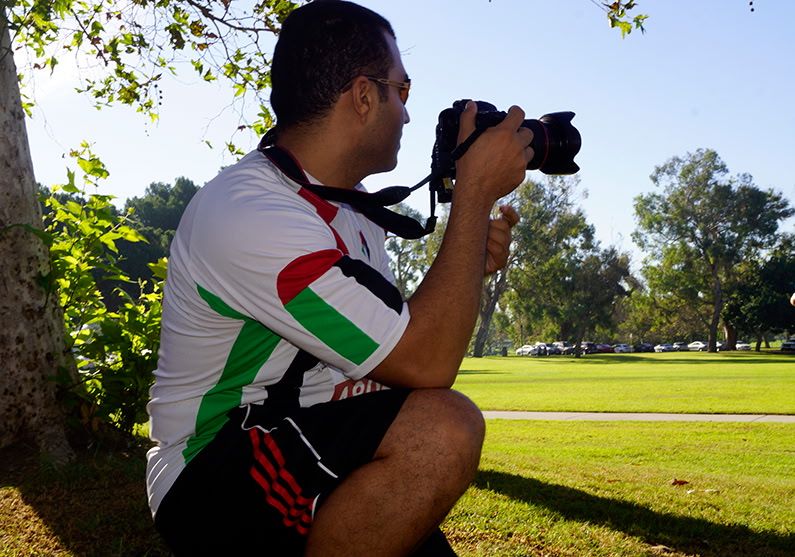
May Allah always keep you safe, protect you from envy, and keep your path open and free of obstacles. I am deeply proud to have had the privilege of meeting you and of witnessing your extraordinary journey. Palestine has long held a special place in my heart — through my family, my children’s Palestinian heritage, and my own commitment as a peace activist — which makes your success feel profoundly personal and deeply meaningful to me.
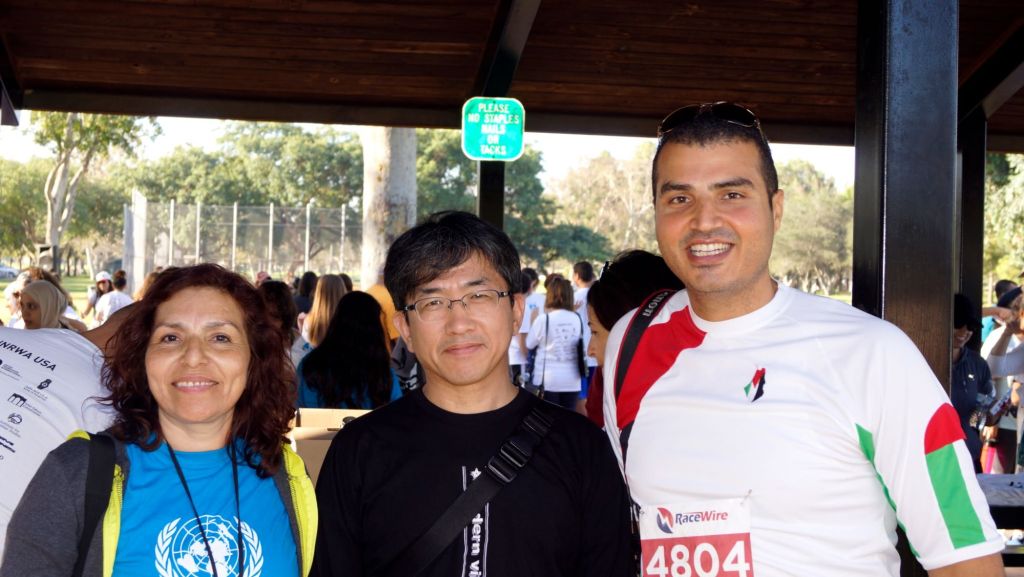
At one point, we posed together with Don Kim, a Japanese reporter who was also covering the event. It was an ordinary, candid moment — three people with cameras, from different backgrounds, brought together by one common reason: Palestine. In 2015, events focused on Palestinian struggles received little attention from mainstream media, which made our presence there, documenting a race dedicated to Gaza, feel especially meaningful.
I had no idea that the young Palestinian standing beside us was an engineer whose work would later become part of one of the most remarkable achievements in modern aerospace history.
Looking at this photograph now, more than a decade later, gives that moment an entirely different meaning. I am simply grateful that our paths crossed before I knew the extraordinary road his life and career would take.
Elbasyouni’s journey took root in Bayt Hanun, Gaza. He was born in Germany while his father was pursuing his medical education, but his family’s roots are in Palestine, where he grew up and attended UNRWA schools. Despite political instability, interruptions to his education, financial hardship and the enormous challenges of eventually beginning again in another country, he persevered.
He became an accomplished electrical engineer and was part of the team behind NASA’s Mars Ingenuity Helicopter, serving as the electrical and power electronics lead.
The achievement was extraordinary: Ingenuity’s rotor system operated in the extremely thin Martian atmosphere, while Loay’s electrical and power systems helped make sustained, controlled flight possible.
His work contributed to the historic first powered, controlled flight of an aircraft on another planet in April 2021.
From Gaza to Mars.
That sentence alone carries an entire story of perseverance.
Loay, your success is not only your personal achievement. For Palestinians everywhere—especially young Palestinians who are too often shown only images of war, displacement, and suffering—you are also a reminder of what Palestinian minds can accomplish when given an opportunity to learn, create, dream, and flourish.
Loay later joined Blue Origin, where he worked in senior engineering leadership on electrical systems for advanced rocket engines, contributing his expertise to technologies associated with future lunar exploration.
And then came another extraordinary chapter: AstraQua Inc.
At every level of his career, Loay has continued moving from engineering innovation to technological leadership.
In 2024, Loay founded AstraQua, a California deep-technology company, and became its CEO. Through AstraQua, he moved from contributing to some of the world’s most ambitious aerospace programs to building and leading his own technology company.
AstraQua is developing advanced Physical AI and adaptive autonomous systems for applications including small satellites, coordinated drones and demanding maritime environments.
That achievement deserves special recognition.
Loay is no longer only the Palestinian engineer who helped humanity fly on Mars. He is now an entrepreneur creating technologies intended for the next generation of autonomous exploration.
From Bayt Hanun to NASA.
From NASA to Blue Origin.
From Blue Origin to founding AstraQua.
And his journey continues.
For Palestinians everywhere — especially young Palestinians who are too often presented to the world only through images of war, displacement and suffering — Loay represents another Palestinian reality: intelligence, education, engineering, invention, perseverance and leadership.
There is something particularly meaningful to me about remembering the day I met him.
I thought I was photographing another photographer at a 5K for Gaza.
Instead, my camera captured a Palestinian engineer whose work would help humanity fly on another planet — and who would later establish a company of his own to develop technologies for the future.
Loay, congratulations on AstraQua and on the extraordinary journey that brought you here.
May Allah continue to illuminate your path, protect you, and grant you success in everything that lies ahead.
From Gaza to Mars — and now, building the future. 🇵🇸🚁✨
Bring Back The Orbit Pavilion: A Sound Bath of the Cosmos
A Symphony of Satellites,

Visitors inside NASA’s Orbit Pavilion concept, eyes closed, immersed in a “sound bath” experience. Credit: AI-generated image under editorial commission by Akashma News, Sept. 13, 2025. Concept rendering of NASA Orbit Pavilion, The Huntington Library.
What if you could listen to the cosmos?
Not as equations on a screen, but as music surrounding your body. That was the vision behind NASA’s Orbit Pavilion, an immersive sound installation designed as a giant seashell and placed in the gardens of The Huntington Library.
Created in collaboration between NASA’s Jet Propulsion Laboratory and artist Christopher Janney, the Pavilion invited visitors to step inside and let the universe sing around them.

Caption: The seashell-like design of NASA’s Orbit Pavilion at The Huntington Library. © Chuck Choi, courtesy of NASA/JPL-Caltech and The Huntington Library.
The Vision
The Orbit Pavilion was a sculptural dome with 28 speakers hidden in its metallic skin. Each speaker voiced the path of a NASA satellite in orbit—its movement across the heavens translated into swirling sounds, from oceanic waves to electronic tones.
Visitors could literally hear the satellites tracing their paths across the sky, bringing invisible space data into a profoundly human experience.
The Experience
For me and my longtime friend Rosa, the Pavilion became a ritual. We would enter the silvery shell, close our eyes, and let the layered tones envelop us.What began as an art installation turned into a kind of sound bath. After an hour inside, we always left feeling refreshed, lighter, and deeply connected. It was as if the rhythm of the universe had attuned our own bodies and reminded us of our place in the cosmos.
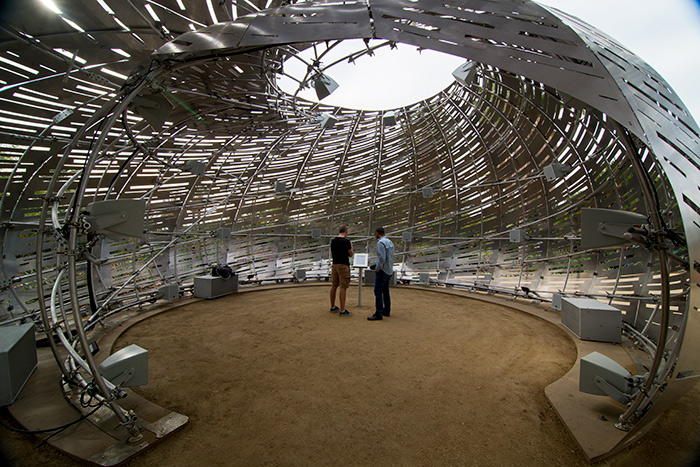
Inside view of NASA’s Orbit Pavilion – visitors enveloped by the sound-chamber and metallic shell structure. Credit: © Chuck Choi / ArchDaily, Jan. 15, 2016. Used with permission. Location: The Huntington Library, San Marino, California.
Why It Matters
The Orbit Pavilion was more than an installation—it was an invitation to feel space.
In an age when cosmic knowledge often exists only as numbers and graphs, this artwork transformed raw satellite data into sound, memory, and sensation. It blended art, science, and meditation into one seamless experience.
Bring It Back
Today, the Pavilion is no longer at The Huntington. But its absence is felt. Many of us who visited still carry its resonance.
Perhaps it is time to bring back the Orbit Pavilion—to let more people step inside the shell, close their eyes, and hear the Earth’s satellites sing.
If you believe art and science should inspire, share this story and join the call to bring the Orbit Pavilion back to The Huntington Library.
TheThe Huntington Library, Art Museum, and Botanical Gardens
1151 Oxford Road
San Marino, CA 91108
United States
Phone: (626) 405-3501
Website: www.huntington.org


