Archive
The Strategic Nexus of the New Silk Road
By Marivel Guzman | Akashma News
Geopolitics, Logistics Capacity, and Debt Sustainability in the China-Pakistan Economic Corridor
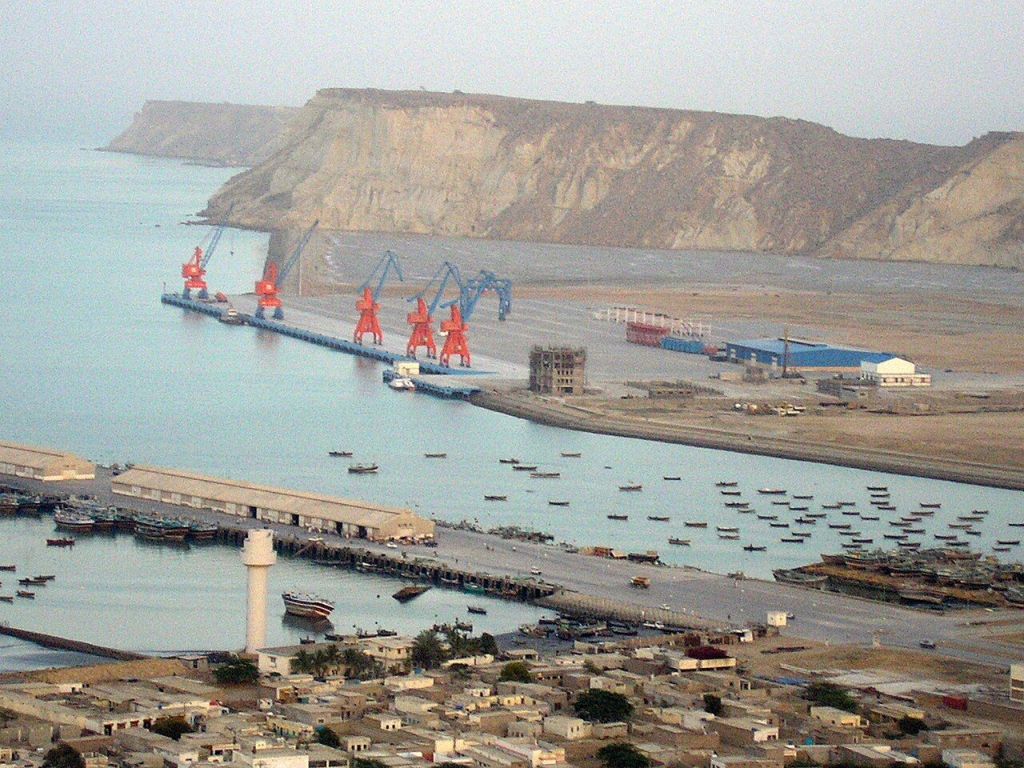
Source: Wikimedia Commons — by J. Patrick Fischer
Gwadar Port handled more shipping containers in April alone than it did in all of 2025. Chinese frigates ran joint drills with the Pakistan Navy off Karachi this spring. Islamabad and Beijing describe a corridor bound for $100 billion in investment by 2030. On paper, the China-Pakistan Economic Corridor looks like it’s accelerating.
Look closer at the road and the ledger, and a different picture emerges — one where the physical infrastructure is still half-built, the most-cited bottleneck isn’t actually the binding one, a parallel rail line exists mostly as a memorandum of understanding, and Beijing’s patience with Pakistan’s debts is visibly running thin.
A Highway Still Being Rebuilt
The entire strategic case for CPEC rests on the Karakoram Highway, the 1,300-kilometer road linking Kashgar in western China to Pakistan’s Arabian Sea coast. It’s a remarkable piece of engineering, but it is not a finished one.
The one section that’s genuinely done — 335 kilometers between Raikot and Khunjerab — was widened from 10 meters to 30 under a $327 million Chinese loan completed back in 2013. That upgrade made the route passable to heavy freight trucks year-round. But the sections north and south of it are a patchwork: the Thakot–Raikot stretch has been stuck at memorandum-of-understanding stage since 2023, and a planned dualization further south, between Hasan Abdal and Mansehra, is still sitting in feasibility review.
That gap matters more than it might sound. A 2025 engineering study modeling freight capacity along this corridor out to 2035 found that the highway’s real chokepoint isn’t the famous, high-altitude Khunjerab Pass — it’s the unfinished Thakot–Raikot section in the middle. The same study estimated that stretch could absorb roughly 9,500 additional trucks a day before hitting saturation, and projected the corridor eventually carrying close to 8 percent of China’s total trade value if the remaining upgrades actually get built on schedule.
Khunjerab’s Bottleneck Changed Shape
Khunjerab Pass, at nearly 5,000 meters, is the highest paved border crossing on Earth, and for decades it was closed every winter — snow and thin air made it impassable from December to March. In late 2023, Beijing and Islamabad agreed to keep it open year-round, and that took effect in December 2024.
It hasn’t gone entirely smoothly. The pass has also been shut down for reasons that have nothing to do with weather — a months-long standoff in 2025 over new customs fees at Sost Dry Port froze cross-border trade until traders and officials worked it out that October. The takeaway: Khunjerab’s bottleneck used to be purely physical. Now it’s just as often bureaucratic.
The Rail Line That Exists Mostly on Paper
For years, CPEC planning documents have floated a rail line running roughly 1,000 kilometers from Havelian, in northern Pakistan, to Kashgar — with Havelian itself becoming a truck-to-train transfer hub. It would be transformative if built. It is nowhere close to being built.
The one rail project that actually has money behind it, the Karachi–Peshawar Main Line-1 upgrade, tells its own story about how CPEC financing has changed. Beijing originally pledged to fund the whole thing — $6.67 billion — back in 2016. Nearly a decade later, that money still hadn’t materialized, and by mid-2026 the project had reportedly been pulled out of the CPEC framework altogether and handed to a multilateral group led by the Asian Development Bank.
No government agency has published a real cargo-volume target for the Kashgar–Havelian rail link. That’s not an oversight — it’s a sign the project hasn’t reached the stage where those numbers would even exist yet.
Gwadar’s Moment, Courtesy of the Strait of Hormuz
None of this infrastructure strain has stopped Gwadar from having a genuinely good year. Instability around the Strait of Hormuz pushed global shippers to look for alternatives, and Gwadar — sitting just 400 kilometers from the strait, with a deep-water harbor most regional ports can’t match — was one of the few places positioned to catch the overflow. The port processed around 11,000 containers in April, more than its entire 2025 total.
The port’s appeal isn’t just commercial. Routing Middle Eastern crude through Gwadar and overland to Kashgar cuts a 12,000-kilometer sea voyage through the tightly patrolled Malacca Strait down to roughly 3,000 kilometers — a serious hedge for Beijing against any future blockade. And the corridor is explicitly dual-use: the Pakistan Navy and China’s PLA Navy ran their fourth joint “Sea Guardians” exercise this spring, with a Chinese guided-missile frigate joining Pakistani Tughril-class ships for anti-submarine and air-defense drills in the Arabian Sea.
Underpinning all of it is a fact rarely stated so plainly: both countries are nuclear powers, and that shared deterrent effectively folds any attack on CPEC infrastructure into each nation’s broader security calculus.
The Debt Problem Beijing Can No Longer Ignore
Here’s where the corridor’s momentum runs into a wall. Chinese power companies operating under CPEC were owed roughly 423 billion Pakistani rupees — about $1.5 billion — in unpaid dues as of the end of the last fiscal year, against a total power-sector debt load of 1.675 trillion rupees. China has refused to waive the associated late fees.
That’s separate from Pakistan’s regular sovereign debt payments to China — in July alone, the State Bank of Pakistan repaid $1.4 billion on a Chinese commercial loan, a different obligation entirely, expected to be refinanced by Chinese banks shortly after. The two debts get conflated a lot in commentary; they shouldn’t be, but both point in the same direction: Pakistan’s fiscal relationship with Beijing is under real strain.
The clearest evidence of how much that strain has changed Chinese behavior is the ML-1 railway’s financing shift, described above. A project China once insisted on funding alone has now been pushed onto multilateral lenders. That’s not how a confident creditor behaves.
Some critics call this “debt-trap diplomacy,” pointing to Sri Lanka’s Hambantota Port as the cautionary tale. Others push back, noting that a large share of CPEC’s projects are structured as equity investment rather than sovereign debt, and argue Pakistan’s deeper problem is years of fiscal mismanagement and weak exports that predate CPEC entirely. Both arguments have real evidence behind them — this is a genuine dispute, not a settled question.
Pakistan’s Other Balancing Act
None of this happens in a vacuum separate from Pakistan’s relationship with the West. For decades, Pakistani territory has served as the transit route for NATO supply lines into landlocked Central Asia, moving through the Torkham crossing near the Khyber Pass and the Chaman crossing in Balochistan. That role gives Islamabad leverage it hasn’t given up: it can deepen its partnership with Beijing while still positioning itself as indispensable to Western military logistics.
The Bottom Line
CPEC’s boosters and its critics are, in a sense, both right. The strategic architecture is real — the nuclear backstop, the naval cooperation, the genuine hedge against a Malacca Strait chokepoint. But so is the gap between that ambition and what’s actually built: an unfinished highway whose real weak point isn’t the one everyone talks about, a rail corridor that’s still just a plan, and a debt load that’s making Beijing noticeably more cautious about writing the next check. Whether the corridor delivers on its 2030 targets will depend less on geopolitics than on whether Pakistan and China can close that gap — and right now, the ledger is closing faster than the road.
—
Sources: Pakistan National Highway Authority project records; Adeel et al., “Multi-Dimensional Freight and Trade Capacity Analysis,” Scientific Journal of Silesian University of Technology (2025); The Diplomat; ProPakistani; Asia Times; The Express Tribune; The News (Pakistan); Asian Lite International; Journal of Contemporary Asia.*

 Akashma Online News