Archive
Gwadar, CPEC and the Balochistan Question
Between Strategic Ambition, Political Friction and the Pakistan the World Rarely Sees
By Marivel Guzman | Akashma News
Before talking about ports, pipelines, China, military strategy or billions of dollars in investment, it is worth remembering something much simpler:
People already live there.
Across Pakistan, and particularly across Balochistan, generations of families have built lives under circumstances outsiders often describe through the language of instability, underdevelopment or insecurity.
But those words capture only part of the picture.
Life continues beyond the vocabulary of crisis.
People marry, raise children, cultivate land, tend livestock, fish, sew, weave, trade, teach and practice crafts handed down through generations. Communities adapt to political uncertainty, uneven development and changing economic conditions while preserving ways of life that often long predate the policies designed to transform them.
To understand Gwadar and CPEC from Pakistan and Balochistan’s point of view, those lives have to come first.
Balochistan has experienced insurgency, political unrest, economic disparities, uneven public services and repeated disputes over provincial authority and natural resources. The provincial government of Balochistan describes the region as historically underdeveloped relative to other parts of Pakistan while emphasizing the importance of agriculture, livestock, mineral resources and Gwadar to its future development.
Not every society measures a good life by the conveniences familiar to a metropolitan household.
For some families, continuity itself has value: land cultivated by previous generations, access to the sea, livestock, a family craft, a language, a village or a community in which everybody knows one another.
A fisherman may judge development less by the size of a new terminal than by whether he can continue reaching the sea and supporting his family.
A pastoral family may place greater value on land it has known for generations than on an apartment in a distant city.
A woman preserving embroidery techniques taught by her mother or grandmother may understand economic and cultural value in ways that cannot be measured by gross domestic product alone.
This does not mean hardship should be romanticized.
Lack of safe drinking water is not culture.
Lack of medical care is not authenticity.
Illiteracy is not tradition.
Poverty should not be celebrated simply because traditional life may appear picturesque from a distance.
The challenge is subtler.
Development offered is different from development imposed.
And progress means little if the people expected to experience it have little voice in defining what progress should mean.
That is the human question beneath Gwadar.
To some outside observers, Pakistan is a country defined by corruption, military interference, political instability and insurgency.
To enthusiastic proponents of the China-Pakistan Economic Corridor, or CPEC, Pakistan is the indispensable bridge between western China and the Arabian Sea — a country whose geography could reshape regional trade.
Both perspectives describe elements of a much larger reality.
This article approaches that reality from another direction:
from Pakistan and Balochistan outward.
That means looking first at Pakistani and Balochistan government records, local political discussions, community livelihoods and voices rooted in the province, and then examining the strategic ambitions of Islamabad and Beijing.
The purpose is not to determine whether development itself is good or bad.
The more important questions are:
Development for whom?
Defined by whom?
And who ultimately shares in its benefits?
My Pakistan Began With People, Not Geopolitics
I have never traveled to Pakistan.
Yet Pakistan became very personal to me long before I began researching CPEC.
Two Pakistani friends gave me very different windows into the country.
One was the late retired Maj. Raja Ghulam Mujtaba, founder of the OM Center for Policy Studies and its online publication Opinion Maker.
Raja had served in the Pakistan Army before moving into information technology and strategic analysis. In a 2011 interview published by Opinion Maker, his biography described his military service and subsequent work as an adviser on information systems for the Kuwait Air Force. He spoke extensively about Pakistan’s political weaknesses, national potential and strategic position.
Raja Mujtaba Speaks to Fortress — Opinion Maker
Raja represented one Pakistan to me: the Pakistan of sovereignty, national security, military strategy and the conviction that the country possessed considerably greater potential than outsiders often recognized.
But Raja was not uncritical of Pakistan.
In that same interview, he criticized political leadership and argued that Pakistan possessed substantial natural and human resources but lacked the political vision necessary to use them effectively.
The other Pakistan I came to know was through Humera Karim of Quetta, whom I affectionately called my princess.
Humera showed me Balochistan from inside.
She understood Quetta, tribal and traditional communities, the challenges encountered by women, metropolitan Pakistan, and the social distance that could exist between Balochistan and Pakistan’s larger urban centers.
Before her later work with the United Nations refugee agency, Humera worked in communications with the Pakistan Red Crescent Society in Balochistan.
I knew that period personally. Humera sent me drafts to proofread and polish in English, including material prepared around the Pakistan Red Crescent’s community work. Literacy, skills-building and assistance to local communities were recurring subjects in the material I remember working on with her.
Those drafts remain part of my personal archive and memory of our friendship; I distinguish that firsthand recollection from the publicly archived material cited in this article.
Her later published work shows remarkable continuity.
In a 2020 UNHCR report from Quetta, a skills-development program for Afghan refugee and Pakistani women provided occupational training intended to improve income-generating capacity and economic independence.
UNHCR — Skills Development Project for Refugee and Local Women in Quetta
In another article, Humera documented a young Afghan refugee woman in Quetta who continued her education despite intense resistance and eventually pursued medicine. The story was not simply about schooling; it showed how change can occur within a traditional community when determination, education and eventual community acceptance intersect.
Humera Karim — Breaking Barriers: A Young Refugee Woman Fulfils Her Medical Career Dream
That story reminds me very much of the Humera I knew.
She never romanticized social restrictions imposed on women.
But neither did she speak about traditional communities as though they were people waiting for civilization to arrive.
She understood that people may want education, medicine and economic opportunity while still valuing family, community, language and tradition.
That distinction became important to me long before I began investigating Gwadar.
Humera Karim’s 2014 Balochistan
Humera also left something particularly valuable for this investigation: her own contemporaneous assessment of her province.
On March 24, 2014, she published “Balochistan the Poorest Province of Pakistan” on PK Articles Hub. The original website is no longer operating, but the article survives through the Internet Archive’s Wayback Machine, allowing readers to consult Humera’s original 2014 wording exactly as it appeared at the time.
Original archived article
In September 2026, I republished the article at Akashma News as a memorial tribute to Humera, with the permission of her widower, Hashim Ali. Because Urdu was Humera’s native language, the republication received careful editing for English grammar, sentence structure, punctuation and terminology while preserving her argument, political criticism, irony and distinctive voice.
The intention was not to rewrite Humera, but to make her original analysis more accessible to English-language readers without changing the substance or spirit of what she wrote.
Edited memorial republication at Akashma News:
These projects matter.
But a project ledger cannot by itself answer the human questions.
Does a fisherman retain reliable access to his livelihood?
Do local families obtain water and electricity?
Can a young resident obtain the training required for the new economy developing around the port?
How much employment remains local?
How much authority do provincial and municipal communities have over decisions affecting their land and coastline?
These are not arguments against development.
They are questions about what development actually means once the construction crews leave.
Progress Is Not a Neutral Word
Governments speak of progress.
Investors speak of development.
Strategists speak of connectivity.
Economists speak of growth.
But those words do not necessarily mean the same thing to everybody.
A highway can mean opportunity to one family and disruption to another.
A port can mean national revenue to Islamabad and economic uncertainty to a fishing community.
A technical institute can open possibilities for young residents while simultaneously signaling that the economy around their families is changing rapidly.
None of this means Balochistan should be frozen in time.
Young people in the province have the same right to education, health care, communications, technology and economic opportunity as anyone elsewhere.
But choice matters.
Modernity offered is different from modernity imposed.
Development shared is different from development merely passing through.
And respecting traditional life does not require preserving deprivation.
Humera’s own journalism demonstrated that distinction.
She supported literacy.
She supported education.
She wrote about women developing economic independence.
She documented people challenging restrictive customs.
But she did so while remaining rooted in the communities she was describing.
That is a very different approach from assuming that outsiders already know what those communities ought to become.
Pakistan’s Critics Are Not Wrong About Governance Problems
A Pakistan-centered account should not become an exercise in denying Pakistan’s problems.
Corruption, patronage and governance failures are legitimate subjects of scrutiny.
But there is a significant difference between documenting failures within institutions and declaring an entire nation institutionally worthless.
Pakistan possesses functioning federal and provincial governments, courts, universities, ports, regulatory authorities, public statistical agencies and infrastructure institutions.
Some perform better than others.
Some are vulnerable to corruption or political pressure.
Institutional capacity and institutional weakness can coexist inside the same state.
That complexity is more useful than caricature.
Pakistan’s Military Cannot Be Removed From the Political Story
Pakistan’s military also occupies an unusually influential position in national politics.
Pakistan holds multiparty elections, but outside political-rights assessments continue to describe the armed forces as exercising substantial influence over government formation and public policy. Freedom House’s 2026 assessment explicitly identifies extensive military influence while also noting security threats from militant organizations.
Freedom House — Pakistan 2026
Pakistan CPEC Secretariat — Gwadar Projects
This is Pakistan’s principal official project inventory for Gwadar under CPEC. It separates completed projects from those under construction and those still in the pipeline, making it particularly useful for distinguishing physical infrastructure already delivered from future strategic ambitions.
Open the official CPEC Gwadar project inventory
https://web.archive.org/web/20140329043245/http://www.pkarticleshub.com/2014/03/24/balochistan-the-poorest-province-of-pakistan-2/
UNHCR — Skills Development Project for Refugee and Local Women in Quetta, 2020
This report documents vocational training for Afghan refugee and Pakistani women in Quetta and illustrates the community-development themes that characterized Humera’s later professional work. It provides concrete evidence of efforts to combine skills, livelihoods and women’s economic participation in Balochistan.
UNHCR Quetta skills-development report
Humera Karim — “Breaking Barriers,” UNHCR, 2021
Written by Humera in Quetta, this story follows a young refugee woman who continued her education despite strong social resistance and eventually pursued medicine. It is particularly valuable to this article because it illustrates Humera’s ability to criticize restrictive customs without reducing an entire community to those customs.
Breaking Barriers — UNHCR
Humera Karim — Girls’ Education in Saranan Refugee Village, UNHCR, 2018
Humera reported on a community elder who encouraged families to educate their children, particularly girls, and advocated skills development to make the community more self-sufficient. The story demonstrates that traditional communities themselves can become agents of change rather than simply objects of outside development policy.
Humera Karim’s UNHCR education report
Open the Gwadar Port and Free Zone project
CPEC Secretariat — Development of Gwadar Port and Free Zone
This source documents the 2,281-acre free zone, investment registrations and initial industrial production. It provides the official Pakistani account of Gwadar’s intended evolution from a port into an industrial and commercial complex.
Dawn — Balochistan Multi-Party Conference, Sept. 13, 2026
This contemporary Quetta report records discussions among several political parties concerning security, constitutional issues, economic conditions, resource control and political rights. Its importance is that calls for dialogue and greater attention to provincial grievances are coming from political actors operating within Pakistan, not solely from armed separatist organizations.
https://opinion-maker.org/2011/04/raja-mujtaba-speaks-to-fortress/?utm_source=chatgpt.com)
Tony Lazaro — Letter Responding to TIME, 2012
Lazaro’s response is used as an example of a longstanding argument over how Pakistan is represented internationally. He did not deny violence or governance problems; instead, he argued that universities, businesses, students and economic activity also belonged in the picture.
Read Tony Lazaro’s full response
https://goodnews.pk/2012/01/29/tony-lazaros-letter-to-the-editor/
TIME subsequently published a substantially shorter reader response under the heading “Not All Bad in Karachi.”
TIME — Not All Bad in Karachi
https://www.amnesty.org/en/documents/asa33/1057/2026/en/?utm_source=chatgpt.com)
Raja Mujtaba — “Raja Mujtaba Speaks to Fortress,” Opinion Maker, 2011
This interview provides Raja Mujtaba’s own account of his military and professional background and his views of Pakistan’s political leadership, strategic potential and national identity. It gives the article an identifiable Pakistani national-security perspective rather than relying solely on outside descriptions of the country.
Read Raja Mujtaba’s Fortress interview
Gwadar Port Authority — Port Operations
The authority reported in April 2026 that Gwadar had three operational berths and capacity for vessels of approximately 50,000 deadweight tons. This source is important because it helps distinguish Gwadar’s present commercial capabilities from the much larger petroleum and logistics corridor frequently depicted in strategic projections.
Open Gwadar Port Authority operational updates](https://gwadarport.gov.pk/events.aspx
CPEC Secretariat — Gwadar Eastbay Expressway
The official project page describes the expressway as the principal road connection between Gwadar Port, the free zone and Pakistan’s national highway network. It also reports 2,000 project jobs, including 1,700 local positions, making it relevant to the question of whether infrastructure creates direct economic participation for local communities.
Open the Eastbay Expressway project record
https://www.dawn.com/news/2029470/multi-party-conference-voices-concern-over-balochistans-law-and-order
Amnesty International — Jiand Baloch, 2026
Amnesty reported that student activist Jiand Baloch returned after an 11-day enforced disappearance and described it as the third such episode involving him. This source is used specifically as an attributed human-rights allegation and not as evidence characterizing every Pakistani security operation.
Open Amnesty International’s Jiand Baloch report
Humera wrote bluntly.
She discussed poverty, political privilege, tribal elites, corruption, insufficient roads, education, health care, shortages of clean drinking water and weak electricity infrastructure.
Her criticism was unmistakably local.
It was not an outsider looking at Balochistan and announcing what was wrong with it.
It was a woman from Quetta writing about problems she believed her own province needed to confront.
Her article is particularly useful when placed beside the Government of Balochistan’s later statistical record.
The provincial Bureau of Statistics has produced a Trend Analysis of Development Statistics of Balochistan, 2010–2023, alongside its Socio-Economic Indicators of Balochistan series.
The timing is almost ideal for historical comparison.
Humera was writing in 2014, within the period covered by the 2010–2023 statistical review.
Her article therefore provides something statistical tables cannot:
a human account from inside Balochistan while those conditions were being experienced.
The provincial statistics provide the longer trajectory.
Government of Balochistan — Trend Analysis of Development Statistics of Balochistan, 2010–2023
Government of Balochistan — Socio-Economic Indicators of Balochistan 2024
Balochistan covers approximately 347,190 square kilometers, or 43.61 percent of Pakistan’s total land area, while its 2023 population was approximately 14.89 million. Federal Pakistani data confirm both figures.
About 10.28 million people — roughly 69 percent of Balochistan’s population — lived in rural areas according to 2023 census-based provincial reporting.
Education statistics illustrate the rural-urban divide particularly clearly.
Census-based figures put Balochistan’s overall literacy rate at 42.01 percent, compared with 55.86 percent in urban areas and 35.74 percent in rural areas. Rural female literacy was reported at 26.59 percent.
Yet the broader development record also documents infrastructure expansion.
That distinction matters.
Balochistan has not stood still since Humera wrote in 2014.
Nor have the disparities she described simply disappeared.
Read together, her article and the provincial statistical record provide a far more useful picture than either source alone.
Humera gives us the human baseline.
The statistics give us the development trajectory.
Gwadar: The Geographical Temptation
Gwadar’s attraction to Pakistani and Chinese strategists becomes immediately apparent on a map.
The port sits on Balochistan’s Arabian Sea coast, near the approaches to the Persian Gulf and some of the world’s most important energy-exporting states.
China, meanwhile, depends heavily on long maritime supply chains connecting energy producers with Chinese markets.
The idea of using Pakistan as an alternative trade and energy corridor is older than CPEC itself.
During President Pervez Musharraf’s 2006 visit to Beijing, Pakistan publicly promoted the concept of using Gwadar as an energy and trade connection toward western China.
The idea was simple in geographical terms:
Middle Eastern energy could reach Gwadar by sea and, in theory, eventually travel north through Pakistan toward Xinjiang.
But geographical simplicity does not mean engineering or economic simplicity.
That distinction remains essential today.
Gwadar Is Not Yet China’s Operating Oil Gateway
Gwadar is frequently depicted on geopolitical maps as though crude oil already arrives at the port and flows directly through Pakistan into China.
That is not the present commercial reality.
The Gwadar Port Authority reported in April 2026 that the port had three operational berths and could accommodate vessels of up to approximately 50,000 deadweight tons, with modern container and general-cargo equipment installed.
Gwadar Port Authority — News and Operational Updates
These are genuine commercial facilities.
But they are not the same thing as an operating trans-Pakistan crude-oil corridor.
The distinction matters because the strategic idea is real while the complete petroleum system remains prospective.
Gwadar’s significance therefore derives partly from what exists today and partly from what Pakistan and China hope the port may eventually become.
CPEC Is Not Merely an Idea
The opposite claim — that China has built nothing of consequence in Pakistan — is equally difficult to sustain.
Pakistan’s official CPEC Secretariat lists a substantial portfolio of completed infrastructure.
In Gwadar, completed projects include development of the port and free zone, the Gwadar Smart Port City Master Plan, Pak-China Technical and Vocational Institute, Eastbay Expressway, Pak-China Friendship Hospital, a 1.2-million-gallon-per-day desalination plant and the New Gwadar International Airport.
Pakistan CPEC Secretariat — Gwadar Projects https://cpec.gov.pk/gwadar
https://www.amnesty.org/en/documents/asa33/1355/2026/en/
Amnesty International — Dad Shah, 2026
Amnesty alleged that Dad Shah, brother of human-rights defender Fozia Baloch, was forcibly disappeared and that relatives were subsequently harassed while seeking information. As with the Jiand Baloch case, the article attributes these claims explicitly to Amnesty rather than presenting unresolved allegations as independently established facts.
Open Amnesty International’s Dad Shah report
https://goodnews.pk/2012/01/29/tony-lazaros-letter-to-the-editor/
TIME — “Not All Bad in Karachi,” 2012
TIME later published a much shorter reader response from Lazaro. Reading the published excerpt alongside his longer submission illustrates the article’s broader point that editorial selection can substantially shape how a country and its people are perceived.
Read TIME’s published response
—
https://cdn.bospnd.balochistan.gov.pk/resources/publications/2024/socio-economic-indicators-of-balochistan-2024-1777026030506.pdf
Humera Karim — “Balochistan the Poorest Province of Pakistan,” March 24, 2014
Humera’s archived article is the central historical voice in this investigation. Written from Quetta during the period covered by the provincial development statistics, it addresses poverty, political privilege, tribal power, education, health care, infrastructure, water and the frustration she associated with economic deprivation.
Read Humera Karim’s archived 2014 article
https://cdn.bospnd.balochistan.gov.pk/resources/publications/2026/uploaded-file-2026-1777010446020.pdf
Government of Balochistan — Socio-Economic Indicators of Balochistan 2024
This publication provides provincial and district-level socioeconomic indicators and is particularly useful for examining population, education, health, infrastructure and rural-urban differences. It anchors the human discussion of Balochistan in the province’s own official statistical record.
Open Socio-Economic Indicators of Balochistan 2024
https://freedomhouse.org/country/pakistan/freedom-world/2026
This matters particularly in Balochistan because questions of political representation, resource control and economic development have long overlapped with national-security policy.
When political grievances are understood principally through a security framework, political solutions become more difficult to develop.
Balochistan Is Where Development Meets History
Gwadar does not sit on empty strategic terrain.
It sits in Balochistan.
The province contains distinct political histories, ethnic communities, tribal traditions and longstanding arguments concerning autonomy, resource control and relations with Pakistan’s federal government.
Those disputes existed long before CPEC.
CPEC inherited them.
The political landscape is also far more diverse than the word “separatism” suggests.
There are armed separatists.
There are Baloch nationalist parties operating within Pakistan’s political system.
There are federalists.
There are tribal leaders.
There are human-rights activists.
There are business owners.
There are fishermen and laborers.
And there are millions of ordinary people whose principal ambitions may have considerably more to do with their families than with geopolitical ideology.
No single faction can speak automatically for all of them.
Quetta, Politics — and My Princess Humera
In September 2026, leaders from numerous political parties gathered in Quetta to discuss Balochistan’s deteriorating security environment and broader constitutional, political and economic concerns.
The meeting addressed provincial resources, political and democratic rights, economic problems and security. Participants argued that force alone could not resolve Balochistan’s longstanding difficulties and called for political dialogue involving leadership trusted by the population.
Dawn — Multi-Party Conference Voices Concern Over Balochistan’s Law and Order, Sept. 13, 2026
https://time.com/archive/6641033/not-all-bad-in-karachi/
The importance of Lazaro’s response is not that one visitor’s observations disproved reporting about violence.
They did not.
His point was that selection shapes perception.
Show only violence and corruption, and Pakistan becomes nothing but violence and corruption.
Show only airports, highways and Chinese investment, and Pakistan becomes a development advertisement.
Neither is journalism.
Pakistan Does Not Need Romanticism. Neither Does Balochistan.
Pakistan does not need protection from criticism.
It needs accurate description.
Balochistan deserves the same standard.
Traditional life should not be romanticized.
Women should not be expected to accept discrimination because a practice is described as culture.
Children should not lose access to education in the name of preserving tradition.
Families should not lack clean drinking water because deprivation is confused with simplicity.
But outsiders should also resist the assumption that every community wishes to become a version of Karachi, Islamabad, Beijing, London or Los Angeles.
Attachment to land, fishing, livestock, language, craft or village life does not mean that a person has failed to understand progress.
Sometimes it means that progress has been defined differently.
That distinction is at the heart of this investigation.
Gwadar’s Future Runs Through Balochistan
The future of CPEC will probably not be determined by a single dramatic announcement.
It will develop gradually.
By cargo volumes.
By investment.
By electricity.
By water.
By employment.
By fisheries.
By land.
By local government.
By mineral and resource revenues.
By political representation.
By security.
By whether armed movements choose politics over violence.
By whether the state chooses negotiation where negotiation is possible.
And by whether development leaves communities with more choices rather than fewer.
Gwadar may eventually become a major strategic and commercial gateway for the China-Pakistan partnership to the Arabian Sea.
But that gateway stands in Balochistan.
Its future cannot be separated from the people who live there, the livelihoods they already possess, the resources beneath their land and sea, and the political arrangements under which development proceeds.
Gwadar may become a major regional logistics center.
It may eventually form part of a wider energy corridor connecting Gulf markets with western China.
Or some of those ambitions may prove economically or politically impractical.
The outcome is not predetermined.
What should already be clear is this:
Balochistan is not an empty corridor waiting for development to pass through it.
It is a living society whose people have histories, livelihoods, political disagreements and competing visions of their own future.
Any China-Pakistan project that hopes to endure must account for that reality.
—
References and Source Notes
The following sources form the documentary foundation of this analysis. They combine Pakistani and Balochistan government records, contemporary reporting, archival journalism and primary material written by Humera Karim. The annotations explain why each source matters rather than merely listing links.
Government of Balochistan — Trend Analysis of Development Statistics of Balochistan, 2010–2023
This provincial statistical study provides the long-term development timeline against which Humera Karim’s 2014 observations can be compared. It allows the article to distinguish persistent structural problems from areas where measurable infrastructure expansion occurred over the following decade.
Open the Government of Balochistan 2010–2023 report
Balochistan the poorest province of Pakistan
https://akashmanews.com/2026/09/19/humera-karim-balochistan-poorest-province-pakistan-2014/
https://www.amnesty.org/en/documents/asa33/1057/2026/en/
These allegations should be reported as allegations documented by Amnesty International, not transformed into a characterization of every Pakistani security operation.
The same evidentiary discipline must apply to armed groups.
Political grievances do not justify violence against civilians.
State security concerns do not erase political grievances.
A serious examination of Balochistan has to hold both realities at once.
Could China Play a Different Role?
China has an obvious interest in stability around CPEC.
That does not mean Beijing can simply impose a settlement between Islamabad and Baloch political actors.
Pakistan regards Balochistan as an internal political and security matter, while China traditionally emphasizes national sovereignty.
But major investors inevitably influence the environment in which development takes place.
China can prioritize local employment.
It can support vocational education.
It can encourage consultation.
It can finance water, health and municipal infrastructure alongside commercial infrastructure.
And it can recognize that economic security and political legitimacy are connected.
A community that sees itself as a participant in development has a very different relationship to a project than a community that believes development is simply being done to it.
The Pakistan the Headlines Miss
The tendency to reduce Pakistan to crisis is not new.
In 2012, Australian businessman Tony Lazaro objected to a TIME portrayal of Karachi that he believed focused disproportionately on violence and dysfunction.
Lazaro did not argue that Pakistan lacked serious problems.
His argument concerned proportion.
His original response described Pakistani universities, students, businesses and exporters he had encountered during visits to Karachi and Islamabad and argued that these realities also belonged in any meaningful portrayal of the country.
Tony Lazaro — Letter to the Editor Responding to TIME
https://cpec.gov.pk/gwadar?
Pakistan CPEC Secretariat — CPEC Energy Projects
The official energy portfolio documents completed and proposed electricity-generation and transmission projects associated with CPEC throughout Pakistan. It demonstrates that the China-Pakistan economic relationship has already produced substantial physical infrastructure even though the proposed Gwadar-to-China petroleum corridor remains unrealized.
Open the official CPEC energy-project inventory
https://www.cpec.gov.pk/energy
Gwadar Port Authority — Development Projects
The port authority’s own project inventory records completed and ongoing infrastructure, including the Eastbay Expressway, desalination facilities, technical training, fisheries assistance and further port expansion. It provides a useful Pakistani primary source for determining what has actually been constructed at Gwadar.
Open Gwadar Port Authority development projects](https://gwadarport.gov.pk/project.aspx
Balochistan the poorest province of Pakistan
This gives readers a choice: they can examine the surviving 2014 archival version or read the authorized, lightly edited Akashma News edition prepared more than a decade later.
Humera’s article is particularly valuable because it was written during the period later examined by the Government of Balochistan’s 2010–2023 development statistics. Her observations therefore provide a contemporaneous human account against which more than a decade of provincial data can now be compared.
The official CPEC energy portfolio also lists major completed electricity-generation and transmission projects across Pakistan, including the 1,320 MW China Hub power project in Balochistan.
Pakistan CPEC Secretariat — Energy Projects https://www.cpec.gov.pk/energy
Gwadar’s Eastbay Expressway was designed to connect the port and free zone directly to Pakistan’s national highway system. The CPEC Secretariat reports approximately 2,000 jobs associated with the project, including 1,700 local jobs.
CPEC — Gwadar Eastbay Expressway
https://www.cpec.gov.pk/project-details/32)
The Gwadar Port Free Zone covers approximately 2,281 acres. Official project records report dozens of registered enterprises and several companies beginning production.
CPEC — Development of Gwadar Port and Free Zone
At the same time, the project remains incomplete.
Breakwaters, dredging, additional water infrastructure, fisheries facilities and other projects remain under construction or in planning.
The most accurate description therefore lies between celebration and dismissal:
Gwadar is neither imaginary nor finished.
The Human Side of Infrastructure
Pakistan’s own CPEC records increasingly acknowledge that infrastructure alone cannot define success.
The official portfolio includes vocational training, medical facilities, drinking water, solar projects and other social-development initiatives alongside highways, ports and power generation.
The Gwadar Port Authority also lists completed projects including water-supply infrastructure, vocational facilities and 2,000 boat engines provided to fishermen.
Gwadar Port Authority — Development Projects
https://www.dawn.com/news/2029470/multi-party-conference-voices-concern-over-balochistans-law-and-order
Reading about that meeting brought back memories of conversations with Humera.
We often talked about visiting one another.
I wanted to see Quetta — her Quetta.
But Quetta was never the obvious meeting place.
Humera told me that foreign visitors could face security restrictions and special permission requirements in Balochistan, and our conversations usually turned instead toward meeting in Karachi or Islamabad.
At the time, it seemed like a practical travel problem.
Years later, it carries another meaning.
Quetta was Humera’s hometown.
It was where she lived and worked and understood communities I knew largely through her stories.
Yet even something as ordinary as two friends planning to meet could be shaped by Balochistan’s political and security environment.
I never had the opportunity to meet Humera, but I knew Quetta through her eyes.
Those conversations remain part of how I understand the province today.
Security and Human Rights: Two Realities at Once
Pakistan faces genuine armed violence in Balochistan.
Separatist organizations have attacked Pakistani security forces, civilians, infrastructure and Chinese interests.
Those security threats cannot be removed from an honest account of CPEC.
Neither can allegations concerning state conduct.
In August 2026, Amnesty International reported that Baloch student leader Jiand Baloch returned after disappearing for 11 days. Amnesty described it as his third enforced disappearance and attributed the incidents to his peaceful activism.
Amnesty International — Jiand Baloch, Aug. 6, 2026
https://www.amnesty.org/en/documents/asa33/1355/2026/en/
Amnesty separately alleged that Dad Shah, the brother of human-rights defender Fozia Baloch, was forcibly disappeared in April 2026 and that relatives experienced harassment while seeking information about him.
Amnesty International — Dad Shah, May 29, 2026
Under Siege: The Security Crisis Threatening CPEC and Gwadar Port
By Marivel Guzman | Akashma News
A Companion Briefing to the Gwadar– CPEC Phase II Dashboard
Compiled September 12, 2026 from 14 primary and supplementary sources
Executive Summary
The China-Pakistan Economic Corridor (CPEC), once hailed as the flagship of China’s Belt and Road Initiative, is facing an existential security crisis in Balochistan. A sustained and escalating campaign of sabotage by Baloch separatist militant groups — primarily the Balochistan Liberation Army (BLA) — has systematically targeted CPEC infrastructure, Chinese personnel, and Pakistani security forces across the province. In February 2026, China suspended all ground operations in Gwadar and evacuated its personnel. By the summer of 2026, the BLA declared an “economic blockade” of Balochistan, destroying dozens of vehicles, bridges, and supply routes. Pakistan has deployed over two army divisions and spent more than $200 million on security, yet the attacks continue to intensify. Almost all major CPEC projects are now described as “languishing” by independent analysts.
I. The Militant Landscape
Balochistan Liberation Army (BLA)
The BLA is the most prominent and operationally capable separatist group in Balochistan. Formed in the early 2000s, it has evolved from a low-level insurgency into a sophisticated militant organization with specialized units:
• Majeed Brigade — the BLA’s suicide attack wing, responsible for multiple high-profile operations including the April 2022 Karachi University bombing and the October 2024 Karachi airport attack
• Fateh Squad — a tactical operations unit involved in coordinated assaults on military installations
• Special Tactical Operations Squad (STOS) — an elite unit for targeted operations
• Hammal Maritime Defence Force — the BLA’s naval wing, which carried out its first maritime attack in April 2026 against a Pakistan Coast Guard boat near Jiwani
The BLA operates through spokespersons Jeeyand Baloch and Azad Baloch, who regularly issue claims of responsibility. The group was designated as a terrorist organization by the United States in August 2025, Australia in May 2026, and the United Kingdom in July 2026.
The BLA’s most active faction is BLA-J (Junaid faction), which launched Operation Herof II on January 31, 2026 — a coordinated wave of attacks across 12+ locations in Balochistan targeting government buildings, schools, hospitals, banks, and security installations.
Balochistan Liberation Front (BLF)
The BLF has focused its attacks on the Frontier Works Organization (FWO), the Pakistani military engineering arm responsible for constructing CPEC roads and infrastructure. The BLF’s operations have specifically targeted construction crews and equipment along the CPEC route.
Tehrik-e-Taliban Pakistan (TTP) and IS-K
While Baloch separatists dominate the violence in Balochistan proper, the TTP and Islamic State Khorasan (IS-K) have been active in the Gilgit-Baltistan region along the northern CPEC corridor. The TTP was blamed for attacks on Chinese workers at the Dasu hydropower project. Both groups represent a separate but overlapping security threat to CPEC’s northern axis.
II. Escalation Timeline: Key Incidents
| Date | Incident | Source
|Nov 2018 | Gunmen attacked the Chinese consulate in Karachi, killing 4+ people | [ORF](https://www.orfonline.org/expert-speak/when-the-flagship-starts-sinking-china-s-cpec-is-foundering-in-balochistan) Apr 2022 | BLA suicide bomber Shaari Baloch killed 3 Chinese tutors and 1 Pakistani driver at Karachi University’s Confucius Institute | [LSE South Asia Centre](https://blogs.lse.ac.uk/southasia/2025/05/19/balochistan-cpec-anti-china-sentiment-and-the-way-ahead/) |
Mar 2024 | BLA attacked Gwadar Port Authority Complex and Naval Air Base PNS Siddique | [ORF](https://www.orfonline.org/expert-speak/when-the-flagship-starts-sinking-china-s-cpec-is-foundering-in-balochistan) Aug 2024 | BLA convoy attack on Chinese engineers near Gwadar | [BBC](https://www.bbc.com/news/articles/c0r84p0dp1jo) |
Oct 6 “7, 2024 | BLA Majeed Brigade suicide attack (vehicle-borne IED) near Karachi airport killed 2 Chinese nationals, 10+ injured; targeted Port Qasim Power Generation engineers; perpetrator Shah Fahad | [ORF](https://www.orfonline.org/expert-speak/when-the-flagship-starts-sinking-china-s-cpec-is-foundering-in-balochistan); [Eurasia Review](https://www.eurasiareview.com/15072026-the-new-phase-of-pakistans-instability-and-its-strategic-implications-analysis/) |
Late Jan 2026 | BLA Operation Herof 2.0 — coordinated attacks across 12 districts targeting government buildings, schools, hospitals, banks, and security installations; 31 civilians and 17 security personnel killed | [Eurasia Review](https://www.eurasiareview.com/15072026-the-new-phase-of-pakistans-instability-and-its-strategic-implications-analysis/) |
Feb 2, 2026 | China suspended ALL ground operations in Gwadar and evacuated all Chinese personnel via special flights; Chinese Embassy called it “precautionary and temporary” | [News18](https://www.news18.com/world/china-suspends-all-ground-operations-in-gwadar-after-attacks-across-balochistan-exclusive-ws-kl-9873491.html) |
Mar 2026 | BLA attacks on army camps in Kech, Hub, and Kalat; gas pipeline blown up in Quetta | [Eurasia Review](https://www.eurasiareview.com/15072026-the-new-phase-of-pakistans-instability-and-its-strategic-implications-analysis/) |
Apr 12, 2026 | BLA naval wing (Hammal Maritime Defence Force) attacked a Pakistan Coast Guard boat near Jiwani using a speedboat, killing 3 personnel — the group’s first maritime attack | [Eurasia Review](https://www.eurasiareview.com/15072026-the-new-phase-of-pakistans-instability-and-its-strategic-implications-analysis/) |
Late Apr 2026 | 27 attacks in 10 days; 42 military personnel killed | [Eurasia Review](https://www.eurasiareview.com/15072026-the-new-phase-of-pakistans-instability-and-its-strategic-implications-analysis/) |
May 2026 | BLA suicide car bomb on a train carrying soldiers and their families in Quetta | [Eurasia Review](https://www.eurasiareview.com/15072026-the-new-phase-of-pakistans-instability-and-its-strategic-implications-analysis/) |
Jun 1, 2026 | BLA seized the Panjgur “Chedgi route for 2 days, burning 6 vehicles | [Organiser](https://organiser.org/2026/06/14/358165/world/baloch-liberation-army-blow-up-bridges-on-cpec-road-dozens-of-pakistani-vehicles-carrying-minerals-set-on-fire/) |
Jun 5, 2026 | BLA set up checkpoints in Lasbela district, burning 10 vehicles and heavy machinery | [Organiser](https://organiser.org/2026/06/14/358165/world/baloch-liberation-army-blow-up-bridges-on-cpec-road-dozens-of-pakistani-vehicles-carrying-minerals-set-on-fire/) |
Jun 7, 2026 | BLA attacked a Saindak convoy in Kardegap, Mastung; destroyed 3 mineral vehicles and 1 military vehicle; 6 Pakistani personnel killed or injured | [Organiser](https://organiser.org/2026/06/14/358165/world/baloch-liberation-army-blow-up-bridges-on-cpec-road-dozens-of-pakistani-vehicles-carrying-minerals-set-on-fire/) |
Jun 10, 2026 | BLA burned 10 mineral vehicles near Rehmanzai, Nushki | [Organiser](https://organiser.org/2026/06/14/358165/world/baloch-liberation-army-blow-up-bridges-on-cpec-road-dozens-of-pakistani-vehicles-carrying-minerals-set-on-fire/) |
Jun 11, 2026 | BLA destroyed two CPEC bridges with explosives near Kharan/Washuk | [Organiser](https://organiser.org/2026/06/14/358165/world/baloch-liberation-army-blow-up-bridges-on-cpec-road-dozens-of-pakistani-vehicles-carrying-minerals-set-on-fire/) |
Jul 2026 | Coordinated assaults left 42 dead (38 security personnel and 4 civilians); 11 soldiers and 14 militants killed in a Lasbela ambush | [Eurasia Review](https://www.eurasiareview.com/15072026-the-new-phase-of-pakistans-instability-and-its-strategic-implications-analysis/) |
Jul 15, 2026 | Pakistan increased security around the Saindak copper-gold mine after insurgent violence disrupted supply routes; Saindak’s managing director warned operations could become unsustainable within a month | [Reuters](https://www.reuters.com/world/asia-pacific/pakistan-pledges-more-security-china-run-copper-gold-mine-after-insurgency-2026-07-15/) |
Aug 1 “8, 2026 | BLA claimed 38 operations across Balochistan; 32+ Pakistani military killed; destroyed a bridge, railway track, and multiple vehicles | [The Balochistan Post](https://thebalochistanpost.net/2026/08/bla-releases-details-of-38-operations-across-balochistan-between-august-1-and-august-8/) |
At least 21 Chinese nationals have been killed in attacks since 2021, according to the Observer Research Foundation.
III. The Infrastructure Sabotage Campaign
The BLA’s strategy shifted dramatically in 2026 from targeting personnel to waging a systematic economic warfare campaign. The group’s stated goal is an “economic blockade” of Balochistan — disrupting infrastructure, transport routes, and state economic activity to make CPEC ungovernable.
Destroyed or Damaged Infrastructure
• CPEC Bridges: Two bridges destroyed with explosives near Kharan and Washuk (June 11, 2026), severing key CPEC road links ([Organiser](https://organiser.org/2026/06/14/358165/world/baloch-liberation-army-blow-up-bridges-on-cpec-road-dozens-of-pakistani-vehicles-carrying-minerals-set-on-fire/))
• Vehicles: 36+ vehicles destroyed in June 2026 alone, including mineral transport trucks, fuel tankers, gas transport vehicles, and military vehicles ([Organiser](https://organiser.org/2026/06/14/358165/world/baloch-liberation-army-blow-up-bridges-on-cpec-road-dozens-of-pakistani-vehicles-carrying-minerals-set-on-fire/))
• Railway Tracks: Destroyed near Quetta (August 2026 operations) ([The Balochistan Post](https://thebalochistanpost.net/2026/08/bla-releases-details-of-38-operations-across-balochistan-between-august-1-and-august-8/))
• Gas Pipeline: Blown up in Quetta (March 2026) ([Eurasia Review](https://www.eurasiareview.com/15072026-the-new-phase-of-pakistans-instability-and-its-strategic-implications-analysis/))
• Heavy Machinery: Set ablaze at company construction sites, including equipment at the Saindak copper-gold mine and along CPEC road construction routes ([Organiser](https://organiser.org/2026/06/14/358165/world/baloch-liberation-army-blow-up-bridges-on-cpec-road-dozens-of-pakistani-vehicles-carrying-minerals-set-on-fire/); [Reuters](https://www.reuters.com/world/asia-pacific/pakistan-pledges-more-security-china-run-copper-gold-mine-after-insurgency-2026-07-15/))
• Highway Blockades: The BLA claimed “complete control” of the Quetta “Taftan highway and set up checkpoints along the Panjgur “Chedgi route, the Quetta “Karachi highway, and the Chamalang “Kohlu road ([Organiser](https://organiser.org/2026/06/14/358165/world/baloch-liberation-army-blow-up-bridges-on-cpec-road-dozens-of-pakistani-vehicles-carrying-minerals-set-on-fire/))
The targeting of mineral transport vehicles is particularly significant: the BLA is attacking the extractive industries (copper, gold, barite, marble) that form the economic backbone of CPEC’s Phase II industrial integration. By disrupting supply chains from mines to ports, the group aims to make CPEC commercially unviable.
IV. China’s Response: Suspension and Strategic Recalibration
The Gwadar Evacuation (February 2026)
On February 2, 2026, China suspended all ground operations in Gwadar and evacuated all Chinese personnel via special flights. The Chinese Embassy in Islamabad issued a statement calling the move “precautionary and temporary,” adding: “The overall security situation in Balochistan, particularly in Gwadar, is under review” ([News18](https://www.news18.com/world/china-suspends-all-ground-operations-in-gwadar-after-attacks-across-balochistan-exclusive-ws-kl-9873491.html)).
Chinese teams continued to monitor projects remotely, and the Embassy emphasized that the suspension did not signal a withdrawal from CPEC. However, the evacuation came after the BLA’s Operation Herof 2.0 in late January, which demonstrated the group’s ability to launch coordinated attacks across 12 districts simultaneously.
Broader Chinese Reactions
China’s response to the security crisis has evolved through several phases:
1. Bilateral negotiations (2022 – 2023): China reportedly attempted to negotiate with Baloch separatist groups, but these efforts failed ([Hindu Post](https://hindupost.in/world/paying-price-of-insecurity-how-paks-security-crisis-is-undermining-chinas-cpec-dream/)).
2. Financial incentives: China tried offering economic packages to tribal leaders, which proved ineffective ([Hindu Post](https://hindupost.in/world/paying-price-of-insecurity-how-paks-security-crisis-is-undermining-chinas-cpec-dream/)).
3. Military cooperation: In November “December 2024, China and Pakistan conducted the “Warrior VIII” counter-terrorism exercises ([CISES](https://cises.org/2026/02/12/how-does-the-recent-surge-in-balochistan-violence-threaten-the-security-of-the-china-pakistan-economic-corridor-cpec/)).
4. Pressure for a major offensive: China asked Pakistan to launch a military operation similar to Operation Zarb-e-Azb (the 2014 North Waziristan offensive), but Pakistan was hesitant due to the backlash against such operations ([Hindu Post](https://hindupost.in/world/paying-price-of-insecurity-how-paks-security-crisis-is-undermining-chinas-cpec-dream/)).
5. Private security companies: China and Pakistan discussed forming a joint private security company (PSC) to protect Chinese personnel ([Hindu Post](https://hindupost.in/world/paying-price-of-insecurity-how-paks-security-crisis-is-undermining-chinas-cpec-dream/)).
6. Diversification: In August 2025, Chinese Foreign Minister Wang Yi publicly encouraged third-party participation in CPEC, signaling Beijing’s desire to broaden the initiative beyond a purely bilateral framework ([ORF](https://www.orfonline.org/expert-speak/when-the-flagship-starts-sinking-china-s-cpec-is-foundering-in-balochistan)).
Private Sector Withdrawals
• Han Geng Trade Company shut down its Gwadar operations on May 1, 2026, citing “persistent non-market factors” ([Hindu Post](https://hindupost.in/world/paying-price-of-insecurity-how-paks-security-crisis-is-undermining-chinas-cpec-dream/))
• Shanghai Electric abandoned its $1.77 billion purchase of K-Electric in September 2025 ([ORF](https://www.orfonline.org/expert-speak/when-the-flagship-starts-sinking-china-s-cpec-is-foundering-in-balochistan))
• Century Steel Group threatened to dismantle its Rashakai SEZ plant in November 2024, listing 18 grievances including security cost increases ([ORF](https://www.orfonline.org/expert-speak/when-the-flagship-starts-sinking-china-s-cpec-is-foundering-in-balochistan))
V. Pakistan’s Security Response
Military Deployment
Pakistan has raised approximately two army divisions (roughly 20,000 “30,000 troops) dedicated to CPEC security, spending more than $200 million on security for what was originally a $21 billion Chinese investment ([Hindu Post](https://hindupost.in/world/paying-price-of-insecurity-how-paks-security-crisis-is-undermining-chinas-cpec-dream/); [ORF](https://www.orfonline.org/expert-speak/when-the-flagship-starts-sinking-china-s-cpec-is-foundering-in-balochistan)). A Special Protection Unit (SPU) was created specifically for CPEC, but its performance has been widely criticized.
Operation Azm-e-Istehkam
In 2025, Pakistan announced Operation Azm-e-Istehkam , a nationwide counter-terrorism campaign. However, the announcement triggered massive public backlash, forcing the government to qualify it as “targeted and intelligence-based” operations rather than a full-scale military offensive. The operation has been ongoing but, according to the Observer Research Foundation, has been ineffective in curbing the insurgency ([ORF](https://www.orfonline.org/expert-speak/when-the-flagship-starts-sinking-china-s-cpec-is-foundering-in-balochistan)).
Saindak Mine Security
On July 15, 2026, Interior Minister Talal Chaudhry directed increased deployment of forces around the Saindak copper-gold mine after insurgent violence disrupted supply routes. The mine’s managing director warned that operations could become unsustainable within a month if security did not improve ([Reuters](https://www.reuters.com/world/asia-pacific/pakistan-pledges-more-security-china-run-copper-gold-mine-after-insurgency-2026-07-15/)).
Economic Measures
Pakistan has attempted to artificially boost Gwadar Port traffic by forcing government departments to route 50% of their bulk imports through the port. However, this has not addressed the underlying security concerns deterring commercial shipping ([ORF](https://www.orfonline.org/expert-speak/when-the-flagship-starts-sinking-china-s-cpec-is-foundering-in-balochistan)).
Pakistan also owes Chinese independent power producers (IPPs) approximately $1.5 billion in unpaid dues, further straining the bilateral economic relationship ([ORF](https://www.orfonline.org/expert-speak/when-the-flagship-starts-sinking-china-s-cpec-is-foundering-in-balochistan)).
VI. Impact on CPEC Projects
The security crisis has had a devastating impact on CPEC’s operational trajectory:
Project Status
Project | Status | Impact
Gwadar Port Operations | Suspended (Feb 2026) | All Chinese ground operations halted; virtually no commercial traffic |
Gwadar Airport | Operational but underutilized | NGIA opened January 2025 but faces low traffic due to security concerns |
ML-1 Railway | Stalled | Cost revised from $6.8B → $9.85B → $6.7B; Beijing frustrated with cost inflation |
Saindak Copper-Gold Mine | Under threat Supply routes disrupted; MD warned of unsustainable operations within a month |
Rashakai SEZ | Threatened | Century Steel Group threatened to dismantle plant (Nov 2024) |
Eastbay Expressway Phase II | Stalled | 13.8 km extension not progressing |
M-8 Motorway | Partially operational | Only 193 km of 893 km (Gwadar “Hoshab section) operational |
Scale of Violence
According to the Pakistan Institute for Peace Studies (PIPS), Baloch insurgent groups carried out 225 attacks in 2025 , resulting in 338 fatalities and 462 injuries across 27 districts. The South Asia Terrorism Portal recorded 248 terrorism-related incidents in the first seven months of 2024 alone ([CISES](https://cises.org/2026/02/12/how-does-the-recent-surge-in-balochistan-violence-threaten-the-security-of-the-china-pakistan-economic-corridor-cpec/); [ORF](https://www.orfonline.org/expert-speak/when-the-flagship-starts-sinking-china-s-cpec-is-foundering-in-balochistan)).
The ORF assessment is stark: almost all major CPEC projects are “languishing,” and Chinese investment has “slowed drastically or halted” ([ORF](https://www.orfonline.org/expert-speak/when-the-flagship-starts-sinking-china-s-cpec-is-foundering-in-balochistan)).
VII. Civil Unrest and the Political Dimension
Baloch Yakjehti Committee (BYC)
The BYC, led by Mahrang Baloch , has emerged as the most prominent civil society movement in Balochistan. The BYC has organized mass protests under the banner of a “movement against Baloch genocide,” drawing thousands of participants. Mahrang Baloch has directly accused China of complicity, stating: “China or any other country investing in Balochistan is directly involved in the Baloch genocide” ([The Print](https://theprint.in/world/baloch-yakjehti-committee-condemns-pakistan-china-for-exploiting-local-resources/2186878/); [DW](https://www.dw.com/en/china-pakistan-economic-corridor-sparks-pakistan-protests/a-69941212)).
The BYC has condemned both Pakistan and China for “exploiting local resources” and has organized protests in Karachi, Quetta, and Gwadar demanding an end to what it describes as systematic marginalization of the Baloch people ([The Print](https://theprint.in/world/baloch-yakjehti-committee-condemns-pakistan-china-for-exploiting-local-resources/2186878/)).
Haq Do Tehreek (HDT)
In Gwadar specifically, the HDT led by Maulana Hidayat Ur Rehman has organized protests demanding local fishing rights, an end to checkposts, and basic services. The HDT’s protests have at times paralyzed Gwadar and drawn international attention to the militarization of the city ([DW](https://www.dw.com/en/china-pakistan-economic-corridor-sparks-pakistan-protests/a-69941212)).
The “Fortress” of Gwadar
Gwadar has been described as a “fortress” — local Baloch residents are excluded from the port area, permits are required for movement, and checkpoints dot the city. The security apparatus has created an atmosphere of occupation rather than development, fueling resentment among the local population ([DW](https://www.dw.com/en/china-pakistan-economic-corridor-sparks-pakistan-protests/a-69941212); [Nikkei Asia](https://asia.nikkei.com/politics/protests-disrupt-pakistan-s-gwadar-home-of-chinese-controlled-port)).
Women in the Movement
A notable development is the increasing participation of women — both in peaceful protests and as militants. The April 2022 Karachi University bombing was carried out by a female suicide bomber, Shaari Baloch, marking a new dimension in the conflict. Women have been at the forefront of BYC protests, facing arrests and harassment ([LSE South Asia Centre](https://blogs.lse.ac.uk/southasia/2025/05/19/balochistan-cpec-anti-china-sentiment-and-the-way-ahead/)).
VIII. Strategic Implications
For China
China’s CPEC investment — originally projected at $62 billion — now appears increasingly precarious. The suspension of Gwadar operations in February 2026 marked the first time China publicly halted CPEC activities due to security concerns. While Beijing has framed the suspension as temporary, the pattern of private sector withdrawals (Han Geng, Shanghai Electric, Century Steel) suggests a deeper loss of confidence. China’s pivot toward encouraging third-party participation in CPEC signals a search for burden-sharing — and potentially an exit strategy if security does not improve ([ORF](https://www.orfonline.org/expert-speak/when-the-flagship-starts-sinking-china-s-cpec-is-foundering-in-balochistan)).
For Pakistan
Pakistan faces a strategic dilemma: a full-scale military offensive risks further alienating the Baloch population and international condemnation, while the current targeted operations have proven insufficient. The economic costs are mounting — with over $200 million spent on security, unpaid IPP dues of $1.5 billion, and stalled infrastructure projects. The forced diversion of government imports through Gwadar underscores the artificiality of the port’s current traffic figures ([ORF](https://www.orfonline.org/expert-speak/when-the-flagship-starts-sinking-china-s-cpec-is-foundering-in-balochistan)).
For CPEC Phase II
CPEC Phase II, with its emphasis on industrialization, agriculture, and IT development, is particularly vulnerable to the security crisis. The SEZs — including Rashakai, Dhabeji, and Bostan — depend on stable supply chains and investor confidence, both of which have been shattered. The BLA’s economic blockade strategy directly targets the extractive industries and mineral transport that underpin CPEC Phase II’s industrial integration model.
For Regional Stability
The escalation has implications beyond Pakistan. India has been accused by Pakistan of supporting Baloch militants — a claim India denies but which adds a geopolitical dimension to the conflict. The involvement of the TTP and IS-K in the northern corridor creates a multi-front security challenge. And the potential failure of CPEC would represent a significant setback for China’s Belt and Road Initiative globally, with implications for Beijing’s ambitions in South and Central Asia ([Eurasia Review](https://www.eurasiareview.com/15072026-the-new-phase-of-pakistans-instability-and-its-strategic-implications-analysis/)).
IX. Assessment
The security situation in Balochistan represents the single greatest threat to CPEC’s viability. The BLA has demonstrated an escalating operational capability — from isolated attacks on Chinese personnel to coordinated multi-district operations, maritime attacks, and a sustained economic warfare campaign targeting CPEC’s supply chains. Pakistan’s military response, while substantial in scale, has been unable to contain the insurgency. China’s suspension of Gwadar operations, while framed as temporary, reflects a strategic recalibration that may prove permanent if security conditions do not improve.
The core contradiction remains: CPEC is designed to bring development to Balochistan, but the local population perceives it as an extractive enterprise that benefits China and Pakistan’s federal government at the expense of the Baloch people. Until this fundamental grievance is addressed, no amount of military deployment is likely to secure the corridor.
Sources
1. Observer Research Foundation — “When the Flagship Starts Sinking: China’s CPEC is Foundering in Balochistan” — [ORF](https://www.orfonline.org/expert-speak/when-the-flagship-starts-sinking-china-s-cpec-is-foundering-in-balochistan)
2. Eurasia Review — “The New Phase of Pakistan’s Instability and Its Strategic Implications” — [Eurasia Review](https://www.eurasiareview.com/15072026-the-new-phase-of-pakistans-instability-and-its-strategic-implications-analysis/)
3. Hindu Post — “Paying Price of Insecurity: How Pakistan’s Security Crisis is Undermining China’s CPEC Dream” — [Hindu Post](https://hindupost.in/world/paying-price-of-insecurity-how-paks-security-crisis-is-undermining-chinas-cpec-dream/)
4. News18 — “Paying Price of Insecurity” (opinion) — [News18](https://www.news18.com/opinion/global-watch-paying-price-of-insecurity-how-paks-security-crisis-is-undermining-chinas-cpec-dream-ws-l-10320116.html)
5. Organiser — “Baloch Liberation Army Blow Up Bridges on CPEC Road” — [Organiser](https://organiser.org/2026/06/14/358165/world/baloch-liberation-army-blow-up-bridges-on-cpec-road-dozens-of-pakistani-vehicles-carrying-minerals-set-on-fire/)
6. LSE South Asia Centre — “Balochistan, CPEC, Anti-China Sentiment and the Way Ahead” — [LSE](https://blogs.lse.ac.uk/southasia/2025/05/19/balochistan-cpec-anti-china-sentiment-and-the-way-ahead/)
7. BBC News — “Balochistan attacks: Why is China being targeted in Pakistan?” — [BBC](https://www.bbc.com/news/articles/c0r84p0dp1jo)
8. Nikkei Asia — “Protests disrupt Pakistan’s Gwadar, home of Chinese-controlled port” — [Nikkei Asia](https://asia.nikkei.com/politics/protests-disrupt-pakistan-s-gwadar-home-of-chinese-controlled-port)
9. DW — “China-Pakistan Economic Corridor sparks Pakistan protests” — [DW](https://www.dw.com/en/china-pakistan-economic-corridor-sparks-pakistan-protests/a-69941212)
10. The Print — “Baloch Yakjehti Committee condemns Pakistan, China for exploiting local resources” — [The Print](https://theprint.in/world/baloch-yakjehti-committee-condemns-pakistan-china-for-exploiting-local-resources/2186878/)
11. News18 — “China Suspends All Ground Operations in Gwadar After Attacks Across Balochistan” — [News18](https://www.news18.com/world/china-suspends-all-ground-operations-in-gwadar-after-attacks-across-balochistan-exclusive-ws-kl-9873491.html)
12. Reuters — “Pakistan pledges more security for China-run copper-gold mine after insurgency” — [Reuters](https://www.reuters.com/world/asia-pacific/pakistan-pledges-more-security-china-run-copper-gold-mine-after-insurgency-2026-07-15/)
13. CISES — “How Does the Recent Surge in Balochistan Violence Threaten CPEC?” — [CISES](https://cises.org/2026/02/12/how-does-the-recent-surge-in-balochistan-violence-threaten-the-security-of-the-china-pakistan-economic-corridor-cpec/)
14. The Balochistan Post — “BLA Releases Details of 38 Operations Across Balochistan (Aug 1 “8)” — [The Balochistan Post](https://thebalochistanpost.net/2026/08/bla-releases-details-of-38-operations-across-balochistan-between-august-1-and-august-8/)
15. Mapping Militants — “Balochistan Liberation Army” — [Mapping Militants](https://mappingmilitants.org/profiles/balochistan-liberation-army)
16. Eurasia Review — “Baloch Strike After Talks Stall: Gwadar’s Security Crisis Deepens” — [Eurasia Review](https://www.eurasiareview.com/22042026-baloch-strike-after-talks-stall-gwadars-security-crisis-deepens-oped/)
17. TRT World — [TRT World](https://www.trtworld.com/article/50bcaee91ed2)
18. Amtul Hafeez Qureshi — “How the Balochistan Insurgency Affects CPEC and Regional Trade” — [amtulhafeezqureshi.com](https://amtulhafeezqureshi.com/how-the-balochistan-insurgency-affects-cpec-and-regional-trade/)
—
*This article is a companion to the [Gwadar “CPEC Phase II Dashboard](https://www.perplexity.ai/computer/a/gwadar-cpec-phase-ii-dashboard-4E1Ici50RZKkORWyYN7seg). Data compiled September 2026.*
CPEC Logistics Capacity: Karakoram Highway vs. the Proposed Trans-Karakoram Rail Link
By Marivel Guzman | Akashma News

Photo credit: CPECInfo / China-Pakistan Economic Corridor information portal
Source image: https://cpecinfo.com/wp-content/uploads/2021/10/karakoram-highway.jpg
A Supplementary Technical Analysis to “The Strategic Nexus of the New Silk Road”
Prepared: September 11, 2026
1. Scope Note
The source document supplied for this analysis (Guzman, 2026) addresses CPEC’s geopolitical framing, Gawadar’s naval/commercial role, and Pakistan’s debt exposure to Chinese IPPs — it does not contain freight-throughput, TEU, or rail-engineering data. The figures below are drawn from separate research (government statements, NHA/Pakistan Railways disclosures, and peer-reviewed capacity modeling) to answer the logistics-specific questions posed. Where projections are estimates rather than confirmed government figures, this is flagged explicitly.
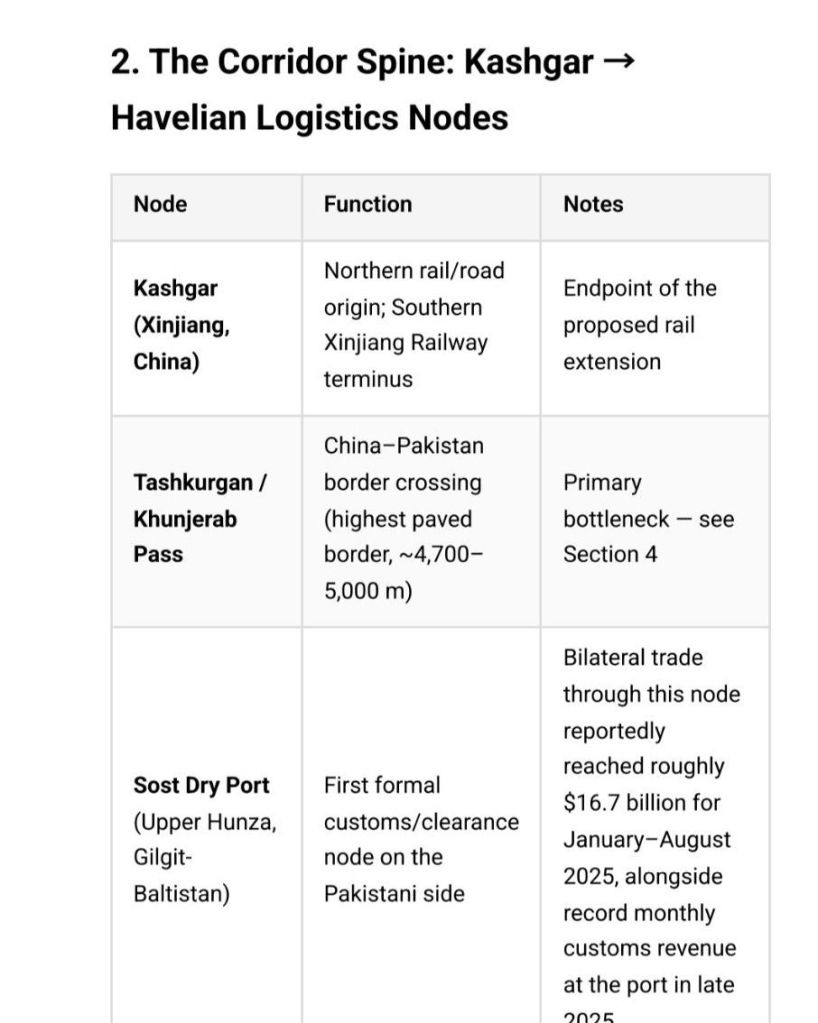
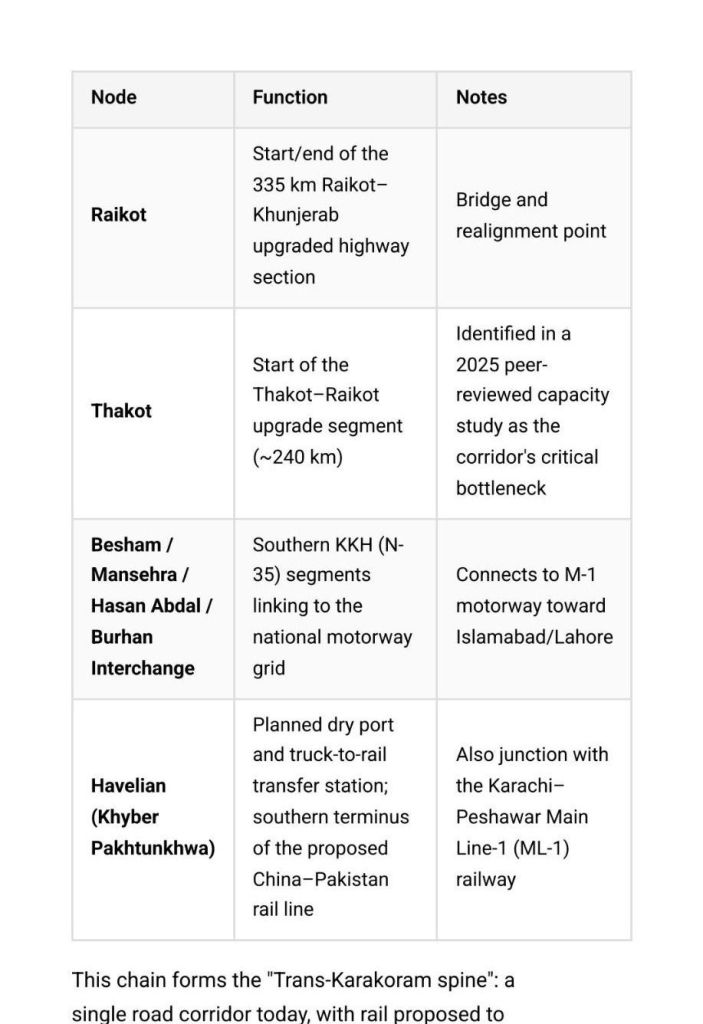
3. Highway Capacity: The 10 m → 30 m Widening Program
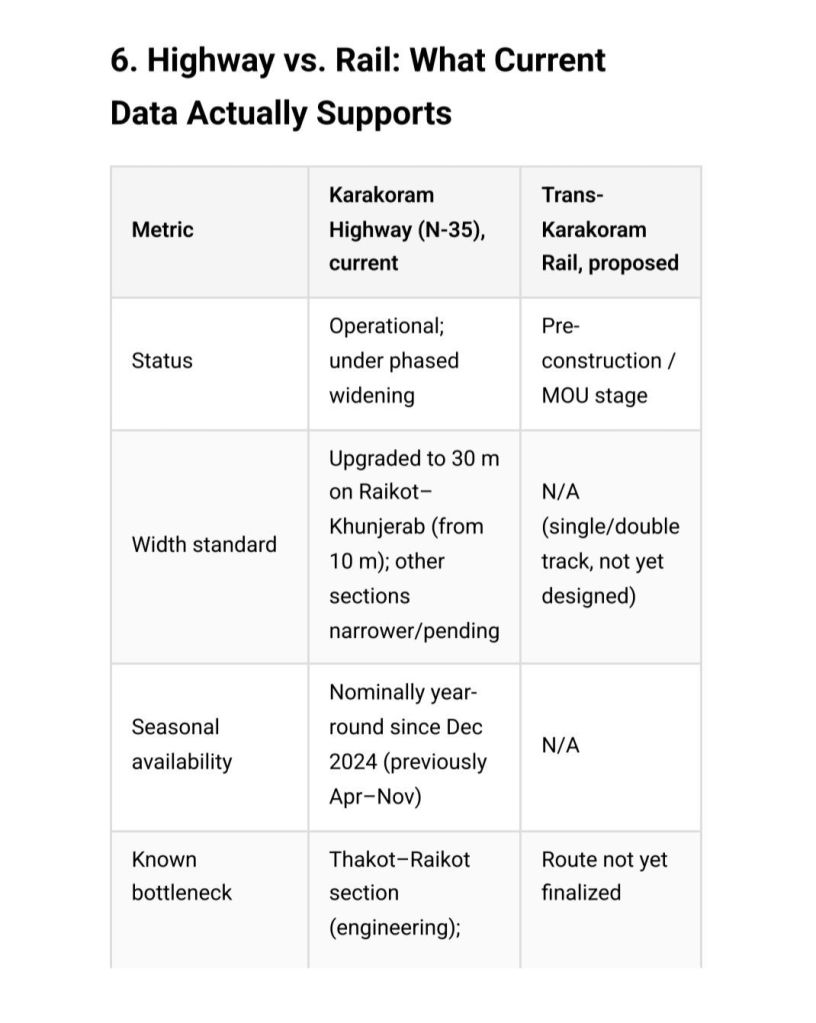
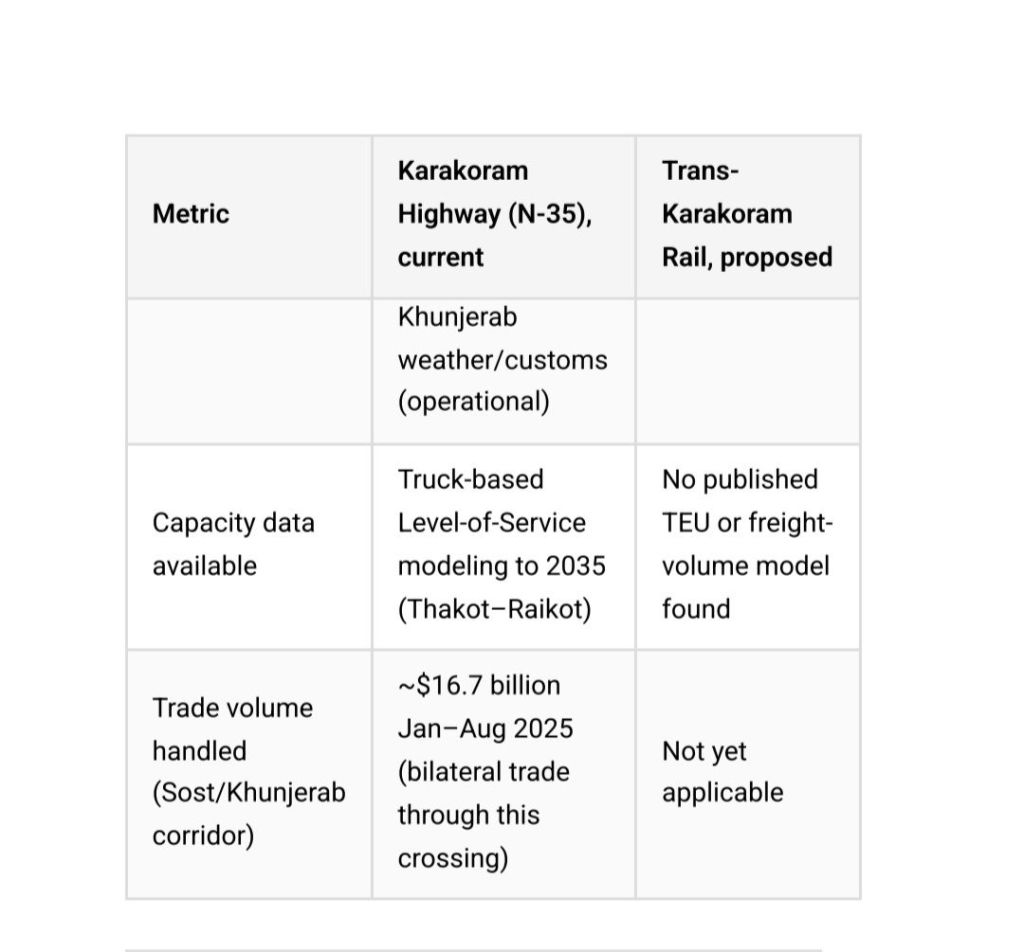
The Raikot–Khunjerab Section (335 km) was upgraded under a **$327.74 million China Eximbank loan** (total project cost ~$491–500 million), completed in November 2013. This project widened the roadway from 10 meters to 30 meters, added 32 new bridges (27 rehabilitated), and was designed to keep the route passable year-round and suitable for heavy, long-body freight vehicles.
Further upgrades are ongoing or planned:
Thakot–Raikot section (~240 km): MOU-stage realignment and upgrade, discussed during 2023 high-level visits, cost estimated in the billions of rupees.
Hasan Abdal–Mansehra section: NHA is reviewing dualization/rehabilitation of the existing carriageway to relieve congestion and slow-moving freight trailers.
Attabad Lake realignment section: Chinese-financed realignment, expected multi-year timeline.
Net effect: the KKH’s Pakistani alignment (N-35, 887 km) is being converted piecemeal from a narrow, seasonally vulnerable mountain road into a wider, hardened freight corridor — but full end-to-end dualization is not yet complete.
4. Bottleneck Analysis: Khunjerab Pass and the Thakot–Raikot Chokepoint
Altitude and seasonal closure (historical bottleneck):
– Khunjerab Pass sits at roughly 4,700–5,000 m, the highest paved international border crossing in the world.
– Under the 1985/2013 border protocols, the pass was traditionally open only April–November, closing December–March due to snow and low-oxygen conditions — a structural constraint on annual freight capacity.
– Following an October 2023 announcement at the Belt and Road Forum, China and Pakistan agreed to convert Khunjerab to **year-round operation; this took effect starting December 1, 2024. However, implementation has been uneven — the pass has also seen ad hoc closures tied to trader disputes over customs procedures (e.g., a multi-month suspension in 2025 over new scanning fees at Sost, resolved that October).
– Practical effect: even after the year-round policy, the corridor remains vulnerable to (a) residual heavy snowfall requiring active clearance, and (b) customs/administrative friction at Sost.
Engineering bottleneck (current capacity constraint):
A 2025 peer-reviewed capacity study (Adeel et al., *Scientific Journal of Silesian University of Technology – Transport*, 2025) modeling the Burhan–Khunjerab route specifically for a 2035 horizon found:
– The Thakot–Raikot section — not Khunjerab itself — is the critical bottleneck, with a modeled additional capacity of roughly 9,519 trucks/day at Level of Service “C” before saturation.
– Under trade-growth assumptions, the corridor is projected to carry about 7.93% of China’s total trade value** and 6.39% of trade tonnage by 2035 if current capacity-expansion plans proceed.
– Statistical relationships derived: each $1 million annual increase in Pakistan’s trade correlates with ~1.3 million ton-km of additional road freight; each 1-million-ton increase in trade volume adds ~1,684 million ton-km of freight movement.
Takeaway: Khunjerab’s altitude/weather profile is the *headline* bottleneck in public narratives, but the *binding engineering constraint* identified in recent modeling sits further south, at Thakot–Raikot — the still-unupgraded middle section of the highway.
No freight currently moves by rail across the Khunjerab/Kashgar frontier — this is a proposed, not operational, corridor.
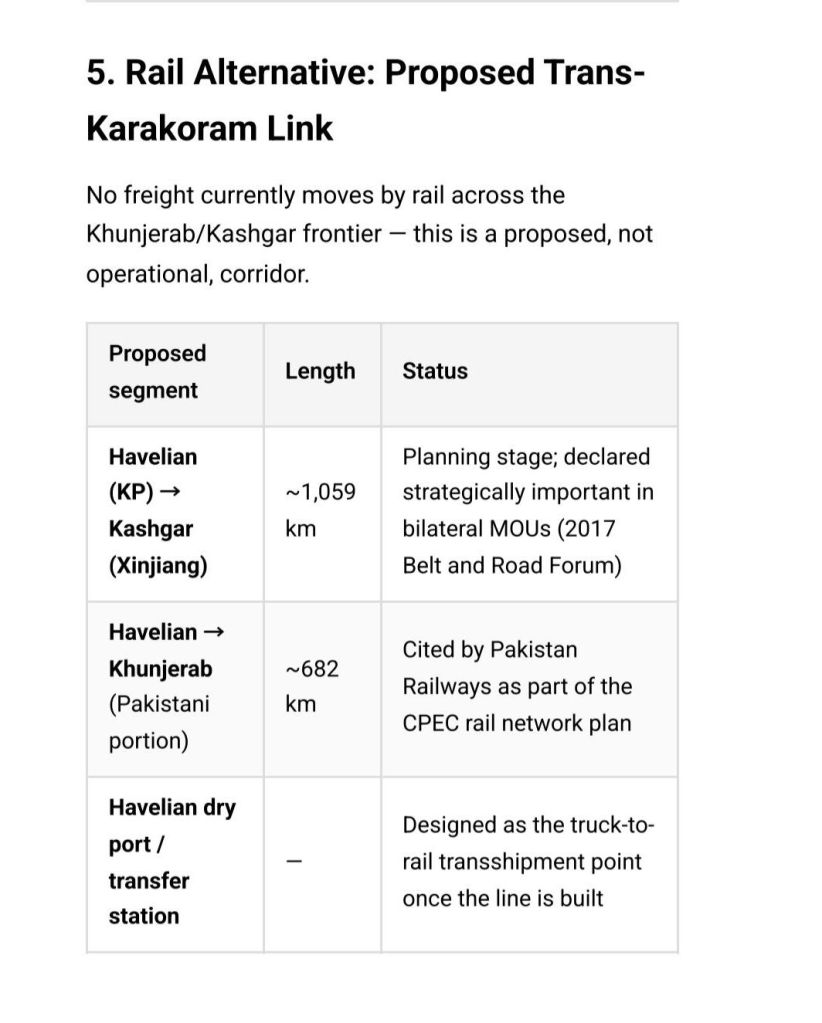
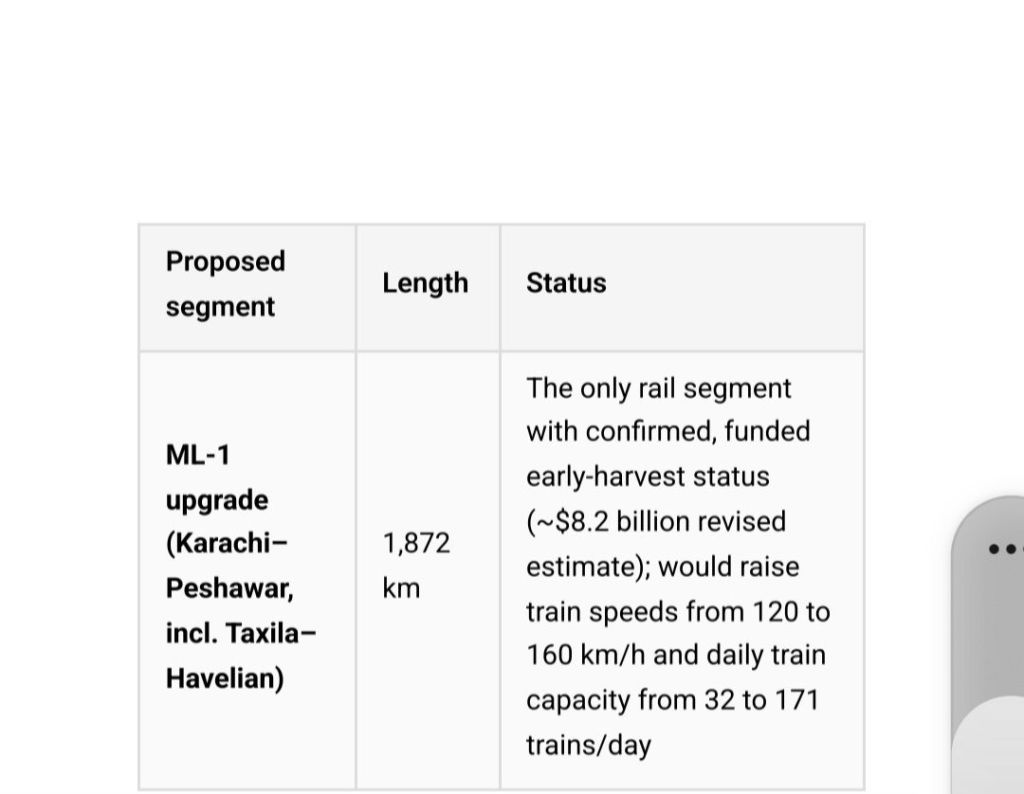
On TEU capacity: No official, engineering-grade TEU throughout projection specifically for the Kashgar–Havelian rail line has been published in government or peer-reviewed sources found in this research. Public statements to date describe the line only in route-length and strategic terms, not container-volume terms — the project remains pre-feasibility/MOU stage rather than at the design stage where TEU modeling would normally be produced. Any TEU figure attributed to this rail link in third-party commentary should be treated as speculative rather than an official target; I’d flag any such number to you rather than present it as sourced. If you need a comparative estimate, an alternative is to benchmark against ML-1’s confirmed capacity uplift (32→171 trains/day) and the trade-tonnage growth rates in Section 4 as a proxy for potential rail demand — I can build that model if useful.
7. Government Targets Toward 2030
– CPEC’s overarching route — 3,218 km of roads, railways, fiber-optic lines and pipelines linking Gwadar to Kashgar** — carries an official completion horizon of **2030**, per Pakistani government statements dating to the corridor’s 2015 launch.
– China’s cumulative investment/contribution under CPEC has been projected by Pakistan’s Planning Commission Centre of Excellence to exceed $100 billion by 2030** (up from an initial $46 billion, revised to $62 billion as of 2018 estimates).
– No single, current, official document was found in this research that sets a specific **TEU or tonnage target for 2030** on the Karakoram Highway or the rail corridor specifically; targets that do exist are expressed in dollar-value trade terms and megawatt/kilometer infrastructure terms rather than container throughput.
8. Caveats
– Figures on cost, length, and dates come from a mix of government statements, wire reporting, and one peer-reviewed engineering study; some (e.g., project costs, MOU-stage segment lengths) have shifted between sources over the corridor’s 15-year history and should be treated as approximate.
– The absence of a published TEU projection for the rail link is itself a finding — it indicates the project has not reached the design stage where such projections are normally produced, not that the figure exists but was simply unavailable to this search.
The Strategic Nexus of the New Silk Road
CPEC Logistics Capacity: Karakoram Highway vs. the Proposed Trans-Karakoram Rail Link
Under Siege: The Security Crisis Threatening CPEC and Gwadar Port
Balochistan the poorest province of Pakistan
The “All-Chinese” Swap: Fact-Checking the Labor Myths in Overseas Lithium Mining
The Strategic Nexus of the New Silk Road
By Marivel Guzman | Akashma News
Geopolitics, Logistics Capacity, and Debt Sustainability in the China-Pakistan Economic Corridor
Source: Wikimedia Commons — by J. Patrick Fischer
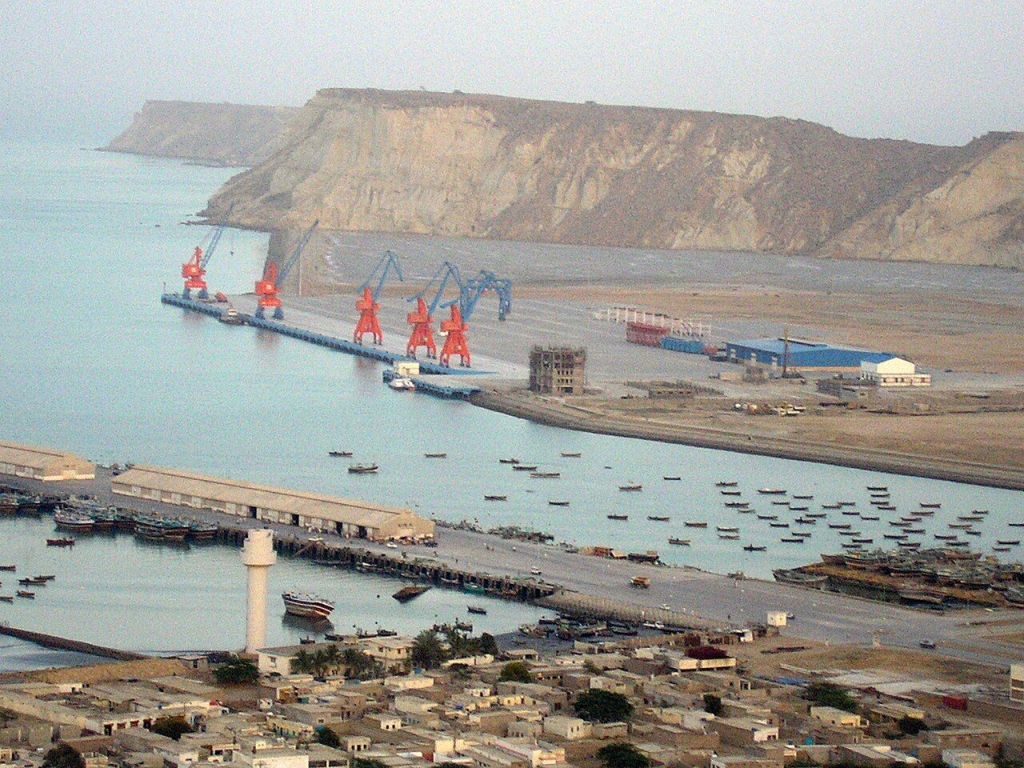
Gwadar Port handled more shipping containers in April alone than it did in all of 2025. Chinese frigates ran joint drills with the Pakistan Navy off Karachi this spring. Islamabad and Beijing describe a corridor bound for $100 billion in investment by 2030. On paper, the China-Pakistan Economic Corridor looks like it’s accelerating.
Look closer at the road and the ledger, and a different picture emerges — one where the physical infrastructure is still half-built, the most-cited bottleneck isn’t actually the binding one, a parallel rail line exists mostly as a memorandum of understanding, and Beijing’s patience with Pakistan’s debts is visibly running thin.
A Highway Still Being Rebuilt
The entire strategic case for CPEC rests on the Karakoram Highway, the 1,300-kilometer road linking Kashgar in western China to Pakistan’s Arabian Sea coast. It’s a remarkable piece of engineering, but it is not a finished one.
The one section that’s genuinely done — 335 kilometers between Raikot and Khunjerab — was widened from 10 meters to 30 under a $327 million Chinese loan completed back in 2013. That upgrade made the route passable to heavy freight trucks year-round. But the sections north and south of it are a patchwork: the Thakot–Raikot stretch has been stuck at memorandum-of-understanding stage since 2023, and a planned dualization further south, between Hasan Abdal and Mansehra, is still sitting in feasibility review.
That gap matters more than it might sound. A 2025 engineering study modeling freight capacity along this corridor out to 2035 found that the highway’s real chokepoint isn’t the famous, high-altitude Khunjerab Pass — it’s the unfinished Thakot–Raikot section in the middle. The same study estimated that stretch could absorb roughly 9,500 additional trucks a day before hitting saturation, and projected the corridor eventually carrying close to 8 percent of China’s total trade value if the remaining upgrades actually get built on schedule.
Khunjerab’s Bottleneck Changed Shape
Khunjerab Pass, at nearly 5,000 meters, is the highest paved border crossing on Earth, and for decades it was closed every winter — snow and thin air made it impassable from December to March. In late 2023, Beijing and Islamabad agreed to keep it open year-round, and that took effect in December 2024.
It hasn’t gone entirely smoothly. The pass has also been shut down for reasons that have nothing to do with weather — a months-long standoff in 2025 over new customs fees at Sost Dry Port froze cross-border trade until traders and officials worked it out that October. The takeaway: Khunjerab’s bottleneck used to be purely physical. Now it’s just as often bureaucratic.
The Rail Line That Exists Mostly on Paper
For years, CPEC planning documents have floated a rail line running roughly 1,000 kilometers from Havelian, in northern Pakistan, to Kashgar — with Havelian itself becoming a truck-to-train transfer hub. It would be transformative if built. It is nowhere close to being built.
The one rail project that actually has money behind it, the Karachi–Peshawar Main Line-1 upgrade, tells its own story about how CPEC financing has changed. Beijing originally pledged to fund the whole thing — $6.67 billion — back in 2016. Nearly a decade later, that money still hadn’t materialized, and by mid-2026 the project had reportedly been pulled out of the CPEC framework altogether and handed to a multilateral group led by the Asian Development Bank.
No government agency has published a real cargo-volume target for the Kashgar–Havelian rail link. That’s not an oversight — it’s a sign the project hasn’t reached the stage where those numbers would even exist yet.
Gwadar’s Moment, Courtesy of the Strait of Hormuz
None of this infrastructure strain has stopped Gwadar from having a genuinely good year. Instability around the Strait of Hormuz pushed global shippers to look for alternatives, and Gwadar — sitting just 400 kilometers from the strait, with a deep-water harbor most regional ports can’t match — was one of the few places positioned to catch the overflow. The port processed around 11,000 containers in April, more than its entire 2025 total.
The port’s appeal isn’t just commercial. Routing Middle Eastern crude through Gwadar and overland to Kashgar cuts a 12,000-kilometer sea voyage through the tightly patrolled Malacca Strait down to roughly 3,000 kilometers — a serious hedge for Beijing against any future blockade. And the corridor is explicitly dual-use: the Pakistan Navy and China’s PLA Navy ran their fourth joint “Sea Guardians” exercise this spring, with a Chinese guided-missile frigate joining Pakistani Tughril-class ships for anti-submarine and air-defense drills in the Arabian Sea.
Underpinning all of it is a fact rarely stated so plainly: both countries are nuclear powers, and that shared deterrent effectively folds any attack on CPEC infrastructure into each nation’s broader security calculus.
The Debt Problem Beijing Can No Longer Ignore
Here’s where the corridor’s momentum runs into a wall. Chinese power companies operating under CPEC were owed roughly 423 billion Pakistani rupees — about $1.5 billion — in unpaid dues as of the end of the last fiscal year, against a total power-sector debt load of 1.675 trillion rupees. China has refused to waive the associated late fees.
That’s separate from Pakistan’s regular sovereign debt payments to China — in July alone, the State Bank of Pakistan repaid $1.4 billion on a Chinese commercial loan, a different obligation entirely, expected to be refinanced by Chinese banks shortly after. The two debts get conflated a lot in commentary; they shouldn’t be, but both point in the same direction: Pakistan’s fiscal relationship with Beijing is under real strain.
The clearest evidence of how much that strain has changed Chinese behavior is the ML-1 railway’s financing shift, described above. A project China once insisted on funding alone has now been pushed onto multilateral lenders. That’s not how a confident creditor behaves.
Some critics call this “debt-trap diplomacy,” pointing to Sri Lanka’s Hambantota Port as the cautionary tale. Others push back, noting that a large share of CPEC’s projects are structured as equity investment rather than sovereign debt, and argue Pakistan’s deeper problem is years of fiscal mismanagement and weak exports that predate CPEC entirely. Both arguments have real evidence behind them — this is a genuine dispute, not a settled question.
Pakistan’s Other Balancing Act
None of this happens in a vacuum separate from Pakistan’s relationship with the West. For decades, Pakistani territory has served as the transit route for NATO supply lines into landlocked Central Asia, moving through the Torkham crossing near the Khyber Pass and the Chaman crossing in Balochistan. That role gives Islamabad leverage it hasn’t given up: it can deepen its partnership with Beijing while still positioning itself as indispensable to Western military logistics.
The Bottom Line
CPEC’s boosters and its critics are, in a sense, both right. The strategic architecture is real — the nuclear backstop, the naval cooperation, the genuine hedge against a Malacca Strait chokepoint. But so is the gap between that ambition and what’s actually built: an unfinished highway whose real weak point isn’t the one everyone talks about, a rail corridor that’s still just a plan, and a debt load that’s making Beijing noticeably more cautious about writing the next check. Whether the corridor delivers on its 2030 targets will depend less on geopolitics than on whether Pakistan and China can close that gap — and right now, the ledger is closing faster than the road.
—
Under Siege: The Security Crisis Threatening CPEC and Gwadar Port
This research-base-report follows The Strategic Nexus of the New Silk Road, which examined CPEC and Gwadar as critical links in China’s broader Belt and Road strategy. The present article turns to the growing security crisis in Balochistan and asks whether insurgent attacks, infrastructure sabotage and mounting security costs could undermine the very corridor designed to connect western China with the Arabian Sea.
A Supplementary Technical Analysis to “The Strategic Nexus of the New Silk Road
Related logistics report: CPEC Logistics Capacity: Karakoram Highway vs. the Proposed Trans-Karakoram Rail Link examines the physical infrastructure behind the corridor—highway widening, freight capacity, the Khunjerab Pass, the Thakot–Raikot bottleneck and the proposed rail connection between Pakistan and China. It complements this geopolitical analysis by asking a practical question: how much trade can CPEC actually move, and where are its most important logistical constraints?
Sources: Pakistan National Highway Authority project records; Adeel et al., “Multi-Dimensional Freight and Trade Capacity Analysis,” Scientific Journal of Silesian University of Technology (2025); The Diplomat; ProPakistani; Asia Times; The Express Tribune; The News (Pakistan); Asian Lite International; Journal of Contemporary Asia.*
Pakistan’s Strategic Potential: A Path Forward Through Regional Alliances
By Akashma News November 3, 2012
UPADTED: November 14, 2024
Pakistan, a culturally rich nation with a strategic location spanning 340,509 square miles, features a 1,046-kilometer (650-mile) coastline along the Arabian Sea and the Gulf of Oman.
Its educated population and emerging urban centers signify a country poised for significant influence in South Asia. However, Pakistan’s growth potential remains constrained by governance challenges and heavy reliance on external powers.
In an interview on Defense and Diplomacy, Major Raja Mujtaba, a dear friend and respected military figure, and Akram Zaki, a seasoned diplomat, discussed the paths Pakistan could take to gain self-sufficiency and regional power. They emphasized that Pakistan’s future lies in regional cooperation and reducing its dependency on the West. January 26, 2012
U.S.-NATO-Zionist Regime Alliance and Its Impact on the Muslim World
Mujtaba and Zaki addressed the complex global dynamics that Pakistan must navigate, including the alliance between the United States, NATO, and the Zionist Regime. They argued that this alliance has often led to actions targeting Muslim-majority countries, under the guise of fighting terrorism or safeguarding Western interests. Pakistan, located at a strategic intersection between Central and West Asia, has experienced firsthand the ramifications of such policies, particularly concerning U.S. military operations in Afghanistan and drone strikes within its borders.
This “war on terror” approach, they noted, has contributed to destabilizing Muslim nations, creating a security dilemma that often pushes Pakistan and similar countries to adopt defensive postures. The political ramifications of this alliance have also extended to trade and defense policies, with U.S. influence pressuring countries to choose sides in conflicts, further complicating Pakistan’s foreign policy options.
Strengthening Regional Cooperation Through ECO and SAARC
Pakistan has been a member of the Economic Cooperation Organization (ECO) and the South Asian Association for Regional Cooperation (SAARC) for over 30 years. Pakistan has played an active role in both organizations and has hosted summits for both.
In response to these pressures, Mujtaba and Zaki stressed the importance of the Economic Cooperation Organisation (ECO) and the South Asian Association for Regional Cooperation (SAARC) as avenues for fostering resilience.
The ECO, which includes Pakistan, Iran, and Central Asian countries, offers a platform for collective economic development. As Mujtaba noted, historical and cultural linkages make the ECO a natural foundation for building economic self-reliance. By expanding trade routes and infrastructure projects, the ECO can help counterbalance Western influence, especially in the energy and defense sectors.
In addition, SAARC provides another framework for regional engagement. Mujtaba and Zaki suggested that granting China a permanent membership in SAARC could offset India’s influence and create a more balanced regional power structure. Furthermore, including Afghanistan in SAARC underscores the value of incorporating neighboring states with shared goals of peace, stability, and development.
The Gwadar Project and Strategic Defense Partnerships
One of Pakistan’s most promising projects is the Gwadar port, envisioned as a hub for oil and gas trade, ideally situated to serve the needs of the ECO and beyond. Mujtaba believed Gwadar’s success hinges on establishing pipelines from Central Asia and Iran, potentially transforming Pakistan into a pivotal player in the global energy market. Cooperation with China, a key partner through the China-Pakistan Economic Corridor (CPEC), is essential for the success of this venture. Pakistan’s commitment to trilateral agreements with China and Iran, covering areas from defense to civil aviation and technology, could help strengthen its economic resilience and defense capabilities.
Imran Khan’s Imprisonment and
Pakistan’s Political Landscape’s internal challenges are compounded by the recent imprisonment of former Prime Minister Imran Khan. His detention, viewed by many as politically motivated, has brought Pakistan’s democratic system under scrutiny. Human rights advocates and international observers have called for transparency, arguing that his arrest is indicative of deeper issues within the country’s political environment.
Conclusion: A Vision for Pakistan’s Independence
Pakistan stands at a crossroads, balancing the influence of powerful global players with its aspirations for regional autonomy. Leaders like Major Raja Mujtaba envisioned an independent Pakistan, fortified through alliances with regional partners and rooted in economic self-reliance. As emphasized in the interview with Akram Zaki, Pakistan’s strategic goals can be achieved through deeper engagement with the ECO and SAARC, the development of Gwadar, and an assertive approach toward economic and political self-determination. Achieving this vision requires visionary leadership committed to Pakistan’s sovereignty and its rightful place as a significant regional player.
Raja Mujtaba’s Military Legacy and Passing
Major Raja Mujtaba, a well-respected defense analyst, and a Pakistani Army veteran left a notable legacy in military and defense circles. His career spanned critical military conflicts and intense international dynamics, often focusing on Pakistan’s strategic needs and its defense capabilities. Sadly, he passed away from cardiac arrest, leaving a void in both military and analytical communities. Mujtaba was admired not only for his contributions but also for his character, as described in a Veterans Today tribute, which highlighted his visits with Pakistani elites, TV interviews, and debates aimed at advocating for Pakistan’s strategic autonomy and collaborative defense efforts with nations like China and Iran. His death marked a profound loss to his friends, colleagues, and admirers worldwide.
Defense and Diplomacy on PTV world


