Archive
Gwadar, CPEC and the Balochistan Question
Between Strategic Ambition, Political Friction and the Pakistan the World Rarely Sees
By Marivel Guzman | Akashma News
Before talking about ports, pipelines, China, military strategy or billions of dollars in investment, it is worth remembering something much simpler:
People already live there.
Across Pakistan, and particularly across Balochistan, generations of families have built lives under circumstances outsiders often describe through the language of instability, underdevelopment or insecurity.
But those words capture only part of the picture.
Life continues beyond the vocabulary of crisis.
People marry, raise children, cultivate land, tend livestock, fish, sew, weave, trade, teach and practice crafts handed down through generations. Communities adapt to political uncertainty, uneven development and changing economic conditions while preserving ways of life that often long predate the policies designed to transform them.
To understand Gwadar and CPEC from Pakistan and Balochistan’s point of view, those lives have to come first.
Balochistan has experienced insurgency, political unrest, economic disparities, uneven public services and repeated disputes over provincial authority and natural resources. The provincial government of Balochistan describes the region as historically underdeveloped relative to other parts of Pakistan while emphasizing the importance of agriculture, livestock, mineral resources and Gwadar to its future development.
Not every society measures a good life by the conveniences familiar to a metropolitan household.
For some families, continuity itself has value: land cultivated by previous generations, access to the sea, livestock, a family craft, a language, a village or a community in which everybody knows one another.
A fisherman may judge development less by the size of a new terminal than by whether he can continue reaching the sea and supporting his family.
A pastoral family may place greater value on land it has known for generations than on an apartment in a distant city.
A woman preserving embroidery techniques taught by her mother or grandmother may understand economic and cultural value in ways that cannot be measured by gross domestic product alone.
This does not mean hardship should be romanticized.
Lack of safe drinking water is not culture.
Lack of medical care is not authenticity.
Illiteracy is not tradition.
Poverty should not be celebrated simply because traditional life may appear picturesque from a distance.
The challenge is subtler.
Development offered is different from development imposed.
And progress means little if the people expected to experience it have little voice in defining what progress should mean.
That is the human question beneath Gwadar.
To some outside observers, Pakistan is a country defined by corruption, military interference, political instability and insurgency.
To enthusiastic proponents of the China-Pakistan Economic Corridor, or CPEC, Pakistan is the indispensable bridge between western China and the Arabian Sea — a country whose geography could reshape regional trade.
Both perspectives describe elements of a much larger reality.
This article approaches that reality from another direction:
from Pakistan and Balochistan outward.
That means looking first at Pakistani and Balochistan government records, local political discussions, community livelihoods and voices rooted in the province, and then examining the strategic ambitions of Islamabad and Beijing.
The purpose is not to determine whether development itself is good or bad.
The more important questions are:
Development for whom?
Defined by whom?
And who ultimately shares in its benefits?
My Pakistan Began With People, Not Geopolitics
I have never traveled to Pakistan.
Yet Pakistan became very personal to me long before I began researching CPEC.
Two Pakistani friends gave me very different windows into the country.
One was the late retired Maj. Raja Ghulam Mujtaba, founder of the OM Center for Policy Studies and its online publication Opinion Maker.
Raja had served in the Pakistan Army before moving into information technology and strategic analysis. In a 2011 interview published by Opinion Maker, his biography described his military service and subsequent work as an adviser on information systems for the Kuwait Air Force. He spoke extensively about Pakistan’s political weaknesses, national potential and strategic position.
Raja Mujtaba Speaks to Fortress — Opinion Maker
Raja represented one Pakistan to me: the Pakistan of sovereignty, national security, military strategy and the conviction that the country possessed considerably greater potential than outsiders often recognized.
But Raja was not uncritical of Pakistan.
In that same interview, he criticized political leadership and argued that Pakistan possessed substantial natural and human resources but lacked the political vision necessary to use them effectively.
The other Pakistan I came to know was through Humera Karim of Quetta, whom I affectionately called my princess.
Humera showed me Balochistan from inside.
She understood Quetta, tribal and traditional communities, the challenges encountered by women, metropolitan Pakistan, and the social distance that could exist between Balochistan and Pakistan’s larger urban centers.
Before her later work with the United Nations refugee agency, Humera worked in communications with the Pakistan Red Crescent Society in Balochistan.
I knew that period personally. Humera sent me drafts to proofread and polish in English, including material prepared around the Pakistan Red Crescent’s community work. Literacy, skills-building and assistance to local communities were recurring subjects in the material I remember working on with her.
Those drafts remain part of my personal archive and memory of our friendship; I distinguish that firsthand recollection from the publicly archived material cited in this article.
Her later published work shows remarkable continuity.
In a 2020 UNHCR report from Quetta, a skills-development program for Afghan refugee and Pakistani women provided occupational training intended to improve income-generating capacity and economic independence.
UNHCR — Skills Development Project for Refugee and Local Women in Quetta
In another article, Humera documented a young Afghan refugee woman in Quetta who continued her education despite intense resistance and eventually pursued medicine. The story was not simply about schooling; it showed how change can occur within a traditional community when determination, education and eventual community acceptance intersect.
Humera Karim — Breaking Barriers: A Young Refugee Woman Fulfils Her Medical Career Dream
That story reminds me very much of the Humera I knew.
She never romanticized social restrictions imposed on women.
But neither did she speak about traditional communities as though they were people waiting for civilization to arrive.
She understood that people may want education, medicine and economic opportunity while still valuing family, community, language and tradition.
That distinction became important to me long before I began investigating Gwadar.
Humera Karim’s 2014 Balochistan
Humera also left something particularly valuable for this investigation: her own contemporaneous assessment of her province.
On March 24, 2014, she published “Balochistan the Poorest Province of Pakistan” on PK Articles Hub. The original website is no longer operating, but the article survives through the Internet Archive’s Wayback Machine, allowing readers to consult Humera’s original 2014 wording exactly as it appeared at the time.
Original archived article
In September 2026, I republished the article at Akashma News as a memorial tribute to Humera, with the permission of her widower, Hashim Ali. Because Urdu was Humera’s native language, the republication received careful editing for English grammar, sentence structure, punctuation and terminology while preserving her argument, political criticism, irony and distinctive voice.
The intention was not to rewrite Humera, but to make her original analysis more accessible to English-language readers without changing the substance or spirit of what she wrote.
Edited memorial republication at Akashma News:
These projects matter.
But a project ledger cannot by itself answer the human questions.
Does a fisherman retain reliable access to his livelihood?
Do local families obtain water and electricity?
Can a young resident obtain the training required for the new economy developing around the port?
How much employment remains local?
How much authority do provincial and municipal communities have over decisions affecting their land and coastline?
These are not arguments against development.
They are questions about what development actually means once the construction crews leave.
Progress Is Not a Neutral Word
Governments speak of progress.
Investors speak of development.
Strategists speak of connectivity.
Economists speak of growth.
But those words do not necessarily mean the same thing to everybody.
A highway can mean opportunity to one family and disruption to another.
A port can mean national revenue to Islamabad and economic uncertainty to a fishing community.
A technical institute can open possibilities for young residents while simultaneously signaling that the economy around their families is changing rapidly.
None of this means Balochistan should be frozen in time.
Young people in the province have the same right to education, health care, communications, technology and economic opportunity as anyone elsewhere.
But choice matters.
Modernity offered is different from modernity imposed.
Development shared is different from development merely passing through.
And respecting traditional life does not require preserving deprivation.
Humera’s own journalism demonstrated that distinction.
She supported literacy.
She supported education.
She wrote about women developing economic independence.
She documented people challenging restrictive customs.
But she did so while remaining rooted in the communities she was describing.
That is a very different approach from assuming that outsiders already know what those communities ought to become.
Pakistan’s Critics Are Not Wrong About Governance Problems
A Pakistan-centered account should not become an exercise in denying Pakistan’s problems.
Corruption, patronage and governance failures are legitimate subjects of scrutiny.
But there is a significant difference between documenting failures within institutions and declaring an entire nation institutionally worthless.
Pakistan possesses functioning federal and provincial governments, courts, universities, ports, regulatory authorities, public statistical agencies and infrastructure institutions.
Some perform better than others.
Some are vulnerable to corruption or political pressure.
Institutional capacity and institutional weakness can coexist inside the same state.
That complexity is more useful than caricature.
Pakistan’s Military Cannot Be Removed From the Political Story
Pakistan’s military also occupies an unusually influential position in national politics.
Pakistan holds multiparty elections, but outside political-rights assessments continue to describe the armed forces as exercising substantial influence over government formation and public policy. Freedom House’s 2026 assessment explicitly identifies extensive military influence while also noting security threats from militant organizations.
Freedom House — Pakistan 2026
Pakistan CPEC Secretariat — Gwadar Projects
This is Pakistan’s principal official project inventory for Gwadar under CPEC. It separates completed projects from those under construction and those still in the pipeline, making it particularly useful for distinguishing physical infrastructure already delivered from future strategic ambitions.
Open the official CPEC Gwadar project inventory
https://web.archive.org/web/20140329043245/http://www.pkarticleshub.com/2014/03/24/balochistan-the-poorest-province-of-pakistan-2/
UNHCR — Skills Development Project for Refugee and Local Women in Quetta, 2020
This report documents vocational training for Afghan refugee and Pakistani women in Quetta and illustrates the community-development themes that characterized Humera’s later professional work. It provides concrete evidence of efforts to combine skills, livelihoods and women’s economic participation in Balochistan.
UNHCR Quetta skills-development report
Humera Karim — “Breaking Barriers,” UNHCR, 2021
Written by Humera in Quetta, this story follows a young refugee woman who continued her education despite strong social resistance and eventually pursued medicine. It is particularly valuable to this article because it illustrates Humera’s ability to criticize restrictive customs without reducing an entire community to those customs.
Breaking Barriers — UNHCR
Humera Karim — Girls’ Education in Saranan Refugee Village, UNHCR, 2018
Humera reported on a community elder who encouraged families to educate their children, particularly girls, and advocated skills development to make the community more self-sufficient. The story demonstrates that traditional communities themselves can become agents of change rather than simply objects of outside development policy.
Humera Karim’s UNHCR education report
Open the Gwadar Port and Free Zone project
CPEC Secretariat — Development of Gwadar Port and Free Zone
This source documents the 2,281-acre free zone, investment registrations and initial industrial production. It provides the official Pakistani account of Gwadar’s intended evolution from a port into an industrial and commercial complex.
Dawn — Balochistan Multi-Party Conference, Sept. 13, 2026
This contemporary Quetta report records discussions among several political parties concerning security, constitutional issues, economic conditions, resource control and political rights. Its importance is that calls for dialogue and greater attention to provincial grievances are coming from political actors operating within Pakistan, not solely from armed separatist organizations.
https://opinion-maker.org/2011/04/raja-mujtaba-speaks-to-fortress/?utm_source=chatgpt.com)
Tony Lazaro — Letter Responding to TIME, 2012
Lazaro’s response is used as an example of a longstanding argument over how Pakistan is represented internationally. He did not deny violence or governance problems; instead, he argued that universities, businesses, students and economic activity also belonged in the picture.
Read Tony Lazaro’s full response
https://goodnews.pk/2012/01/29/tony-lazaros-letter-to-the-editor/
TIME subsequently published a substantially shorter reader response under the heading “Not All Bad in Karachi.”
TIME — Not All Bad in Karachi
https://www.amnesty.org/en/documents/asa33/1057/2026/en/?utm_source=chatgpt.com)
Raja Mujtaba — “Raja Mujtaba Speaks to Fortress,” Opinion Maker, 2011
This interview provides Raja Mujtaba’s own account of his military and professional background and his views of Pakistan’s political leadership, strategic potential and national identity. It gives the article an identifiable Pakistani national-security perspective rather than relying solely on outside descriptions of the country.
Read Raja Mujtaba’s Fortress interview
Gwadar Port Authority — Port Operations
The authority reported in April 2026 that Gwadar had three operational berths and capacity for vessels of approximately 50,000 deadweight tons. This source is important because it helps distinguish Gwadar’s present commercial capabilities from the much larger petroleum and logistics corridor frequently depicted in strategic projections.
Open Gwadar Port Authority operational updates](https://gwadarport.gov.pk/events.aspx
CPEC Secretariat — Gwadar Eastbay Expressway
The official project page describes the expressway as the principal road connection between Gwadar Port, the free zone and Pakistan’s national highway network. It also reports 2,000 project jobs, including 1,700 local positions, making it relevant to the question of whether infrastructure creates direct economic participation for local communities.
Open the Eastbay Expressway project record
https://www.dawn.com/news/2029470/multi-party-conference-voices-concern-over-balochistans-law-and-order
Amnesty International — Jiand Baloch, 2026
Amnesty reported that student activist Jiand Baloch returned after an 11-day enforced disappearance and described it as the third such episode involving him. This source is used specifically as an attributed human-rights allegation and not as evidence characterizing every Pakistani security operation.
Open Amnesty International’s Jiand Baloch report
Humera wrote bluntly.
She discussed poverty, political privilege, tribal elites, corruption, insufficient roads, education, health care, shortages of clean drinking water and weak electricity infrastructure.
Her criticism was unmistakably local.
It was not an outsider looking at Balochistan and announcing what was wrong with it.
It was a woman from Quetta writing about problems she believed her own province needed to confront.
Her article is particularly useful when placed beside the Government of Balochistan’s later statistical record.
The provincial Bureau of Statistics has produced a Trend Analysis of Development Statistics of Balochistan, 2010–2023, alongside its Socio-Economic Indicators of Balochistan series.
The timing is almost ideal for historical comparison.
Humera was writing in 2014, within the period covered by the 2010–2023 statistical review.
Her article therefore provides something statistical tables cannot:
a human account from inside Balochistan while those conditions were being experienced.
The provincial statistics provide the longer trajectory.
Government of Balochistan — Trend Analysis of Development Statistics of Balochistan, 2010–2023
Government of Balochistan — Socio-Economic Indicators of Balochistan 2024
Balochistan covers approximately 347,190 square kilometers, or 43.61 percent of Pakistan’s total land area, while its 2023 population was approximately 14.89 million. Federal Pakistani data confirm both figures.
About 10.28 million people — roughly 69 percent of Balochistan’s population — lived in rural areas according to 2023 census-based provincial reporting.
Education statistics illustrate the rural-urban divide particularly clearly.
Census-based figures put Balochistan’s overall literacy rate at 42.01 percent, compared with 55.86 percent in urban areas and 35.74 percent in rural areas. Rural female literacy was reported at 26.59 percent.
Yet the broader development record also documents infrastructure expansion.
That distinction matters.
Balochistan has not stood still since Humera wrote in 2014.
Nor have the disparities she described simply disappeared.
Read together, her article and the provincial statistical record provide a far more useful picture than either source alone.
Humera gives us the human baseline.
The statistics give us the development trajectory.
Gwadar: The Geographical Temptation
Gwadar’s attraction to Pakistani and Chinese strategists becomes immediately apparent on a map.
The port sits on Balochistan’s Arabian Sea coast, near the approaches to the Persian Gulf and some of the world’s most important energy-exporting states.
China, meanwhile, depends heavily on long maritime supply chains connecting energy producers with Chinese markets.
The idea of using Pakistan as an alternative trade and energy corridor is older than CPEC itself.
During President Pervez Musharraf’s 2006 visit to Beijing, Pakistan publicly promoted the concept of using Gwadar as an energy and trade connection toward western China.
The idea was simple in geographical terms:
Middle Eastern energy could reach Gwadar by sea and, in theory, eventually travel north through Pakistan toward Xinjiang.
But geographical simplicity does not mean engineering or economic simplicity.
That distinction remains essential today.
Gwadar Is Not Yet China’s Operating Oil Gateway
Gwadar is frequently depicted on geopolitical maps as though crude oil already arrives at the port and flows directly through Pakistan into China.
That is not the present commercial reality.
The Gwadar Port Authority reported in April 2026 that the port had three operational berths and could accommodate vessels of up to approximately 50,000 deadweight tons, with modern container and general-cargo equipment installed.
Gwadar Port Authority — News and Operational Updates
These are genuine commercial facilities.
But they are not the same thing as an operating trans-Pakistan crude-oil corridor.
The distinction matters because the strategic idea is real while the complete petroleum system remains prospective.
Gwadar’s significance therefore derives partly from what exists today and partly from what Pakistan and China hope the port may eventually become.
CPEC Is Not Merely an Idea
The opposite claim — that China has built nothing of consequence in Pakistan — is equally difficult to sustain.
Pakistan’s official CPEC Secretariat lists a substantial portfolio of completed infrastructure.
In Gwadar, completed projects include development of the port and free zone, the Gwadar Smart Port City Master Plan, Pak-China Technical and Vocational Institute, Eastbay Expressway, Pak-China Friendship Hospital, a 1.2-million-gallon-per-day desalination plant and the New Gwadar International Airport.
Pakistan CPEC Secretariat — Gwadar Projects https://cpec.gov.pk/gwadar
https://www.amnesty.org/en/documents/asa33/1355/2026/en/
Amnesty International — Dad Shah, 2026
Amnesty alleged that Dad Shah, brother of human-rights defender Fozia Baloch, was forcibly disappeared and that relatives were subsequently harassed while seeking information. As with the Jiand Baloch case, the article attributes these claims explicitly to Amnesty rather than presenting unresolved allegations as independently established facts.
Open Amnesty International’s Dad Shah report
https://goodnews.pk/2012/01/29/tony-lazaros-letter-to-the-editor/
TIME — “Not All Bad in Karachi,” 2012
TIME later published a much shorter reader response from Lazaro. Reading the published excerpt alongside his longer submission illustrates the article’s broader point that editorial selection can substantially shape how a country and its people are perceived.
Read TIME’s published response
—
https://cdn.bospnd.balochistan.gov.pk/resources/publications/2024/socio-economic-indicators-of-balochistan-2024-1777026030506.pdf
Humera Karim — “Balochistan the Poorest Province of Pakistan,” March 24, 2014
Humera’s archived article is the central historical voice in this investigation. Written from Quetta during the period covered by the provincial development statistics, it addresses poverty, political privilege, tribal power, education, health care, infrastructure, water and the frustration she associated with economic deprivation.
Read Humera Karim’s archived 2014 article
https://cdn.bospnd.balochistan.gov.pk/resources/publications/2026/uploaded-file-2026-1777010446020.pdf
Government of Balochistan — Socio-Economic Indicators of Balochistan 2024
This publication provides provincial and district-level socioeconomic indicators and is particularly useful for examining population, education, health, infrastructure and rural-urban differences. It anchors the human discussion of Balochistan in the province’s own official statistical record.
Open Socio-Economic Indicators of Balochistan 2024
https://freedomhouse.org/country/pakistan/freedom-world/2026
This matters particularly in Balochistan because questions of political representation, resource control and economic development have long overlapped with national-security policy.
When political grievances are understood principally through a security framework, political solutions become more difficult to develop.
Balochistan Is Where Development Meets History
Gwadar does not sit on empty strategic terrain.
It sits in Balochistan.
The province contains distinct political histories, ethnic communities, tribal traditions and longstanding arguments concerning autonomy, resource control and relations with Pakistan’s federal government.
Those disputes existed long before CPEC.
CPEC inherited them.
The political landscape is also far more diverse than the word “separatism” suggests.
There are armed separatists.
There are Baloch nationalist parties operating within Pakistan’s political system.
There are federalists.
There are tribal leaders.
There are human-rights activists.
There are business owners.
There are fishermen and laborers.
And there are millions of ordinary people whose principal ambitions may have considerably more to do with their families than with geopolitical ideology.
No single faction can speak automatically for all of them.
Quetta, Politics — and My Princess Humera
In September 2026, leaders from numerous political parties gathered in Quetta to discuss Balochistan’s deteriorating security environment and broader constitutional, political and economic concerns.
The meeting addressed provincial resources, political and democratic rights, economic problems and security. Participants argued that force alone could not resolve Balochistan’s longstanding difficulties and called for political dialogue involving leadership trusted by the population.
Dawn — Multi-Party Conference Voices Concern Over Balochistan’s Law and Order, Sept. 13, 2026
https://time.com/archive/6641033/not-all-bad-in-karachi/
The importance of Lazaro’s response is not that one visitor’s observations disproved reporting about violence.
They did not.
His point was that selection shapes perception.
Show only violence and corruption, and Pakistan becomes nothing but violence and corruption.
Show only airports, highways and Chinese investment, and Pakistan becomes a development advertisement.
Neither is journalism.
Pakistan Does Not Need Romanticism. Neither Does Balochistan.
Pakistan does not need protection from criticism.
It needs accurate description.
Balochistan deserves the same standard.
Traditional life should not be romanticized.
Women should not be expected to accept discrimination because a practice is described as culture.
Children should not lose access to education in the name of preserving tradition.
Families should not lack clean drinking water because deprivation is confused with simplicity.
But outsiders should also resist the assumption that every community wishes to become a version of Karachi, Islamabad, Beijing, London or Los Angeles.
Attachment to land, fishing, livestock, language, craft or village life does not mean that a person has failed to understand progress.
Sometimes it means that progress has been defined differently.
That distinction is at the heart of this investigation.
Gwadar’s Future Runs Through Balochistan
The future of CPEC will probably not be determined by a single dramatic announcement.
It will develop gradually.
By cargo volumes.
By investment.
By electricity.
By water.
By employment.
By fisheries.
By land.
By local government.
By mineral and resource revenues.
By political representation.
By security.
By whether armed movements choose politics over violence.
By whether the state chooses negotiation where negotiation is possible.
And by whether development leaves communities with more choices rather than fewer.
Gwadar may eventually become a major strategic and commercial gateway for the China-Pakistan partnership to the Arabian Sea.
But that gateway stands in Balochistan.
Its future cannot be separated from the people who live there, the livelihoods they already possess, the resources beneath their land and sea, and the political arrangements under which development proceeds.
Gwadar may become a major regional logistics center.
It may eventually form part of a wider energy corridor connecting Gulf markets with western China.
Or some of those ambitions may prove economically or politically impractical.
The outcome is not predetermined.
What should already be clear is this:
Balochistan is not an empty corridor waiting for development to pass through it.
It is a living society whose people have histories, livelihoods, political disagreements and competing visions of their own future.
Any China-Pakistan project that hopes to endure must account for that reality.
—
References and Source Notes
The following sources form the documentary foundation of this analysis. They combine Pakistani and Balochistan government records, contemporary reporting, archival journalism and primary material written by Humera Karim. The annotations explain why each source matters rather than merely listing links.
Government of Balochistan — Trend Analysis of Development Statistics of Balochistan, 2010–2023
This provincial statistical study provides the long-term development timeline against which Humera Karim’s 2014 observations can be compared. It allows the article to distinguish persistent structural problems from areas where measurable infrastructure expansion occurred over the following decade.
Open the Government of Balochistan 2010–2023 report
Balochistan the poorest province of Pakistan
https://akashmanews.com/2026/09/19/humera-karim-balochistan-poorest-province-pakistan-2014/
https://www.amnesty.org/en/documents/asa33/1057/2026/en/
These allegations should be reported as allegations documented by Amnesty International, not transformed into a characterization of every Pakistani security operation.
The same evidentiary discipline must apply to armed groups.
Political grievances do not justify violence against civilians.
State security concerns do not erase political grievances.
A serious examination of Balochistan has to hold both realities at once.
Could China Play a Different Role?
China has an obvious interest in stability around CPEC.
That does not mean Beijing can simply impose a settlement between Islamabad and Baloch political actors.
Pakistan regards Balochistan as an internal political and security matter, while China traditionally emphasizes national sovereignty.
But major investors inevitably influence the environment in which development takes place.
China can prioritize local employment.
It can support vocational education.
It can encourage consultation.
It can finance water, health and municipal infrastructure alongside commercial infrastructure.
And it can recognize that economic security and political legitimacy are connected.
A community that sees itself as a participant in development has a very different relationship to a project than a community that believes development is simply being done to it.
The Pakistan the Headlines Miss
The tendency to reduce Pakistan to crisis is not new.
In 2012, Australian businessman Tony Lazaro objected to a TIME portrayal of Karachi that he believed focused disproportionately on violence and dysfunction.
Lazaro did not argue that Pakistan lacked serious problems.
His argument concerned proportion.
His original response described Pakistani universities, students, businesses and exporters he had encountered during visits to Karachi and Islamabad and argued that these realities also belonged in any meaningful portrayal of the country.
Tony Lazaro — Letter to the Editor Responding to TIME
https://cpec.gov.pk/gwadar?
Pakistan CPEC Secretariat — CPEC Energy Projects
The official energy portfolio documents completed and proposed electricity-generation and transmission projects associated with CPEC throughout Pakistan. It demonstrates that the China-Pakistan economic relationship has already produced substantial physical infrastructure even though the proposed Gwadar-to-China petroleum corridor remains unrealized.
Open the official CPEC energy-project inventory
https://www.cpec.gov.pk/energy
Gwadar Port Authority — Development Projects
The port authority’s own project inventory records completed and ongoing infrastructure, including the Eastbay Expressway, desalination facilities, technical training, fisheries assistance and further port expansion. It provides a useful Pakistani primary source for determining what has actually been constructed at Gwadar.
Open Gwadar Port Authority development projects](https://gwadarport.gov.pk/project.aspx
Balochistan the poorest province of Pakistan
This gives readers a choice: they can examine the surviving 2014 archival version or read the authorized, lightly edited Akashma News edition prepared more than a decade later.
Humera’s article is particularly valuable because it was written during the period later examined by the Government of Balochistan’s 2010–2023 development statistics. Her observations therefore provide a contemporaneous human account against which more than a decade of provincial data can now be compared.
The official CPEC energy portfolio also lists major completed electricity-generation and transmission projects across Pakistan, including the 1,320 MW China Hub power project in Balochistan.
Pakistan CPEC Secretariat — Energy Projects https://www.cpec.gov.pk/energy
Gwadar’s Eastbay Expressway was designed to connect the port and free zone directly to Pakistan’s national highway system. The CPEC Secretariat reports approximately 2,000 jobs associated with the project, including 1,700 local jobs.
CPEC — Gwadar Eastbay Expressway
https://www.cpec.gov.pk/project-details/32)
The Gwadar Port Free Zone covers approximately 2,281 acres. Official project records report dozens of registered enterprises and several companies beginning production.
CPEC — Development of Gwadar Port and Free Zone
At the same time, the project remains incomplete.
Breakwaters, dredging, additional water infrastructure, fisheries facilities and other projects remain under construction or in planning.
The most accurate description therefore lies between celebration and dismissal:
Gwadar is neither imaginary nor finished.
The Human Side of Infrastructure
Pakistan’s own CPEC records increasingly acknowledge that infrastructure alone cannot define success.
The official portfolio includes vocational training, medical facilities, drinking water, solar projects and other social-development initiatives alongside highways, ports and power generation.
The Gwadar Port Authority also lists completed projects including water-supply infrastructure, vocational facilities and 2,000 boat engines provided to fishermen.
Gwadar Port Authority — Development Projects
https://www.dawn.com/news/2029470/multi-party-conference-voices-concern-over-balochistans-law-and-order
Reading about that meeting brought back memories of conversations with Humera.
We often talked about visiting one another.
I wanted to see Quetta — her Quetta.
But Quetta was never the obvious meeting place.
Humera told me that foreign visitors could face security restrictions and special permission requirements in Balochistan, and our conversations usually turned instead toward meeting in Karachi or Islamabad.
At the time, it seemed like a practical travel problem.
Years later, it carries another meaning.
Quetta was Humera’s hometown.
It was where she lived and worked and understood communities I knew largely through her stories.
Yet even something as ordinary as two friends planning to meet could be shaped by Balochistan’s political and security environment.
I never had the opportunity to meet Humera, but I knew Quetta through her eyes.
Those conversations remain part of how I understand the province today.
Security and Human Rights: Two Realities at Once
Pakistan faces genuine armed violence in Balochistan.
Separatist organizations have attacked Pakistani security forces, civilians, infrastructure and Chinese interests.
Those security threats cannot be removed from an honest account of CPEC.
Neither can allegations concerning state conduct.
In August 2026, Amnesty International reported that Baloch student leader Jiand Baloch returned after disappearing for 11 days. Amnesty described it as his third enforced disappearance and attributed the incidents to his peaceful activism.
Amnesty International — Jiand Baloch, Aug. 6, 2026
https://www.amnesty.org/en/documents/asa33/1355/2026/en/
Amnesty separately alleged that Dad Shah, the brother of human-rights defender Fozia Baloch, was forcibly disappeared in April 2026 and that relatives experienced harassment while seeking information about him.
Amnesty International — Dad Shah, May 29, 2026
People We Do not Know
Experimental Poet that loves to love
We come from different backgrounds, cultures, religions, countries, we speak different languages and even with all these dis similarities we are closer that ever.
But who are “WE”?, people around the globe, “People We Do Not Know”, those strange faces that we encounter in every walk of life, in the coffee shop, the market and like a social disease in the social networks. We are every where, we have different skin colors, different social and economic status, but we do not notice those little almost insignificant details that in our everyday life are so important, but not in here. We can not see them as being an impediment to get together as one, as if we were part of the same family.
One of my closest friends, my new found brother Raja Mujtaba have showed me what real trust and friendship is. He owns an online newspaper

Foresight With Insight
That in short period of time have positioned itself as one of the best sources of real news in the world.
It have been the power of the social networks, the interaction with these people that we do not know, that we talk and make part of our everyday life, that have made this little newspaper to grow and positioned itself as one of the most read newspapers in the world.
For years the world was used to the NEWS, but with the coming of the instant communication corridor, we have realized that the NEWS is not what is given to us in a silver box. No…the news are being made everyday, by all of us..we are interchanging NEWS everyday. The TV stopped offering us the TRUTH. I quote a phrase from his website “His conviction is that there can be no peace without justice thus the root cause to every problem must be identified and addressed. Justice leads to peace that develops love” I m over thrilled with his vision for our world, that with closed eyes I help him in his crusade for justice and peace.
The Free Press: The New Press
The Virtual World: It is the New World Order, where the citizens of the world, are taking the world back.
We do not need to receive “News”, we are making the Real News
Every moment someone somewhere write a new Article, Upload a new picture, and they are as real as the people are.
We are the new Opinion Makers of the World, we don’t need Editors. Because the truth is Raw and should be given as it is without dressing or photoshoping as it is been for quite sometimes.
Be happy, the good news are here.
Welcome to the New World Order of life, where the world is coming together in a credo of brotherhood, raising together our voices for a better life for everyone.
Raising our complains to the leaders that “We Appointed” to represent us and work for us.
The Virtual world welcome you, we are more closer than we ever been, the walls are down, the old school of Media is obsolete now, we are the New Press, the Free Press, we are photographers, video technicians, writers, poets, opinion makers: “Where the Truth is the News, and we are the Opinion Makers”.
During my virtual travels I have had the pleasure to meet beautiful people, specially in Gaza Strip..that little piece of land besieged by Israel Madness, but their people do not give up their hopes for Freedom, for Peace, and their dream to lead a normal life.
Take for example my dear Shady Alassar, a photographer from Gaza, that despite all the instability of his land, he keeps striving for a better future.
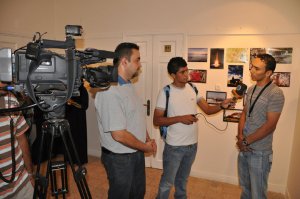
Shady Alassar Photography , Gaza Strip, Palestine
He won’t stop trying to leave Gaza at its will, travel out for pleasure or business. Who are those people inside Gaza that we see with different eyes because we been programmed to do so for so many years of propaganda, Gazans are people like you and me, they are people “We do not know”, but only because we do not dare to know them. It is amazing that now, we “chat” to them as our best friends, we treat them as family. Imagine what will “Bush and Company will say”, our brothers and friends live in a Land out of boundaries to the world, but not for us, the “people” of the networks.
The social networks this phenomenon that took us in a wild ride, unexpected. We live every day their economical crisis from far away, we cry with them for them.
What is our role in this drama, we are part of their drama, we were there in that part of his life, recently he was part of an exhibition of Gaza Youth photography, and he made us part of his happy moments.
Do you know him? maybe you have see him in the walls, it might seem not important, but it is important, you are proud with him. Gaza was in the news, and we were part of the news as well, sharing those moments with the world, we wonder what really happen to all of us?…we take pride in their achievement, we suffer their struggles, we are being part of this strange alliance of hope, where we are coming together as a family.
Shady Alassar is a normal guy like your neighbor , like your son or brother ,what make him special? really in this virtual world that we are being part of, we all are specials or we all are ordinary world citizen. It is your perspective of the world what it make it look beautiful or gray.

Gaza Strip
 The Social Networks unleashed “POWER TO THE PEOPLE-FOR THE PEOPLE”, the invisible revolution is unstoppable, you can feel it in the air, in the wires.
The Internet came to stay. Do not allow it to be taken away. It’s our right to fight for a common cause. Peace Worth it, Love Worth it, You Worth it. I Worth it.
Why is this?. we have no specific answer but we connect with ease, we give our phone numbers our emails, we treat each other as we know for long time.
Can somebody really understand why are we doing this?… Nobody really knows, we just “DO IT”, it is as if we have broken the stereotypes, we have broken the imaginary line that kept us apart.
The religious, social, economic, and race stigmatization, and marginalization that have kept us worlds apart it gone, now, we not do see it, we do not feel bounded by those ideas, now we want to explore all religions and cultures, we want to learn and feel their struggles as ours.
The Poet Of Love
 Munir Mezyet Palestinian Poet, he is my dear friend if it was not for these walsl I would not know him, he lives exiled in Bucharest, but he is not far nor stranger, he is as close as my best friend next door.
We are free now, we feel this freedom to choose to add friends, to share our morning coffee with a complete stranger. The walls that for some people like Germany and Palestine have hold them apart, now “The Walls” are bringing us together.

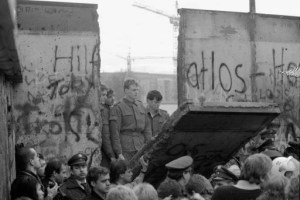
The “Walls” are keeping us together, they are spaces in the virtual world where we share more than ideas, passions, fashions, love experience, causes for freedom.
We are being part of the world with “People we do not Know”.
These intercontinental connections, long distance calls that few years back would have been impossible, for different reasons; social and economical reasons. We calling to Australia, Tunisia, Gaza, Brussels, Argentina, Afghanistan…the whole world is part of our geographical area, skype and messenger broke the barriers of time and space.
We losing our sleep over “People we do not know”, odd, don’t you think?
What have it changed today? we are comfortable interchanging mobil numbers to a complete strangers, if you want to see us this way. We do not think twice before we type out our “private email”.
We interact few times in the walls, in the channels, the spaces. and we call ourselves friends, brothers, comrades. We go to extreme lengths to fight for your rights, to fight for your country, to fight for your causes. 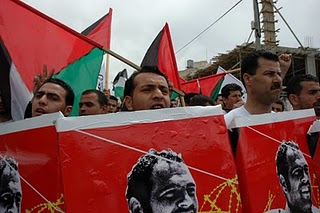
We stand strong for a reason we do not completely understand, other than doing a social justice to peace and friendship.
What really had happen to all of us?, that suddenly we raise our voices for your flag, for the protection of your individual liberties, your civil rights. Really why is this?
What it is going on in the world? Do we find that we were missing the link to Love? Are we able now to befriend and Love a complete stranger? The connectivity of the Universe is showing us the signs that we were overlooking, love is so easy to find, to expand to hold and express, in a single line on a chat room, you can find your long long waited twin love, or your lost friend or new friend.
Do not be afraid to show your kindness, the sensitive fiber of your heart. Love is at the reach of your finger tips at the end of the keyboard. Expand your conscientiousness, open up your mind to the pureness of Love.
I have found more than friends, I found a new family…brothers, sisters, sons, and dozens of nephews and nieces….there is so much diversity in our cultures, but that is the greatness of these new encounters, that is what it make it so special. The relation is more familiar, because you start knowing their beliefs, ideas and soon..you are part of them and they are part of you. You start loving your new family as if you have always know them. The new faces become your everyday experience, your morning, your breakfast your day goes interacting with them. You miss them, you love them because they become part of you.
The social networks have opened the doors the collective conscientiousness. Love is not inclusive of your close families.
The state of the mind now, have reached the tip of the idea that Love is not a feeling but a state of the mind, balanced ripped to the age.
Welcome to the new era of Universally. The web of ideas finally is at its best. LOVE IS ONE. And we are One. Because we are Love.
Meet me at the “Walls”, I think I already know you, if you are a virtual traveler, you are an enlighten being. We all the same, we suffer from the same pains, the red blood that runs throughout my veins is warm with love, and does not see color, but feel the love that you project to the world.
For the Fearful and Naive Global Citizenry
For the Fearful and Naive Global Citizenry
Author: Raja Mujtaba, Editor in World
Posted on 12. Aug, 2010 by Marivel Guzman, Original Posted by Raja Mujtaba in Opinion
Heavy Chatter War Coming to America
By Tommy Tucci

Philadelphia, PA, August 2010…… For The fearful and the Naive Global Citizenry Heavy Chatter War Coming To America. “Controversial billboard comparing the “change” of U.S. President Barack Obama with Adolf Hitler and Vladimir Lenin raised a few eyebrows before it was papered over one day after it appeared in Mason City, Iowa.” Posted by Cristopher Bollyn
Terrorist Deceptions Will Overpower You
American underachievers self admitted FAILURES. Mentally over medicated on shill pills and physically repulsive on $10 figure bonus checks greed. Their dereliction of duty has accelerated America into the greatest ‘To Big To Fail’ criminal empire in history. Their ongoing lack of success has impacted U.S. demise resulting in supreme criminal global crimes; an unhinged failed state, a Global Plague on Humanity; Genocide, Crimes against Humanity, War Crimes, Crimes against Peace, Destruction of Civilizations, Narco-Nexus Drug Cartel Dealing, Repeal of the US Constitution, Articles Bill of Rights, Habeas Corpus, Geneva Conventions, Nuremberg Tribunals, US Military Code of Honor, and the continued theft of its citizenry including global masses of labor, property, and assets.
Hillary Clinton promised to implement the equivalent of twelve holocausts against Iran’s 70 million citizens in her rant to ‘We will Obliterate Iran’ ” Posted by James Petras. Now Hillary Clinton is someone to really look up to in the annals of American Exceptionalism !!! A dysfunctional misanthrope trying to imitate Josef Stalin Jew’s in a man’s pants suit outfit. ‘LET THEM EAT CAKE’ Posted by Paul Craig Roberts
War Against Humanity Chatter Propaganda and Deceptions
War against humanity heavy chatter propaganda and deceptions. Admitted over medicated and physically repulsive fools conning the naive. “Phony Terrorist Leader being “Branded” by Associated Press, the Voice of Israel” senior Staff writer Veteran Today Posted by Gordon Duff. “Adnan Shukrijumah, 35 formerly of Brooklyn, New York and Miami Beach is more likely to carry the real name Levine or Goldstein. The “legend,” intelligence jargon for a false background constructed for an imaginary person, created for Shukrijumah is paper thin. An FBI Agent named Brian LeBlanc in an “exclusive interview” with the Associated Press warned the world of this new “bin Laden” clone. Posted by Gordon Duff
As you keep up your guard fearful and naive of terrorists and get ready to celebrate your favorite deception September 11, 2001, you’ll miss the entire takeover of USA. “The war on terror, invented by the George W. Bush/Dick Cheney regime, destroyed the US Constitution and the civil liberties that the Constitution embodies.” Posted by Paul Craig Roberts
Fallujah The Snapshot of American Cities at War With Itself
Fallujah the snapshot. No revolution is from the bottom up its always from the top down. As America accelerates and compounds failure exponentially it will begin to eviscerate its very own citizenry and nation with Iraq Fallujah type destruction. Its financial and economic systems are a final phase of epic shambles and total demise.
“Unreported in the New Zealand media and virtually unreported in the United States was the release of a report by public health academics who studied the cancer rate, infant mortality and the birth to sex ratio of children in Fallujah. The authors concluded that the findings, “show increases in cancer, leukaemia and infant mortality and perturbations of the normal human population birth sex ratio significantly greater than those reported for the survivors of the A-Bombs at Hiroshima and Nagasaki in 1945.” Posted by Ukrunet
Snapshot of American cities to come. “The report is astounding. It shows that the residents of Fallujah have been collectively poisoned and genetically damaged since 2004. An entire city turned into a radioactive and toxic metropolis. The brain damaged, the deformed and the disabled babies who will be the living victims of this were not even born as the bombs rained on the city and the bullets tore the population apart in 2004.” Posted by Ukrunet
Communism Absolute State Ownership Control of Labor Property Assets
American astounding failures war trajectory against itself. “The billboard suggests that Obama is a radical socialist leader similar to Hitler and Lenin. This is, in fact, a true comparison, which is probably why it was papered over so quickly. Obama, Hitler, and Lenin were all initially financed by Rothschild money. If we look at the historical record, we can clearly see that all three leaders were originally puppets of the House of Rothschild.” Posted by Cristopher Bollyn
LENIN
There is no need to exaggerate the part played in the creating of Bolshevism and in the actual bringing about of the Russian Revolution by these international and for the most part atheistic Jews. It is certainly the very great one; it probably outweighs all others. With the notable exception of Lenin, the majority of the leading figures are Jews. Moreover, the principal inspiration and driving power comes from the Jewish leaders…
– Winston Churchill, “Zionism versus Bolshevism: A Struggle for the Soul of the Jewish People”, Illustrated Sunday Herald, London, February 8, 1920
Leon Trotsky was given $20 million in Jacob Schiff gold to help finance the revolution, which was deposited in a Warburg bank, then transferred to the Nya Banken (The New Bank) in Stockholm, Sweden. According to the Knickerbocker Column in the New York Journal American on February 3, 1949: “Today it is estimated by Jacob’s grandson, John Schiff,that the old man sank about $20,000,000 for the final triumph of Bolshevism in Russia.”
No revolution is from the bottom up it’s always from the top down so forget the TEA PARTY distraction. Democrats, Republications, Congress, Supreme Court they are all colluding with Wall Street bank barons Federal Reserve gang Banksters and crony mainstream media ultra admitted FAILURES operating in unison to the detriment of ‘We The people.’ Accelerating America and global nations into its final death knell. Cities nations and countries into a radioactive and toxic metropolis dump. .. Socialism is deception for communism the absolute state ownership control of labor property and assets.
Fearful and Naive No Recourse
Summary of the fearful and naive. If the future of our planet is going to replicate the crimes committed in Iraq, and Afghanistan then the zenith of ultimate self admitted supreme failures will have failed absolutely. In their fanatical failure and psychopathic hyper militaristic quest for world domination and the total state ownership control of all labor property and assets, their self inflicted failure will have succeeded to render the planet uninhabitable to all humanity, creatures, animals, flora, fauna, and life as we have known since recorded time. A toxic world metropolis dump.
As the fearful and naive continue to be conned by failures and fools while looking in the bath tub for terrorists you’ll have missed the entire takeover of USA going on outside your front door. There is no recourse to the manufactured collapse and total destruction of America and the world as we know. Goodbye America Posted by Occidental Observer “A Nation Cannot Survive Treason from Within” c.103BC Cicer
AUTHORS SOURCES
http://21stcenturyreversepyramid.blogspot.com/
http://www.veteranstoday.com/2010/05/10/gordon-duff-rats-in-wolves-clothing/
http://www.veteranstoday.com/2010/08/07/gordon-duff-new-al-qaeda-leader-may-be-israeli/
http://www.ihr.org/jhr/v14/v14n1p-4_Weber.html
http://wapedia.mobi/en/Crime_against_humanity
http://en.wikipedia.org/wiki/Socialism
http://www.bollyn.com/index.php#article_12327
http://petras.lahaine.org/articulo.php?p=1786
http://www.ynetnews.com/articles/0,7340,L-3342999,00.html
The Zionist Power Configuration in America and Israel’s War with Iran
http://www.rense.com/general91/chel.htm
http://globalresearch.ca/index.php?context=va&aid=19458
http://deoxy.org/wc/wc-nurem.htm
http://uruknet.com/?p=m68629&hd=&size=1&l=e
http://www.theoccidentalobserver.net/authors/Darkmoon-GoodbyeI.html
http://www.bbc.co.uk/news/world-middle-east-10721562
http://www.opinion-maker.org/2010/07/opinion-maker-where-truth-is-the-news-and-readers-are-the-opinion-makers/
Is Obama Subjected To Blackmail?
Posted on 08. Aug, 2010 by Akashma News
Original Reportby Wayne Madsen in Hot Topics from Opinion-Maker
SPECIAL REPORT. Obama and Emanuel: members of same gay bath house club in Chicago
By Wayne Madsen
President Obama and his chief of staff Rahm Emanuel are lifetime members of the same gay bath house in uptown Chicago, according to informed sources in Chicago’s gay community, as well as veteran political sources in the city.
The bath house, Man’s Country, caters to older white men and it has been in business for some 30 years and is known as one of uptown Chicago’s “grand old bathhouses.” WMR was told by sources who are familiar with the bath house that it provides one-year “lifetime” memberships to paying customers and that the club’s computerized files and pre-computer paper files, include membership information for both Obama and Emanuel. The data is as anonymized as possible for confidentiality purposes. However, sources close to “Man’s Country” believe the U.S. Secret Service has purged the computer and filing cabinet files of the membership data on Obama and Emanuel.
Members of Man’s Country are also issued club identification cards. WMR learned that Obama and Emanuel possessed the ID cards, which were required for entry.
Obama began frequenting Man’s Country in the mid-1990s, during the time he transitioned from a lecturer at the University of Chicago Law School to his election as an Illinois State Senator in 1996. Emanuel, reportedly joined Man’s Country after he left the Clinton White Hosue and moved back to Chicago in 1998, joining the investment firm of Wasserstein Perella and maintaining his membership during his 2002 campaign for the U.S. 5th District House seat vacated by Rod Blagojevich, who was elected governor.
Man’s Country appears to be a “one stop shopping” center for gay men. The club’s website advertises steam rooms, “fantasy rooms,” bed rooms, male strippers, adult movies, and lockers.
However, Man’s Country was not the only location for Obama’s predatory gay sex activities. The Chicago gay community is aware that Obama often made contacts with younger men at his famous “pick-up basketball” games. It was at these “pick up” matches where Obama first met Emanuel and a young Democratic campaign worker and senior bank vice president named Alexi Giannoulias. Currently running for Obama’s old U.S. Senate seat now occupied by Roland Burris, Giannoulias successfully ran for Illinois Treasurer in 2006 after being drafted for the run by Chicago’s Democratic machine.
The Blagojevich trial: “Sex, Lies, and Audio tapes” — Fitzgerald’s US Attorney’s Office part of White House cover-up of gay sex in the Second City
Giannoulias was a vice president and senior loan officer for his father’s bank, Broadway Bank, from 2002 to 2006. Broadway Bank made real estate loans to Antoin “Tony” Rezko, the chief of Rezmar Corporation. On May 13, 2008, Rezko was found guilty, after being indicted by a grand jury at the behest of the U.S. Attorney for Northern Illinois Patrick J. Fitzgerald, of six counts of wire fraud, six counts of mail fraud, two counts of corrupt solicitation, and two counts of money laundering. Rezko has been in solitary confinement at the Metropolitan Detention Center at Van Buren and Clark in Chicago since June 2008. However, Rezko has not yet been officially sentenced to a federal prison. A Syrian-American, Rezko is considered to be a flight risk, even though his one-time fortune of $50 million has been reduced to zero.
One Republican politician in Chicago told WMR that Rezko will be a prime witness for Blagojevich’s defense. “Figure it this way, Rezko’s been in solitary confinement in the city jail since June 0f 2008 . . . if he is released to appear at Blagojevich’s trial as the primary witness, everyone expects him to squeal like a pig,” said the Republican politico.
In 2005, Rezko reportedly engaged in a complicated real estate “flip” through which his wife Rita and Obama agreed to split an empty lot adjoining a home that Obama bought in Chicago’s Kenwood district. The deal saw Obama buy the home for $1.65 million, which was $300,00 below market value. Obama then bought a strip of the adjoining property from Mrs. Rezko, a speculative deal that stood to make Obama a handsome profit. Since Rezko’s conviction, the property has has reportedly gone into bankruptcy. Giannoulias’s Broadway Bank was seized by the Illinois Department of Financial and Professional Regulation on April 23, 2010, reportedly as Secretary of Treasury Tim Geithner was on his way to Chicago to present the bank with a bailout check. Geithner quickly changed his plans.
Giannoulias, Broadway’s then-senior loan officer, has denied being involved in the decision to loan money to Rezko.
Blagojevich’s trial judge, U.S. District Court judge James Zagel, a crony of former Illinois Republican Governor Jim Thompson, ruled that all 500 hours of phone calls intercepted and taped by Fitzgerald could not be played during Blagojevich’s trial as demanded by Blagojevich and his defense lawyers. Blagojevich demanded that Fitzgerald “show up in court and explain to everybody . . . why you don’t want those tapes that you made played in court.”
WMR has learned that the tapes may contain salty references Obama’s and Emanuel’s private lives.
WMR attempted to interview Blagojevich’s senior defense lawyer Sam Adam to no avail but other informed sources told us that the tapes, if played, would highlight the corruption of not only Obama, Emanuel, and other member of Obama’s Chicago “brain trust” but also Fitzgerald himself. WMR was told that Fitzgerald’s tactics have included providing sex and drugs to imprisoned felons to get them to provide perjured testimony at federal trials.
It is exactly the type of federal prosecutorial misconduct by Fitzgerald that former Republican Governor said was used by state prosecutors when he commuted the death sentences of Illinois’s death row population. Ryan was indicted by Fitzgerald for fraud and he is currently serving out a federal prison sentence.
Blagojevich’s trial was scheduled to begin on June 3 and Fitzgerald’s main interest was to keep the trial focused on Blagojevich, especially after he managed to “flip” Blagojevich’s former chief of staff John Harris to testify against the impeached and ousted governor. WMR learned from informed sources that one lawyer on Harris’s defense team is involved in a gay partner scandal that was discovered by the attorney’s wife.
Some of the wiretaps may reveal that it was not Valerie Jarrett, Obama’s longtime friend and current White House policy adviser who was Obama’s top candidate to fill his U.S. Senate seat, but the young 32-year old “pick up basketball” friend of Obama, Giannoulias, then serving his second year as state Treasurer. However, Obama had avoided campaigning for Giannoulias in Illinois and there were initial indications that the president had “thrown Giannoulias under the bus,” according to some Democratic political circles in Chicago. However, Obama has since had a change of heart and began to campaign for him.
Mutiple Chicago sources report that Republicans who see Giannoulias’s Obama connections as providing an edge in his Senate race this year should not celebrate prematurely. Giannoulias’s GOP opponent, U.S. Representative Mark Kirk, a Naval Reserve intelligence officer, has also been identified as a closeted gay man. Kirk divorced his wife last year after an eight-year marriage. They had no children.
In addition, U.S. Representative Aaron Shock, who took over the House seat vacated by Obama’s Republican Transportation Secretary Ray LaHood, is, according to Chicago Boy’s Town sources, a habitué of Minibar, a noted gay bar in Chicago’s gay district. For an extremely young first term member of the House, observers were surprised when GOP Minority Whip Eric Cantor of Virginia named Shock as a Deputy Minority Whip.

Man’s Country, one of Chicago’s “grand old bathhouses” and located at 5015 North Clark Street in Chicago’s “Boystown,” was a frequent hangout for State Senator Obama and Rahm Emanuel
Sources in Chicago’s gay community report that Obama was attracted to Man’s Country’s older white clientele because he generally enjoys being fellated by older white men. Obama would regularly be seen at Man’s Country on Wednesdays.
Obama reportedly has never engaged in reciprocal activity. The sources also confirm the allegations made during the 2008 campaign by Larry Sinclair, a Chicago visitor who revealed that in 1999 he engaged in such oral sex activity and crack cocaine use with then-State senator Obama on two occasions, once in the back of a Chicago limousine operated by Five Star Limousine Service, and the other at a Chicago area motel, the Comfort Suites in Gurnee, Illinois.
After revealing details of the encounter at a press conference at the National Press Club in Washington, Sinclair was arrested by Washington Metropolitan Police on a fugitive warrant issued by Delaware Attorney General Beau Biden, the son of Obama’s vice presidential running mate, Senator Joe Biden. Sinclair was charged with a misdemeanor count of theft of money orders, however, the state of Delaware declined prosecution. Beau Biden later declined to run for his father’s old Senate seat because of his duties to prosecute a major pedophilia case involving Lewes, Delaware pediatrician Dr. Earl Bradley. There are reports that Biden’s office helped to cover up Bradley’s activities, including failing to authorize search warants for Bradley’s office and computer.
Chicago’s “DLC” — not the Democratic Leadership Council but the “Down Low Club” — a gay matchmaking service
WMR spoke to several well-placed sources in Chicago who reported that Jeremiah Wright, the pastor of Obama’s former church of 20 years, Trinity United Church of Christ (TUCC) on Chicago’s south side, ran what was essentially a matchmaking service for gay married black professional members of the church, including lawyers and businessmen, particularly those with children. The matchmaking club was called the “Down Low Club” but references to it over the phone and email simply referred to the group with the code phrase “DLC.” The ruse, according to our sources, was to make anyone who was eavesdropping on the communications believe that the references were to the Democratic Leadership Council, also known as the DLC.
The gay DLC’s services were intended to keep ensure TUCC’s gay members avoided posting solicitations on web services like Craig’s List and refrain from cruising gay bars. The strategy was to protect them from getting busted and being “outed.”
Among the members of the gay “DLC” were Obama and TUCC’s choir director, Donald Young, an openly gay man who reportedly had a sexual relationship with Obama. Two other gay members of the church were Larry Bland and Nate Spencer. Young and Bland were brutally murdered, execution style, in late 2007. Bland was murdered on November 17, 2007 and Young on December 24, 2007. The latter was killed by multiple gunshot wounds. Spencer reportedly died on December 26, 2007, official cause of death: “septicemia, pneumonia, and HIV.”
“DLC” members often went on camping trips arranged by TUCC. Wright reportedly was the head of the “DLC” matchmaking services and ensured that its members protected each other.
The “DLC’s” clientele included Obama and other gay members of TUCC, including, reportedly Young, Bland, and Spencer. Fox 32 Chicago reported that Bland’s mother, Josephine Bland, was so upset at her son inviting men into their home as a result of contacting them through gay web sites like “Adam4Adam,” she moved out.
The gay community in Chicago knows to keep away from the TUCC and “DLC” stories because of the “creepiness” of the operation and the suspicious deaths of the three TUCC gay black men.
Although Obama protected his alternate life style through the secretiveness of the “DLC,” he was not so careful when he proclaimed he was a state senator while frolicking at Man’s Country in uptown Chicago.
Love: Obama’s personal trainer
Reggie Love, a former Duke basketball and football player and unsuccessful National Basketball hopeful, currently serves as Obama’s personal trainer and White House “special assistant” — he has been called Obama’s “body man” – who receives a salary of $104,000 a year. Love is also reportedly one of Obama’s regular gay sex partners. Love joined Obama’s Senate staff in a senior staff position in 2006.
Media General’s tabloid, the National Enquirer, proffered a story last year about Michelle Obama being furious about the relationship between her husband and his “body man.” The Enquirer’s sister tabloid, The Globe, later floated a story about Obama having a relationship with a Democratic campaign official named Vera Baker. WMR has been told that this relationship was a clever ruse to throw off speculation about Obama’s actual past sex partners. Baker has apparently left the United States for relatively more obscurity in Martinique. Media General’s tabloids have scooped the mainstream media on sex scandals involving Bill Clinton and Gennifer Flowers and Monica Lewinsky, Tiger Woods, and John Edwards and Rielle Hunter.
WMR’s Chicago sources believe the Secret Service records of presidential candidate Obama’s activities in Chicago would show that Obama regularly arrived at Love’s Chicago residence at 9:00 am and departed at 9:15 am. Sources told WMR that while 15 minutes is much too short for a personal training exercise, it is ample time for fellatio.
Bill Frist, “Brokeback Mountain,” and Obama
In 2006, after Obama became the junior senator from Illinois, WMR’s sources in the Congressional Black Caucus reported that there were persistent rumors of gay trysts between Obama and then-GOP Senate Majority Leader Bill Frist of Tennessee. The allegations at the time seemed unbelievable.
However, based on Obama’s penchant for receiving fellatio from older white men, a column written by The Washington Post’s “In the Loop” columnist Al Kamen on April 7, 2006, some four months into Obama’s Senate term, may have expanded relevance. Kamen reported he received an invitation to attend Frist’s “5th Annual VOLPAC ’06 Weekend” in Nashville from April 21st to 23rd and that the invitation card required one to “unbuckle the cowboy’s pants and look inside to see what this was all about.” Kamen opined that the invitation seemed “a bit too ‘Brokeback Mountain.’”
The invitation advertised that the shindig would feature “one-of-a-kind music and special friends,” although Kamen said there was no indication what made the “friends” so “special.” Kamen then wrote, “The back of the card shows the cowboy from behind with a red flowered handkerchief sticking out of his right pocket. Wait a minute — wasn’t there something about how this used to be some kind of code in the gay community years ago? A way to signal each other in crowded, noisy bars? So we checked the GayCityUSA.com’s Hanky Codes. Sure enough, there it was in the chart explaining what they mean: red hanky in right pocket. Oh, dear.”

Rumors about Obama and Frist ran amok in Congressional Black Caucus circles in 2006.
Although Frist ran on the pledge of only serving two terms, he became Senate Majority Leader with all the perks of the office. WMR’s sources in Chicago’s gay community revealed that Frist’s Majority Leader predecessor, Senator Trent Lott of Mississippi, was also known to seek the services of male prostitutes. Frist, who said he planned to run for President in 2006, decided against a run for the White House and also declined a run for Tennessee governor in 2010.
With the rumor mill running at full speed in 2006, it is obvious why Frist abandoned politics so quickly for the medical business. Frist later endorsed Obama’s health care proposals. A year later, when GOP Senator Larry Craig was arrested while soliciting for sex in a men’s toilet stall at Minneapolis-St. Paul International Airport, he changed his mind about immediately resigning his Senate seat. Knowing about his colleagues’ behavior, he dug in his heels and completed his term in January 2009.
Rahm the “Sugar Daddy”
Obama’s chief of staff Emanuel, who won a scholarship to the Joffrey Ballet but turned it down to attend college, is married and, like Obama, has children, in Emanuel’s case, a son and two daughters.
However, Emanuel, who is 50, also travel frequently with a male companion, a wealthy Chicago real estate developer, some five to six years his senior. WMR has learned from Chicago’s gay community as well as political sources that Emanuel and his friend have gone together on a trip to India, skiing vacations, and soon plan a vacation in Florida, sans Mrs. Emanuel and the kids.
In Chicago’s gay community, Emanuel is known as “sugar daddy,” promising young men with perks and lucrative positions if they sleep with him. On occasion, Emanuel has been with older men, such as his travel companion, but his preference is young, according to WMR’s sources. Emanuel also often uses bicycling and basketball venues to make his approaches. Being an Emanuel “basketball buddy” is a key to professional success.
WMR spoke to one member of the gay community in Chicago who had first hand knowledge of one of Emanuel’s bed partners, an older man who runs a non-profit symphony organization.
Obama’s other sex partners
WMR has previously reported on Obama’s past trysts with Alabama Democratic U.S. Representative Artur Davis, a current primary candidate for governor of Alabama. Although not in the same class, Obama and Davis attended Harvard Law School during an overlap of their attendance at the law school.
The information on Davis and Obama was gathered by opposition researchers for former Alabama Representative Earl Hilliard, who Davis defeated in the 2002 Democratic primary. Recently, WMR was informed by sources in Alabama that Attorney General Eric Holder traveled three days ago to Alabama to inform Davis that if he loses his primary race, he would be nominated by Obama to fill the job of U.S. Attorney for the Middle District of Alabama, a position still held by Bush-appointee Leura Canary, one of the main prosecutors of convicted and jailed former Alabama Democratic Governor Don Siegelman.
Chicago sources also informed WMR of another past gay partner of Obama, Massachusetts Democratic Governor Deval Patrick.
The Clear and Present Blackmail Threat
Leading secret alternate life styles, Obama and his chief of staff provide classic blackmail threats. Considering Obama’s choice for the Supreme Court, Elena Kagan, who is reputedly a semi-open lesbian, the question must be posed how much Obama’s and Emanuel’s own covert life styles led to the decision to nominate Kagan, someone with no experience on a judicial bench.
Similarly, the fact that so much is known about Obama’s and Emanuel’s trysts in Chicago begs another important question. If politicians, gay community activists, and journalists in the Windy City are aware of Obama’s and Emanuel’s highly blackmailable gay life styles, the same can certainly hold true for the executives of one of Chicago’s corporate headquarters — that of BP America’s Production Operations.
Throw in the intelligence agencies of America’s allies, friends, enemies, and the situation becomes a clear and present danger to the national security of the United States.
Wayne Madsen is a Washington, DC-based investigative journalist, author and syndicated columnist. He has written

for several renowned papers and blogs.
Madsen is a regular contributor on Russia Today. He has been a frequent political and national security commentator on Fox News and has also appeared on ABC, NBC, CBS, PBS, CNN, BBC, Al Jazeera, and MS-NBC. Madsen has taken on Bill O’Reilly and Sean Hannity on their television shows. He has been invited to testifty as a witness before the US House of Representatives, the UN Criminal Tribunal for Rwanda, and an terrorism investigation panel of the French government.
As a U.S. Naval Officer, he managed one of the first computer security programs for the U.S. Navy. He subsequently worked for the National Security Agency, the Naval Data Automation Command, Department of State, RCA Corporation, and Computer Sciences Corporation.
Madsen is a member of the Society of Professional Journalists (SPJ), Association for Intelligence Officers (AFIO), and the National Press Club.
Guilt By Association: Deceiving People
Guilt By Association: Deceiving People
Editor Raja Mujtaba
Posted on August 8, 2010 by Marivel Guzman
Posted on www.Opinion-Maker.org on 17. Jun, 2010 by Jeff in Uncategorized
By Tarik Jan
Jeff Gates new book Guilt by Association belongs to the same genre of works that one may characterize as humanistic, developed by Noam Chomsky, William Blum, Kevin Philip, Peter Beinart, Edward Said, John Mearsheimer-Stephen Walt, John Perkins, and others. The latter two are the insiders previously working for the government (CIA) or the corporate sector associated with CIA.
From data collection to analyses, their approaches are different but the common thread that runs through their works is the desire to move the world from the paradigm of domination and plunder to a relatively more equitable relationship among the nations. That is why many would consider them as children of humanity.
For instance, Noam Chomsky’s Year 501 the Conquest Continues and his other works place the U.S. in the European tradition of colonial conquest and plunder, defining it as modern-day imperialism.
William Blum’s The Rogue State centers on the U.S. desire to control the planet in the name of peace and protection. His thesis is that the U.S. wants the world to buy its weapons. “[L]et our military and our corporations roam freely across your land, and give us veto power over whom your leader will be, and we will protect you.” Blum describes it as the cleverest protection racket.
Kevin Philip’s American Theocracy is also in the same line though more focused on the deadly combination of oil and religion as arbiters of U.S. policies. By all counts it is a profound work.
Peter Beinart’s The Icarus Syndrome narrows down on the fallout of the U.S. policy in remaking world after its image.
Edward Said’s Culture and Imperialism is a transformative work that traces culture role as informing the political and economic effort to control and consolidate the Western domination over others.
John Mearsheimer’s The Israeli Lobby and the U.S. Foreign Policy deals with the exaggerated American tilt toward Israel and the problems it has created to the U.S. image in the community of nations.
John Perkins’ Confessions of a Hitman is a testimonial work of a corporate employee trained to destabilize other countries through ill fated economic policies. In the process it exposes the linkage between American business and CIA sponsored subversion.
Why are these brilliant minds critical of their country? No doubt, their cause is unpopular with the powerful entrenched interests who often accused them of being anti-American. But they are not. Most of these writers share Edward Said‘s feelings about himself when he said, “It is part of morality not to be at home in one’s home.”
Jeff Gates follows their trail but with his own lantern. The imprint he leaves behind is easily discernable owing to its individuality, a sense of being earnest, and sincerity to his craft. His leitmotif is to unravel the machination and deception of the Jewish oligarchy at the micro-level, which he does with the skill of a consummate lawyer.
With attributes like these, Guilt by Association is a masterful study of how a “land grab” named Israel operates at the American expense. It is also an exhaustive study of how a small U.S. minority can manipulate the policies of a superpower for the benefit of the so-called Jewish homeland. More than that, it is a study of the criminalization of the American politics and economy. Combine the three aspects and one finds himself reading a book that is at once scholarly and yet free from the tedium of being pedantic, dealing with people and their wiles in pursuing a ruthless Zionist ideology and its grab for other’s land. In this sense, it has more than one dimension – a manual of subversion, a mix of psychology, brain manipulation, coercion, money laundering, and worst exploitation of human emotions.
To sift the myth from reality and facts from fiction, Gates applies the “game theory,” a branch of applied mathematics, to the Zionist manipulation of the U.S. political and economic scene. The game theory is a helpful tool in his hands to explain the role of each player in his strategic posturing. Thus as he explains it, there is the “target,” who is to be enfeebled and discredited; the “manipulator,” who plans and employs human consciousness to set the dynamics into motion against the backdrop of shared beliefs of Judeo-Christianity, democracy, and war against terrorism.
In pursuing their goals, the Israelis have layers of operatives whom Gates splinters into agents, assets, and helpers. Agents of course are trained for a job; assets are those who can be baited into empathizing with an intended cause for money, influence, sex, or ideology. Even a president can be made a pliable peddler for pro-Israeli policies through such means. Helpers are a corps of workers who give helping hand to Israeli operations. They could be as many as 7000 in London alone. As they say themselves, “[t]here are a lot of guys at the working level up here [on Capitol Hill] … who happen to be Jewish, who are willing to look … at certain issues in terms of their Jewishness. … You can get an awful lot done just at the staff level.”
With all these cadres in place, the mode is sophisticated meandering through a maze of actions. To begin with, the Israelis have chalked out dossiers of psychological profiles of individuals who can be influenced owing to their inclination or vulnerability. Jeff Gates mentions two such incidents where Jewish women used their charm on at least two presidents. For laundering money to have political clout he has a long list of beneficiaries of Jewish generosity from presidents to lawmakers, including recent presidential aspirant John McCain and White House inmate Barack Obama.
Validating his game theory, Gates mention, among others, two instances. Both are relevant to our times.
In the 1980s Libya was hot in the news for its vanguard role in supporting the Palestinian cause. Israel decided to neutralize Qadhafi through a three-phase action plan, which Jeff Gates spells out as pre-staging, orchestration, and provocation.
As pre-staging, messages are transmitted from the Libyan soil to its embassies to set off a chain of terrorist acts. The intension is obvious. Such messages are prone to interception. And that brings Libya blinking as a terrorist state on the intelligence screens in Europe and elsewhere. The U.S. shows its gullibility and accepts such doctored messages as real.
The Orchestrating phase activates the Mossad operatives to terrorist acts through proxy. The Israeli target is to get some Americans killed so that the U.S. is lured into killing those whom Israelis consider as offensive to their cause.
In the provocation phase, Berlin’s La Belle Discotheque is blasted, killing an American serviceman.
Enraged, 160 American, German, and British aircrafts unload 160 tons of explosives on Libya killing 40 civilians, including 2-year old Qadhafi’s daughter.
Berlin’s selection as the site for the terrorist attack is important as the ripple effect would be felt all over Europe convincing even cynical regimes about the Israeli plight surrounded by a sea of Muslim states.
Second, it will give the West a much needed new enemy of “radical Islam” against the backdrop of a winding cold war.
Third, it will alienate the Muslim world from the United States, eventually forcing Americans to identify themselves with Israel.
Here Jeff Gates cites a senior Mossad operative saying 15 year before 9/11 that after neutralizing Qadhafi, Iraq and Saddam Hussein will be their next target, “We are starting now to build him up as the big villain. It will take some time, but in the end, there is no doubt that it ‘ll work.” The rest is history. Saddam was hanged, and his country was decimated.
Gates is convincing in linking Berlin’s and 9/11 incidents to Israeli plan of bringing out U.S. total support to its security concerns in the Middle East.
He finds the genesis of the Israeli plan to involve U.S. in its war against its neighbors when Ariel Sharon’s staged an armed march to Temple Mount in the year 2000. It took Palestinians a year to start a series of suicide bombing as expected by Israel. The U.S. and Europe were of course prompt in condemning suicide bombing. But Israel was looking for something more. Iraqi support to Palestinian cause was worrisome and so was its economic and military rebound after the Gulf War. Iraq had to be axed, minimizing threat to Israel.
Gates quotes Sharon and Netanyahu saying that only when Americans “feel our pain” would they understand the Israeli plight. “Both men mentioned a weighted body count of 4,500 to 5,000 American lost to terrorism – the initial estimate of those who died a year later in the Twin Towers of New York City’s World Trade Center.”
September 11, 2001 is another orchestrated event to give Israel the much desired edge over others in the region. Two preparatory steps in Jeff Gates calculus were necessary to make this tragic event happened.
One, how to create a mental environment supportive to March 2003 invasion of Iraq? This called for a massive exercise in brain washing sustained and made plausible by a believable theoretical framework provided by Samuel Huntington 1993-1996 The Clash of Civilization.
Two, how to make people believe that Iraq was behind 9/11, and that it had weapons of mass destruction? Gates characterizes this effort as “the displacement of an inconvenient truth (that Iraq had no role in 9/11) with what people could be induced to believe. The emotionally wrenching nature of that event played a key fact-displacing role.”
But mere publication of a plausible work would not have helped unless it was critically acclaimed by the media, and academia owned it. Gates says “100 academies and think tanks were prepared to promote it, pre-staging a clash consensus five years before 9/11.”
As a capper, it would need a legislative act to legitimize Iraqi invasion. The Iraq Liberation Act of 1998, made possible by the cumulative efforts of pro-Zionist lawmakers like John McCain, Joe Lieberman, and Jon Kyl, should be seen against this scenario. Gates could have also said that the Iraqi Liberation Act of 1998, when 9/11 was still three years ahead, was a prelude to the U.S. invasion of Iraq in 2003. This implies that the plan to invade Iraq was already in gestation; 9/11 was a ruse.
Gates cites an important individual named Philip Zelikow, executive director of the 9/11 Commission. He was addressing September 10, 2002 audience of University of Virginia:
Why would Iraq attack America or use nuclear weapons against us?
I’ll tell you what I think the real threat [is] and actually has been since 1990 –
it’s the threat against Israel. And this is the real threat that dare not speak its
name, because the Europeans don’t care deeply about that threat, I will tell you
frankly. And the American government doesn’t want to lean too hard on it rhe-
torically, , because it’s not a popular sell.
Critiquing it, Gates says, “Zelikow omitted that candor in the 9/11 Commission report.”
Such devious cover-ups are usually associated with Third-World nations who are believed to be gullible and thus can be deceived. But here we are ironically encountering a superpower said to be free, has a vigilant press and a powerful Congress and yet the administration succeeds in deceiving people – that too without a whimper causing a major calamity to a segment of humanity (Muslims in this case). Gates dares to expose this criminality.
One should not however get the impression as if this is the only deception the U.S. played on its people. Gore Vidal’s The Golden Age has the narrative of a novel but it is history he writes without being irreverent that otherwise he is known for. According to him, it was Franklin Roosevelt who provoked Japan to attack Pearl Harbor, Harry Truman scorched Hiroshima and Nagasaki to dust on pretense that a million Americans would lose their lives even when the military heads disagreed. Vidal cites three serious works like Charles A. Beard’s President Roosevelt and the Coming of War, Robert A. Stinnet’s Day of Deceit, and Gar Alperovitz’s The Decision to Use the Atomic Bomb and the Architecture of an American Myth to validate his assertion.
To people who think democracy is open and that it is people’s will, which is sovereign forget that democracy is a process that calls for shrewd management. Otherwise, it can backfire, hurting people at the hands of special interest groups who may deflect the process toward the fulfillment of their own parochial agenda. In this sense, democracy is a challenge to a people’s genius asking for their ability to sift right from wrong. Media which is considered to be a watch dog can become somebody else’s dog, susceptible to influences — acting as anesthetic to the people. If this can happen in the U.S., it can happen elsewhere too. Unfortunately, there are no exceptions.
Gates touches a few other important bases like demand or purchasing-power economics as against supply-side economics, privatization, and globalization. He shows reasonably well that supply-side economics based on the Chicago model is a root cause of our problems jeopardizing the world economy and creating monopolies. He does not, however, expose the privatization issue and its ramifications for the economy in general or how public interest is hurt, especially when it goes in the hands of international controllers of businesses. Privatization experience especially in a country like Pakistan has not been of much help in increasing efficiency or cost saving, as its proponents claimed. Public accountability to which utility services were amenable has now diminished as their ownership has moved to private hands. Karachi Electric Supply Company is one such instance.
While I agree with Gates that U.S. is guilty by association in its exaggerated tilt toward Israel, I disagree with part of his thesis giving me the impression as if it is only Israel making use of the United States. Accepting it would mean as if the Americans are too simple to care for their interests. On the contrary, there is a great deal of evidence to suggest that it is a two-ended relationship. Maybe I discuss it later.
Tariq Jan is a research scholar working with IPS Islamabad. He is also Member Board of Advisros, Opinion Maker. He has authored several books including ‘Secular Threat To Pakistan.’
PALESTINE: Arabs Damaging The Palestinian Cause
PALESTINE: Arabs Damaging The Palestinian Cause
Posted on 01. Aug, 2010 by Raja Mujtaba in Palestine
Saudi regime is the most reactionary and the most backward regime in the whole region. They’re closer to the Taliban than to anything else in terms of regime and society. Saudi rulers are better advised to change their own regime rather than trying to change the regimes in other countries.
Prof Gilbert Achcar
Arabs’ ties with Israel damages the Palestinian cause: Prof Gilbert Achcar
By Kourosh Ziabari
Prof Gilbert Achcar
Prof. Gilbert Achcar is a renowned Lebanese academician, writer, socialist and anti-war activist. He left Lebanon in 1983 and taught international relations and politics at the University of Paris VII for several years. Since 2007, Achcar has been Professor of Development Studies and International Relations at the School of Oriental and African Studies of the University of London. He is a frequent contributor to Le Monde Diplomatique and ZNet.
Prof. Achcar joined me in an interview to discuss the latest developments related to the Israeli-Palestinian conflict, Israel’s attack on the Freedom Flotilla and the prospect of Israel’s occupation of West Bank and Gaza.
Kourosh Ziabari: Dear Prof. Achcar, what’s your estimation of the prospect of the Israeli-Palestinian conflict?
Gilbert Achcar: This is extremely difficult to answer because the situation of the Middle East is changing so quickly and frequently that any kind of prediction about the future is always very risky, so what I can say in reply to your question is that in the foreseeable future, there can’t be any serious and acceptable compromise leading to a peaceful coexistence between Israel and the Palestinians. The reason is that the Israeli society has been continuously shifting to the right so that more and more extreme branches of Zionism are governing Israel, and therefore it’s extremely difficult to imagine that governments like the present government of Israel would make all of the concessions that are required for a true peace with the Palestinians. There can’t be any beginning of peace actually without an end to the occupation of the territories that were occupied since 1967, the dismantlement of the separation wall which Israel has been building and the dismantlement of the settlements. These are basic conditions to which of course one should add the immediate lifting of the blockade of Gaza. So, there’s absolutely no indication at present that the Israeli government as it is, has any inclination to go in that direction.
KZ: Both of the Palestinians and the Israelis, from a religious viewpoint, claim that the land of Israel belongs to them. Both of them cite the historical evidences and religious implications in this regard. What’s your idea about that? How should this interminable conflict come to an end?
GA: This should be hardly debatable among serious people because it’s absolutely clear that when the United Nations voted on the partition of Palestine and voted on creating a Jewish state on Palestine which was the goal of the Zionists, it gave 56 percent of the land of Palestine to the Jewish population which constituted only one third of the whole population. Moreover, the majority of this one third were immigrants, the overwhelming majority of whom had been in Palestine less than 15 years, so there is no fair standard on earth by which this kind of resolution could be considered as legitimate and just; it was completely unjust and completely unfair. No people on earth would admit that recently arrived immigrants have a right to establish their own state in their country. However, I believe that a just solution to the problem is one that would not involve any new expulsion of population; it should be a solution based on democratic principles and peaceful coexistence of Muslims, Christians and Jews, Arabs and Israelis in the region. But, for this to happen, the very nature of Israel’s relationship with its environment should change whereas what we’re seeing now is more and more violence, barbarity and cruelty on the part of Israel.
KZ: Israelis believe and claim that they should have a state with its borders spanned from Nile to Euphrates. This is the “Promised Land” which they recurrently refer to. What do you think about that? Is it a reasonable and justifiable claim?
GA: Even in Israel, very few people subscribe to this view. Only some extremist branches of Zionism believe in this idea. It sounds so absurd that only crazy people can uphold such perspectives. Now, if we had to redraw the map of the world to go back to how the world was 2,000 years ago, we can imagine what a terrible mess would happen in the whole world. Besides, there’s much debate even on the fact that the European Jews who came to Palestine in the 20th century are descendants of the Jews who were in Palestine 2,000 years ago. But even if that were the case, and again, if we had to redraw the map of the world as it was 2,000 years ago, why not 3,000 years ago or 1,000 years ago? So the only legitimate claim to a land is that of the people who were living on it in recent centuries. But no Palestinian group among the main Palestinian forces is calling for the expulsion of Jews and Israelis from the Middle East. All of them call for coexistence, but coexistence based on democratic principles and on equal footing, not the present situation of very harsh oppression of the Palestinians and the Lebanese by Israel.
KZ: Some Arab nations are progressively taking steps to normalize their ties with Israel. We can name the United Arab Emirates which invited the Israel’s transport and infrastructure minister to an international summit held in Abu Dhabi. Other Arab states, in turn, are making efforts to establish new relations with Israel. Isn’t it going to be harmful and destructive for the cause of Palestinian people?
GA: Four countries have established relations with Israel among the Arab states and they are Egypt, Jordan, Qatar and Oman. This is damaging for the cause of the Palestinians, especially when the country betraying them is Egypt which is the largest Arab country. This is a result of the increasing hegemony of the United States over the Middle East, which pushes the Arab governments to establish relations with the state of Israel against the will of their own people. If you look at Jordan and Egypt, you’ll see that the overwhelming majority of their population is opposed to Israel and its policies, and this creates a wide gap between governmental policies and what the population wants.
KZ: What’s your view regarding the recent Israeli assault on the Gaza Freedom Flotilla? What would happen if another country rather than Israel, say Iran, had attacked the flotilla of 600 international peace activists? Would the international community’s response have been the same?
GA: You should ask me what would happen if the United States had attacked the flotilla, because they do such things quite often. But, you’re right in saying that Israel gets the least protest in comparison with other countries when it comes to the violation of international law and perpetration of war crimes and crimes against humanity. This judgment is in line with the reports of Judge Richard Goldstone who is a devout Jew and even a devout Zionist, but honest enough for acknowledging the fact that Israel committed war crimes and crimes against humanity in Gaza. So of course Israel gets much less condemnation than any countries that are opposed to the United States and to Western hegemony. One should say, however, that Israel started to lose even the support of Western public opinion recently, especially since the Gaza war of 2008-2009 which was a brutal and cruel attack on defenseless civilians and was criticized even by traditional friends of Israel. After the attack on Freedom Flotilla, the international condemnation of Israel reached an unprecedented level. A few countries cut their diplomatic relations with Israel in Latin America like Venezuela and Bolivia in the last year and Nicaragua in the current year. A number of countries recalled their ambassadors: we have seen a shift in the stance of public opinion and even a wave of protests has taken shape in the United States. So there’s been a real impact and this shows that the Israeli state by its cruelty and brutality is losing more and more ground in the global public opinion.
KZ: The Saudi King has recently made remarks in which he likened Iran’s government to the state of Israel and said that these two countries don’t deserve to exist. Is this a fair and rational statement? Doesn’t it damage the Islamic solidarity and integrity?
GA: First of all, this statement, if true, is a really infamous statement. Putting Iran and Israel on the same level is totally absurd. Israel is a state that has been created through a colonial process and is violently oppressing the original population of the land it seized. Iran is a country which has been there for a long period of history and there was no involvement of colonial powers in its creation. Its government is certainly more legitimate than that of the Saudi kingdom, which was established by armed conquest less than one century ago, and never elected since then. However, the Saudi King meant probably that both the Israeli government and the Iranian government are extremist to his taste. The truth is that the Saudi regime is the most reactionary and the most backward regime in the whole region. They’re closer to the Taliban than to anything else in terms of regime and society. Saudi rulers are better advised to change their own regime rather than trying to change the regimes in other countries.
Kourosh Ziabari is Iranian media correspondent, freelance journalist and the author of Book 7+1. He is a contributing writer for websites and magazines in the Netherlands, Canada, Italy, Hong Kong, Bulgaria, South Korea, Belgium, Germany, the U.K. and the U.S. . Currently, he works for the Foreign Policy Journal as a media correspondent. He is a member of Tlaxcala Translators Network for Linguistic Diversity and World Student Community for Sustainable Development. Kourosh Ziabari is an Iranian freelance journalist and media correspondent. He has interviewed political commentator and linguist Noam Chomsky, member of New Zealand parliament Keith Locke, Australian politician Ian Cohen, member of German Parliament Ruprecht Polenz, former Mexican President Vicente Fox, former U.S. National Security Council advisor Peter D. Feaver, Nobel Prize laureate in Physics Wolfgang Ketterle, Nobel Prize laureate in Chemistry Kurt Wüthrich, Nobel Prize laureate in biology Robin Warren, famous German political prisoner Ernst Zündel, Brazilian cartoonist Carlos Latuff, American author Stephen Kinzer, syndicated journalist Eric Margolis, former assistant of the U.S. Department of the Treasury Paul Craig Roberts, American-Palestinian journalist Ramzy Baroud and the former President of the American Motion Picture Arts and Sciences Sid Ganis.
K Ziabari contribute regularly to Opinion Maker


