Archive
CPEC Logistics Capacity: Karakoram Highway vs. the Proposed Trans-Karakoram Rail Link
By Marivel Guzman | Akashma News
A Supplementary Technical Analysis to “The Strategic Nexus of the New Silk Road”
Prepared: September 11, 2026
1. Scope Note
The source document supplied for this analysis (Guzman, 2026) addresses CPEC’s geopolitical framing, Gawadar’s naval/commercial role, and Pakistan’s debt exposure to Chinese IPPs — it does not contain freight-throughput, TEU, or rail-engineering data. The figures below are drawn from separate research (government statements, NHA/Pakistan Railways disclosures, and peer-reviewed capacity modeling) to answer the logistics-specific questions posed. Where projections are estimates rather than confirmed government figures, this is flagged explicitly.
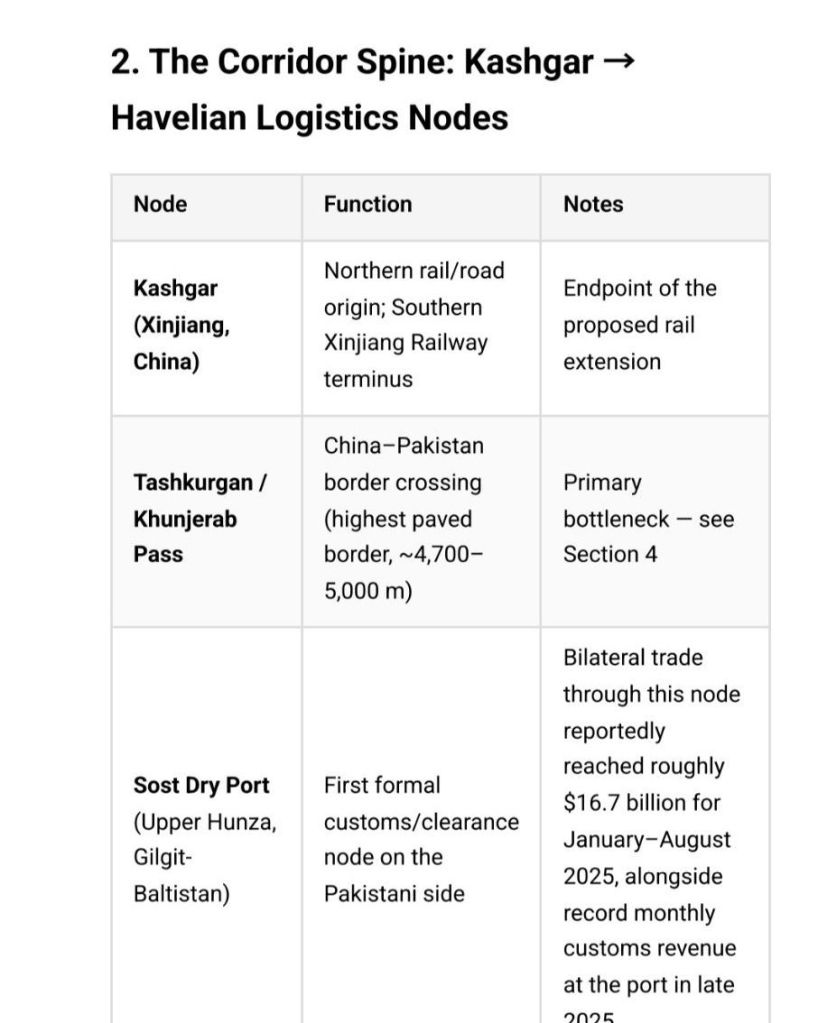
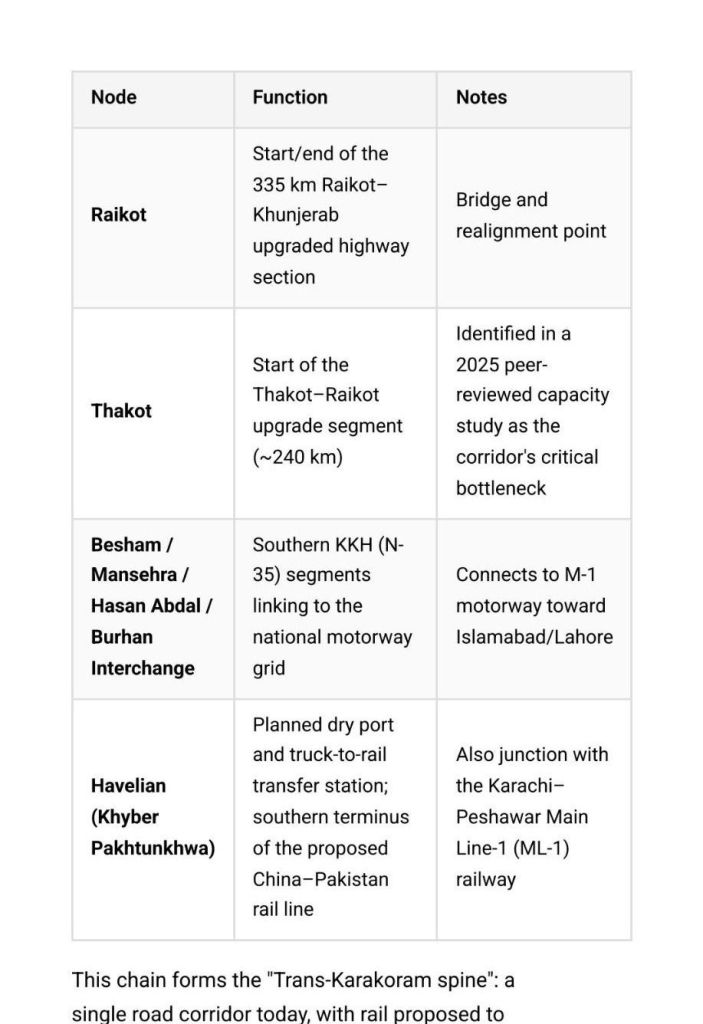
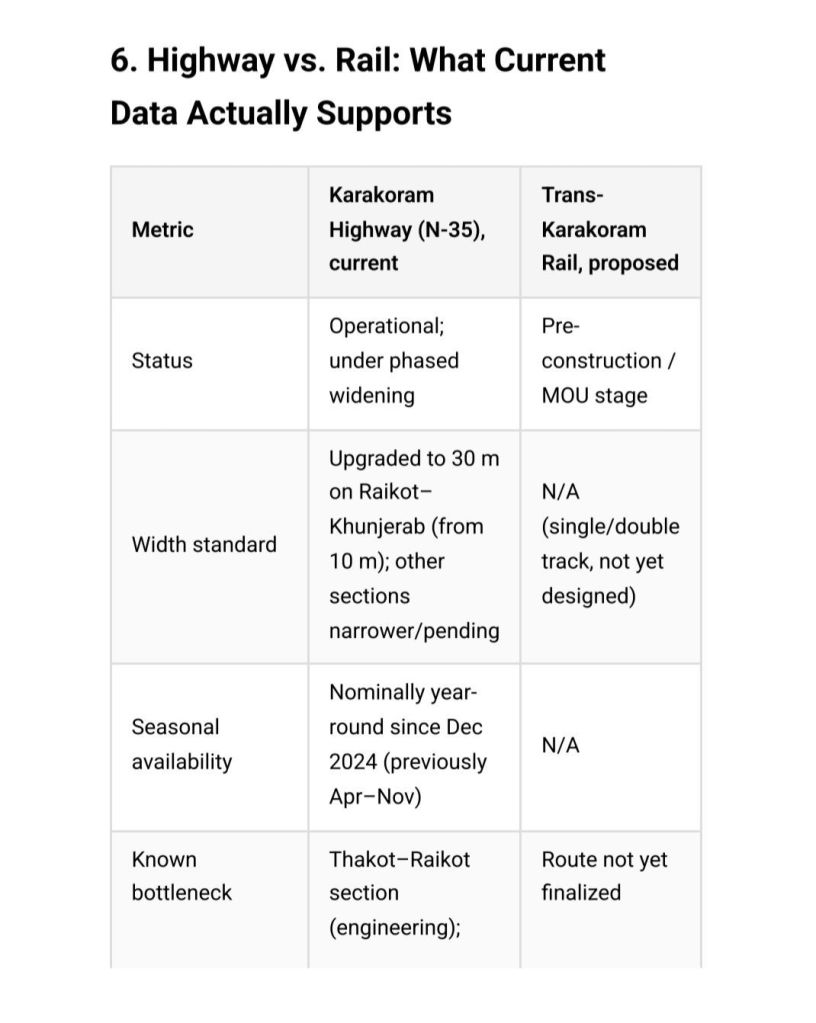
3. Highway Capacity: The 10 m → 30 m Widening Program
The Raikot–Khunjerab Section (335 km) was upgraded under a **$327.74 million China Eximbank loan** (total project cost ~$491–500 million), completed in November 2013. This project widened the roadway from 10 meters to 30 meters, added 32 new bridges (27 rehabilitated), and was designed to keep the route passable year-round and suitable for heavy, long-body freight vehicles.
Further upgrades are ongoing or planned:
Thakot–Raikot section (~240 km): MOU-stage realignment and upgrade, discussed during 2023 high-level visits, cost estimated in the billions of rupees.
Hasan Abdal–Mansehra section: NHA is reviewing dualization/rehabilitation of the existing carriageway to relieve congestion and slow-moving freight trailers.
Attabad Lake realignment section: Chinese-financed realignment, expected multi-year timeline.
Net effect: the KKH’s Pakistani alignment (N-35, 887 km) is being converted piecemeal from a narrow, seasonally vulnerable mountain road into a wider, hardened freight corridor — but full end-to-end dualization is not yet complete.
4. Bottleneck Analysis: Khunjerab Pass and the Thakot–Raikot Chokepoint
Altitude and seasonal closure (historical bottleneck):
– Khunjerab Pass sits at roughly 4,700–5,000 m, the highest paved international border crossing in the world.
– Under the 1985/2013 border protocols, the pass was traditionally open only April–November, closing December–March due to snow and low-oxygen conditions — a structural constraint on annual freight capacity.
– Following an October 2023 announcement at the Belt and Road Forum, China and Pakistan agreed to convert Khunjerab to **year-round operation; this took effect starting December 1, 2024. However, implementation has been uneven — the pass has also seen ad hoc closures tied to trader disputes over customs procedures (e.g., a multi-month suspension in 2025 over new scanning fees at Sost, resolved that October).
– Practical effect: even after the year-round policy, the corridor remains vulnerable to (a) residual heavy snowfall requiring active clearance, and (b) customs/administrative friction at Sost.
Engineering bottleneck (current capacity constraint):
A 2025 peer-reviewed capacity study (Adeel et al., *Scientific Journal of Silesian University of Technology – Transport*, 2025) modeling the Burhan–Khunjerab route specifically for a 2035 horizon found:
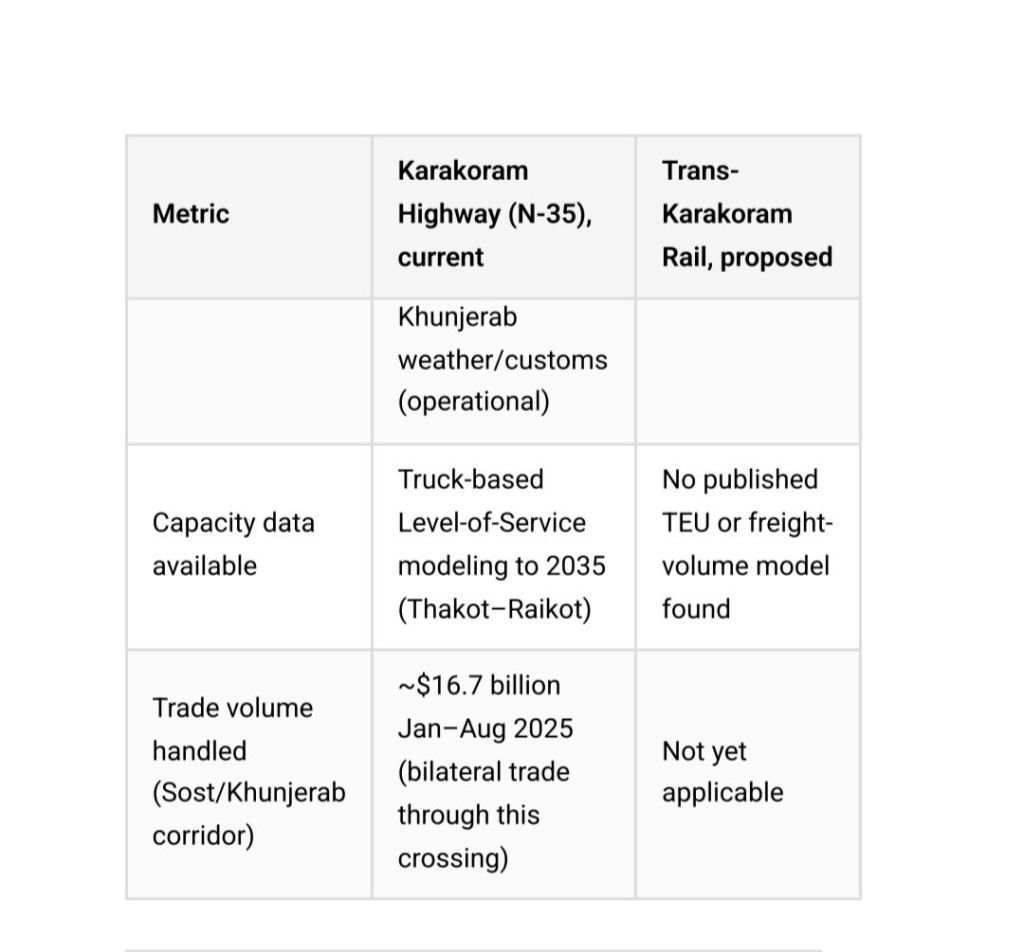
– The Thakot–Raikot section — not Khunjerab itself — is the critical bottleneck, with a modeled additional capacity of roughly 9,519 trucks/day at Level of Service “C” before saturation.
– Under trade-growth assumptions, the corridor is projected to carry about 7.93% of China’s total trade value** and 6.39% of trade tonnage by 2035 if current capacity-expansion plans proceed.
– Statistical relationships derived: each $1 million annual increase in Pakistan’s trade correlates with ~1.3 million ton-km of additional road freight; each 1-million-ton increase in trade volume adds ~1,684 million ton-km of freight movement.
Takeaway: Khunjerab’s altitude/weather profile is the *headline* bottleneck in public narratives, but the *binding engineering constraint* identified in recent modeling sits further south, at Thakot–Raikot — the still-unupgraded middle section of the highway.
No freight currently moves by rail across the Khunjerab/Kashgar frontier — this is a proposed, not operational, corridor.
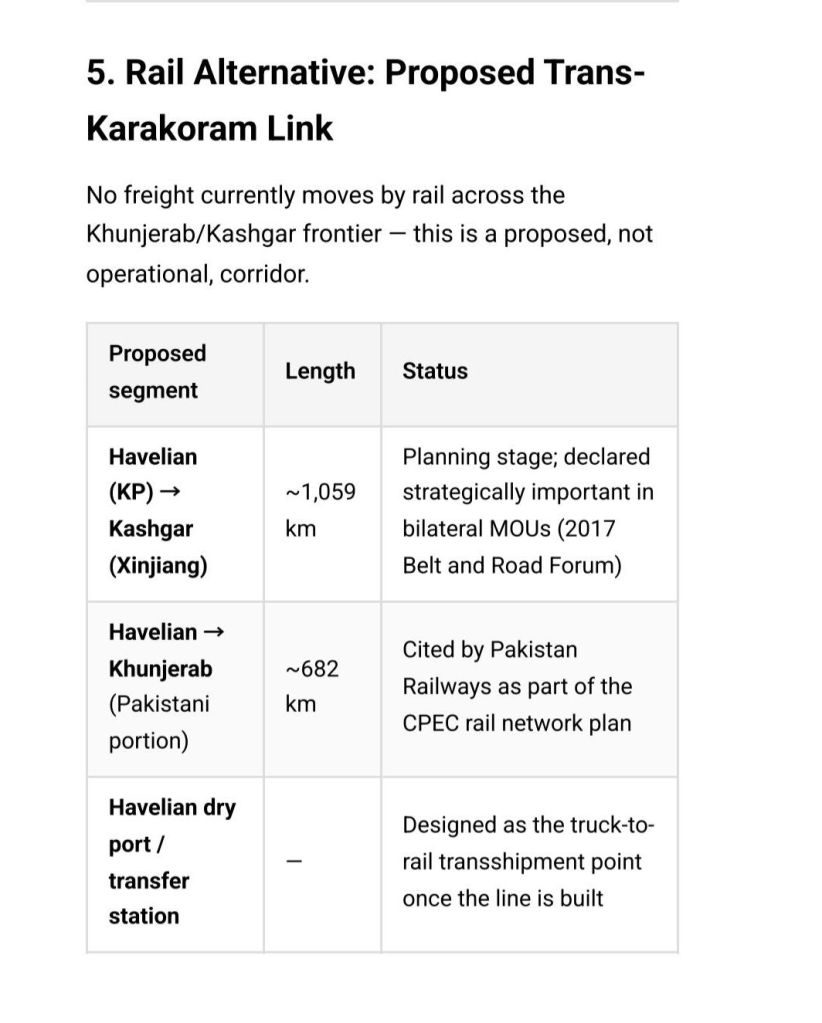
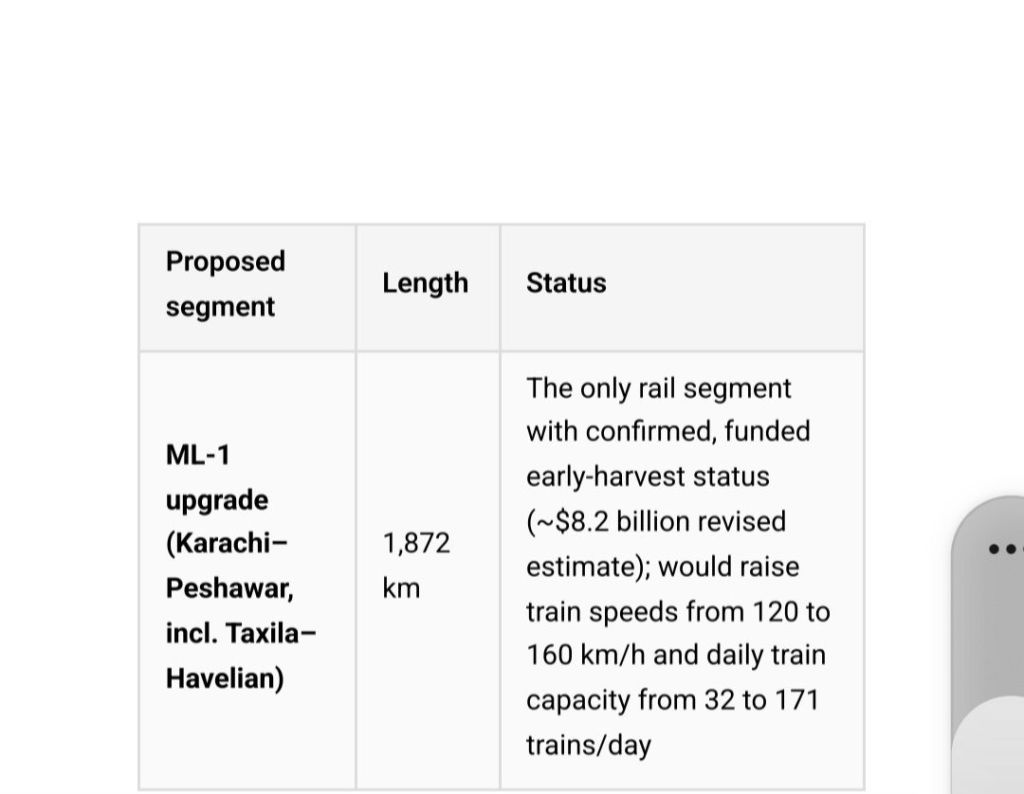
On TEU capacity: No official, engineering-grade TEU throughout projection specifically for the Kashgar–Havelian rail line has been published in government or peer-reviewed sources found in this research. Public statements to date describe the line only in route-length and strategic terms, not container-volume terms — the project remains pre-feasibility/MOU stage rather than at the design stage where TEU modeling would normally be produced. Any TEU figure attributed to this rail link in third-party commentary should be treated as speculative rather than an official target; I’d flag any such number to you rather than present it as sourced. If you need a comparative estimate, an alternative is to benchmark against ML-1’s confirmed capacity uplift (32→171 trains/day) and the trade-tonnage growth rates in Section 4 as a proxy for potential rail demand — I can build that model if useful.
7. Government Targets Toward 2030
– CPEC’s overarching route — 3,218 km of roads, railways, fiber-optic lines and pipelines linking Gwadar to Kashgar** — carries an official completion horizon of **2030**, per Pakistani government statements dating to the corridor’s 2015 launch.
– China’s cumulative investment/contribution under CPEC has been projected by Pakistan’s Planning Commission Centre of Excellence to exceed $100 billion by 2030** (up from an initial $46 billion, revised to $62 billion as of 2018 estimates).
– No single, current, official document was found in this research that sets a specific **TEU or tonnage target for 2030** on the Karakoram Highway or the rail corridor specifically; targets that do exist are expressed in dollar-value trade terms and megawatt/kilometer infrastructure terms rather than container throughput.
8. Caveats
– Figures on cost, length, and dates come from a mix of government statements, wire reporting, and one peer-reviewed engineering study; some (e.g., project costs, MOU-stage segment lengths) have shifted between sources over the corridor’s 15-year history and should be treated as approximate.
– The absence of a published TEU projection for the rail link is itself a finding — it indicates the project has not reached the design stage where such projections are normally produced, not that the figure exists but was simply unavailable to this search.
The Strategic Nexus of the New Silk Road
CPEC Logistics Capacity: Karakoram Highway vs. the Proposed Trans-Karakoram Rail Link
Under Siege: The Security Crisis Threatening CPEC and Gwadar Port
Balochistan the poorest province of Pakistan
The “All-Chinese” Swap: Fact-Checking the Labor Myths in Overseas Lithium Mining
American Perspective
Posted on September 18, 2012 by Akashma Online News
by Todd Shea
 A little perspective for my fellow Americans to consider regarding the impressions they are fed by the media, and the facts and realities which are constantly withheld in what I call “the lies of omission”:
Since this story about the anti-Islam film made the World headlines, I have been in Karachi, Pakistan all week for many meetings related to my Humanitarian mission in Pakistan. Karachi is a metropolis of over 20 million people, one of the largest cities on the planet.
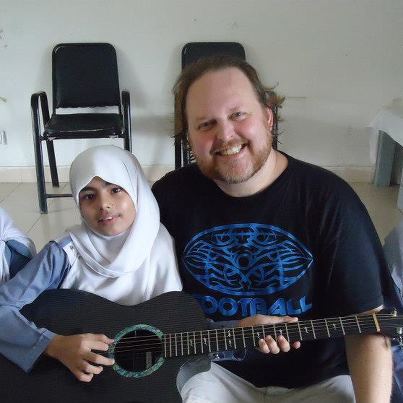
There are perhaps a couple thousand or less who have engaged in any violence related to the film. I have been running around all over Karachi (even in the so-called “dangerous” areas) and literally thousands of people have seen me walking around in public areas, sitting in the car at traffic lights, going for a bite to eat with friends, walking into office buildings for meetings, going to gas stations or convenience stores, feeding stray cats, playing music for kids and buying small flocks of birds from street vendors and setting them free which creates a feeling of joy for everyone within the vicinity, even if they do look at me like I’m a bit nutty.
But NO ONE has been rude or angry towards me. I haven’t changed anything about my routine and have zero security. I even happened upon a couple of the peaceful demonstrations against the film yesterday.
Not a single person has come up to me and threatened me or even so much as given me a dirty look. People greet me, smile and wave back to me and treat me with the genuine kindness and respect that any Human Being would want to be treated with.
I love Karachi. It’s a great city with great people. New York has bad and misguided people, LA and Miami and Chicago have them too, and so does Karachi. But all of these cities share so much in common because they have mostly decent ordinary people who do their best to get through each day surviving and taking care of there families.
No doubt it’s a lot tougher for most Pakistanis to take care of their families than it is for your average American, but I can assure you that if you visited Karachi, you would also find this city to be a vibrant and fascinating place with beautiful gardens, shopping malls, bustling urban commerce, and amazing waterfront eateries and a major port and transit hub for Asia and the Middle East.
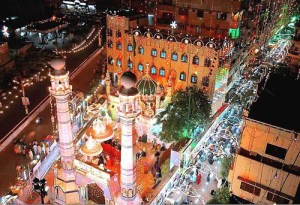 There are places here that are absolutely wonderful and Americans have no idea about them because the Western media doesn’t ever tell us about them- they would rather suck up your hard earned Dollars selling hate and peddling fear to exaggerate and exploit every situation that will continue justifying unnecessary wars and destruction they eagerly cover for the gluttonous financial gain of a few powerful individuals and corporations and those who make bullets and bombs) by portraying Pakistanis and Muslims with articles about subjects such as “Muslim Rage” than to show you the overwhelming majority of the 19,998,000 Human Beings in Karachi, Pakistan who are almost universally outraged by the film but are NOT protesting violently and tearing up their own city. And based on my experience, I’m convinced it’s pretty much the same situation everywhere else in the Muslim World, otherwise it would be a much worse situation than just a relative few incidents perpetrated by a small number of violent idiots when compared to the 1.5 billion Muslims living on Planet Earth.
So rest assured, Karachi is still here- it has its big city troubles but it’s not on fire, and it will still be here tomorrow and the day after and the day after and the day after that until the fateful day that we all collectively self destruct with some kind of advanced weaponry or God finally gets tired of watching too many of us using up our energies destroying our planet and hating each other and making millions of children suffer and letting thousands die of preventable disease, hunger and poverty every day and decides to pull the plug on us all, having failed the big test.
**************************************************************************************************
American Musician Todd Shea has developed a reputation for being the ‘go-to guy for relief’, an accolade that has come with his unique dedication for helping out with disasters around the world from places like Sri Lanka and India to Japan and Pakistan. His life and work make for a great narrative as he traipses all over Pakistan with medicines and music to bring not only physical relief, but emotional and psychological too.
Todd Shea, an American who came to volunteer in Pakistan after the 2005 earthquake, a disaster that killed 80,000 people. In 2000, Shea established a charity hospital in Kashmir called CDRS, or Comprehensive Disaster Relief Services, which provides quality healthcare services to the people in the remote and earthquake-affected areas in northwest Pakistan. And now, it has expanded to more areas of Pakistan.
Todd Shea is the Chief Operating Officer of SHINE Humanity, a US-registered nonprofit that specializes in disaster relief and long-term sustainable healthcare initiatives in developing countries. He began life as a vocalist, songwriter and guitarist. He was in
New York City on September 11th, 2001 to perform at a world famous live music establishment, CBGB’s Gallery. Instead, he ended up working at the site of the fallen World Trade Center for almost a week, assisting first responders by delivering anything
they needed to keep them going, from ice to contact lens wash and medications. Realizing that he had an ability for acquiring and coordinating needed items efficiently in a chaotic and disastrous situation, Todd put his music career on an indefinite hiatus to
work in Sri Lanka after the Tsunami, and in New Orleans after Hurricane Katrina. In October 2005, Todd was compelled to go to Pakistan immediately after the earthquake as a logistics coordinator for a Pakistan-American medical response team. After seeing the magnitude of the need and having fallen in love with Pakistan and its people during the emergency response phase, Todd founded Comprehensive Disaster Response Services (CDRS) in the Spring of 2006 and serves as its Executive Director. Todd currently works and resides in Islamabad, providing primary care and an Innovative Community- Based Healthcare Empowerment Project to different rural and disaster striken areas of Pakistan who would otherwise be without adequate healthcare services.
In April 2009, SHINE Humanity was registered in USA and Todd joined as the COO. Todd and SHINE Humanity deployed in Haiti in January 2010 and are working in Pakistan to provide relief aid to victims of the floods through mobile medical units, livelihood initiatives, and food and non-food assistance. The agency hopes to transition into longterm rehabilitation programs focussed on mother/child care in the areas served.


