Archive
Under Siege: The Security Crisis Threatening CPEC and Gwadar Port
By Marivel Guzman | Akashma News
A Companion Briefing to the Gwadar– CPEC Phase II Dashboard
Compiled September 12, 2026 from 14 primary and supplementary sources
Executive Summary
The China-Pakistan Economic Corridor (CPEC), once hailed as the flagship of China’s Belt and Road Initiative, is facing an existential security crisis in Balochistan. A sustained and escalating campaign of sabotage by Baloch separatist militant groups — primarily the Balochistan Liberation Army (BLA) — has systematically targeted CPEC infrastructure, Chinese personnel, and Pakistani security forces across the province. In February 2026, China suspended all ground operations in Gwadar and evacuated its personnel. By the summer of 2026, the BLA declared an “economic blockade” of Balochistan, destroying dozens of vehicles, bridges, and supply routes. Pakistan has deployed over two army divisions and spent more than $200 million on security, yet the attacks continue to intensify. Almost all major CPEC projects are now described as “languishing” by independent analysts.
I. The Militant Landscape
Balochistan Liberation Army (BLA)
The BLA is the most prominent and operationally capable separatist group in Balochistan. Formed in the early 2000s, it has evolved from a low-level insurgency into a sophisticated militant organization with specialized units:
• Majeed Brigade — the BLA’s suicide attack wing, responsible for multiple high-profile operations including the April 2022 Karachi University bombing and the October 2024 Karachi airport attack
• Fateh Squad — a tactical operations unit involved in coordinated assaults on military installations
• Special Tactical Operations Squad (STOS) — an elite unit for targeted operations
• Hammal Maritime Defence Force — the BLA’s naval wing, which carried out its first maritime attack in April 2026 against a Pakistan Coast Guard boat near Jiwani
The BLA operates through spokespersons Jeeyand Baloch and Azad Baloch, who regularly issue claims of responsibility. The group was designated as a terrorist organization by the United States in August 2025, Australia in May 2026, and the United Kingdom in July 2026.
The BLA’s most active faction is BLA-J (Junaid faction), which launched Operation Herof II on January 31, 2026 — a coordinated wave of attacks across 12+ locations in Balochistan targeting government buildings, schools, hospitals, banks, and security installations.
Balochistan Liberation Front (BLF)
The BLF has focused its attacks on the Frontier Works Organization (FWO), the Pakistani military engineering arm responsible for constructing CPEC roads and infrastructure. The BLF’s operations have specifically targeted construction crews and equipment along the CPEC route.
Tehrik-e-Taliban Pakistan (TTP) and IS-K
While Baloch separatists dominate the violence in Balochistan proper, the TTP and Islamic State Khorasan (IS-K) have been active in the Gilgit-Baltistan region along the northern CPEC corridor. The TTP was blamed for attacks on Chinese workers at the Dasu hydropower project. Both groups represent a separate but overlapping security threat to CPEC’s northern axis.
II. Escalation Timeline: Key Incidents
| Date | Incident | Source
|Nov 2018 | Gunmen attacked the Chinese consulate in Karachi, killing 4+ people | [ORF](https://www.orfonline.org/expert-speak/when-the-flagship-starts-sinking-china-s-cpec-is-foundering-in-balochistan) Apr 2022 | BLA suicide bomber Shaari Baloch killed 3 Chinese tutors and 1 Pakistani driver at Karachi University’s Confucius Institute | [LSE South Asia Centre](https://blogs.lse.ac.uk/southasia/2025/05/19/balochistan-cpec-anti-china-sentiment-and-the-way-ahead/) |
Mar 2024 | BLA attacked Gwadar Port Authority Complex and Naval Air Base PNS Siddique | [ORF](https://www.orfonline.org/expert-speak/when-the-flagship-starts-sinking-china-s-cpec-is-foundering-in-balochistan) Aug 2024 | BLA convoy attack on Chinese engineers near Gwadar | [BBC](https://www.bbc.com/news/articles/c0r84p0dp1jo) |
Oct 6 “7, 2024 | BLA Majeed Brigade suicide attack (vehicle-borne IED) near Karachi airport killed 2 Chinese nationals, 10+ injured; targeted Port Qasim Power Generation engineers; perpetrator Shah Fahad | [ORF](https://www.orfonline.org/expert-speak/when-the-flagship-starts-sinking-china-s-cpec-is-foundering-in-balochistan); [Eurasia Review](https://www.eurasiareview.com/15072026-the-new-phase-of-pakistans-instability-and-its-strategic-implications-analysis/) |
Late Jan 2026 | BLA Operation Herof 2.0 — coordinated attacks across 12 districts targeting government buildings, schools, hospitals, banks, and security installations; 31 civilians and 17 security personnel killed | [Eurasia Review](https://www.eurasiareview.com/15072026-the-new-phase-of-pakistans-instability-and-its-strategic-implications-analysis/) |
Feb 2, 2026 | China suspended ALL ground operations in Gwadar and evacuated all Chinese personnel via special flights; Chinese Embassy called it “precautionary and temporary” | [News18](https://www.news18.com/world/china-suspends-all-ground-operations-in-gwadar-after-attacks-across-balochistan-exclusive-ws-kl-9873491.html) |
Mar 2026 | BLA attacks on army camps in Kech, Hub, and Kalat; gas pipeline blown up in Quetta | [Eurasia Review](https://www.eurasiareview.com/15072026-the-new-phase-of-pakistans-instability-and-its-strategic-implications-analysis/) |
Apr 12, 2026 | BLA naval wing (Hammal Maritime Defence Force) attacked a Pakistan Coast Guard boat near Jiwani using a speedboat, killing 3 personnel — the group’s first maritime attack | [Eurasia Review](https://www.eurasiareview.com/15072026-the-new-phase-of-pakistans-instability-and-its-strategic-implications-analysis/) |
Late Apr 2026 | 27 attacks in 10 days; 42 military personnel killed | [Eurasia Review](https://www.eurasiareview.com/15072026-the-new-phase-of-pakistans-instability-and-its-strategic-implications-analysis/) |
May 2026 | BLA suicide car bomb on a train carrying soldiers and their families in Quetta | [Eurasia Review](https://www.eurasiareview.com/15072026-the-new-phase-of-pakistans-instability-and-its-strategic-implications-analysis/) |
Jun 1, 2026 | BLA seized the Panjgur “Chedgi route for 2 days, burning 6 vehicles | [Organiser](https://organiser.org/2026/06/14/358165/world/baloch-liberation-army-blow-up-bridges-on-cpec-road-dozens-of-pakistani-vehicles-carrying-minerals-set-on-fire/) |
Jun 5, 2026 | BLA set up checkpoints in Lasbela district, burning 10 vehicles and heavy machinery | [Organiser](https://organiser.org/2026/06/14/358165/world/baloch-liberation-army-blow-up-bridges-on-cpec-road-dozens-of-pakistani-vehicles-carrying-minerals-set-on-fire/) |
Jun 7, 2026 | BLA attacked a Saindak convoy in Kardegap, Mastung; destroyed 3 mineral vehicles and 1 military vehicle; 6 Pakistani personnel killed or injured | [Organiser](https://organiser.org/2026/06/14/358165/world/baloch-liberation-army-blow-up-bridges-on-cpec-road-dozens-of-pakistani-vehicles-carrying-minerals-set-on-fire/) |
Jun 10, 2026 | BLA burned 10 mineral vehicles near Rehmanzai, Nushki | [Organiser](https://organiser.org/2026/06/14/358165/world/baloch-liberation-army-blow-up-bridges-on-cpec-road-dozens-of-pakistani-vehicles-carrying-minerals-set-on-fire/) |
Jun 11, 2026 | BLA destroyed two CPEC bridges with explosives near Kharan/Washuk | [Organiser](https://organiser.org/2026/06/14/358165/world/baloch-liberation-army-blow-up-bridges-on-cpec-road-dozens-of-pakistani-vehicles-carrying-minerals-set-on-fire/) |
Jul 2026 | Coordinated assaults left 42 dead (38 security personnel and 4 civilians); 11 soldiers and 14 militants killed in a Lasbela ambush | [Eurasia Review](https://www.eurasiareview.com/15072026-the-new-phase-of-pakistans-instability-and-its-strategic-implications-analysis/) |
Jul 15, 2026 | Pakistan increased security around the Saindak copper-gold mine after insurgent violence disrupted supply routes; Saindak’s managing director warned operations could become unsustainable within a month | [Reuters](https://www.reuters.com/world/asia-pacific/pakistan-pledges-more-security-china-run-copper-gold-mine-after-insurgency-2026-07-15/) |
Aug 1 “8, 2026 | BLA claimed 38 operations across Balochistan; 32+ Pakistani military killed; destroyed a bridge, railway track, and multiple vehicles | [The Balochistan Post](https://thebalochistanpost.net/2026/08/bla-releases-details-of-38-operations-across-balochistan-between-august-1-and-august-8/) |
At least 21 Chinese nationals have been killed in attacks since 2021, according to the Observer Research Foundation.
III. The Infrastructure Sabotage Campaign
The BLA’s strategy shifted dramatically in 2026 from targeting personnel to waging a systematic economic warfare campaign. The group’s stated goal is an “economic blockade” of Balochistan — disrupting infrastructure, transport routes, and state economic activity to make CPEC ungovernable.
Destroyed or Damaged Infrastructure
• CPEC Bridges: Two bridges destroyed with explosives near Kharan and Washuk (June 11, 2026), severing key CPEC road links ([Organiser](https://organiser.org/2026/06/14/358165/world/baloch-liberation-army-blow-up-bridges-on-cpec-road-dozens-of-pakistani-vehicles-carrying-minerals-set-on-fire/))
• Vehicles: 36+ vehicles destroyed in June 2026 alone, including mineral transport trucks, fuel tankers, gas transport vehicles, and military vehicles ([Organiser](https://organiser.org/2026/06/14/358165/world/baloch-liberation-army-blow-up-bridges-on-cpec-road-dozens-of-pakistani-vehicles-carrying-minerals-set-on-fire/))
• Railway Tracks: Destroyed near Quetta (August 2026 operations) ([The Balochistan Post](https://thebalochistanpost.net/2026/08/bla-releases-details-of-38-operations-across-balochistan-between-august-1-and-august-8/))
• Gas Pipeline: Blown up in Quetta (March 2026) ([Eurasia Review](https://www.eurasiareview.com/15072026-the-new-phase-of-pakistans-instability-and-its-strategic-implications-analysis/))
• Heavy Machinery: Set ablaze at company construction sites, including equipment at the Saindak copper-gold mine and along CPEC road construction routes ([Organiser](https://organiser.org/2026/06/14/358165/world/baloch-liberation-army-blow-up-bridges-on-cpec-road-dozens-of-pakistani-vehicles-carrying-minerals-set-on-fire/); [Reuters](https://www.reuters.com/world/asia-pacific/pakistan-pledges-more-security-china-run-copper-gold-mine-after-insurgency-2026-07-15/))
• Highway Blockades: The BLA claimed “complete control” of the Quetta “Taftan highway and set up checkpoints along the Panjgur “Chedgi route, the Quetta “Karachi highway, and the Chamalang “Kohlu road ([Organiser](https://organiser.org/2026/06/14/358165/world/baloch-liberation-army-blow-up-bridges-on-cpec-road-dozens-of-pakistani-vehicles-carrying-minerals-set-on-fire/))
The targeting of mineral transport vehicles is particularly significant: the BLA is attacking the extractive industries (copper, gold, barite, marble) that form the economic backbone of CPEC’s Phase II industrial integration. By disrupting supply chains from mines to ports, the group aims to make CPEC commercially unviable.
IV. China’s Response: Suspension and Strategic Recalibration
The Gwadar Evacuation (February 2026)
On February 2, 2026, China suspended all ground operations in Gwadar and evacuated all Chinese personnel via special flights. The Chinese Embassy in Islamabad issued a statement calling the move “precautionary and temporary,” adding: “The overall security situation in Balochistan, particularly in Gwadar, is under review” ([News18](https://www.news18.com/world/china-suspends-all-ground-operations-in-gwadar-after-attacks-across-balochistan-exclusive-ws-kl-9873491.html)).
Chinese teams continued to monitor projects remotely, and the Embassy emphasized that the suspension did not signal a withdrawal from CPEC. However, the evacuation came after the BLA’s Operation Herof 2.0 in late January, which demonstrated the group’s ability to launch coordinated attacks across 12 districts simultaneously.
Broader Chinese Reactions
China’s response to the security crisis has evolved through several phases:
1. Bilateral negotiations (2022 – 2023): China reportedly attempted to negotiate with Baloch separatist groups, but these efforts failed ([Hindu Post](https://hindupost.in/world/paying-price-of-insecurity-how-paks-security-crisis-is-undermining-chinas-cpec-dream/)).
2. Financial incentives: China tried offering economic packages to tribal leaders, which proved ineffective ([Hindu Post](https://hindupost.in/world/paying-price-of-insecurity-how-paks-security-crisis-is-undermining-chinas-cpec-dream/)).
3. Military cooperation: In November “December 2024, China and Pakistan conducted the “Warrior VIII” counter-terrorism exercises ([CISES](https://cises.org/2026/02/12/how-does-the-recent-surge-in-balochistan-violence-threaten-the-security-of-the-china-pakistan-economic-corridor-cpec/)).
4. Pressure for a major offensive: China asked Pakistan to launch a military operation similar to Operation Zarb-e-Azb (the 2014 North Waziristan offensive), but Pakistan was hesitant due to the backlash against such operations ([Hindu Post](https://hindupost.in/world/paying-price-of-insecurity-how-paks-security-crisis-is-undermining-chinas-cpec-dream/)).
5. Private security companies: China and Pakistan discussed forming a joint private security company (PSC) to protect Chinese personnel ([Hindu Post](https://hindupost.in/world/paying-price-of-insecurity-how-paks-security-crisis-is-undermining-chinas-cpec-dream/)).
6. Diversification: In August 2025, Chinese Foreign Minister Wang Yi publicly encouraged third-party participation in CPEC, signaling Beijing’s desire to broaden the initiative beyond a purely bilateral framework ([ORF](https://www.orfonline.org/expert-speak/when-the-flagship-starts-sinking-china-s-cpec-is-foundering-in-balochistan)).
Private Sector Withdrawals
• Han Geng Trade Company shut down its Gwadar operations on May 1, 2026, citing “persistent non-market factors” ([Hindu Post](https://hindupost.in/world/paying-price-of-insecurity-how-paks-security-crisis-is-undermining-chinas-cpec-dream/))
• Shanghai Electric abandoned its $1.77 billion purchase of K-Electric in September 2025 ([ORF](https://www.orfonline.org/expert-speak/when-the-flagship-starts-sinking-china-s-cpec-is-foundering-in-balochistan))
• Century Steel Group threatened to dismantle its Rashakai SEZ plant in November 2024, listing 18 grievances including security cost increases ([ORF](https://www.orfonline.org/expert-speak/when-the-flagship-starts-sinking-china-s-cpec-is-foundering-in-balochistan))
V. Pakistan’s Security Response
Military Deployment
Pakistan has raised approximately two army divisions (roughly 20,000 “30,000 troops) dedicated to CPEC security, spending more than $200 million on security for what was originally a $21 billion Chinese investment ([Hindu Post](https://hindupost.in/world/paying-price-of-insecurity-how-paks-security-crisis-is-undermining-chinas-cpec-dream/); [ORF](https://www.orfonline.org/expert-speak/when-the-flagship-starts-sinking-china-s-cpec-is-foundering-in-balochistan)). A Special Protection Unit (SPU) was created specifically for CPEC, but its performance has been widely criticized.
Operation Azm-e-Istehkam
In 2025, Pakistan announced Operation Azm-e-Istehkam , a nationwide counter-terrorism campaign. However, the announcement triggered massive public backlash, forcing the government to qualify it as “targeted and intelligence-based” operations rather than a full-scale military offensive. The operation has been ongoing but, according to the Observer Research Foundation, has been ineffective in curbing the insurgency ([ORF](https://www.orfonline.org/expert-speak/when-the-flagship-starts-sinking-china-s-cpec-is-foundering-in-balochistan)).
Saindak Mine Security
On July 15, 2026, Interior Minister Talal Chaudhry directed increased deployment of forces around the Saindak copper-gold mine after insurgent violence disrupted supply routes. The mine’s managing director warned that operations could become unsustainable within a month if security did not improve ([Reuters](https://www.reuters.com/world/asia-pacific/pakistan-pledges-more-security-china-run-copper-gold-mine-after-insurgency-2026-07-15/)).
Economic Measures
Pakistan has attempted to artificially boost Gwadar Port traffic by forcing government departments to route 50% of their bulk imports through the port. However, this has not addressed the underlying security concerns deterring commercial shipping ([ORF](https://www.orfonline.org/expert-speak/when-the-flagship-starts-sinking-china-s-cpec-is-foundering-in-balochistan)).
Pakistan also owes Chinese independent power producers (IPPs) approximately $1.5 billion in unpaid dues, further straining the bilateral economic relationship ([ORF](https://www.orfonline.org/expert-speak/when-the-flagship-starts-sinking-china-s-cpec-is-foundering-in-balochistan)).
VI. Impact on CPEC Projects
The security crisis has had a devastating impact on CPEC’s operational trajectory:
Project Status
Project | Status | Impact
Gwadar Port Operations | Suspended (Feb 2026) | All Chinese ground operations halted; virtually no commercial traffic |
Gwadar Airport | Operational but underutilized | NGIA opened January 2025 but faces low traffic due to security concerns |
ML-1 Railway | Stalled | Cost revised from $6.8B → $9.85B → $6.7B; Beijing frustrated with cost inflation |
Saindak Copper-Gold Mine | Under threat Supply routes disrupted; MD warned of unsustainable operations within a month |
Rashakai SEZ | Threatened | Century Steel Group threatened to dismantle plant (Nov 2024) |
Eastbay Expressway Phase II | Stalled | 13.8 km extension not progressing |
M-8 Motorway | Partially operational | Only 193 km of 893 km (Gwadar “Hoshab section) operational |
Scale of Violence
According to the Pakistan Institute for Peace Studies (PIPS), Baloch insurgent groups carried out 225 attacks in 2025 , resulting in 338 fatalities and 462 injuries across 27 districts. The South Asia Terrorism Portal recorded 248 terrorism-related incidents in the first seven months of 2024 alone ([CISES](https://cises.org/2026/02/12/how-does-the-recent-surge-in-balochistan-violence-threaten-the-security-of-the-china-pakistan-economic-corridor-cpec/); [ORF](https://www.orfonline.org/expert-speak/when-the-flagship-starts-sinking-china-s-cpec-is-foundering-in-balochistan)).
The ORF assessment is stark: almost all major CPEC projects are “languishing,” and Chinese investment has “slowed drastically or halted” ([ORF](https://www.orfonline.org/expert-speak/when-the-flagship-starts-sinking-china-s-cpec-is-foundering-in-balochistan)).
VII. Civil Unrest and the Political Dimension
Baloch Yakjehti Committee (BYC)
The BYC, led by Mahrang Baloch , has emerged as the most prominent civil society movement in Balochistan. The BYC has organized mass protests under the banner of a “movement against Baloch genocide,” drawing thousands of participants. Mahrang Baloch has directly accused China of complicity, stating: “China or any other country investing in Balochistan is directly involved in the Baloch genocide” ([The Print](https://theprint.in/world/baloch-yakjehti-committee-condemns-pakistan-china-for-exploiting-local-resources/2186878/); [DW](https://www.dw.com/en/china-pakistan-economic-corridor-sparks-pakistan-protests/a-69941212)).
The BYC has condemned both Pakistan and China for “exploiting local resources” and has organized protests in Karachi, Quetta, and Gwadar demanding an end to what it describes as systematic marginalization of the Baloch people ([The Print](https://theprint.in/world/baloch-yakjehti-committee-condemns-pakistan-china-for-exploiting-local-resources/2186878/)).
Haq Do Tehreek (HDT)
In Gwadar specifically, the HDT led by Maulana Hidayat Ur Rehman has organized protests demanding local fishing rights, an end to checkposts, and basic services. The HDT’s protests have at times paralyzed Gwadar and drawn international attention to the militarization of the city ([DW](https://www.dw.com/en/china-pakistan-economic-corridor-sparks-pakistan-protests/a-69941212)).
The “Fortress” of Gwadar
Gwadar has been described as a “fortress” — local Baloch residents are excluded from the port area, permits are required for movement, and checkpoints dot the city. The security apparatus has created an atmosphere of occupation rather than development, fueling resentment among the local population ([DW](https://www.dw.com/en/china-pakistan-economic-corridor-sparks-pakistan-protests/a-69941212); [Nikkei Asia](https://asia.nikkei.com/politics/protests-disrupt-pakistan-s-gwadar-home-of-chinese-controlled-port)).
Women in the Movement
A notable development is the increasing participation of women — both in peaceful protests and as militants. The April 2022 Karachi University bombing was carried out by a female suicide bomber, Shaari Baloch, marking a new dimension in the conflict. Women have been at the forefront of BYC protests, facing arrests and harassment ([LSE South Asia Centre](https://blogs.lse.ac.uk/southasia/2025/05/19/balochistan-cpec-anti-china-sentiment-and-the-way-ahead/)).
VIII. Strategic Implications
For China
China’s CPEC investment — originally projected at $62 billion — now appears increasingly precarious. The suspension of Gwadar operations in February 2026 marked the first time China publicly halted CPEC activities due to security concerns. While Beijing has framed the suspension as temporary, the pattern of private sector withdrawals (Han Geng, Shanghai Electric, Century Steel) suggests a deeper loss of confidence. China’s pivot toward encouraging third-party participation in CPEC signals a search for burden-sharing — and potentially an exit strategy if security does not improve ([ORF](https://www.orfonline.org/expert-speak/when-the-flagship-starts-sinking-china-s-cpec-is-foundering-in-balochistan)).
For Pakistan
Pakistan faces a strategic dilemma: a full-scale military offensive risks further alienating the Baloch population and international condemnation, while the current targeted operations have proven insufficient. The economic costs are mounting — with over $200 million spent on security, unpaid IPP dues of $1.5 billion, and stalled infrastructure projects. The forced diversion of government imports through Gwadar underscores the artificiality of the port’s current traffic figures ([ORF](https://www.orfonline.org/expert-speak/when-the-flagship-starts-sinking-china-s-cpec-is-foundering-in-balochistan)).
For CPEC Phase II
CPEC Phase II, with its emphasis on industrialization, agriculture, and IT development, is particularly vulnerable to the security crisis. The SEZs — including Rashakai, Dhabeji, and Bostan — depend on stable supply chains and investor confidence, both of which have been shattered. The BLA’s economic blockade strategy directly targets the extractive industries and mineral transport that underpin CPEC Phase II’s industrial integration model.
For Regional Stability
The escalation has implications beyond Pakistan. India has been accused by Pakistan of supporting Baloch militants — a claim India denies but which adds a geopolitical dimension to the conflict. The involvement of the TTP and IS-K in the northern corridor creates a multi-front security challenge. And the potential failure of CPEC would represent a significant setback for China’s Belt and Road Initiative globally, with implications for Beijing’s ambitions in South and Central Asia ([Eurasia Review](https://www.eurasiareview.com/15072026-the-new-phase-of-pakistans-instability-and-its-strategic-implications-analysis/)).
IX. Assessment
The security situation in Balochistan represents the single greatest threat to CPEC’s viability. The BLA has demonstrated an escalating operational capability — from isolated attacks on Chinese personnel to coordinated multi-district operations, maritime attacks, and a sustained economic warfare campaign targeting CPEC’s supply chains. Pakistan’s military response, while substantial in scale, has been unable to contain the insurgency. China’s suspension of Gwadar operations, while framed as temporary, reflects a strategic recalibration that may prove permanent if security conditions do not improve.
The core contradiction remains: CPEC is designed to bring development to Balochistan, but the local population perceives it as an extractive enterprise that benefits China and Pakistan’s federal government at the expense of the Baloch people. Until this fundamental grievance is addressed, no amount of military deployment is likely to secure the corridor.
Sources
1. Observer Research Foundation — “When the Flagship Starts Sinking: China’s CPEC is Foundering in Balochistan” — [ORF](https://www.orfonline.org/expert-speak/when-the-flagship-starts-sinking-china-s-cpec-is-foundering-in-balochistan)
2. Eurasia Review — “The New Phase of Pakistan’s Instability and Its Strategic Implications” — [Eurasia Review](https://www.eurasiareview.com/15072026-the-new-phase-of-pakistans-instability-and-its-strategic-implications-analysis/)
3. Hindu Post — “Paying Price of Insecurity: How Pakistan’s Security Crisis is Undermining China’s CPEC Dream” — [Hindu Post](https://hindupost.in/world/paying-price-of-insecurity-how-paks-security-crisis-is-undermining-chinas-cpec-dream/)
4. News18 — “Paying Price of Insecurity” (opinion) — [News18](https://www.news18.com/opinion/global-watch-paying-price-of-insecurity-how-paks-security-crisis-is-undermining-chinas-cpec-dream-ws-l-10320116.html)
5. Organiser — “Baloch Liberation Army Blow Up Bridges on CPEC Road” — [Organiser](https://organiser.org/2026/06/14/358165/world/baloch-liberation-army-blow-up-bridges-on-cpec-road-dozens-of-pakistani-vehicles-carrying-minerals-set-on-fire/)
6. LSE South Asia Centre — “Balochistan, CPEC, Anti-China Sentiment and the Way Ahead” — [LSE](https://blogs.lse.ac.uk/southasia/2025/05/19/balochistan-cpec-anti-china-sentiment-and-the-way-ahead/)
7. BBC News — “Balochistan attacks: Why is China being targeted in Pakistan?” — [BBC](https://www.bbc.com/news/articles/c0r84p0dp1jo)
8. Nikkei Asia — “Protests disrupt Pakistan’s Gwadar, home of Chinese-controlled port” — [Nikkei Asia](https://asia.nikkei.com/politics/protests-disrupt-pakistan-s-gwadar-home-of-chinese-controlled-port)
9. DW — “China-Pakistan Economic Corridor sparks Pakistan protests” — [DW](https://www.dw.com/en/china-pakistan-economic-corridor-sparks-pakistan-protests/a-69941212)
10. The Print — “Baloch Yakjehti Committee condemns Pakistan, China for exploiting local resources” — [The Print](https://theprint.in/world/baloch-yakjehti-committee-condemns-pakistan-china-for-exploiting-local-resources/2186878/)
11. News18 — “China Suspends All Ground Operations in Gwadar After Attacks Across Balochistan” — [News18](https://www.news18.com/world/china-suspends-all-ground-operations-in-gwadar-after-attacks-across-balochistan-exclusive-ws-kl-9873491.html)
12. Reuters — “Pakistan pledges more security for China-run copper-gold mine after insurgency” — [Reuters](https://www.reuters.com/world/asia-pacific/pakistan-pledges-more-security-china-run-copper-gold-mine-after-insurgency-2026-07-15/)
13. CISES — “How Does the Recent Surge in Balochistan Violence Threaten CPEC?” — [CISES](https://cises.org/2026/02/12/how-does-the-recent-surge-in-balochistan-violence-threaten-the-security-of-the-china-pakistan-economic-corridor-cpec/)
14. The Balochistan Post — “BLA Releases Details of 38 Operations Across Balochistan (Aug 1 “8)” — [The Balochistan Post](https://thebalochistanpost.net/2026/08/bla-releases-details-of-38-operations-across-balochistan-between-august-1-and-august-8/)
15. Mapping Militants — “Balochistan Liberation Army” — [Mapping Militants](https://mappingmilitants.org/profiles/balochistan-liberation-army)
16. Eurasia Review — “Baloch Strike After Talks Stall: Gwadar’s Security Crisis Deepens” — [Eurasia Review](https://www.eurasiareview.com/22042026-baloch-strike-after-talks-stall-gwadars-security-crisis-deepens-oped/)
17. TRT World — [TRT World](https://www.trtworld.com/article/50bcaee91ed2)
18. Amtul Hafeez Qureshi — “How the Balochistan Insurgency Affects CPEC and Regional Trade” — [amtulhafeezqureshi.com](https://amtulhafeezqureshi.com/how-the-balochistan-insurgency-affects-cpec-and-regional-trade/)
—
*This article is a companion to the [Gwadar “CPEC Phase II Dashboard](https://www.perplexity.ai/computer/a/gwadar-cpec-phase-ii-dashboard-4E1Ici50RZKkORWyYN7seg). Data compiled September 2026.*
The Strategic Nexus of the New Silk Road
By Marivel Guzman | Akashma News
Geopolitics, Logistics Capacity, and Debt Sustainability in the China-Pakistan Economic Corridor
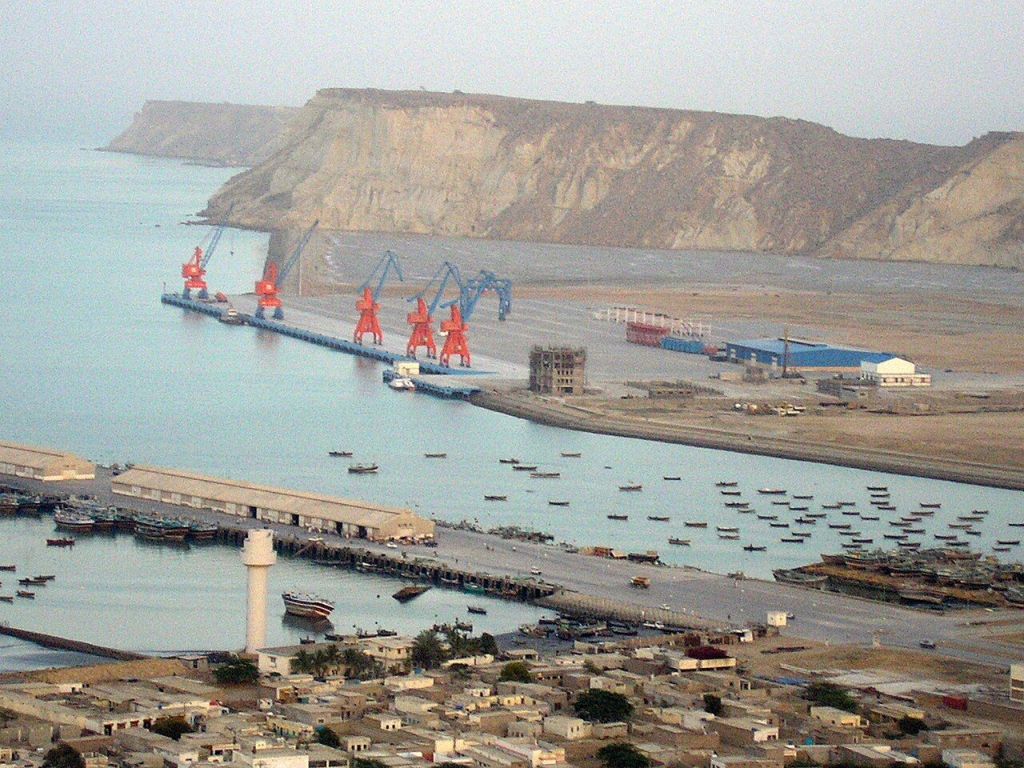
Source: Wikimedia Commons — by J. Patrick Fischer
Gwadar Port handled more shipping containers in April alone than it did in all of 2025. Chinese frigates ran joint drills with the Pakistan Navy off Karachi this spring. Islamabad and Beijing describe a corridor bound for $100 billion in investment by 2030. On paper, the China-Pakistan Economic Corridor looks like it’s accelerating.
Look closer at the road and the ledger, and a different picture emerges — one where the physical infrastructure is still half-built, the most-cited bottleneck isn’t actually the binding one, a parallel rail line exists mostly as a memorandum of understanding, and Beijing’s patience with Pakistan’s debts is visibly running thin.
A Highway Still Being Rebuilt
The entire strategic case for CPEC rests on the Karakoram Highway, the 1,300-kilometer road linking Kashgar in western China to Pakistan’s Arabian Sea coast. It’s a remarkable piece of engineering, but it is not a finished one.
The one section that’s genuinely done — 335 kilometers between Raikot and Khunjerab — was widened from 10 meters to 30 under a $327 million Chinese loan completed back in 2013. That upgrade made the route passable to heavy freight trucks year-round. But the sections north and south of it are a patchwork: the Thakot–Raikot stretch has been stuck at memorandum-of-understanding stage since 2023, and a planned dualization further south, between Hasan Abdal and Mansehra, is still sitting in feasibility review.
That gap matters more than it might sound. A 2025 engineering study modeling freight capacity along this corridor out to 2035 found that the highway’s real chokepoint isn’t the famous, high-altitude Khunjerab Pass — it’s the unfinished Thakot–Raikot section in the middle. The same study estimated that stretch could absorb roughly 9,500 additional trucks a day before hitting saturation, and projected the corridor eventually carrying close to 8 percent of China’s total trade value if the remaining upgrades actually get built on schedule.
Khunjerab’s Bottleneck Changed Shape
Khunjerab Pass, at nearly 5,000 meters, is the highest paved border crossing on Earth, and for decades it was closed every winter — snow and thin air made it impassable from December to March. In late 2023, Beijing and Islamabad agreed to keep it open year-round, and that took effect in December 2024.
It hasn’t gone entirely smoothly. The pass has also been shut down for reasons that have nothing to do with weather — a months-long standoff in 2025 over new customs fees at Sost Dry Port froze cross-border trade until traders and officials worked it out that October. The takeaway: Khunjerab’s bottleneck used to be purely physical. Now it’s just as often bureaucratic.
The Rail Line That Exists Mostly on Paper
For years, CPEC planning documents have floated a rail line running roughly 1,000 kilometers from Havelian, in northern Pakistan, to Kashgar — with Havelian itself becoming a truck-to-train transfer hub. It would be transformative if built. It is nowhere close to being built.
The one rail project that actually has money behind it, the Karachi–Peshawar Main Line-1 upgrade, tells its own story about how CPEC financing has changed. Beijing originally pledged to fund the whole thing — $6.67 billion — back in 2016. Nearly a decade later, that money still hadn’t materialized, and by mid-2026 the project had reportedly been pulled out of the CPEC framework altogether and handed to a multilateral group led by the Asian Development Bank.
No government agency has published a real cargo-volume target for the Kashgar–Havelian rail link. That’s not an oversight — it’s a sign the project hasn’t reached the stage where those numbers would even exist yet.
Gwadar’s Moment, Courtesy of the Strait of Hormuz
None of this infrastructure strain has stopped Gwadar from having a genuinely good year. Instability around the Strait of Hormuz pushed global shippers to look for alternatives, and Gwadar — sitting just 400 kilometers from the strait, with a deep-water harbor most regional ports can’t match — was one of the few places positioned to catch the overflow. The port processed around 11,000 containers in April, more than its entire 2025 total.
The port’s appeal isn’t just commercial. Routing Middle Eastern crude through Gwadar and overland to Kashgar cuts a 12,000-kilometer sea voyage through the tightly patrolled Malacca Strait down to roughly 3,000 kilometers — a serious hedge for Beijing against any future blockade. And the corridor is explicitly dual-use: the Pakistan Navy and China’s PLA Navy ran their fourth joint “Sea Guardians” exercise this spring, with a Chinese guided-missile frigate joining Pakistani Tughril-class ships for anti-submarine and air-defense drills in the Arabian Sea.
Underpinning all of it is a fact rarely stated so plainly: both countries are nuclear powers, and that shared deterrent effectively folds any attack on CPEC infrastructure into each nation’s broader security calculus.
The Debt Problem Beijing Can No Longer Ignore
Here’s where the corridor’s momentum runs into a wall. Chinese power companies operating under CPEC were owed roughly 423 billion Pakistani rupees — about $1.5 billion — in unpaid dues as of the end of the last fiscal year, against a total power-sector debt load of 1.675 trillion rupees. China has refused to waive the associated late fees.
That’s separate from Pakistan’s regular sovereign debt payments to China — in July alone, the State Bank of Pakistan repaid $1.4 billion on a Chinese commercial loan, a different obligation entirely, expected to be refinanced by Chinese banks shortly after. The two debts get conflated a lot in commentary; they shouldn’t be, but both point in the same direction: Pakistan’s fiscal relationship with Beijing is under real strain.
The clearest evidence of how much that strain has changed Chinese behavior is the ML-1 railway’s financing shift, described above. A project China once insisted on funding alone has now been pushed onto multilateral lenders. That’s not how a confident creditor behaves.
Some critics call this “debt-trap diplomacy,” pointing to Sri Lanka’s Hambantota Port as the cautionary tale. Others push back, noting that a large share of CPEC’s projects are structured as equity investment rather than sovereign debt, and argue Pakistan’s deeper problem is years of fiscal mismanagement and weak exports that predate CPEC entirely. Both arguments have real evidence behind them — this is a genuine dispute, not a settled question.
Pakistan’s Other Balancing Act
None of this happens in a vacuum separate from Pakistan’s relationship with the West. For decades, Pakistani territory has served as the transit route for NATO supply lines into landlocked Central Asia, moving through the Torkham crossing near the Khyber Pass and the Chaman crossing in Balochistan. That role gives Islamabad leverage it hasn’t given up: it can deepen its partnership with Beijing while still positioning itself as indispensable to Western military logistics.
The Bottom Line
CPEC’s boosters and its critics are, in a sense, both right. The strategic architecture is real — the nuclear backstop, the naval cooperation, the genuine hedge against a Malacca Strait chokepoint. But so is the gap between that ambition and what’s actually built: an unfinished highway whose real weak point isn’t the one everyone talks about, a rail corridor that’s still just a plan, and a debt load that’s making Beijing noticeably more cautious about writing the next check. Whether the corridor delivers on its 2030 targets will depend less on geopolitics than on whether Pakistan and China can close that gap — and right now, the ledger is closing faster than the road.
—
Under Siege: The Security Crisis Threatening CPEC and Gwadar Port
This research-base-report follows The Strategic Nexus of the New Silk Road, which examined CPEC and Gwadar as critical links in China’s broader Belt and Road strategy. The present article turns to the growing security crisis in Balochistan and asks whether insurgent attacks, infrastructure sabotage and mounting security costs could undermine the very corridor designed to connect western China with the Arabian Sea.
A Supplementary Technical Analysis to “The Strategic Nexus of the New Silk Road
Related logistics report: CPEC Logistics Capacity: Karakoram Highway vs. the Proposed Trans-Karakoram Rail Link examines the physical infrastructure behind the corridor—highway widening, freight capacity, the Khunjerab Pass, the Thakot–Raikot bottleneck and the proposed rail connection between Pakistan and China. It complements this geopolitical analysis by asking a practical question: how much trade can CPEC actually move, and where are its most important logistical constraints?
Sources: Pakistan National Highway Authority project records; Adeel et al., “Multi-Dimensional Freight and Trade Capacity Analysis,” Scientific Journal of Silesian University of Technology (2025); The Diplomat; ProPakistani; Asia Times; The Express Tribune; The News (Pakistan); Asian Lite International; Journal of Contemporary Asia.*


