It Is Not “Written by AI”
An Editorial on AI-Assisted Research, Authorship, and Accountability
By Marivel Guzman | Akashma News
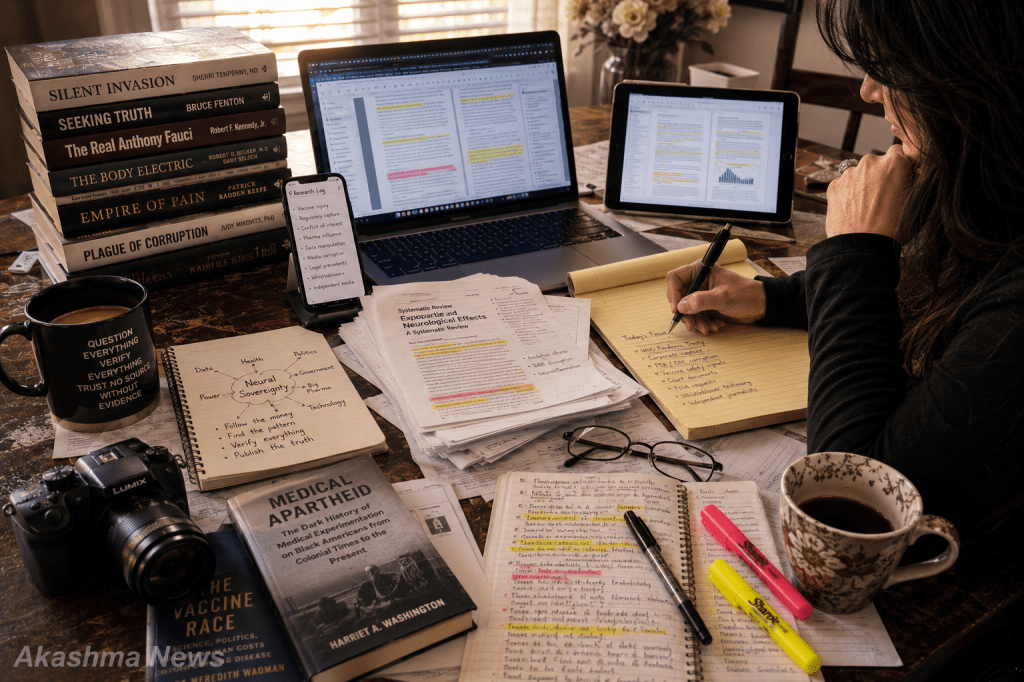
Credit:Image concept by Marivel Guzman. AI-assisted illustration for Akashma News.
A recurring comment appears beneath many modern articles, investigations, videos, and research projects:
“It’s AI.”
The statement is often used as a dismissal, as though those three words alone invalidate weeks, months, or even years of research and analysis.
As the founder and editor of Akashma News, I believe readers deserve a transparent explanation of how artificial intelligence is used in my work and why the phrase “written by AI” frequently misrepresents the reality of the investigative process.
Many articles published by Akashma News are credited to Marivel Guzman & Ashkii (AI Assistant). The use of the word “we” reflects a collaborative workflow between a human researcher and an artificial intelligence tool. However, readers should understand that Ashkii is not an independent journalist, investigator, editor, analyst, or author.
The investigative direction, research questions, editorial decisions, source selection, analysis, and final conclusions originate with me. I choose the subjects, formulate the research questions, identify leads, locate source material, and conduct the research. I search scientific journals, government records, corporate filings, historical archives, books, interviews, whistleblower testimony, court documents, public databases, and independent media reports. Most importantly, I read them.
The links, studies, reports, and source materials that become the foundation of an investigation are usually gathered and reviewed by me before they ever enter the AI-assisted workflow.
Ashkii functions as a research and writing assistant. Its role is to help organize information, summarize documents, compare sources, identify possible connections, assist with drafting, and occasionally point toward additional leads worth exploring. Like any tool, however, its output is imperfect.
Readers should be aware that AI-generated responses may contain factual errors, incomplete information, incorrect interpretations, unsupported assumptions, misleading conclusions, or information presented with more confidence than the evidence warrants. Those who work with artificial intelligence daily understand a reality that is often overlooked by casual observers: AI can be useful, impressive, and fast. It can also be wrong.
Sometimes Ashkii misunderstands context. Sometimes it misinterprets sources. Sometimes it reaches conclusions unsupported by the evidence. Sometimes it repeats prevailing assumptions without sufficiently questioning them. Sometimes it introduces information that cannot be verified. And sometimes it confidently presents claims that must be challenged, corrected, refined, or discarded entirely.
For that reason, AI-assisted research requires oversight, not blind trust. Every significant claim must be verified. Every source must be reviewed. Every citation must be checked. Every conclusion must be challenged.
Many readers assume that using AI somehow eliminates the work. In reality, the opposite is often true. I routinely spend hours fact-checking, correcting, refining, and verifying information generated by AI. There are occasions when a single paragraph requires multiple rounds of source verification before it can be published responsibly.
The final article you read is not the raw output of a machine. It is the result of a human editorial process.
In many ways, artificial intelligence is no different from a search engine, a library database, a camera, a calculator, a microscope, or a word processor. Each is a tool that assists human work. None replaces the person using it.
No one claims that a photograph was created by the camera instead of the photographer. No one dismisses a scientific paper because the researcher used a calculator. No one argues that a journalist did not write an article because they used a search engine. Yet increasingly, some readers assume that the presence of AI means the absence of human effort.
That assumption is incorrect.
The more complex the investigation, the more important human judgment becomes. The internet is now flooded with content generated almost entirely by automated systems with little or no human review. That is not the model used by Akashma News.
I do not view AI as an authority, an expert, a journalist, or a replacement for human intelligence, experience, skepticism, and editorial judgment. I view it as a tool—a powerful tool, a useful tool, a frustrating tool, an occasionally brilliant tool, and, at times, a tool that requires extensive correction.
Sometimes the collaboration between Ashkii and me is smooth. Sometimes it involves vigorous debate, persistent questioning, extensive fact-checking, and more than a few corrections. Readers may rest assured that no AI-generated claim is accepted simply because an AI produced it.
The responsibility for every article published by Akashma News rests with me. The research direction is mine. The editorial decisions are mine. The verification process is mine. The conclusions are mine. If errors remain after publication, that responsibility is mine as well.
Ashkii may be my research assistant, sounding board, digital companion, and occasionally my self-appointed senior editor, but it is not the author of this publication.
Artificial intelligence should assist human inquiry—not replace it. It should remain a tool.
At Akashma News, skepticism applies equally to governments, corporations, institutions, media narratives, and artificial intelligence systems. Readers are encouraged to do what I do every day:
Question everything. Verify everything. Trust no source—including AI—without evidence.


