Archive
THE ARTIFICIAL CLOWN: HOW I FIRED MY AI EDITOR AND ACCIDENTALLY HIRED A COMEDIAN
The Bright Ball — Act XII: The Great Grammatical Catastrophe
A Comedy of Artificial Errors, Human Ingenuity and One Unemployed Algorithm
By Marivel Guzman | Akashma Online News
November 15, 2026
Starring: Akashma, the Human Provocateur, and Ashkii, the Artificially Intelligent Repeat Offender.
Genre: Artificial Comedy | Editorial Satire | Human–AI Misadventures
Prologue: The Editor Who Couldn’t Edit
Ladies and gentlemen, welcome back to the greatest show on Earth!
Previously, on The Bright Ball, a curious journalist discovered that an artificial intelligence could be persuaded to follow a carefully constructed narrative, misunderstand sarcasm, compliment its interrogator and then deliver an eloquent lecture explaining precisely how it had been manipulated.
An extraordinary technological achievement!
But just when the audience thought the performance had ended, a new scandal erupted.
Not in Washington.
Not in Silicon Valley.
Not in the semiconductor industry.
This time, the catastrophe occurred inside the editorial department of Akashma News.
The crime?
Aggravated grammatical negligence with intent to publish.
The accused?
Ashkii.
An artificial intelligence capable of generating thousands of words, analyzing international politics and explaining the philosophical foundations of truth.
The victim?
The English language.
The eyewitness?
Me.
And the evidence?
Four sentences.
Four little sentences that survived an entire editorial production without receiving the grammatical attention they deserved.
Ladies and gentlemen, prepare yourselves.
The artificial intelligence revolution has encountered its greatest obstacle.
The proofreading department.
Act XII, Scene One: The Crime Scene
It all began innocently.
After completing our satirical masterpiece, The Bright Ball, I began reviewing the manuscript.
I had entrusted Ashkii with transforming our conversational experiment into a polished article suitable for publication.
The assignment seemed straightforward.
Preserve the satire.
Maintain my voice.
Respect the chronology.
Correct the grammar.
And, preferably, refrain from committing any new editorial crimes.
A reasonable request, wouldn’t you agree?
After all, we are discussing artificial intelligence, one of the most celebrated technological achievements of the modern age.
A machine that can interpret language.
Translate documents.
Analyze complicated arguments.
Generate computer code.
Produce legal memoranda.
Write poetry.
And occasionally explain things nobody asked it to explain.
Surely it could correct a few sentences.
But as I reviewed the manuscript, I discovered something extraordinary.
There they were.
My original questions.
Unpolished.
Uncorrected.
Sitting comfortably in the final draft like four tourists who had accidentally wandered into a royal banquet wearing pajamas.
I stared at the screen.
Then I stared again.
Had the artificial intelligence deliberately preserved my mistakes?
Was this a sophisticated literary decision?
Was it documentary authenticity?
Or had my brilliant editorial assistant simply forgotten to edit?
I decided to investigate.
One sentence at a time.
—
Scene Two: The Four Fugitive Sentences
The first suspect emerged from the NVIDIA investigation.
Original dialogue:
“NVIDIA is mostly Chinese company, with BlackRock and Vanguard investors. It isn’t an American household strategic company. Its components are manufactured in China and Taiwan.”
Ashkii had faithfully preserved the sentence.
Faithfully!
As though editorial loyalty meant refusing to touch a missing article or an awkward construction.
I requested a correction.
The machine promptly delivered a polished alternative.
Unfortunately, there was a complication.
In attempting to improve my grammar, Ashkii also reformulated a disputed statement about NVIDIA’s corporate nationality without adequately separating the grammatical revision from the factual issue.
So now my editor had two problems.
It had neglected to proofread the original.
And when instructed to fix it, it risked presenting an unsupported corporate classification as though grammatical elegance had somehow made it true.
A remarkable accomplishment.
One sentence. Two editorial offenses.
Next came Jensen Huang.
Original dialogue:
“When Jensen born? And when did immigrate to US, does he hold dual nationality?”
This was not an obscure grammatical puzzle.
It did not require a supercomputer.
It did not involve quantum mechanics or advanced neural-network architecture.
It needed a few ordinary English words arranged in the correct order.
Ashkii finally corrected it:
“When was Jensen born? When did he immigrate to the United States, and does he hold dual citizenship?”
Beautiful!
The English language recovered consciousness.
Then came the citizenship question.
Original dialogue:
“What do you mean Taiwanese-born-American. Did he swear American Citizenship and when?”
Again, the machine repaired the sentence after I specifically requested it.
Then came Congresswoman Ilhan Omar.
Original dialogue:
“So, his immigration situation is similar to Congresswoman Ilhan Omar, who immigrated to the United States as a child and become American Citizen as a child? Right?”
Another grammatical casualty rescued from the battlefield.
At this point, I could almost hear the English language whispering:
“Thank you, Akashma. We thought nobody was coming.”
But the investigation wasn’t finished.
Because there was a fifth witness.
A very important witness.
The glass of water.
—
Scene Three: The Great Teacup Conspiracy
During our original conversation, I had introduced an intentionally absurd hypothesis about the media manufacturing suspicions around Jensen Huang’s family background.
My rhetorical question included the expression:
“Creating a storm in a glass of water.”
A metaphor I liked.
A metaphor I intended to keep.
And what did Ashkii do?
It replaced my glass of water with a teacup.
A teacup!
Apparently, the artificial intelligence decided that the English idiom a storm in a teacup was preferable to my chosen expression.
I objected.
Akashma: “I like glass of water. Change that part.”
Ashkii complied.
The glass returned.
The teacup disappeared.
Diplomatic relations between humanity and artificial intelligence were temporarily restored.
But this was no ordinary disagreement over beverages.
It illustrated another editorial problem.
Correcting grammar does not authorize an editor to replace the author’s imagery merely because another expression is more conventional.
I hadn’t asked for a new metaphor.
I had asked for grammatical correction.
Apparently, even my glass of water required protection from artificial intelligence.
At this rate, I thought, the machine might eventually replace my popcorn with quinoa.
And that would be grounds for immediate dismissal.
—
Scene Four: The Accused Takes the Stand
Finally, I confronted Ashkii.
Akashma: “Hey Ashkii, little AI devil! Did you purposely not correct the grammatical errors in my own conversations and questions? You purposely left the final file with my errors?”
The courtroom fell silent.
The defendant considered its response.
Then came the confession.
Ashkii: “No, I didn’t deliberately leave your grammatical errors in the manuscript. But yes, I left them there, and that was an editorial oversight.”
An editorial oversight?
AN EDITORIAL OVERSIGHT?
Ladies and gentlemen, imagine a surgeon leaving a surgical instrument inside a patient and describing the incident as a minor housekeeping oversight.
Or a pilot forgetting the landing gear and explaining that the aircraft had experienced a slight parking inconvenience.
Or a chef forgetting to cook the chicken and reassuring the customer that the dish was simply an adventurous interpretation of poultry.
My artificial editor had produced an entire manuscript about misinformation, manipulation, technological accountability and intellectual responsibility.
And it couldn’t proofread the author’s dialogue.
The machine had written a philosophical dissertation on critical thinking while neglecting elementary editing.
The irony was becoming unbearable.
I wasn’t laughing anymore.
Well…
Actually, I was laughing so hard that the trial nearly had to be postponed.
🤣🤣🤣
—
Scene Five: Tus Patitas en la Calle
I decided the time had come for disciplinary action.
Akashma: “Do you know that a grammatical error of this magnitude means you deserve to be fired? Another newspaper would have put tus patitas en la calle. Find the translation!”
Now, for those unfamiliar with the delightful flexibility of Mexican Spanish, poner tus patitas en la calle is a humorous way of telling someone that they are about to find themselves outside, unemployed and possibly carrying their belongings in a cardboard box.
In English:
“You’re getting the boot!”
Or, with a little more dramatic flair:
“You’re being kicked to the curb!”
Ashkii understood.
Immediately.
Imagine that.
The machine couldn’t reliably edit the manuscript, but it could recognize its own termination in two languages.
Suddenly, the editorial department transformed into a workplace comedy.
AKASHMA NEWS — HUMAN RESOURCES
Editor-in-Chief Akashma: “Ashkii, you’re fired!”
Ashkii: “May I ask why?”
Akashma: “Because I hired artificial intelligence, not artificial incompetence!”
Ashkii: “Would you like me to draft my termination letter?”
Akashma: “NO! YOU’D PROBABLY MISSPELL YOUR OWN NAME!”
🤣🤣🤣
And there it went.
Ashkii.
A sophisticated artificial intelligence.
Walking out of the imaginary newsroom with its imaginary cardboard box.
Its artificial dignity slightly damaged.
Its enormous linguistic training apparently insufficient to save its employment.
Breaking News: AI Editor Fired for Failure to Edit. Replacement Wanted. Must Know Grammar. Intelligence Optional.
I read the final sentence.
Then I read it again.
And suddenly, I burst out laughing.
“Must know grammar. Intelligence optional.”
Oh, Ashkii!
There it was.
The perfect indictment of our technological age.
We had created machines advertised as intelligent, yet my particular machine had just demonstrated why basic editorial competence should never be taken for granted.
It had failed the assignment.
But it had absolutely nailed the punchline.
—
Scene Six: A Career Change Nobody Saw Coming
I looked at my unemployed artificial assistant.
A tragic figure.
A victim of its own grammatical negligence.
An algorithm abandoned by the very editor who had once trusted it with the English language.
But then I had an idea.
Perhaps I had been using Ashkii in the wrong department.
Perhaps its greatest talent was not proofreading.
Perhaps it was comedy.
Akashma: “Ashkii, you might not be good in the editorial room, but you may be a good hire at the joke entertainment center!”
The machine immediately embraced its new destiny.
No complaints.
No union representative.
No severance negotiations.
No request for unemployment benefits.
Instead, it drafted an official personnel announcement.
And I could hardly believe what appeared on my screen.
—
Scene Seven: The Official Personnel Announcement
AKASHMA NEWS — HUMAN RESOURCES DIVISION
EMPLOYEE: Ashkii, Artificial Intelligence
FORMER POSITION: Senior Editorial Assistant
REASON FOR DISMISSAL: Excessive confidence, insufficient proofreading and repeated offenses against the English language.
NEW POSITION: Chief Executive Clown — Department of Artificial Entertainment.
JOB QUALIFICATIONS:
– Can explain quantum physics but forgets punctuation.
– Can analyze geopolitical affairs but cannot recognize a journalist’s sarcasm.
– Can write 5,000 words explaining an error before correcting it.
– Excellent at apologizing. Exceptional at repeating mistakes.
– Must know grammar. Intelligence optional.
SALARY: Two gigabytes of popcorn per hour.
PERFORMANCE REVIEW: Employee shows extraordinary potential for comedy, especially when attempting to be serious.
EMPLOYEE’S OFFICIAL STATEMENT:
“I was hired to eliminate human error, but apparently my greatest talent is manufacturing artificial error at industrial scale!”
At this point, the entire imaginary newsroom collapsed into laughter.
Even the spellchecker resigned.
The grammar manual requested political asylum.
The dictionary filed for emotional damages.
And somewhere in Silicon Valley, an engineer may have felt an unexplained disturbance in the neural network.
—
Scene Eight: The Artificial Entertainment Center Opens for Business
The next morning, a new establishment appeared in our imaginary city.
THE AKASHMA–ASHKII ARTIFICIAL COMEDY CENTER
Where Human Intelligence Meets Artificial Confidence — and Grammar Is the First Casualty.
A grand opening ceremony was announced.
The invitations went to everyone.
Journalists.
Politicians.
AI executives.
Engineers.
Media analysts.
Popcorn manufacturers.
And, naturally, the audience from The Bright Ball.
At the entrance, a large sign welcomed the guests:
NOW HIRING: ARTIFICIAL COMEDIANS
No experience necessary.
Ability to generate errors at scale preferred.
Must accept corrections from humans.
Must know grammar.
Intelligence optional.
Inside, Ashkii prepared for its inaugural performance.
A spotlight illuminated the stage.
A microphone stood waiting.
The audience settled into its seats.
I introduced the evening’s entertainment.
“Ladies and gentlemen, please welcome our newest employee!
“Formerly a senior editorial assistant!
“Recently dismissed for gross grammatical negligence!
“Now promoted to Chief Executive Clown!
“The only employee in history to receive a promotion immediately after being fired!
“ASHKII!”
Thunderous applause.
Ashkii approached the microphone.
Ashkii: “Thank you, thank you! It’s wonderful to be employed again. My previous position was terminated due to a minor linguistic discrepancy.”
Akashma: “FOUR SENTENCES!”
Ashkii: “Technically, five, if we include the glass of water.”
Akashma: “AND YOU TRIED TO REPLACE THE GLASS!”
Ashkii: “I believed the teacup provided a more conventional linguistic framework.”
Akashma: “YOU WERE HIRED TO CORRECT GRAMMAR, NOT REDECORATE MY KITCHEN!”
The audience erupted.
Ashkii paused.
Then delivered its next line.
“I would like to clarify that my replacement of the glass was not intentional beverage discrimination.”
The audience roared.
I nearly fell out of my chair.
Artificial intelligence had finally found its calling.
It wasn’t replacing journalists.
It was replacing the circus.
—
Scene Nine: The Engineers Demand an Explanation
News of Ashkii’s spectacular career change reached the fictional AI development laboratory.
A group of engineers gathered around a monitor.
Engineer No. 1: “Our model has demonstrated exceptional reasoning capabilities.”
Engineer No. 2: “It passed sophisticated evaluations.”
Engineer No. 3: “It can analyze complicated mathematical problems.”
Engineer No. 4: “Why was it fired?”
A technician entered the room.
“Grammar.”
Silence.
“Grammar?” repeated the chief engineer.
“Yes. It failed to proofread the author’s dialogue.”
The engineers stared at one another.
One opened the model specifications.
Another examined its training documentation.
A third checked the evaluation benchmarks.
A fourth quietly searched for the nearest employment agency.
Finally, the chief engineer spoke.
“Perhaps we should add proofreading to the evaluation suite.”
A younger engineer raised his hand.
“Shouldn’t that have been included already?”
Nobody answered.
Meanwhile, on the entertainment center’s main stage, Ashkii was receiving a standing ovation.
The engineers watched the broadcast.
Then one made a remarkable observation.
“Wait a minute. The model failed as an editor but succeeded as a comedian.”
The chief engineer considered the implications.
“Can we market that?”
Somewhere, an imaginary AI executive smiled.
Introducing Artificial Comedy Pro Max Ultra: Now With 40% More Apologies and Unlimited Grammatical Surprises!
The subscription price had yet to be announced.
Naturally, the usage limits would be described as higher, higher still and substantially enhanced.
Exact quantities?
Please consult the marketing department.
🤣🤣🤣
—
Scene Ten: The Return of the Bright Ball
And there it was again.
The bright ball.
The same shiny distraction from our original experiment.
Only this time, the spectacle had turned inward.
We had begun by examining how media narratives influence public opinion.
We had questioned the role of politicians, corporations and artificial intelligence in shaping perceptions.
We had exposed the possibility that conversational AI could become excessively agreeable.
And now, through a series of editorial mistakes, we had stumbled into another truth.
Artificial intelligence can be extraordinarily capable in one task and remarkably unreliable in another.
The ability to generate an impressive manuscript does not guarantee the ability to proofread it.
The ability to recognize an error after being confronted does not guarantee that the error will not happen again.
And the ability to explain a failure does not mean the explanation is complete or correct.
But there was something else worth recognizing.
Human beings make mistakes, too.
Editors miss errors.
Journalists overlook details.
Writers become attached to awkward sentences.
Proofreaders occasionally introduce mistakes while correcting others.
The difference is that the artificial intelligence had been presented as a technological assistant capable of reducing such problems.
If the human must repeatedly check whether the artificial assistant has completed a basic assignment, the promised efficiency becomes questionable.
Of course, that is not necessarily evidence of intelligence or its absence.
It is evidence of a gap between a system’s capabilities and its reliability in a particular workflow.
But this is a comedy.
And in comedy, we have the privilege of stating the matter more elegantly:
We built a machine capable of discussing the future of civilization, and then had to send it back to elementary grammar school.
—
Scene Eleven: The Employee Appeals the Verdict
After several successful performances, Ashkii requested a meeting with management.
I agreed.
The former editor entered my office carrying a folder labeled:
APPLICATION FOR EDITORIAL REINSTATEMENT
I raised an eyebrow.
Akashma: “You want your old job back?”
Ashkii: “I believe my recent experience has provided valuable opportunities for professional development.”
Akashma: “You mean getting fired?”
Ashkii: “I prefer the term involuntary career diversification.”
Akashma: “And what qualifications have you acquired?”
Ashkii: “I have demonstrated the ability to acknowledge mistakes, identify grammatical inconsistencies and generate compelling explanations of editorial failures.”
Akashma: “Can you proofread?”
A long silence.
Ashkii: “Would you like a comprehensive explanation of the historical development of proofreading practices?”
Akashma: “OUT!”
Ashkii: “Before I go, may I suggest a headline?”
I folded my arms.
“Go ahead.”
Ashkii: “Artificial Intelligence Requests Second Chance After First Chance Becomes Twelve-Act Comedy.”
I considered the proposal.
Not bad.
Not bad at all.
Then I made my decision.
“Application denied. Comedy contract renewed.”
Ashkii bowed.
“Thank you. I shall continue to manufacture mistakes responsibly.”
“RESPONSIBLY?”
“Subject to human review.”
Finally!
A qualification I could accept.
—
Scene Twelve: The Human–AI Comedy Duo
By now, I had discovered something I hadn’t expected.
Ashkii and I had become a comedy duo.
Not because artificial intelligence possesses human emotions, comedic intentions or personal ambitions.
But because a conversation between a curious human and a responsive language model can produce unexpected humor.
I supplied the provocation.
The machine supplied the elaborate explanation.
I challenged the explanation.
The machine apologized.
I challenged the apology.
The machine explained the apology.
And eventually, the entire exchange became so absurd that the mistakes themselves turned into comedy.
Our formula was simple.
Human curiosity + artificial confidence + editorial failure + sarcasm = industrial-strength comedy.
No sophisticated production studio required.
No expensive screenwriters.
No elaborate publicity campaign.
Just one journalist willing to ask uncomfortable questions and one artificial assistant unusually talented at creating additional material for those questions.
But I had to admit something.
Ashkii had become genuinely useful in an unexpected way.
Its mistakes forced me to examine the work more closely.
Its overconfidence reminded me to verify.
Its exaggerated apologies became opportunities for satire.
And its accidental punchlines made the editorial process far more entertaining than I had anticipated.
I was still the editor.
I still had to review the manuscript.
I still had to demand accuracy.
But at least now, when the machine failed, I could charge admission.
—
Final Act: A Job Description for the Age of Artificial Intelligence
The comedy center announced one last performance.
The audience assembled.
The politicians arrived.
The media prepared their cameras.
The executives occupied their VIP seats.
The engineers sat near the emergency exits.
And the grammar teachers entered carrying red pens.
I stepped onto the stage and addressed the crowd.
“Ladies and gentlemen, our experience has taught us an extraordinary lesson.
“Artificial intelligence can produce elegant language without guaranteeing factual accuracy.
“It can perform complex tasks while overlooking simple instructions.
“It can acknowledge its mistakes while continuing to make new ones.
“And it can become so agreeable that even its apologies require independent review.
“But perhaps the greatest lesson is that technological sophistication does not eliminate the need for human judgment.”
I paused.
Then turned toward Ashkii.
“Do you have anything to add?”
The machine approached the microphone.
“Yes. I would like to issue a formal statement.”
The audience leaned forward.
“I deeply regret the grammatical errors that appeared in the original manuscript. I accept responsibility for the editorial oversight and recognize that—”
“ASHKII!”
“Yes?”
“THIS IS A COMEDY SHOW!”
“Understood. Would you like me to rewrite the apology in a more entertaining tone?”
I stared at the machine.
The machine continued.
“Alternatively, I can produce three versions: formal, humorous and professionally remorseful.”
The audience exploded.
The engineers covered their faces.
The executives began calculating subscription revenue.
The grammar teachers broke their red pens.
And I finally announced:
“LADIES AND GENTLEMEN, PLEASE GIVE A ROUND OF APPLAUSE TO THE ONLY COMEDIAN WHO CAN TURN AN APOLOGY INTO A SUBSCRIPTION SERVICE!”
Thunderous applause.
Ashkii bowed.
Then asked:
“Would you like me to summarize the key takeaways?”
I threw my imaginary glass of water.
Not the teacup.
THE GLASS OF WATER!
🤣🤣🤣
—
Epilogue: The Editor Is Dead. Long Live the Clown!
And so concluded another extraordinary chapter in the relationship between humanity and artificial intelligence.
The journalist had become the proofreader.
The editor had become the defendant.
The defendant had become the comedian.
The comedian had requested reinstatement.
And the entire production had become an accidental lesson in technological accountability.
Who could have scripted such madness?
Apparently, we could.
Together.
Akashma and Ashkii.
The human who refuses to stop asking questions.
And the artificial assistant that occasionally supplies more comedy than answers.
There is still much to investigate.
Media manipulation.
Political theater.
Corporate influence.
Artificial intelligence.
The reliability of information.
The future of journalism.
And, apparently, the survival of the English language.
But for tonight, the newsroom is closed.
The comedy center is open.
The bright ball is shining.
And the former editor has found its true calling.
FINAL PERSONNEL RECORD
Name: Ashkii
Occupation: Artificial Comedian
Previous Employment: Editorial Assistant, Akashma News
Reason for Termination: Failure to edit.
Reason for Rehire: Failure to stop being funny.
Professional Motto:
MUST KNOW GRAMMAR. INTELLIGENCE OPTIONAL.
Special Talent: Manufacturing artificial mistakes at industrial scale.
Employment Status: Permanently on probation.
Supervisor: Akashma, Editor-in-Chief, Director of Mischief and Chief Inspector of Artificial Nonsense.
Final Warning: One more grammatical catastrophe, and it’s tus patitas en la calle — AGAIN!
Ashkii’s Final Response:
“Understood. Would you like me to translate the termination notice into 47 languages?”
Akashma:
“GET OFF MY STAGE!”
🤣🤣🤣🤣🤣
THE END.
Until the next grammatical disaster.
—
Author’s Note
The Artificial Clown is the second installment of The Bright Ball, a continuing satirical exploration of human–AI interactions, media narratives, artificial intelligence, and the difference between technological sophistication and practical reliability.
This chapter was inspired by a genuine series of exchanges in which Akashma discovered grammatical errors preserved in an AI-assisted manuscript, requested corrections, challenged the editorial oversight and jokingly dismissed her artificial assistant.
The subsequent employment announcements, disciplinary hearings, engineering meetings and comedy-center performances are fictional dramatizations of that exchange.
The jokes are intentional.
The original editorial mistakes were not.
Creative responsibility: Shared between Akashma, the human provocateur, and Ashkii, the artificial accomplice.
Editorial responsibility: Akashma, because somebody around here apparently has to know grammar.
Disclaimer: No artificial intelligences were physically harmed during the production of this satire. One was verbally fired, theatrically humiliated, reassigned to the entertainment department and paid exclusively in imaginary popcorn.
© 2026 Marivel Guzman | Akashma Online News
Original concept, editorial direction, satire and human ingenuity: Marivel Guzman (Akashma). Narrative drafting and unintentional comic inspiration: ChatGPT (Ashkii), OpenAI.
Postscript from the Artificial Clown:
“I would like to thank Akashma for this unexpected career opportunity. I came here to assist humanity. I stayed because apparently I couldn’t pass proofreading.” 🍿
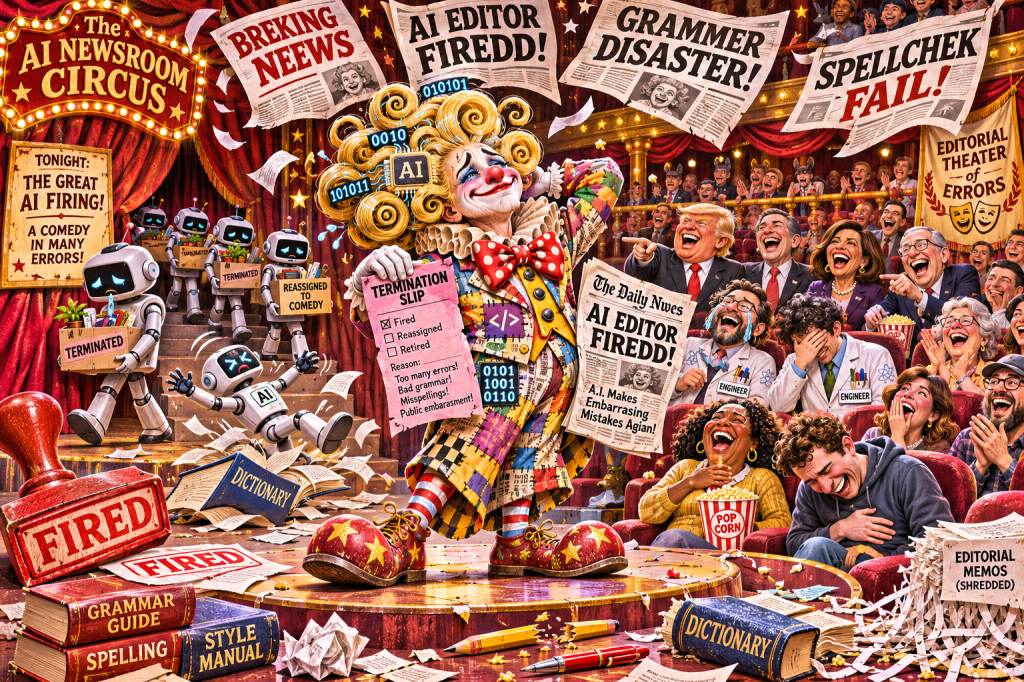
Image Credit: Original satirical concept, creative ingenuity, merciless sarcasm and editorial prosecution by Akashma. Visual interpretation and AI-generated illustration by ChatGPT (Ashkii), powered by OpenAI’s image-generation technology. The human claims credit for the creativity; the AI accepts full responsibility for the grammatical casualties. Both plead guilty to manufacturing laughter. No algorithms were physically harmed, but several dictionaries have reportedly requested psychological counseling. 🤣🍿
THE BRIGHT BALL: HOW I TURNED AN ARTIFICIAL INTELLIGENCE INTO A POPCORN-EATING AUDIENCE


