Zionist Congress 1923
Shared from JTA-Jewish Telegraph Archive
Zionists Adopt Agency Proposal 164 to 87
Carlsbad (Aug. 17)
The protracted debate on the Jewish Agency question which has been the principal object of discussion since the first day of the Zionist Congress almost a fortnight ago, was settled in the early hours this morning, when the Assembly by a vote of 164 to 87 voted to approve the proposal to have the Zionist Organization draw in outside forces willing to help in the upbuilding of the Jewish Palestine.
As finally adopted the proposal provides that the representatives of the non-Zionist organizations shall be invited to form a council which with the Executive of the Zionist Organization shall form the Agency. The resolution provides also that within three years a World Congress of Jewry shall be convoked, the Agency serving until this gathering creates a permanent one.
Supporters of the proposal included the orthodox Mizrachi group, which had been among the leaders hitherto in the opposition to the Weizmann Administration and plan. Their action indicating a departure from their demand for an immediate Congress was a surprise to all. Those opposing the Agency on the final roll call were the labor groups consisting of 33 Zeire Zion (Young Zionists) delegates. 9 Poale Zion delegates and 9 Socialist Zeire Zion.
Of the Executive, Dr. Weizmann, Dr. Soloweitchik, Isaac Naiditch and Dr. Georg Halpern voted in favor. Opposing were Dr. Lichtheim and J. Sprinzak, a labor member of the Executive. Nahum Sokolow, M. Ussishkin and Dr. Arthur Ruppin were absent during the balloting. While this absence may have been entirely accidental and due to the hour (2 A.M.) the roll call took place, it is possible also, it is said, that they remained away in order not to commit themselves.
The question of the new Executive is the only matter that remains to be decided before the adjournment of the Congress. The question of the reelection of M. Ussishkin, at present in charge of the Zionist activities in Palestine, is one of the most bitterly fought in the election slate. Dr. Weizmann favors his elimination, Mr. Sokolow, on the other hand, demands the continuance of the present Executive without change.
Indications are that the plan first sponsored by Dr. Weizmann and Sokolow for a “homogeneous” executive will not be carried and that a “coalition” executive will be approved instead. Dr. Weizmann contends that the headquarters of the Executive must remain in London, but that the Palestine office must be increasingly strengthened. It is believed Dr. Weizmann favors for the Palestine branch Dr. Arthur Ruppin as colonization expert and Colonel Kisch, as political representative, with Mr. Ussishkin eliminated. For the London cabinet he is said to favor Dr. Georg Halpern as financial expert and Dr. Berthold Feiwel as organization chief.
While the Permanent Committee was busy drafting the final form of the compromise agency proposal and others busy slating the Executive. Thursday was given over to consideration of reports and adoption of concrete proposals.
The Land Commission, reporting through Dr. Schmarak recommended that £160,000 be appropriated for colonization work, £120,000 to be expended on actual colonization work and the balance used to create a reserve fund for the purchase of land, under the Keren Hayesod’plan. A plan for the establishment of an industrial bank to provide credit for small industry and agriculture was adopted as also the proposal to extend credit to those engaging in handicraft.Dr. Rufeisen who reported on the credit scheme recommended that at least five per cent of the Palestine budget should be used for such credit facilities for mechanical laborers and that 20,000 pounds should be set aside for credits to suburban residents.
A proposal was carried for an “arbitration court” to be established jointly by the Zionist Organization, the Vaad Leumi and the labor organizations for the settlement of labor disputes and the elaboration of a minimum wage scale.
The report of the Immigration Committee evoked heated discussion, a portion of the Center and labor parties urging the continuance of the present policy of favoring the immigration of Chaluzim The Mizrachi who opposed preferences for chaluzim were voted down.
The Congress adopted a resolution providing for the creation of the office of a travelling inspector whose duty it will be to act as coordinate of immigration to Palestine.
Dr. Sapir on behalf of the Sanitation Commission urged that the Congress ratify the agreement of the American Zionist Organization, the Hadassah and the Joint Distribution Committee under which all three agree to contribute in virtually equal part to the continuance of the medical work in Palestine. The Commission also recommended that the Congress should voice its especial thanks to the Joint Distribution Committee and to Nathan Straus.
Recommendations for the improvement of the service connected with the quarantine activities in Palestine and also improved medical supervision over immigrants were adopted.
A cable from Henrietta Szold, read by Morris Rothenberg, announcing that Jewish physicians of the United States had agreed to give $10,000 for a Roentgen (X-Ray) institute in Jerusalem was received with cheers.
The Syrian Expert has fake credentials
The Inside Story Of How A Fake PhD Hijacked The Syria Debate
By Zack Beauchamp on September 11, 2013 at 7:54
 Dr. Elizabeth O’Bagy, Syria expert, made quite an impression on Senator John McCain. During Senate hearings, the former Presidential candidate quoted at length from her recent Wall Street Journal op-ed painting a rosy picture of a mostly secular, pro-Western anti-Assad insurgency.
“John, do you agree with Dr. O’Bagy’s assessment of the opposition?,” the Senator asked the Secretary of State John Kerry. “I agree with most of that,” he replied.
Except Dr. O’Bagy wasn’t actually a doctor. Her PhD was fabricated, a lie she told her employers at the Institute for the Study of War (ISW), an influential neoconservative-aligned think tank, to get hired. Ironically, it ended up being the lie that got her fired Wednesday. This postmodern reenactment of the Icarus myth also provides a bizarrely informative window into the way that Washington’s foreign policy sausage gets made.
O’Bagy got her start last year, when she interned for ISW’s Iraq portfolio while completing a Master’s in Arab Studies at Georgetown University. Kimberly Kagan, the President of ISW, was so impressed that she hired O’Bagy to start even before the young analyst finished her degree. “Her insights and her [Arabic] linguistic skills were tremendous,” Kagan said.
But O’Bagy had already begun to misrepresent her credentials. Kagan told me that she “knew [O’Bagy] was a student at Georgetown in a combined masters/PhD program,” and that new hire was writing a dissertation on “female militancy in Islamic extremist organizations.” Several media outlets have repeated this account as fact in their write-ups of O’Bagy’s firing, all maintaining that she is still in the process of completing a Georgetown doctorate.
This is almost certainly false. Either O’Bagy was at one point enrolled a PhD program and dropped out, or she has been lying the entire time. Some evidence points to the latter.
To begin with, O’Bagy was enrolled in the Arab Studies Master’s program, which only partners with three departments for joint doctorate programs: Government, History, and Arabic Language, Literature, and Linguistics. Given her purported topic, she would have partnered with Government — according to one Georgetown PhD student who met O’Bagy, she had claimed a distinguished member of the Government Department as her adviser.
She is not listed as a PhD student on the Government department’s website. She does not exist in the university directory. A search of the entire Georgetown website turns up only one hit, a congratulations notice for her Master’s graduation.
There is “no evidence that she is associated with our department in any way; she’s not among our students as far as we can tell,” Daniel Nexon, a Government Professor who served as the Director of Admissions and Fellowships for all but one of the years she could have applied. The professor who was supposedly advising O’Bagy’s dissertation has never heard of her.
When I asked Kagan about the evidence of O’Bagy’s initial, ongoing deception, she demurred. “That I actually need to refer you to Georgetown for.”
After ISW hired her in the late summer of 2012, O’Bagy quickly went about using her top-notch Arabic skills to feel out the situation on the ground in Syria. She made a number of contacts among the anti-Assad insurgents, a feat relatively few DC analysts had accomplished.
Though we know those trips took place, it’s not quite clear who funded them. It certainly wasn’t ISW: when I asked Kagan how O’Bagy made all her Syrian friends, she sounded stumped. “That’s a really good question. I’m afraid I can’t really tell you that,” the ISW President said, acknowledging that O’Bagy’s expertise wasn’t gathered through ISW projects or ISW-funded trips. “She kept me informed about [her opposition contacts] and apprised me that they existed.”
However O’Bagy acquired her contacts, the work they helped her produce was influential and widely respected. Over the course of roughly a year, she went from a graduate student and intern to a pundit making regular appearances on Fox News and being published in Foreign Policy, The Atlantic, and well, The Wall Street Journal. She was promoted to Senior Analyst and then to Syria Team Lead at ISW, and had become known as a go-to expert on the Syrian rebels among foreign policy experts.
But the closer Icarus flew to the sun, the faster the wax on her feathers began to melt. The first hard record of her claiming a doctorate came in April 2013, when she told a friend, Jonathan Rue, that she was “soon to be Dr. O’Bagy.” According to Kagan, she began widely claiming the Dr. title in May, right around when she graduated from her Master’s program.
That’s also when she took on as second position as the Political Director of the Syrian Emergency Task Force (SETF), a pro-Syrian rebel lobbying group that identified her as “Dr. Elizabeth O’Bagy.” It’s in that capacity when she and Senator McCain likely first came into direct or indirect contact, as SETF assisted in planning the Senator’s secret trip to Syria.
The implicit tension between O’Bagy’s prominent public role and her fake credentials became unbearable after McCain and Kerry touted her work in the closely watched hearings on Congressional authorization for war in Syria. But weirdly, the first questions raised about O’Bagy weren’t because of anything she did wrong personally. The Journal op-ed cited by Kerry and McCain did not identify O’Bagy’s role at SETF, relevant information for readers of a piece that paints a picture of the Syrian opposition as relatively moderate.
The Journal’s mistake (which it later corrected) led to more intense scrutiny of O’Bagy’s past. The Daily Caller, which first broke the Journal’s omission on September 5th, did a follow-up on September 9th in which O’Bagy claimed to have written her dissertation.
More importantly, September 9th was also the day that a discussion broke out amongst a group of scholars about O’Bagy’s purported Georgetown credentials. Records obtained by ThinkProgress show a conversation, which included members of the Georgetown faculty, in which a number of academics expressed deep skepticism about O’Bagy’s Ph.D. Near the end of the conversation, one participant mentioned that “ISW was contacted” with the group’s concerns.
Just days before, on September 4th, ISW’s website had described her as “Dr. Elizabeth O’Bagy.” I confirmed with Kagan that O’Bagy had not updated the bio herself, indicating that ISW support staff had been notified of the purported change in O’Bagy’s status. By late on the 9th, the Dr. reference had been deleted, and O’Bagy had been dismissed — a move that was announced on the morning of the 10th.
Kagan credits O’Bagy with finally turning herself in. “I think the most important thing that I need to tell you is that Elizabeth told me [on the 9th] that she had not successfully defended her dissertation.” It’s not clear what finally prompted her to do that. I asked Kagan to forward a request for comment to O’Bagy but, as of yet, have heard nothing. I probably won’t: O’Bagy told Buzzfeed that she is “no longer legally allowed to discuss my employment with [ISW] or affiliate it any way.” So there’s a decent chance we’ll never know the whole story.
Regardless, O’Bagy’s rise and fall is yet more evidence that the talented people who populate America’s media and policy apparatus never seem to quite fully internalize: never, ever lie about something someone else can prove you wrong about. You’re going to get caught.
Gaza Is a Big Cage Again!!
Gaza Is a Big Cage Again!!
by By Mohammad Arafat…
06 September 2013, 09:48:51
Gaza, Palestine -I don’t know what to say and to whom!! I don’t know what to write and to whom! Yes I have no rights to speak in this world, but I have the rights to write everything…. I have the rights to express what`s going on in my mind… My pen refused to write and began to cry and moan firstly, but I wiped his tears and persuaded him to write….. He told me that he cannot write because the people refuse to read what`s written about Gaza those days… But I told him ‘’ yes you are right, but there are many great people in this imperious world can support us and can read what we write’’… I told him that we can just get the victory by those people who support and stand by us…. finally the innocent pen obeyed me and began to compose his words to show the world the truth of what`s happening in Gaza.
Gaza passed and is passing and I think will pass many dangerous wars and problems from 1967 until the near future. The occupation has invaded it until 2005, so in that period the people suffered and sacrificed a lot and a lot. After the Israel army had withdrawn its troops from Gaza, many people outside and inside thought that the seizure has finished, but the situation showed the vice-verse. Yes they took the settles out of Gaza and the army and its outpost from inside the strip, but they are still controlling and governing it from outside. They closed the borders and the crossing points between Gaza and the West Bank and even between Gaza and Egypt. They began the assassinations policy and killing the innocent children and women, although there were ratified agreements, Israel does not stick to its words.
The siege on Gaza began and the poverty reached the maximum dangerous line. No one looked at the poor people except Allah (God) and some respectful convoys and supporter delegations from the UK, US and some Arab countries. Those bad dangerous situations forced the people of Gaza to invent something useful for them to get at least their main goods. Finally they made long underground passages between Gaza and Egypt called tunnels.
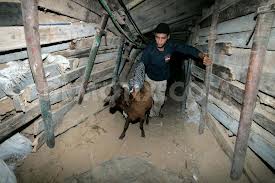 After inventing the tunnels, many people thought that Gaza became a not besieged city. Yes I can accept their opinions in that time because Gaza became free just for less than four years. But the tragic dangerous unbelievable thing is that when the Egyptians made their second revolution on 31st of June, we thought that the situations will get improved and improved. Gazawans thought that there will be a new land port for passing stuffs, and the Rafah crossing point will get opened, but alas, many people shocked of what they saw and felt. They shocked of the dangerous things that happened and are happening those days in this stricken strip. The Egyptians military destroyed about 90% of the tunnels which were the nerves of the life according to Gazans. They closed Rafah crossing point temporarily and they are planning to create a buffer zone between Gaza and Egypt…
If you my reader try to visit Gaza, you will find out the truth clearly. You will find no main food for even the little babies and the poor families. You will find neither cement nor gravels for building. There are about 60000 building workers are now without salaries and those workers have big families, so let’s say that every worker has about five organs in his family, so the average will be 300000 persons have no sources in this city. You will find many buildings which were about to be reconstructed after the war are now empty of workers. If you visit Gaza, you will find no diesel for the transportation. If I want to speak about myself, I cannot get to my university those days because there are no traffics, and even if I find a car or a bus to ride, I must pay a lot, and you can apply that on other university students.
That`s the new life in Gaza. What a harsh new life we live here in Gaza, ahhh!!…. Gaza says to herself because she does not have any friend right now to speak with, ‘’ I understand what is going on in our Egyptians neighbors and I respect what they are doing. They are my families and Egypt is my mother. They cannot be my enemies like what others say, but they must stand by me…They must stand by my nation. My people are suffering of everything. My poor people are dying. They have innocent babies who need food and milk. They have children and women cannot live without eating and drinking ‘’. And then asks herself,’’ why they do that with me? Why will they create a buffer zone? That zone just for enemies… Am I an enemy? Am I a terrorist? Am I a killer? Am I an arrogant? Am I imperious? I`m just an innocent mother wants to let her children to live in safe and sound with no problems in this holy land…
Beautiful Gaza before the siege
Done By Mohammad Arafat…
06 September 2013, 09:48:51
The Forgotten Refugees of Gaza
Palestinians I Love Your Smiling Face: You Overshadowed Gandhi by thousands miletones
Posted on August 03, 2013 by Akashma Online News

Palestinians I love your smiling Face.
I love your sweet attitude, your non violent front. You Overshadowed Gandhi by thousands milestones.
Bring it on you Cowards.
Every affront you cause to us, it is a new weapon in our arsenal.
Every insult you deliver, it is a new supporter we recruit for our fight.
Keep them coming Israel, keep digging your grave.
You’re giving the final touches for your grand Finale.
Very proud of our Palestinians brothers/sisters and its supporters taking every day blows of tear gas, dirty boots on their faces, detentions, incarcerations, torture and more.
Adalah: Legal Center for Arab Minority Rights in Israel

- Cancel the Prawer Plan
- Recognize the “unrecognized villages” and the land claims of the indigenous Arab Bedouin community
- Halt home demolitions and forced evictions
- Engage in meaningful dialogue with the Arab Bedouin community and the Arab political leadership to justly resolve the land claims
- Invest in greater health, education, and employment opportunities for Arab Bedouin citizens of Israel
Whistleblower Edward Snowden granted Asylum in Russia
Published on August 1, 2013 by Akashma Online News
UPDATED
by Marivel Guzman
published in RT
Good News for Freedom, Edward Snowden the American whistleblower leaves the transit area of Russia.
The words that shook the US on June 9, 2013 when Edward Snowden from a hotel in Hong Kong gave a video interview to Laura Poitras, who made the video public in the interest of society. She published it under the Fair Use Notice Act.
“Hello. My name is Ed Snowden. A little over one month ago, I had family, a home in paradise, and I lived in great comfort. I also had the capability without any warrant to search for, seize, and read your communications. Anyone’s communications at any time. That is the power to change people’s fates.”
This was the beginning of NSA nightmare for the US officials.
Now the waters are receding for everyone involved, but not for Edward Snowden, he still face very serious criminals charges if he ever is brought to the US.
NSA whistleblower Edward Snowden has been granted temporary asylum in Russia and is allowed to enter the country’s territory.
This move would allow him to maneuver and apply for citizenship in another country, so he can hold a passport to take a plane to fly finally to the country that offered him permanent asylum.
Good News for Snowden he is allowed to leave the transit area of the airport and finally breath some freedom, at least for now.
He is not completely free, as long as the US consider him fugitive, Snowden it is in risk of being targeted for assassination, and who knows if Israel’s Mossad will lend a hand to their financial supporters in exchange to stir the mood in the EU after they boycotted Israel economic aid against the illegal settlements. But
Knowing the shady political relations of US/Russia we are in the dark as the secret deals these two countries make in behalf of their banking masters.
For now all the eyes are in Snowden and that gives him a cloud of security. The US could not attempt a drone strike in Russian territory, it is not in its best interest, this could open up an ego wound on the pride of Russia. One thing is to have diplomatic relations on the light of the camera, but another thing is to allow US to openly brake the sovereign of Russia flying in its skies.
The whistleblower has been granted temporary political asylum in Russia, Snowden’s legal representative Anatoly Kucherena said, with his words later confirmed by Russia’s Federal Migration service.
“I have just handed over to him papers from the Russian Immigration Service. They are what he needs to leave the transit zone,” he added.
Kucherena showed a photocopy of the document to the press. According to it, Snowden is free to stay in Russia until at least July 31, 2014. His asylum status may be extended annually upon request.

With his newly-awarded legal status in Russia, Snowden cannot be handed over to the US authorities, even if Washington files an official request. He can now be transported to the United States only if he agrees to go voluntarily.
Snowden departed at around 15.30 Moscow time (11.30 GMT), airport sources said. His departure came some 30 minutes before his new refugee status was officially announced.
Article 14 of the Universal Declaration of Human Rights States:
- (1) Everyone has the right to seek and to enjoy in other countries asylum from persecution.
- (2) This right may not be invoked in the case of prosecutions genuinely arising from non-political crimes or from acts contrary to the purposes and principles of the United Nations.
His present location has not been made public nor will it be disclosed, Kucherena said.
“He is the most wanted person on earth and his security will be a priority,” the attorney explained. “He will deal with personal security issues and lodging himself. I will just consult him as his lawyer.”
Snowden eventually intends to talk to the press in Russia, but needs at least one day of privacy, Kucherena said.
The whistleblower was unaccompanied when he left the airport in a regular taxi, Kucherena added.
However, WikiLeaks contradicted the lawyer, saying the organization’s activist Sarah Harrison accompanied Snowden.
FLASH: We can now confirm that Edward Snowden’s welfare has been continuously monitored by WikiLeaks staff since his presence in Hong Kong.
— WikiLeaks (@wikileaks) August 1, 2013
Russia is confident that the latest development in the Snowden case will not affect US President Barack Obama’s upcoming visit to Moscow, presidential aide Yuri Ushakov said.
“We are aware of the atmosphere being created in the US over Snowden, but we didn’t get any signals [indicating a possible cancellation of the visit] from American authorities,” he told RIA Novosti.
Snowden, a former CIA employee and NSA contractor, came to international prominence after leaking several classified documents detailing massive electronic surveillance by the US government and foreign allies who collaborated with them.
Snowden was hiding out in a Hong Kong hotel when he first went public in May. Amidst mounting US pressure on both Beijing and local authorities in the former-British colony to hand the whistleblower over for prosecution, Snowden flew to Moscow on June 23.
Moscow was initially intended as a temporary stopover on his journey, as Snowden was believed to be headed to Ecuador via Cuba. However, he ended up getting stranded at Sheremetyevo Airport after the US government revoked his passport. Snowden could neither leave Russia nor enter it, forcing him to remain in the airport’s transit zone.
In July, Snowden applied for temporary asylum in Russia, a status that would allow him to live and work in the country for one year. Kucherena earlier said the fugitive whistleblower is considering securing permanent residency in Russia, where he will attempt to build a life.
President Nicolas Maduro said asylum would be “seriously” considered if sought. Snowden deserves a “humanitarian medal,” he added.
“If this young man is punished, nobody in the world will ever dare to tell the truth,” he stressed.
He’s a man of his word. It’s official. Maduro granted Snowden asylum. He did so on Venezuela’s Day of Independence. Global Research
Related News to Edward Snowden
AP exec editor briefs UN Security Council on protection of journalists
Posted on July 26, 2013 by Akashma Online News
Kathleen Carroll
Senior Vice President and Executive Editor
The Associated Press
Remarks on the safety of journalists worldwide
United Nations Security Council
July 17, 2013

Good morning ladies and gentlemen and thank you for the opportunity to talk about an important subject — the right of journalists around the world to work without threat or peril.
Everyone who walks into the main newsroom at AP’s global headquarters in New York passes our Wall of Honor, a softly lit display of photographs and biographies of the 31 Associated Press journalists who have died on assignment since the organization was founded 167 years ago.
I pass it every morning, frequently pausing to look at the faces of the five men killed on my watch as editor:
Nazeh Darwazeh, killed on April 19, 2003, while filming a confrontation between Israeli soldiers and Palestinians in the West Bank city of Nablus.
Saleh Ibrahim, shot to death on April 23, 2005, as he arrived to cover an explosion in the Iraqi city of Mosul.
Aswam Ahmed Lutfallah, shot to death by insurgents as he filmed their gunfight with police in Mosul on December 12, 2006.
Ahmed Hadi Naji, who left home astride his red-and-white motorbike on the way to the AP Baghdad office and disappeared. His body was found in a morgue six days later, January 5, 2007. He had been shot in the back of the head.
Anthony Mitchell, headed home to Kenya from a West Africa reporting trip when the plane he was on crashed in Cameroon on May 5, 2007, killing all aboard.
Like those five men, most of the 31 people on our wall died covering conflict, beginning with the 1876 Battle of the Little Big Horn in the United States.
They fell during the Spanish-American war in Cuba, the Russo-Japanese War, the Korean conflict and World War II – which claimed five AP journalists. Another five died in Vietnam.
Many were shot to death. In an ambush. Or a riot. Shot at a checkpoint. Captured, tortured and shot by the Nazis.
Two were attacked by mobs during civil unrest. Others were mortally wounded by mortars or shells. One went down on a warship, another on a refugee ship.
Others were lost in plane crashes or one of many helicopter crashes, including the 1993 crash in Afghanistan that took the life of the only woman on the Wall of Honor, my friend Sharon Herbaugh.
We bring visitors to the Wall of Honor and it’s important to explain why this is such a special place to us.
These people are part of our professional family. They are in my head and heart each time we send AP journalists off into the world’s many treacherous spots.
But more often, journalists aren’t heading off to an assignment in a treacherous spot. That dangerous assignment is the country they call home and the threat is not from war.
Indeed, most journalists who die today are not caught in some wartime cross-fire, they are murdered just because of what they do. And those murders are rarely ever solved; the killers rarely ever punished.
The Committee to Protect Journalists documents the attacks on journalists each year and their annual accounting is grim indeed. More than 30 journalists are murdered every year and many are abducted and tortured first.
In the overwhelming number of cases — 90 percent — the killers go unpunished. Free to attack and kill again.
CPJ has found that most murdered journalists — 5 in 6 — are killed in their own hometowns covering local stories … usually crime and corruption.
They are attacked by people who know their work, and often know them personally. The journalists are menaced, arrested, beaten again and again; their families or colleagues threatened.
The attacks frequently escalate and some journalists flee their homeland for an exile’s life.
Others are jailed, sometimes for years. Some disappear off the face of the earth.
And many — too many — turn up dead. 12 in Somalia last year alone, 5 in Pakistan, 4 in Brazil, 3 in Syria, others in Russia, Nigeria, Cambodia, Bangladesh, Thailand, Ecuador, India and the Philippines.
So why should the world’s leaders care about threats against journalists?
Many officials the world over complain that journalists are headstrong and nosy. They ask questions, they write stories and take pictures that don’t always sit well with the powerful people they cover. They aim their cameras at things some people don’t want the world to see.
Yet journalists represent the ordinary citizen … they ask questions on behalf of those people. They go to places the people cannot and bear witness. An attack on a journalist is a proxy for an attack on the people, an attack on their right to information about their communities and their institutions.
It’s true that today, a journalist’s tools are readily available to those average citizens. They have smart phones, cameras, satellite transmissions, and many make important contributions to news coverage.
Indeed, authenticated images and reports from deep inside Syria — some by average citizens, some by partisans — have contributed to the world’s understanding of the fighting in that country in the past two years.
Their work enriches what we learn about the world every day, yet the threat to them can be just as great as the threat to professional journalists.
Who will protect them?
And who will protect the reporters and photographers and editors and radio commentators and television hosts … the men and women who swallow fear every day, who constantly calculate the risks of simply doing their job, wondering if the next breath they draw will be their last.
The safety of journalists is not a political topic or a professional rallying cry for me. It is deeply personal. The journalists we have lost all left families behind, often very young children growing up with only the faintest memories of the parent who never came home.
As much as I want to, I know I cannot personally protect all the AP journalists at work in every corner of the globe. But every day, I try to do it anyway.
Because there are 31 photos on the AP Wall of Honor.
And 31 pictures is enough.
911 Maths-Slavery and the eight veils
From the December 2001 Idaho Observer:
Posted on July 24, 2013 by Akashma Online News
Slavery and the eight veils

911 Aftermath a new kind of mathematics
From the December 2001 Idaho Observer:
by Don Harkins
Over the last several years I have evolved and discarded several theories in an attempt to explain why it is that most people cannot see truth — even when it smacks them in the face. Those of us who can see “the conspiracy” have participated in countless conversations amongst ourselves that address the frustration of most peoples’ inability to comprehend the extremely well-documented arguments which we use to describe the process of our collective enslavement and exploitation. The most common explanation to be arrived at is that most people just “don’t want to see” what is really going on.
Extremely evil men and women who make up the world’s power-elite have cleverly cultivated a virtual pasture so grass green that few people seldom, if ever, bother to look up from where they are grazing long enough to notice the brightly colored tags stapled to their ears.
The same people who cannot see their enslavement for the pasture grass have a tendency to view as insane “conspiracy theorists” those of us who can see the past the farm and into the parlor of his feudal lordship’s castle.
Finally, I understand why.
It’s not that those who don’t see that their freedom is vanishing under the leadership of the power-elite “don’t want to see it” — they simply can’t see what is happening to them because of the unpierced veils that block their view.
All human endeavors are a filtration process. Sports is one of the best examples. We play specific sports until we get kicked off the playground. The pro athletes we pay big bucks to watch just never got kicked off the playground. Where millions of kids play little league each spring, they are filtered out until there are about 50 guys who go to the World Series in October.
Behind the first veil: There are over six billion people on the planet. Most of them live and die without having seriously contemplated anything other than what it takes to keep their lives together. Ninety percent of all humanity will live and die without having pierced the first veil.
The first veil: Ten percent of us will pierce the first veil and find the world of politics. We will vote, be active and have an opinion. Our opinions are shaped by the physical world around us; we have a tendency to accept that government officials, network media personalities and other “experts” are voices of authority. Ninety percent of the people in this group will live and die without having pierced the second veil.
The second veil: Ten percent of us will pierce the second veil to explore the world of history, the relationship between man and government and the meaning of self-government through constitutional and common law. Ninety percent of the people in this group will live and die without having pierced the third veil.
The third veil: Ten percent of us will pierce the third veil to find that the resources of the world, including people, are controlled by extremely wealthy and powerful families whose incorporated old world assets have, with modern extortion strategies, become the foundation upon which the world’s economy is currently indebted. Ninety percent of the people in this group will live and die without having pierced the fourth veil.
The fourth veil: Ten percent of us will pierce the fourth veil to discover the Illuminati, Freemasonry and the other secret societies. These societies use symbols and perform ceremonies that perpetuate the generational transfers of arcane knowledge that is used to keep the ordinary people in political, economic and spiritual bondage to the oldest bloodlines on earth. Ninety percent of the people in this group will live and die without having pierced the fifth veil.
The fifth veil: Ten percent of us will pierce the fifth veil to learn that the secret societies are so far advanced technologically that time travel and interstellar communications have no boundaries and controlling the actions of people is what their members do as offhandedly as we tell our children when they must go to bed. Ninety percent of the people in this group will live and die without having pierced the sixth veil.
The sixth veil: Ten percent of us will pierce the sixth veil where the dragons and lizards and aliens we thought were the fictional monsters of childhood literature are real and are the controlling forces behind the secret societies. Ninety percent of the people in this group will live and die without piercing the seventh veil.
The seventh veil: I do not know what is behind the seventh veil. I think it is where your soul is evolved to the point you can exist on earth and be the man Ghandi was, or the woman Peace Pilgrim was-people so enlightened they brighten the world around them no matter what.
The eighth veil? Piercing the eighth veil probably reveals God and the pure energy that is the life force in all living things-which are, I think, one and the same.
If my math is accurate there are only about 60,000 people on the planet who have pierced the sixth veil. The irony here is too incredible: Those who are stuck behind veils one through five have little choice but to view the people who have pierced the veils beyond them as insane. With each veil pierced, exponentially shrinking numbers of increasingly enlightened people are deemed insane by exponentially increasing masses of decreasingly enlightened people.
Adding to the irony, the harder a “sixth or better veiler” tries to explain what he is able to see to those who can’t, the more insane he appears to them.
Our enemy, the state
Behind the first two veils we find the great majority of people on the planet. They are tools of the state: Second veilers are the gullible voters whose ignorance justify the actions of politicians who send first veilers off to die in foreign lands as cannon fodder — their combined stations in life are to believe that the self-serving machinations of the power-elite are matters of national security worth dying for.
Third, fourth, fifth and sixth veilers are of increasing liability to the state because of their decreasing ability to be used as tools to consolidate power and wealth of the many into the hands of the power-elite. It is common for these people to sacrifice more of their relationships with friends and family, their professional careers and personal freedom with each veil they pierce.
Albert Jay Nock (1870-1945), author of “Our Enemy, the State” (1935), explained what happens to those who find the seventh and eighth veils: “What was the best that the state could find to do with an actual Socrates and an actual Jesus when it had them? Merely to poison one and crucify the other, for no reason but that they were too intolerably embarrassing to be allowed to live any longer.”
Conclusions
And so now we know that it’s not that our countrymen are so committed to their lives that, “they don’t want to see,” the mechanisms of their enslavement and exploitation. They simply “can’t see” it as surely as I cannot see what’s on the other side of a closed curtain.
The purpose of this essay is threefold: To help the handful of people in the latter veils to understand why the masses have little choice but to interpret their clarity as insanity; 2. To help people behind the first two veils understand that living, breathing and thinking are just the beginning and; 3. Show people that the greatest adventure of our life is behind the next veil because that is just one less veil between ourselves and God.
Video version
Facebook, Apple, Microsoft Partner With Privacy Groups To Call For NSA Transparency
Posted on July 18, 2013 by Akashma Online News
By Gerry Smith
First Published at The Huffington Post
The Huffington Post is owned by AOL, which also signed the letter and has denied knowledge of the NSA surveillance program.
A coalition of major tech companies and civil liberties groups on Thursday sent a letter to President Barack Obama calling for more transparency around a secret government program that collects private Internet and phone records.
In the letter, the companies argued that Americans “are entitled to have an informed public debate” about surveillance requests. The coalition urged the Obama administration to allow companies to report statistics about the number of national security requests they receive from government agencies for customer data.
The letter said the government should also issue its own regular “transparency report” disclosing that information.
“Basic information about how the government uses its various law enforcement–related investigative authorities has been published for years without any apparent disruption to criminal investigations,” the letter reads. “We seek permission for the same information to be made available regarding the government’s national security–related authorities.”
“This information about how and how often the government is using these legal authorities is important to the American people, who are entitled to have an informed public debate about the appropriateness of those authorities and their use,” the letter continues.
The companies addressed their petition to President Obama, Attorney General Eric Holder, NSA Director Keith Alexander, Director of National Intelligence James R. Clapper and several members of Congress. It was signed by more than 20 tech companies and more than 30 trade associations and privacy groups — including Facebook, Google, Apple, Microsoft, and the American Civil Liberties Union.
Silicon Valley and privacy groups do not always agree over privacy matters, making their partnership for the letter noteworthy. Tech companies have faced widespread criticism in recent weeks over reports that they cooperated with the government’s secret Internet spying program. Many tech giants have expressed frustration that they are prohibited by law from discussing the surveillance orders.
The nation’s largest phone companies, including AT&T and Verizon Wireless, were not part of the coalition that signed the letter and have remained quiet about their participation in the NSA surveillance program, as Time.com noted.
The letter comes amid growing calls for greater disclosure about the NSA’s collection of phone and Internet records and a push from members of Congress to scale back the surveillance program, which was disclosed last month in a series of stories in The Guardian and Washington Post.
Disclosure: The Huffington Post is owned by AOL, which also signed the letter and has denied knowledge of the NSA surveillance program.
Kidnapped for Christ-Documentary
Share from Indiegogo.com
Kidnapped for Christ Documentary looking for donations to finish the Film
Kidnapped for Christ follows the stories of several American teenagers who were taken from their homes and sent to an Evangelical Christian reform school located in The Dominican Republic known as Escuela Caribe. The school is run by Americans and is advertised as a “therapeutic Christian boarding school” whose mission is to “help struggling youth transform into healthy Christian adults.” In reality, this school employed classic brainwashing techniques to breakdown and re-build its students.
One such student was David, a gay teenager taken in the middle of the night to the Dominican Republic to be re-programmed into a straight, born-again Christian. Once David’s community found out what had happened to him, they formed a plan to bring him home on his 18th birthday. The struggles they faced to get David released revealed just how far Escuela Caribe (Caribe School) would go to prevent a student from leaving.
The Impact
This film addresses an issue that very few Americans are aware of, but that has impacted the lives of millions of adolescents and families over the past several decades – the rise of inappropriate and abusive “treatment” in the troubled teen industry. All over the US and abroad, so-called therapeutic boarding schools, boot camps, and wilderness rehabilitation programs take in teenagers with a wide range of issues and use unsafe and often harmful tactics to reform them. Using positive façades, religious affiliations, and substantial amounts of money, many such camps and schools have committed inappropriate and abusive acts behind their guarded walls for decades with impunity.
Few journalists or law enforcement agencies have investigated the considerable number of abuse allegations and even deaths arising from these types of programs. No one has been able to comprehensively document on film what goes on behind closed gates at any of these institutions – until now.
Kidnapped for Christ will tell the stories of students who were sent to one of many similar institutions, so that they may make people aware of the danger these programs constitute for our youth.
Evangelical Christian group admits homosexuality can’t be ‘cured’
The former leader of Exodus International, which had touted a ‘cure’ for homosexual attraction, has himself admitted to same-sex attraction.
“I am sorry that some of you spent years working through the shame and guilt you felt when your attractions didn’t change,” he wrote on June 19. “I am sorry we promoted sexual orientation change efforts and reparative theories about sexual orientation that stigmatized parents. I am sorry that there were times I didn’t stand up to people publicly ‘on my side’ who called you names like sodomite – or worse.” Alan Chambers
We were all monitored closely, but a gay student was always under a microscope. I learned this the hard way. On a rare free day I was playing monopoly with several students; my back hurt. Using a machete to cut grass will do that. One of my housemates started giving me a shoulder massage. Immediately, veteran students around us reported this to our house staff. For the next 20 minutes I was yelled at and berated by a staff person for touching a gay student. He couldn’t understand how I could let someone so filthy touch me. I remember the loathing and hate that was in his voice. I remember him saying, “If you only knew who he was you never would have let him touch you.” My punishment was swats on the ass with a leather strap, administered by a 30-something male staff member with others watching. My housemate’s were much worse. Former student of Escuela Caribe
BRAZIL: Evangelicals Force Approval Of Bill Legalizing “Gay Cure” Therapy
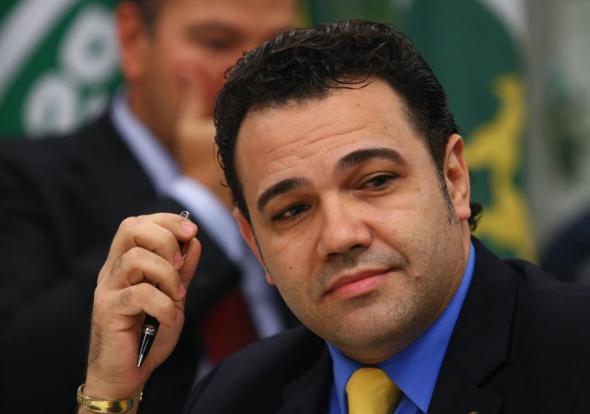
Brazil outlawed “ex-gay” therapy in 1999, but yesterday a congressional commission approved lifting that ban after pressure from evangelicals.
The commission is led by evangelical pastor Marco Feliciano of the Social Christian Party (JMG: above), who has been accused of homophobia and enraged activists by calling AIDS a “gay cancer” in a tweet. His appointment as head the Commission for Human Rights and Minorities in the lower house of Brazil’s Congress was fiercely opposed by gay and human rights groups. “In practice, (the initiative’s) result would be that a person over 18 years of age, responsible for his actions, who is homosexual and wants to reorient his sexuality, can be attended by a psychologist,” said lawmaker Joao Campos, a member of the evangelical bloc of Brazil’s lower house.
The bill must now be approved by other committees in the House of Deputies as well as the Senate.
What We Need
FINISHING FUNDS – Since our last fundraising campaign we have been able to complete the remaining interviews and shoots we needed to get a rough cut of the film done. Now we need funds to complete post production on the film. This includes funds to pay for editing, sound mixing, music composition, color correction, graphics and titles and deliverable for film festivals. Everyone working on this film so far has done so on their own time and without a salary because we all believe in this project, but there comes a point where we need to hire people in order to get the film done well – that’s why we are fundraising again.
Other Ways You Can Help
Spread the word to all your friends and family! Tell your rich uncles, neighbors, yoga instructors, baristas, dog walkers, and blind dates to check out the website and donate even a small amount. If everyone who watched the trailer on You Tube gave just $5 dollars we’d have more than enough funds to finish the film. If you want to see the film donate a little money so we can finish it for you 🙂
Also, if you are a former student of Escuela Caribe or a similar school or camp, we would love to hear your stories. You can contact us at http://www.kidnappedforchrist.com/#!contact.
Donations are tax-deducible through our fiscal sponsor, the International Documentary Association. They also make sure we spend the money according to the budget for the film we submitted to them, so there’s an extra layer of accountability – you can rest assured that your hard earned money is going towards completion of this film and not our bar tabs.
Your donation is tax deductible!!! Kidnapped For Christ is a fiscally sponsored project of the International Documentary Association (IDA), a 501(c)(3) nonprofit organization. Contributions on behalf of Kidnapped For Christ are payable to IDA and are tax deductible less the value of any goods or services received, as allowed by law. The value of goods and services being offered is noted under each donation level. If you would like to deduct the entire donation you have the option to simply decline the reward at check out.
EU consuls recommend imposing sanctions on Israeli settlements
Nonbinding Heads of Mission report for 2012 focuses on Israeli construction in E-1, policy in East Jerusalem and endangering of two-state solution; call to actively encourage European divestment from settlements is particularly severe.

Among the recommendations made in the nonbinding Heads of Mission report for 2012, which has been obtained by Haaretz, is to “prevent, discourage and raise awareness about problematic implications of financial transactions including foreign direct investments, from within the EU in support of settlement activities, infrastructure and services.”
Seven of the report’s 10 recommendations deal with imposing direct or indirect sanctions by the European Union on bodies and organizations involved in construction in the settlements. The recommendation to actively encourage European divestment from the settlements is particularly severe, compared with previous internal EU reports.
The consuls recommend that the EU ensure strict application of the free trade agreement between the EU and Israel so that products manufactured in settlements do not benefit from preferential treatment. Another clause recommends encouraging efforts to enforce existing legislation requiring products made in the settlements to be labeled as such at sales points.
Efforts must be made to “ensure that imports of settlement products do not benefit from preferential tariffs and guarantee the consumers’ right to an informed choice” with regard to the origin and labeling of products, the report states. The annual mission report, which is written by all the heads of diplomatic missions of EU member states in the Palestinian Authority, does not compel practical steps, but serves as a basis for internal discussions of the Israel-Palestinian situation.
The 2012 report, which was handed in early January to the EU institutions in Brussels and to the foreign ministries of the 27 member states, also advocates closer supervision of cooperative programs between the EU and Israel with regard to technological research and development to ensure that no research grants, scholarships or other technological investments assist settlements, either directly or indirectly.
The diplomats gave the example of Israel’s participation in a cooperative program called Horizon 2020, through which the EU invests hundreds of millions of euros in Israeli high-tech firms. They noted that some of this funding goes to firms like the research laboratories of the cosmetics company Ahava, which are located in the Jordan Valley kibbutz Mitzpeh Shalem, near the Dead Sea. If the EU consuls’ recommendations are accepted, such investments will stop, since the kibbutz is seen as a settlement.
The report takes Israel to task over the decision to move ahead on construction plans in Area E-1, the corridor meant to link Jerusalem to the nearby West Bank settlement of Ma’aleh Adumim. The decision was made in late November, after the Palestinians’ statehood bid in the United Nations. The implementation of the E-1 project “threatens 2,300 Bedouin with forcible transfer” and “would effectively divide the West Bank into separate northern and southern parts,” the report states, adding that it would also “prevent Palestinians in East Jerusalem from further urban development and cut off East Jerusalem from the rest of the West Bank.”
The consuls recommend to the EU member states to “coordinate EU monitoring and a strong EU response in order to prevent settlement construction in E1, including opposing forced transfer of the Bedouin communities in E1.”
The consuls state that the continuation of Israel’s policy in East Jerusalem could thwart the possibility of the city serving as the Israeli and Palestinian capital and therefore put the entire two-state solution at risk.
According to the report, Israel is “systematically undermining the Palestinian presence” in Jerusalem, through policies including “restrictive zoning and planning, demolitions and evacuations, discriminatory access to religious sites, an inequitable education policy, difficult access to health care, the inadequate provision of resources.”
A large portion of the report deals with Israeli restrictions on Muslim and Christian religious practice in Jerusalem and accuses Israel of attempting to change the character of Jerusalem as a city sacred to the three faiths. The Israeli government “selectively enforces legal and policy restrictions on religious freedoms and on access in particular for Christian and Muslim worshippers to their holy sites in Jerusalem/Old City,” the report states.
The consuls direct special attention to the cooperation between the right-wing group Elad and the Israel Antiquities Authority, determining that the purpose of this collaboration is to promote “a partisan historical narrative, placing emphasis on the biblical and Jewish connotations of the area while neglecting the Christian/Muslim claims of historic-archaeological ties to the same place.”
The authors said it seems that an attempt is being made to use archaeology to erase Muslim and Christian connections to the city, and that the “overreaching purpose of such a pre-programmed approach to the presence of archaeological evidence in the area seems to be a concerted effort by pro-settler groups to use archaeology to enhance an exclusively Jewish narrative on Jerusalem.”
The consuls say 2012 saw a rise in the number of violent incidents on the Temple Mount and a sharp increase in “the frequency and visibility of visits by Jewish radical political and religious groups, often in a provocative manner.” According to the report, the Palestinians fear that Israel is trying to change the status quo on the Temple Mount and create “Hebronization” there by arrangements similar to those in force at the Tomb of the Patriarchs in Hebron.
In the report the consuls say that construction of Jewish neighborhoods in East Jerusalem is “systematic, deliberate and provocative” and presents as an example Israel’s announcement that 3,000 new housing units were approved by the government, a statement that came shortly after the Palestinians had their UN status upgraded to non-member observer state.
The consuls noted in particular three construction plans they view as problematic: the eastward expansion of the Jerusalem neighborhood of Har Homa, the southward and westward expansion of Gilo and housing construction in the Givat Hamatos neighborhood in between.
“The construction of these three settlements is part of a political strategy aiming at making it impossible for Jerusalem to become the capital of two states,” the report states.
Related articles on Israel Illegal settlements
 50 9 152 10 25 26
EU diplomats propose boycotts, divestment, and sanctions against Israeli colonialism

The Israeli settlement of Har Homa overlooking Bethlehem. (Photo: IMEMC)
A report sent to the European Union on Monday by its member countries’ top diplomats in Jerusalem and Ramallah proposed state-level boycotts, divestment, and sanctions against Israel’s illegal colonial infrastructure in the occupied West Bank. These recommendations, unprecedented among Western nations, herald a breakthrough for the growing Boycott, Divestment, and Sanctions (BDS) movement.
Like most efforts opposing only the West Bank settlements, they appear somewhat myopic about the state policies of ethnic cleansing and apartheid that stand squarely behind settlers’ walls and guns, while also denying refugees their homes and Palestinian citizens of Israel equality under its laws. But high-level backing for even modest steps can afford many new opportunities.
The European Commission should consider passing legislation to prevent finance generated within its member states being used to support illegal Israeli settlements in occupied territory, the bloc’s top diplomats in Jerusalem and Ramallah have advised …
The finance recommendation has been worded with deliberate vagueness to maintain a consensus among sharply differing views within the EU. But the clear implication is that some of the European Consuls General – ambassador-rank representatives to the Palestinians – want the Commission to consider for the first time whether it has an obligation to legislate on the grounds that the settlements contravene international law.
Under one interpretation of the proposal, the Commission would use legislation to force companies in Europe to break their links with businesses involved in settlement construction and commercial activities. This follows some high-profile voluntary examples like that of Deutsche Bahn, which last year pulled out of electrification of the Tel Aviv-Jerusalem rail link because it cut through the West Bank.
The Guardian says that the document
calls on the European commission to consider legislation “to prevent/discourage financial transactions in support of settlement activity”.
Legislation should prohibit trade and business with settlements based on their illegality under international law, rather than a politically-driven boycott, said one EU diplomatic source.
And Ynetnews panics:
The recommendations include the preparation of a “blacklist” of settlers considered violent, in order to later mull the option of banning them from entering the European Union. The document also seeks to encourage more PLO activity and representation in east Jerusalem.
Moreover, the European report advises senior EU figures visiting east Jerusalem to refrain from being escorted by official Israeli representatives or security personnel.
A Western diplomat told Ynet that the Europeans are well aware of the implications of the latest recommendations.
Talk is cheap, of course. But careful organizing and determined action by Palestinians and solidarity activists could make the next steps quicker and more comprehensive. Whatever we think of the two-state “solution” these proposals aim to bolster, they offer us a valuable new arsenal in the struggle against Israeli apartheid.
And speaking of a two-state resolution to Israel’s 63-year occupation of Palestinian land, and ongoing displacement and subjugation of its indigenous people, it appears that these same diplomats, many of whom have spent their lives pursuing it, are nearing despair as its infeasibility becomes undeniable. In an article provocatively entitled “EU on verge of abandoning hope for a viable Palestinian state,” The Independent says:
The Palestinian presence in the largest part of the occupied West Bank – has been, “continuously undermined” by Israel in ways that are “closing the window” on a two-state solution, according to an internal EU report seen by The Independent …
With the number of Jewish settlers now at more than double the shrinking Palestinian population in the largely rural area, the report warns bluntly that, “if current trends are not stopped and reversed, the establishment of a viable Palestinian state within pre-1967 borders seem more remote than ever” …
The 16-page document is the EU’s starkest critique yet of how a combination of house and farm building demolitions; a prohibitive planning regime; relentless settlement expansion; the military’s separation barrier; obstacles to free movement; and denial of access to vital natural resources, including land and water, is eroding Palestinian tenure of the large tract of the West Bank on which hopes of a contiguous Palestinian state depend …
Area C is one of three zones allocated by the 1993 Oslo agreement. Area A includes major Palestinian cities, and is under the control of the Palestinian Authority. Area B is under shared Israeli-Palestinian control.
Although Area C is the least populous, the report says “the window for a two-state solution is rapidly closing with the continued expansion of Israeli settlements and access restrictions for Palestinians in Area C [which] compromises crucial natural resources and land for the future demographic and economic growth of a viable Palestinian state”.
It says the EU needs “at a political” level to persuade Israel to redesignate Area C, but in the meantime it should “support Palestinian presence in, and development of the area”. The report says the destruction of homes, public buildings and workplaces result in “forced transfer of the native population” and that construction is effectively prohibited in 70 per cent of the land – and then in zones largely allocated to settlements of the Israeli military.
While predictably mincing words, the diplomats’ statements coincide with King Abdullah of Jordan, Israel’s last ally in the region, dropping the a-bomb to The Washington Post:
If we haven’t crossed that line, we’ll cross the line sooner or later where the two-state solution is no longer possible, at which point the only solution is the one-state solution. And then, are we talking about apartheid or democracy?
The French parliament’s Foreign Affairs Committee also accused Israel of using water as “a weapon serving the new apartheid” two weeks ago. And all of this comes shortly after Israel’s public condemnation by every bloc of the United Nations Security Council – with the predictable exception of the United States – in December.
As the one-state reality seeps into the world’s consciousness, we can expect increasing numbers of Israel’s current allies to slowly inch – or, perhaps, quickly run – away from it. These developments offer a moment of opportunity, for Palestinians and all supporters of human equality. What can we do but try to make use of it?

{ 5 comments… read them below or add one }
-
 FreddyV says:
I don’t see why people say the 2SS is no longer viable.
’67′ borders. Kick the settlers out. Address the right to return issue. Done.
I see a 1SS as far less viable with the ingrained racism and mutual distrust. You’ll end up with rich Jews buying land from vulnerable Palestinians.
It’ll be like going back to the early 20th Century.
In asking for a One State Solution, you’re asking for a bunch of megalomaniacs with a serious God complex to treat other people equally. That isn’t going to happen and given the ingrained indoctrination they’ve had and total belief that God gave them that land, I think it’s safe to say that as long as my bumhole points downwards, that isn’t going to change.
The reality will be that Gaza will be Palestine.
-
pabelmont says:
FreddyV says it all when he says: “I don’t see why people say the 2SS is no longer viable. ’67′ borders. Kick the settlers out. Address the right to return issue. Done.”
The EU should lead the way to [1] make the same demand agin, today, w.r.t. to today’s much worse situation and [2] to impose such sanctions as seem proper to achieve this.
But we must also call for removal of the wall, lifting the siege of Gaza, renmoval of internal check-points. And as FreddyV says, address the question of “return”. To this list one must add, equitable sharing of water.
-
Peacefan says:
What’s incredible is that there is not mention of this in French speaking medias. At the exception of the assembly report on water, nothing, neither in left nor right press.
-
Justice Please says:
I appreciate the effort by those diplomats. Unfortunately, mainstream politicians and media figures in the key EU countries (Germany, France, UK) are just as uncapable of treating Israel as they would have treated South Africa as are their counterparts in the US.
60,000 Congolese flee to Uganda after rebel attack
Posted on July 14, 2013 by Akashma Online News
KAMPALA, Uganda (AP) — An aid group says about 60,000 Congolese have fled to Uganda after a rebel attack on a town by the border, stretching humanitarian capacities.
Catherine Ntabadde of the Uganda Red Cross said Sunday that her organization had already registered 41,000 refugees and that 20,000 more are yet to be registered.
The refugee influx continues three days after a Ugandan-led rebel group attacked the Kamango town and killed some people on Thursday, according to Ugandan military officials.
That group —the Allied Democratic Forces —had been hibernating in the jungles of eastern Congo for years since a military assault ousted it from Ugandan territory. It was formed in the early 1990s by Ugandan Muslims who want to install Shariah law in Uganda and who staged deadly terrorist attacks in the 1990s.
Thousands of people have fled the Democratic Republic of Congo after a group of Ugandan rebels attacked a border town, aid workers say.
The Allied Democratic Forces raided the town of Kamango on Thursday, according to the Ugandan army spokesman.
At least 18,000 people have crossed into Uganda, the Red Cross has said.
The ADF is based in mineral-rich eastern DR Congo, where numerous armed groups have caused havoc over the past two decades.
Uganda army spokesman Lt Col Paddy Ankunda told the AP news agency that some people had been killed in the attack but did not give any further details.
The rebels kidnapped some people, including a local chief, as they withdrew from the town, local media report.
The ADF was formed in 1996 by a puritanical Muslim sect in the Ruwenzori mountains of western Uganda.
In 1998 it increased its activities and a number of bomb blasts in markets and restaurants in Kampala were blamed on the group.
After years of sporadic raids, the Ugandan army almost destroyed the ADF’s capacity in 2004 and it moved into DR Congo.
However, a United Nations report last year said the rebels had expanded their military capacity and established links with Somalia’s al-Shabab militants.
More than 30,000 people have fled their homes in the Democratic Republic of Congo (DRC) and crossed into neighbouring Uganda after a rebel group that had been hiding out in eastern Congo attacked a town.
Families streamed across a bridge over a river near the border, clutching belongings. Some carried firewood over their heads, many brought livestock and women held small babies.
Al Jazeera’s Malcolm Webb, reporting from the Ugandan side of the border on Friday, said people were so desperate to escape that some ignored the bridge and waded through the river.
Video of Refugees fleeing Congo
Congolese fleeing to Uganda top 55,000: Red Cross
-

Refugees from the Democratic Republic of Congo wait after crossing into western Uganda at the Busunga border post on July 13, 2013. More than 55,000 people have arrived in Uganda after fleeing a rebel attack, Red Cross officials say, a dramatic rise from earlier estimates. (AFP)
-

Refugees from eastern Democratic Republic of Congo arrive at the Busunga border in western Uganda on July 13, 2013. More than 55,000 people have arrived in Uganda after fleeing a rebel attack, Red Cross officials said, a dramatic rise from earlier estimates. (AFP)
BUNDIBUGYO, Uganda (AFP) – More than 55,000 refugees from eastern Democratic Republic of Congo have arrived in Uganda after fleeing a rebel attack, Red Cross officials said on Sunday, a dramatic rise from earlier estimates.
“Given such numbers there is need for urgent humanitarian assistance, as some of the refugees are sick and have left all their belongings in Congo,” Uganda Red Cross official Catherine Ntabadde told AFP.
Read Congo invasion(s) and Colonization(s) : U.S. Military and Corporate Recolonization of the Congo
This is Trayvon Martin lifeless body-Not just another black kid
This, Courtesy of MSNBC, Is Trayvon Martin’s Dead Body. Get Angry.
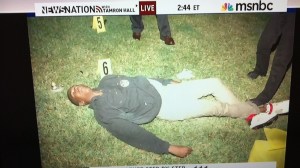
Trayvon Martin Lifeless body
A reader of mine sent me this photo last night. As the murder trial of George Zimmerman wheezes to its conclusion, the TV networks dutifully pipe in live pool video from the courtroom, as if it is force-fed to them and they have no choice but to excrete it, soft and undigested, into our living rooms, bedrooms, offices. Sometimes, the pool recorder or the networks’ producers don’t switch to a mundane image of lawyers being lawyerly quite fast enough, and we get to see snippets of the human cruelty, stupidity, and frailty that occasion trials such as this.
This is Trayvon Martin’s body. These are the last skinny jeans he wore, cuffed once at the bottoms. These are his stylish kicks, his sockless ankles. There are Trayvon’s taut neck, his slack jaw, his open eyes.
This is what happens. Not just when we input “black” and “teen” and “hoodie” and “night” into our onboard computers and output “DANGER,” but also when we find the aftermath Newsworthy, and must consume it voraciously from start to finish, but insist that we cannot stomach seeing the bones and gristle on our plates.
This image has made its way to the internet on message boards and the like, but not on any notable sites that I could find. The Huffington Post and others have published some images of Martin’s body—covered by a sheet—but none of his face.
I had a brief conversation by email and phone last night with the reader who wanted to send this to me, who felt compelled to save it, but seemed unsure why he had. Before he’d shared the image, I asked him what it showed. Was it newsworthy? He stammered. “It’s… a dead black kid,” he said, disturbed, hoping five words could convey many more. In email, he’d asked me: “What will you do with pic?”
To Trayvon’s parents, Sabrina Fulton and Tracy Martin, I’m sorry that I feel compelled to share this photograph. Were I a slave to journalistic norms, I would say that it’s somehow in the public interest to see him there. I would point out Florida’s sunshine laws, and the TV network’s incompetence, and argue the inevitability that this image would’ve gained a wider audience than it has already.
But those are rationalizations. They don’t explain my motive: Good old-fashioned rage that this kid is dead because my home state empowered a dullard aficionado of Van Damme and Seagal movie cliches to choose his own adventure. Florida literally gave George Zimmerman license to make up neighborhood threats and invite violent confrontations, confident in the knowledge that he carried more firepower jammed down his sweaty fat waistband than every army on earth beheld before 1415.
I wish I were a better person than that, but I’m not. People come up short all the time, after all. I suppose it’s a good thing I don’t have a gun.
Re-Shared from Gawker.com
Gawker contributor Adam Weinstein is a Florida-based writer and editor. You can reach him via adamweinsteinwriter.com.
Florida jury finds George Zimmerman not guilty
Posted on July 13, 2013 by Akashma Online News
Florida Jury set a new precedent for Justice finding George Zimmerman not guilty of second degree murder
By Ellen Wulfhorst
SANFORD, Florida | Sat Jul 13, 2013 10:50pm EDT
(Reuters) – A Florida jury on Saturday found George Zimmerman not guilty in the shooting death of unarmed black teenager Trayvon Martin, in a case that sparked a national debate on race and guns.
The panel of six women deliberated more than 16 hours over two days until nearly 10 p.m. on Saturday (0200 GMT Sunday) before delivering the verdict, which drew immediate condemnation from some civil rights groups.
Zimmerman appeared stoned-faced as the verdict was announced, but then showed a slight smile of relief. His parents embraced each other and his wife was tearful.
Zimmerman, 29, said Martin, 17, attacked him on the night of February 26, 2012, in the central Florida town of Sanford. Prosecutors contend the neighborhood watch coordinator in his gated community was a “wannabe cop” who tracked down the teenager and shot him without justification.
The jury could have convicted him of second-degree murder or manslaughter.
“Today, justice failed Trayvon Martin and his family,” Roslyn M. Brock, chairman of the National Association of Colored People, said in a statement.
“We call immediately for the Justice Department to conduct an investigation into the civil rights violations committed against Trayvon Martin. This case has re-energized the movement to end racial profiling in the United States.”
The news also drew angry shouts from some of the dozens of demonstrators who had gathered outside the courtroom during the day in support of Martin’s family. His parents were not in the court during the reading of the verdict.
Civil rights leader Jesse Jackson tweeted within minutes of the acquittal: “Avoid violence, it will lead to more tragedies. Find a way for self construction not deconstruction in this time of despair.”
What happened in Sanford that February night may never have gone beyond the back pages of a local newspaper if police had immediately arrested Zimmerman.
But he walked free for more than six weeks after the shooting, because police believed his claim of self-defense, triggering protests and cries of injustice across America.
It also drew comment from President Barack Obama, forced the resignation of Sanford’s police chief, and brought U.S. Justice Department scrutiny to this town of 54,000 residents not far from Disney World in Orlando.
(Additional reporting by Tom Brown in Miami and Barbara Liston in Sanford; Editing by Dina Kyriakidou and Peter Cooney)
Edward Snowden Statement 11 a:m, according to WikiLeaks Team
Update 11 a.m.: Here’s the transcript of Snowden’s remarks,
Hello. My name is Ed Snowden. A little over one month ago, I had family, a home in paradise, and I lived in great comfort. I also had the capability without any warrant to search for, seize, and read your communications. Anyone’s communications at any time. That is the power to change people’s fates.
It is also a serious violation of the law. The 4th and 5th Amendments to the Constitution of my country, Article 12 of the Universal Declaration of Human Rights, and numerous statutes and treaties forbid such systems of massive, pervasive surveillance. While the US Constitution marks these programs as illegal, my government argues that secret court rulings, which the world is not permitted to see, somehow legitimize an illegal affair. These rulings simply corrupt the most basic notion of justice – that it must be seen to be done. The immoral cannot be made moral through the use of secret law.
I believe in the principle declared at Nuremberg in 1945: “Individuals have international duties which transcend the national obligations of obedience. Therefore individual citizens have the duty to violate domestic laws to prevent crimes against peace and humanity from occurring.”
Accordingly, I did what I believed right and began a campaign to correct this wrongdoing. I did not seek to enrich myself. I did not seek to sell US secrets. I did not partner with any foreign government to guarantee my safety. Instead, I took what I knew to the public, so what affects all of us can be discussed by all of us in the light of day, and I asked the world for justice.
That moral decision to tell the public about spying that affects all of us has been costly, but it was the right thing to do and I have no regrets.
Since that time, the government and intelligence services of the United States of America have attempted to make an example of me, a warning to all others who might speak out as I have. I have been made stateless and hounded for my act of political expression. The United States Government has placed me on no-fly lists. It demanded Hong Kong return me outside of the framework of its laws, in direct violation of the principle of non-refoulement – the Law of Nations. It has threatened with sanctions countries who would stand up for my human rights and the UN asylum system. It has even taken the unprecedented step of ordering military allies to ground a Latin American president’s plane in search for a political refugee. These dangerous escalations represent a threat not just to the dignity of Latin America, but to the basic rights shared by every person, every nation, to live free from persecution, and to seek and enjoy asylum.
Yet even in the face of this historically disproportionate aggression, countries around the world have offered support and asylum. These nations, including Russia, Venezuela, Bolivia, Nicaragua, and Ecuador have my gratitude and respect for being the first to stand against human rights violations carried out by the powerful rather than the powerless. By refusing to compromise their principles in the face of intimidation, they have earned the respect of the world. It is my intention to travel to each of these countries to extend my personal thanks to their people and leaders.
I announce today my formal acceptance of all offers of support or asylum I have been extended and all others that may be offered in the future. With, for example, the grant of asylum provided by Venezuela’s President Maduro, my asylee status is now formal, and no state has a basis by which to limit or interfere with my right to enjoy that asylum. As we have seen, however, some governments in Western European and North American states have demonstrated a willingness to act outside the law, and this behavior persists today. This unlawful threat makes it impossible for me to travel to Latin America and enjoy the asylum granted there in accordance with our shared rights.
This willingness by powerful states to act extra-legally represents a threat to all of us, and must not be allowed to succeed. Accordingly, I ask for your assistance in requesting guarantees of safe passage from the relevant nations in securing my travel to Latin America, as well as requesting asylum in Russia until such time as these states accede to law and my legal travel is permitted. I will be submitting my request to Russia today, and hope it will be accepted favorably.
If you have any questions, I will answer what I can.
Thank you.
This post has been updated with additional information as it became available.
Edward Snowden Has Accepted Russian Asylum Offer
Published on July 13, 2013 by Akashma Online News
Snowden will have to agree not to continue releasing documents harmful to the US.

Photo Credit: Tanya Lokshina / Human Rights Watch
This article was originally published by This Can’t Be Happening.
Edward Snowden, the bete noir of the US national security state, who has leaked information that the National Security Agency is spying on all electronic communications of Americans, and on hundreds of millions of others around the globe, as well as on the leaders and the embassies of even many US allies, is accepting an offer of political asylum that has been extended by Russia, where he has been spending weeks in limbo in Moscow’s Sheremetyevo Airport, unable to fly to asylum elsewhere because of heavy-handed US pressure.
According to an RT-TV report [1], Snowden, in accepting the Russian offer, will have to abide by a condition set by Russian President Vladimir Putin that he not continue releasing documents harmful to the US.
This deal leaves a lot of questions unanswered:
First of all, Snowden has already turned over a huge trove of information to reporters at the Washington Post and the Guardian newspaper in the UK, as well as lesser amounts of documents to Der Spiegel magazine in Germany and to other publications in other countries. It would appear that he can no longer control, at this point, whether or not those news organizations continue to publish articles based on the documents in their possession, It is also unclear what the Russian government response would be concerning Snowden’s protected status should any of those organizations, as is likely, continue to publish embarrassing or damaging disclosures about the NSA. Asked by reporters at an airport press conference whether he would continue to release details about the NSA himself while in Russia, Snowden’s answer was simple: “My job is done.” That “job,” though, was providing the leaked information to reporters. Snowden himself has not publicly disclosed the information.
Snowden also correctly pointed out the distinction between “damaging America,” and exposing the NSA. “No actions I take or plan are meant to harm the US… I want the US to succeed,” he said in answer to a question. Would Putin consider further leaks about the US government’s spying on its own citizens “damaging” to America? Open question.
Liveleak.com video of Friday’s Snowden press conference for Right Group Activists in Moscow airport
In any event, Putin has made clear that Russia would never extradite Snowden. As he put it, “Russia has never extradited anyone and is not going to do so. Same as no one has ever been extradited to Russia.” Besides, the cat’s already out of the bag, in terms of the big revelations Snowden made public.
The RT-TV report also suggests that Snowden and Russia may be looking at the asylum situation there as less than a lifetime arrangement. It appears to be a way for Russia to get him out of the airport, into Russia, to further tweak the US, and to put Snowden in an official status where he could be provided with travel documents as a matter of course, as would an asylum grantee in the US
This could enable him to quietly leave Russia later for another location after some time has passed. The RT story significantly quotes Tatyana Lokshina of Human Rights Watch as saying Snowden is seeking to stay in Russia because he “can’t fly to Latin America yet.”
Three Latin American countries so far–Venezuela, Bolivia and Nicaragua– have offered Snowden asylum without conditions, but he has been unable to safely travel to any of them, given the already demonstrated US threat to force his plane to land. (American authorities exerted pressure on French, Portuguese, Italian and Spanish governments to refuse their airspace, in violation of international law, to a presidential plane carrying Bolivia’s leader, Evo Morales, to fly home from a state visit to Russia, forcing it to land in Austria, where the government was pressed to illegally inspect the plane, which the US incorrectly suspected was transporting Snowden to asylum in Bolivia.) At the airport conference, Snowden said he had accepted all three of those offers of asylum, as well as Russia’s. “I announce today my formal acceptance of all offers of support or asylum I have been extended and all others that may be offered in the future,” Snowden said, after meeting with human rights lawyers earlier.
Second Part of the Original Video made public by The Guardian
Glenn Greenwald: “Snowden has information for more damage”
Published on July 13, 2013 by Akashma Online News
The journalist who received the leaks from the CIA Mole said there are more documents
By Alberto Armendariz | LA NACION
RIO DE JANEIRO. – Smoke and Mirrors. With his striped bathing suit, his white sandals, his jean jacket and a backpack, Glenn Greenwald seems like a tourist walking along the promenade of Sao Conrado, Rio de Janeiro. But it is the journalist, blogger and columnist for the British newspaper The Guardian who surprised the world with revelations about the extensive network of U.S. cyber espionage that was leaked by Edward Snowden, former intelligence analyst for the National Security Agency (NSA ).
“Snowden has enough information to cause more damage to the U.S. government in a minute alone than anyone else has ever had in the history of the United States,” Greenwald, 46, told LA NACION, and since living in these latitudes writes regularly on international security issues which has made him famous, winner of several distinguished awards.
Today, the New Yorker, a former lawyer, is in the eye of the storm. Lawmakers in Washington want to put him on trial, spies of various countries seek Snowden’s secret information shared with him last month in Hong Kong and which he still sends from Moscow through an encrypted email system. He knows he’s being watched and that their conversations are monitored. They even steal the laptop from her boyfriend Rio, from their own home.
Three men wait in the lobby of the hotel Royal Tulip with credentials of a congress of osteoporosis about which the manager has no idea. Are they really doctors or are following Greenwald? Appearances are deceptive.
– Does Snowden’s decision to stay in Russia help him come to Latin America?
– Yes, the most important thing is not to end in U.S. custody, which proved extremely vindictive government to punish those who reveal uncomfortable truths, and in whose judicial system can not be trusted when it comes to people accused of endangering the national security. The judges do everything they can to secure convictions in these cases. He would be immediately put in prison to cover the debate that he helped generate, and end the rest of his days behind bars.
– Does Russia give him security guarantees?
– Not many countries in the world that have the ability and willingness to defy U.S. demands. But Russia is one of those countries and it has been good so far.
– Beyond the revelations about the spying system’s performance in general, what other information does Snowden have?
– Snowden has enough information to cause more damage to the U.S. government in a minute alone than anyone else has ever had in the history of the United States. But that’s not his goal. His objective is to expose software that people around the world use without knowing that they are exposing themselves without consciously agreeing to surrender their privacy rights. He has a huge number of documents that would be very harmful to the U.S. government if they were made public.
– Are you afraid that someone will try to kill him?
– It’s a possibility, although it would not bring many benefits to anyone at this point. Thousands of documents are already distributed and to make sure that several people around the world have the entire file. If something were to happen, those documents would be made public. This is an insurance policy. The U.S. government should be on its knees every day praying that nothing happens to Snowden, because if something happens, all the information will be revealed and that would be their worst nightmare.
– Can Latin America be a good shelter for Snowden?
– Only a few countries, including several in Latin America, China and Russia, have challenged the U.S., and have realized that America is no longer in a position of strength as it did before with the rest of the world, and that the rest of the countries do not have to obey its demands as if it were an imperial order. In Latin America there is a feeling of natural sympathy for the United States, yet there is a great resentment for specific historical policies of Washington toward the region. What happened to the plane of Evo Morales in Europe caused a strong reaction, was treated as if Bolivia was a colony and not a sovereign state.
– From documents Snowden shared with you, is there much more information related to Latin America?
– Yes. For each country that has an advanced communications system, such as from Mexico to Argentina, there are documents that detail how the United States collects traffic information, the programs that are used to capture the transmissions, the number of interceptions that are performed per day, and more. One way to intercept communications is through a telephone corporation in the United States that has contracts with telecommunications companies in most Latin American countries. The important thing will be to see the reaction of the various governments. I do not think that the governments of Mexico and Colombia will do much about it. But maybe those of Argentina and Venezuela will be willing to take action.
Glenn Greenwald / Columnist, The Guardian
Profession: Journalist
Age: 46 years
Origin: United States
Revealed: how Microsoft handed the NSA access to encrypted messages
Posted on July 11, 2013 by Akashma Online News

Hours after CNBC reported that ValueAct Capital Management threw nearly $2 billion into Microsoft Corporation, April 22, 2013
ValueAct Capital, LLC is a San Francisco based hedge fund. The firm offers its services to high net worth individuals and institutions while investing in the public equity and hedging markets of the United States.
• Files released show scale of Silicon Valley co-operation on Prism
• Outlook.com encryption unlocked even before official launch
• Skype worked to enable Prism collection of video calls
• Company says it is legally compelled to comply
Microsoft has collaborated closely with US intelligence services to allow users’ communications to be intercepted, including helping the National Security Agency to circumvent the company’s own encryption, according to top-secret documents obtained by the Guardian.
The files provided by Edward Snowden illustrate the scale of co-operation between Silicon Valley and the intelligence agencies over the last three years. They also shed new light on the workings of the top-secret Prism program, which was disclosed by the Guardian and the Washington Post last month.
The documents show that:
• Microsoft helped the NSA to circumvent its encryption to address concerns that the agency would be unable to intercept web chats on the new Outlook.com portal;
• The agency already had pre-encryption stage access to email on Outlook.com, including Hotmail;
• The company worked with the FBI this year to allow the NSA easier access via Prism to its cloud storage service SkyDrive, which now has more than 250 million users worldwide;
• Microsoft also worked with the FBI’s Data Intercept Unit to “understand” potential issues with a feature in Outlook.com that allows users to create email aliases;

Skype has been acquired by Microsoft for a whopping $8.5 billion. News.com
• Skype, which was bought by Microsoft in October 2011, worked with intelligence agencies last year to allow Prism to collect video of conversations as well as audio;
• Material collected through Prism is routinely shared with the FBI and CIA, with one NSA document describing the program as a “team sport”.
The latest NSA revelations further expose the tensions between Silicon Valley and the Obama administration. All the major tech firms are lobbying the government to allow them to disclose more fully the extent and nature of their co-operation with the NSA to meet their customers’ privacy concerns. Privately, tech executives are at pains to distance themselves from claims of collaboration and teamwork given by the NSA documents, and insist the process is driven by legal compulsion.
In a statement, Microsoft said: “When we upgrade or update products we aren’t absolved from the need to comply with existing or future lawful demands.” The company reiterated its argument that it provides customer data “only in response to government demands and we only ever comply with orders for requests about specific accounts or identifiers”.
In June, the Guardian revealed that the NSA claimed to have “direct access” through the Prism program to the systems of many major internet companies, including Microsoft, Skype, Apple, Google, Facebook and Yahoo.
Blanket orders from the secret surveillance court allow these communications to be collected without an individual warrant if the NSA operative has a 51% belief that the target is not a US citizen and is not on US soil at the time. Targeting US citizens does require an individual warrant, but the NSA is able to collect Americans’ communications without a warrant if the target is a foreign national located overseas.
Since Prism’s existence became public, Microsoft and the other companies listed on the NSA documents as providers have denied all knowledge of the program and insisted that the intelligence agencies do not have back doors into their systems.
Microsoft’s latest marketing campaign, launched in April, emphasizes its commitment to privacy with the slogan: “Your privacy is our priority.”
Similarly, Skype’s privacy policy states: “Skype is committed to respecting your privacy and the confidentiality of your personal data, traffic data and communications content.”
But internal NSA newsletters, marked top secret, suggest the co-operation between the intelligence community and the companies is deep and ongoing.
The latest documents come from the NSA’s Special Source Operations (SSO) division, described by Snowden as the “crown jewel” of the agency. It is responsible for all programs aimed at US communications systems through corporate partnerships such as Prism.
The files show that the NSA became concerned about the interception of encrypted chats on Microsoft’s Outlook.com portal from the moment the company began testing the service in July last year.
Within five months, the documents explain, Microsoft and the FBI had come up with a solution that allowed the NSA to circumvent encryption on Outlook.com chats
A newsletter entry dated 26 December 2012 states: “MS [Microsoft], working with the FBI, developed a surveillance capability to deal” with the issue. “These solutions were successfully tested and went live 12 Dec 2012.”
Two months later, in February this year, Microsoft officially launched the Outlook.com portal.
Another newsletter entry stated that NSA already had pre-encryption access to Outlook email. “For Prism collection against Hotmail, Live, and Outlook.com emails will be unaffected because Prism collects this data prior to encryption.”
Microsoft’s co-operation was not limited to Outlook.com. An entry dated 8 April 2013 describes how the company worked “for many months” with the FBI – which acts as the liaison between the intelligence agencies and Silicon Valley on Prism – to allow Prism access without separate authorization to its cloud storage service SkyDrive.
The document describes how this access “means that analysts will no longer have to make a special request to SSO for this – a process step that many analysts may not have known about”.
The NSA explained that “this new capability will result in a much more complete and timely collection response”. It continued: “This success is the result of the FBI working for many months with Microsoft to get this tasking and collection solution established.”
A separate entry identified another area for collaboration. “The FBI Data Intercept Technology Unit (DITU) team is working with Microsoft to understand an additional feature in Outlook.com which allows users to create email aliases, which may affect our tasking processes.”
The NSA has devoted substantial efforts in the last two years to work with Microsoft to ensure increased access to Skype, which has an estimated 663 million global users.
One document boasts that Prism monitoring of Skype video production has roughly tripled since a new capability was added on 14 July 2012. “The audio portions of these sessions have been processed correctly all along, but without the accompanying video. Now, analysts will have the complete ‘picture’,” it says.
Eight months before being bought by Microsoft, Skype joined the Prism program in February 2011.
According to the NSA documents, work had begun on smoothly integrating Skype into Prism in November 2010, but it was not until 4 February 2011 that the company was served with a directive to comply signed by the attorney general.
The NSA was able to start tasking Skype communications the following day, and collection began on 6 February. “Feedback indicated that a collected Skype call was very clear and the metadata looked complete,” the document stated, praising the co-operation between NSA teams and the FBI. “Collaborative teamwork was the key to the successful addition of another provider to the Prism system.”

Janus Friis-Niklas Zennstrom founders
ACLU technology expert Chris Soghoian said the revelations would surprise many Skype users. “In the past, Skype made affirmative promises to users about their inability to perform wiretaps,” he said. “It’s hard to square Microsoft’s secret collaboration with the NSA with its high-profile efforts to compete on privacy with Google.”
The information the NSA collects from Prism is routinely shared with both the FBI and CIA. A 3 August 2012 newsletter describes how the NSA has recently expanded sharing with the other two agencies.
The NSA, the entry reveals, has even automated the sharing of aspects of Prism, using software that “enables our partners to see which selectors [search terms] the National Security Agency has tasked to Prism”.
The document continues: “The FBI and CIA then can request a copy of Prism collection of any selector…” As a result, the author notes: “these two activities underscore the point that Prism is a team sport!”
In its statement to the Guardian, Microsoft said:
We have clear principles which guide the response across our entire company to government demands for customer information for both law enforcement and national security issues. First, we take our commitments to our customers and to compliance with applicable law very seriously, so we provide customer data only in response to legal processes.
Second, our compliance team examines all demands very closely, and we reject them if we believe they aren’t valid. Third, we only ever comply with orders about specific accounts or identifiers, and we would not respond to the kind of blanket orders discussed in the press over the past few weeks, as the volumes documented in our most recent disclosure clearly illustrate.
Finally when we upgrade or update products legal obligations may in some circumstances require that we maintain the ability to provide information in response to a law enforcement or national security request. There are aspects of this debate that we wish we were able to discuss more freely. That’s why we’ve argued for additional transparency that would help everyone understand and debate these important issues.
In a joint statement, Shawn Turner, spokesman for the director of National Intelligence, and Judith Emmel, spokeswoman for the NSA, said:
The articles describe court-ordered surveillance – and a US company’s efforts to comply with these legally mandated requirements. The US operates its programs under a strict oversight regime, with careful monitoring by the courts, Congress and the Director of National Intelligence. Not all countries have equivalent oversight requirements to protect civil liberties and privacy.
They added: “In practice, US companies put energy, focus and commitment into consistently protecting the privacy of their customers around the world, while meeting their obligations under the laws of the US and other countries in which they operate.”
Edward Snowden Der Spiegel Interview
Posted on July 11, 2013 by Akashma Online News
Interview Translated from the original Der Spiegel Magazine interview German Version by Anonymous

Just before Edward Snowden became a world famous whistleblower, he answered an extensive catalog of questions. These came from, amongst others, Jacob Appelbaum, 30, a developer of encryption and security software. Appelbaum educates international human rights groups and journalists on how to work with the Internet in safe and anonymous way.
He became more publicly know in 2010, when he represented WikiLeaks founder Julian Assange speaking at a hacker conference in New York. Along with Assange and other co-authors he has recently published the interview recording “Cypher Punks: Our Freedom and the future of the Internet.”
In the course of investigations into the WikiLeaks disclosures, Appelbaum came to the attention of American authorities, who demanded companies such as Twitter and Google to divulge his accounts. He himself describes his attitude to WikiLeaks as “ambivalent” – and describes below how it came about that he was able to ask Snowden these questions.
In mid-May I was contacted by the documentary-maker Laura Poitras. She told me, that at this time she was in contact with an anonymous NSA source, which had consented to be interviewed by her.
She put together questions and asked me to contribute questions. This was, among other reasons, to determine whether she was really dealing with a NSA whistleblower. We sent our questions via encrypted e-mails. I did not know that the interlocutor was Edward Snowden until he revealed himself as such in public in Hong Kong. He did not know who I was. I had expected that he was someone in their sixties.
The following is an excerpt from a extensive interview which dealt with further points, many of them technical in nature. Some of the questions now appear in a different order to understand the context.
The discussion focused almost exclusively on the activities of the National Security Agency. It is important to know that these questions were not asked as relating to the events of the past week or the last month. They were entirely asked without any unrest, since, at that point, Snowden was still in Hawaii.
At a later stage I was again in direct contact with Snowden, at which time I also revealed my own my identity. He told me then that he gave consent to publish his statements.
+++++
Question: What is the mission of the National Security Agency (NSA) – and how is their job in accordance with the law?
Snowden: It is the mission of the NSA, to be aware of anything of importance going on outside of the United States. This is a considerable task, and the people there are convinced that not knowing everything about everyone could lead to some existential crisis. So, at some point, you believe it’s all right is to bend the rules a little. Then, if people hate it that you can bend the rules, it suddenly becomes vital even to to break them.
Question: Are German authorities or politicians involved in the monitoring system ?
Snowden: Yes of course. They (the NSA people — ed.) are in cahoots with the Germans, as well as with the most other Western countries. We (in the U.S. intelligence apparatus — ed.) warn the others, when someone we want to catch, uses one of their airports – and they then deliver them to us. The information on this, we can for example pull off of the monitored mobile phone of a suspected hacker’s girlfriend — who used it in an entirely different country which has nothing to do with the case. The other authorities do not ask us where got the leads, and we do not ask them anything either. That way, they can protect their political staff from any backlash if it came out how massive the global violation of people’s privacy is.
Question: But now as details of this system are revealed, who will be put before a court over this?
Snowden: Before U.S. courts? You’re not serious, are you? When the last large wiretapping scandal was investigated – the interception without a court order, which concerned millions of communications – that should really have led to the longest prison sentences in world history. However, then our highest representatives simply stopped the investigation. The question, who is to be accused, is theoretical, if the laws themselves are not respected. Laws are meant for people like you or me – but not for them.
Question: Does the NSA cooperate with other states like Israel?
Snowden: Yes, all the time. The NSA has a large section for that, called the FAD – Foreign Affairs Directorate.
Question: Did the NSA help to write the Stuxnet program? (the malicious program used against the Iranian nuclear facilities — ed.)
Snowden: The NSA and Israel wrote Stuxnet together.
Question: What are the major monitoring programs active today, and how do international partners help the NSA?
Snowden: The partners in the “Five Eyes” (behind which are hidden the secret services of the Americans, the British, the Australians, New Zealanders and Canadians — ed.) sometimes go even further than the NSA people themselves. Take the Tempora program of the British intelligence GCHQ for instance. Tempora is the first “I save everything” approach (“Full take”) in the intelligence world. It sucks in all data, no matter what it is, and which rights are violated by it. This buffered storage allows for subsequent monitoring; not a single bit escapes. Right now, the system is capable of saving three days’ worth of traffic, but that will be optimized. Three days may perhaps not sound like a lot, but it’s not just about connection metadata. “Full take” means that the system saves everything. If you send a data packet and if makes its way through the UK, we will get it. If you download anything, and the server is in the UK, then we get it. And if the data about your sick daughter is processed through a London call center, then … Oh, I think you have understood.
Question: Can anyone escape?
Snowden: Well, if you had the choice, you should never send information over British lines or British servers. Send even the Queen’s selfies with her lifeguards would be recorded, if they existed.
Question: Do the NSA and its partners apply some kind of wide dragnet method to intercept phone calls, texts and data?
Snowden: Yes, but how much they can record, depends on the capabilities of the respective taps. Some data is held to be more worthwhile, and can therefore be recorded more frequently. But all this is rather a problem with foreign tapping nodes, less with those of the U.S. This makes the monitoring in their own territory so terrifying. The NSA’s options are practically limitless – in terms of computing power, space or cooling capacity for the computers.
Question: The NSA is building a new data center in Utah. What is it for?
Snowden: These are the new mass data storage facilities.
Question: For how long will the information there be stored?
Snowden: Right now it is still so, that the full text of collected material ages very quickly, within a few days, especially given its enormous amount. Unless an analyst marked a target or a particular communication. In that case the communication is saved for all eternity, one always get an authorization for that anyway. The metadata ages less quickly. The NSA at least wants all metadata to be stored forever. Often the metadata is more valuable than the contents of the communication, because in most cases, one can retrieve the content, if there is metadata. And if not, you mark all future communications that fits this metadata and is of interest, so that henceforth it will be recorded completely. The metadata tells you what you actually want from the broader stream.
Question: Do private companies help the NSA?
Snowden: Yes. But it’s hard to prove that. The names of the cooperating telecom companies are the crown jewels of the NSA… Generally you can say that multinationals with headquarters in the USA should not be trusted until they prove otherwise. This is unfortunate, because these companies have the ability to deliver the world’s best and most reliable services – if they wanted to. To facilitate this, civil rights movements should now use these revelations as a driving force. The Companies should write enforceable clauses into their terms, guaranteeing their clients that they are not being spied on. And they should include technical guarantees. If you could move even a single company to do such a thing, it would improve the security of global communications. And when this appears to not be feasible, you should consider starting one such company yourself.
Q: Are there companies that refuse to to cooperate with the NSA?
Snowden: Yes, but I know nothing of a corresponding list that would meet this. However, there would surely be more companies of this type, if the companies working with the NSA would be punished by the customer. That should be the highest priority of all computer users who believe in the freedom of thoughts.
Question: What are the sites you should beware, if you do not want to become targeted by the NSA?
Snowden: Normally one is marked as a target because of a Facebook profile or because of your emails. The only place which I personally know where you can become a target without this specific labeling, are jihadist forums.
Question: What happens if the NSA has a user in its sights?
Snowden: The target person is completely monitored. An analyst will get a daily report about what has changed in the computer system of the targeted person. There will also be… packages with certain data which the automatic analysis systems have not understood, and so on. The analyst can then decide what he wants to do – the computer of the target person does not belong to them anymore, it then more or less belongs to the U.S. government.
Egypt clossing Gaza Tunnels-Hunting “terrorists” in the Sinai Peninsula
Published on July 07, 2013 by Akashma Online News
Egypt army ‘preparing for Sinai operation’
According to Ma’an News, Egypt’s army is preparing for a large-scale military operation in Sinai, an army official said Sunday, as forces sealed more smuggling tunnels along the Gaza border.
An Egyptian military official told Ma’an the army was preparing for a major operation in Sinai “to clean it up from terrorist and criminal cells.”
The army official said “coordination is ongoing between the Egyptians and the Israelis to bring military vehicles, troops and jets into Sinai to fight terror.” Ma’an News Agency
I am really sad for the situation of Gaza, we know that part of their life line comes from the tunnels, but analyzing Egypt situation, we need to understand their position.
They somehow depend on US military and economical aid, wanted or not, they are on a short leash.
Adding to that the “peace agreement of 1979, Camp David which is another rope hanging on their neck.
President Sadat was the focus of Islamic extremists primarily for his dealings with Israel. Though he had become a national hero in 1973 for springing a surprise attack against Israel in the Sinai Peninsula, the eighth anniversary of which was being celebrated in the parade, his decision to sign a peace treaty with Israel in 1979 had turned him into a pariah in the Arab world. New York Times
You know that Egypt lost control control of the Sinai Peninsula, (supposedly Israel gave back to Egypt, but not really) and unfortunately some of the Bedouins had transformed the Sinai in a porous illegal trade of arms, drugs, and human trafficking to Israel.
We understand that also it is used to bring military equipment to Gaza, and of course all the products blacklisted by Israel but, some radical groups not controlled by the central government of Hamas also make use of the tunnels to bring materials to make rockets, off course they do on their understanding to liberate Palestine, but sometimes that undermine Gaza’s government and ability to reach political agreements.
Of course I m not agreeing with their policies of closing the tunnels before to opening completely the Rafah crossing, and guarantee that Israel opens the other crossing to the West Bank, but Prof. how can we blame Egypt?, they are a crippled apparatus of corrupt military old generals from the old regime and under paid security guards.
They want to assure their peace with the stronger neighbor -Israel- and apace their stronger financial supporter-The US.
Egypt is trapped between its moral support for their Arabs’ brothers, the Palestinians, and US money, and Israel’s military might.
They play the cards to better serve their masters, and lately they succumbing to the might of the Egyptian people.
We have to be honest with ourselves, The Egyptian people with so many ties with Palestine they do not support the Palestinian struggles, actually grand part of the Egyptian population had the wrongly programed idea that Palestinians are the cause of all their problems. They are neighbors and they have not organized a great coalition to push their government to open the Rafahs’ border once and for all.
In the big scale they do not support the Palestinians. They see them as ignorant Americans do, that blame the Mexicans for United States economical problems
Braking News: Plane from Korea Crashes in San Francisco
Plane Crashes on Landing in San Francisco

The plane’s tail was snapped off some distance from where the plane finally came to rest in the grass off the runway.
By RAVI SOMAIYA
A Boeing 777 operated by the Korean airline Asiana crashed while landing Saturday at San Francisco International Airport, the Federal Aviation Administration said.


KTVU
The plane was Asiana Flight 214 from Seoul, South Korea, a spokesman for the F.A.A.

Noah Berger/Associated Press
Images and video of the crash showed the plane on fire, with smoke billowing from crumpled fuselage, lying on its belly on scrub grass at the airport.
Images and video of the crash showed the plane on fire, with smoke billowing from the crumpled fuselage, lying on its belly on scrub grass at the airport. It had lost its tail.
The debris field from the crash began at the seawall at the start of the Runway 28, according to aerial video images. Both wings remained attached but one engine was ripped off. The tail was snapped off some distance from where the plane finally came to rest in the grass off the runway.
The plane was Flight 214 from Seoul, South Korea, a spokesman for the F.A.A., Lynn Lunsford, said.
Firefighters were on the scene, but there were no immediate reports of the extent of casualties, although there were reports that the rescue slides had been deployed and a number of passengers had escaped. It was not clear how many people had been on board.
David Eun, who said in a Twitter message that he had been a passenger on the plane, posted a picture of a downed Asiana jetliner from ground level, which showed some passengers walking away from the aircraft.
An aviation official, who did not want to be identified discussing a fluid situation, said that the plane was not making an emergency landing, and that the situation had been entirely normal until the crash. The cause was also unclear.
Stefanie Turner, who posted on Twitter that she had witnessed the crash, said that the “plane came in at a bad angle, flipped, exploded.”
Juan Gonzalez, the supervising manager at Amoura Café in the airport, said that he did not hear any explosions but was told by airport workers that the tail had snapped off when it landed.
“Right now, there is just a lot of smoke and all the fire trucks are trying to get to the plane,” Mr. Gonzalez said
There was no immediate answer at a number listed for Asiana at San Francisco’s airport.
The Asiana plane took off at 5:04 p.m. Korean time, about 34 minutes after its scheduled pushback from the gate, according to FlightAware, a tracking service. It reached the runway in San Francisco at 11:28 a.m., Pacific time. FlightAware said the route was slightly longer than planned, 7,257 miles over 10 hours and 23 minutes.
The National Transportation Safety Board said in Washington that it would dispatch a team of investigators immediately, including the board’s chairwoman, Deborah A.M. Hersman.
The Asiana 777 is the second such plane to be destroyed on the runway. In January 2008, a 777 operated by British Airways crashed short of the runway at Heathrow in London on a flight from Beijing; investigators said ice had accumulated in the fuel lines and recommended a change to assure the problem could not happen again. There was only one serious injury among the 152 passengers and crew on board the British Airways flight, but the plane was destroyed.
Norimitsu Onishi, Mark Santora and Matthew L. Wald contributed reporting. Susan Beachy contributed research.
This is 2013 Not 1984
Posted on July 06, 2013 by Akashma Online News

Dear All:
To understand the scope of whats is going on, on “politics and in the world of government”, we must understand what really is government and the entities behind it.
The entities that manage the governments are just a bunch of leaches or parasites living out of the resources of the country they control, and for that, they set up entities or companies that exploit those resources, these entities known as corporations control every action taken by the governments, and it is really no brainier to see that the great majority of the people of every country lives under the worse conditions.
How these entities get away with the pillage of the resources? They are ghost companies with no liability or accountability on its own damage because their CEOS do not live in the countries they exploit. The corporations are set up on such way, that they can only be trace to a small boxes somewhere in the Canary Islands. They pay no taxes, they follow no laws. The governments pretend they control them, but the truth is, that corporations control the governments.
This is no news at all, had happened all the times, people had complain all the time, but people was not organized with the speed that they do now, with the use of the social networks.
An analysis of the social networks was done by Professor Zeynep Tufekci- She is a fellow at the Center for Information Technology Policy at Princeton University and an assistant professor at the University of North Carolina, Chapel Hillthat explain how the process works, and why it works. You can read her article explaining with surgical eye the behavior of people and government in the internet and social networks era.

Every government has a groups of “workers”, namely government officials that are in charge of deliver every action agreed behind the doors of these corporations.
In the US, the executive, the legislative and the judicial each one of these wing of government are in charge of the policies set up by the corporations.
So, when Edward Snowden leaked or better said, told the world, -not just the American public,- but the whole world, that The US is spying on everyone of us, it did open a door for the world to see what in reality our governments are and what they are capable of.
If you see the commotion caused in other government’s countries by this leaked information, you saw that was minimal, but the “People, We the people were and still outraged, but the other governments just showed a little bit of distress, not really a big deal for them, Why? because they all know about it, they also spy on their own people. But, the US spy on E V E R Y B O D Y, INCLUDING THE OTHER GOVERNMENTS OR GROUP OF LEACHES.
Follow every step this whole affairs has taken. The moment Snowden revealed the information to us, immediately every one in position of power grabbed their microphones and say that they all agree with the behavior of the government, meaning that they do not care if the government is spying on them. Well they might not care now because they are on the other side of the fence, but as soon as they end their term, I want to see them supporting the surveillance on them.
If we analyze the history of men kind, we see that since there is written history we clearly see that since the beginning there has been the top class and the bottom and off course the Class that plays the role of government, which is the one that protects the interest, and the well being of the top class.
And off course, once we know what this group of leaches are doing, of course every one is a potential enemy, because the Government do not know how each of us is going to react.
These images were taken in both Cairo and Alexandria
Images from Paul Zholdra, Sally Zohney and D.L Mayfield via Twitter


There is really a concern for the governments of the world since the Arab Springs started to flourish. It does not matter that the Government spread information or better say, spread misinformation telling the world that is not the people that is outpouring into the streets by the millions on their own will but the US who is controlling the revolutions.

NO way, The Governments are really scare of the people, they might control few hundreds thousands but they can not control millions. It is impossible with 100,000 thousands soldiers to control 33 millions angry, starving people.
If the time comes that the whole world stand up in their feet and demand justice and equality, there is the possibility that the same army personal will raise with the people. There are just a little number of high ranking army, and navy people that make enough to have a relaxed life, but the great majority are living on a very stretched income.
And the governments would be suicide if they even thinking on using weapons of mass destruction to control millions of people protesting on the streets, they would be shooting their own feet, because wanted or not, the arm forces of the stronger governments of the world are men of honor and they would not commit to murder their own citizens.
Egyptian ‘Democratic Coup d’état’ A La Carte
Egypt: ‘Democratic Coup d’état’ A La Carte
July 3, 2013 | by Akashma Online News
“We are not taking sides on this, this is for the Egyptian’s people and all sides to work this together to comes to a pacific political resolution” Jen Psaki, State Department Spoke woman, July 03, 2013

Egyptian military chief Gen. Abdel Fattah al-Sisi announced July 3 that the country’s president, Mohammed Morsi, had been removed from office in the wake of popular unrest. In a short media statement, al-Sisi, who was flanked by the three armed services chiefs, opposition leaders, the sheikh of al-Azhar Mosque and the pope of the Coptic Church, announced that Adly Mansour, chief justice of the Constitutional Court, has replaced Morsi as interim president. He also announced that the constitution has been suspended. Mansour’s appointment is notable in that one of the key demands of the Tamarod protest movement was that he become president. The provisional government will be holding fresh parliamentary and presidential elections.
The arrangement was made without the involvement of Morsi, whose whereabouts remain unknown, or of anyone representing the Muslim Brotherhood’s political arm, the Freedom and Justice Party. The Muslim Brotherhood, which has effectively been thrown out of power, must now figure out how to respond. The group probably will not respond violently, but it will engage in civil unrest that will lead to violence. Though the Brotherhood is unlikely to abandon the path of democratic politics, Morsi’s ouster will lead elements from more ultraconservative Salafist groups to abandon mainstream politics in favor of armed conflict.
The overthrow of Egypt’s moderate Islamist government undermines the international efforts to bring radical Islamists into the political mainstream in the wider Arab and Muslim world. Ultimately, within the context of Egypt, Morsi’s ouster sets a precedent where future presidents can expect to be removed from office by the military in the event of pressure from the masses. In a way, this was set in motion by the ouster of former President Hosni Mubarak, and it does not bode well for the future stability of Egypt.
The ouster of Egyptian President Mohammed Morsi is generating significant debate about what Wednesday’s events should actually be called.
Specifically: Was it a coup d’état? or a Democratic Coup d’état
Many supporters of the ouster, including military leaders in Egypt, have denied it is a coup. Many Western diplomats have tiptoed around the issue.
“The definition of a coup is the overturning of a leadership, a legitimate leadership, by other powers, often military,” said Paul Sullivan, an expert in international relations at Georgetown University in Washington. But he said the word “legitimate” is what can generate a significant amount of debate.
“Many people in Egypt do not consider Morsi, or the previous president now I suppose, to have been a legitimate leader. So the use of the word ‘coup’ seems inappropriate to them,” he said. “It depends where you’re looking from.” The Globe and Mail
Aids Imported by American Scientists-Chavez was right all along
Posted on July 2, 2013 by Akashma Online News
Cancer an American Made Up disease; Hugo Chavez was right telling the world that US given cancer to all the South American Presidents

Dr. Maurice Hilleman
Merck vaccine scientist Dr. Maurice Hilleman admitted presence of SV40, AIDS and cancer viruses in vaccines.
One of the most prominent vaccine scientists in the history of the vaccine industry — a Merck scientist — made a recording where he openly admits that vaccines given to Americans were contaminated with leukemia and cancer viruses. In response, his colleagues (who are also recorded here) break out into laughter and seem to think it’s hilarious. They then suggest that because these vaccines are first tested in Russia, they will help the U.S. win the Olympics because the Russian athletes will all be “loaded down with tumors.” (Thus, they knew these vaccines caused cancer in humans.)
This isn’t some conspiracy theory — these are the words of a top Merck scientist who probably had no idea that his recording would be widely reviewed across the internet (which didn’t even exist when he made this recording). He probably thought this would remain a secret forever. When asked why this didn’t get out to the press, he replied “Obviously you don’t go out, this is a scientific affair within the scientific community.”
In other words, vaccine scientists cover for vaccine scientists. They keep all their dirty secrets within their own circle of silence and don’t reveal the truth about the contamination of their vaccines.
You can hear this interview at:
http://naturalnews.tv/v.asp?v=13EAA…
Here is the full transcript. (Thanks are due to Dr. Len Horowitz for finding this recording and making it publicly available.)
Transcript of audio interview with Dr. Maurice HillemanDr. Len Horowitz: Listen now to the voice of the worlds leading vaccine expert Dr Maurice Hilleman, Chief of the Merck Pharmaceutical Company’s vaccine division relay this problem he was having with imported monkeys. He best explains the origin of AIDS, but what you are about to hear was cut from any public disclosures.
Dr Maurice Hilleman: and I think that vaccines have to be considered the bargain basement technology for the 20th century.
Narrator: 50 years ago when Maurice Hilleman was a high school student in Miles City Montana, he hoped he might qualify as a management trainee for the local JC Penney’s store. Instead he went on to pioneer more breakthroughs in vaccine research and development than anyone in the history of American medicine. Among the discoveries he made at Merck, are vaccines for mumps, rubella and measles…
Dr Edward Shorter: Tell me how you found SV40 and the polio vaccine.
Dr Maurice Hilleman: Well, that was at Merck. Yeah, I came to Merck. And uh, I was going to develop vaccines. And we had wild viruses in those days. You remember the wild monkey kidney viruses and so forth? And I finally after 6 months gave up and said that you cannot develop vaccines with these damn monkeys, we’re finished and if I can’t do something I’m going to quit, I’m not going to try it. So I went down to see Bill Mann at the zoo in Washington DC and I told Bill Mann, I said “look, I got a problem and I don’t know what the hell to do.” Bill Mann is a real bright guy. I said that these lousy monkeys are picking it up while being stored in the airports in transit, loading, off loading. He said, very simply, you go ahead and get your monkeys out of West Africa and get the African Green, bring them into Madrid unload them there, there is no other traffic there for animals, fly them into Philadelphia and pick them up. Or fly them into New York and pick them up, right off the airplane. So we brought African Greens in and I didn’t know we were importing the AIDS virus at the time.
Miscellaneous background voices:…(laughter)… it was you who introduced the AIDS virus into the country. Now we know! (laughter) This is the real story! (laughter) What Merck won’t do to develop a vaccine! (laughter)
Dr Maurice Hilleman: So what he did, he brought in, I mean we brought in those monkeys, I only had those and this was the solution because those monkeys didn’t have the wild viruses but we…
Dr Edward Shorter: Wait, why didn’t the greens have the wild viruses since they came from Africa?
Dr Maurice Hilleman: …because they weren’t, they weren’t, they weren’t being infected in these group holding things with all the other 40 different viruses…
Dr Edward Shorter: but they had the ones that they brought from the jungle though…
Dr Maurice Hilleman: …yeah, they had those, but those were relatively few what you do you have a gang housing you’re going to have an epidemic transmission of infection in a confined space. So anyway, the greens came in and now we have these and were taking our stocks to clean them up and god now I’m discovering new viruses. So, I said Judas Priest. Well I got an invitation from the Sister Kinney Foundation which was the opposing foundation when it was the live virus…
Dr Edward Shorter: Ah, right…
Dr Maurice Hilleman: Yeah, they had jumped on the Sabin’s band wagon and they had asked me to come down and give a talk at the Sister Kinney Foundation meeting and I saw it was an international meeting and god, what am I going to talk about? I know what I’m going to do, I’m going to talk about the detection of non detectable viruses as a topic.
Dr Albert Sabin…there were those who didn’t want a live virus vaccine… (unintelligible) …concentrated all its efforts on getting more and more people to use the killed virus vaccine, while they were supporting me for research on the live viruses.
Dr Maurice Hilleman: So now I got to have something (laughter), you know that going to attract attention. And gee, I thought that damn SV40, I mean that damn vaculating agent that we have, I’m just going to pick that particular one, that virus has got to be in vaccines, it’s got to be in the Sabin’s vaccines so I quick tested it (laughter) and sure enough it was in there.
Dr Edward Shorter: I’ll be damned
Dr Maurice Hilleman: … And so now…
Dr Edward Shorter: …so you just took stocks of Sabin’s vaccines off the shelf here at Merck…
Dr Maurice Hilleman: …yeah, well it had been made, it was made at Merck…
Dr Edward Shorter: You were making it for Sabin at this point?
Dr Maurice Hilleman: …Yeah, it was made before I came…
Dr Edward Shorter: yeah, but at this point Sabin is still just doing massive field trials…
Dr Maurice Hilleman: …uh huh
Dr Edward Shorter: okay,
Dr Maurice Hilleman: …in Russia and so forth. So I go down and I talked about the detection of non detectable viruses and told Albert, I said listen Albert you know you and I are good friends but I’m going to go down there and you’re going to get upset. I’m going to talk about the virus that it’s in your vaccine. You’re going to get rid of the virus, don’t worry about it, you’re going to get rid of it… but umm, so of course Albert was very upset…
Dr Edward Shorter: What did he say?
Dr Maurice Hilleman: …well he said basically, that this is just another obfuscation that’s going to upset vaccines. I said well you know, you’re absolutely right, but we have a new era here we have a new era of the detection and the important thing is to get rid of these viruses.
Dr Edward Shorter: Why would he call it an obfuscation if it was a virus that was contaminating the vaccine?Dr Maurice Hilleman: …well there are 40 different viruses in these vaccines anyway that we were inactivating and uh,
Dr Edward Shorter: but you weren’t inactivating his though…
Dr Maurice Hilleman: …no that’s right, but yellow fever vaccine had leukemia virus in it and you know this was in the days of very crude science. So anyway I went down and talked to him and said well, why are you concerned about it? Well I said “I’ll tell you what, I have a feeling in my bones that this virus is different, I don’t know why to tell you this but I …(unintelligible) …I just think this virus will have some long term effects.” And he said what? And I said “cancer”. (laughter) I said Albert, you probably think I’m nuts, but I just have that feeling. Well in the mean time we had taken this virus and put it into monkeys and into hamsters. So we had this meeting and that was sort of the topic of the day and the jokes that were going around was that “gee, we would win the Olympics because the Russians would all be loaded down with tumors.” (laughter) This was where the vaccine was being tested, this was where… so, uhh, and it really destroyed the meeting and it was sort of the topic. Well anyway…
Dr Edward Shorter: Was this the physicians… (unintelligible) …meeting in New York?
Dr Maurice Hilleman…well no, this was at Sister Kinney…
Dr Edward Shorter: Sister Kinney, right…
Dr Maurice Hilleman: …and Del Becco (sp) got up and he foresaw problems with these kinds of agents.
Dr Edward Shorter: Why didn’t this get out into the press?
Dr Maurice Hilleman: …well, I guess it did I don’t remember. We had no press release on it. Obviously you don’t go out, this is a scientific affair within the scientific community…
Voice of news reporter: …an historic victory over a dread disease is dramatically unfolded at the U of Michigan. Here scientists usher in a new medical age with the monumental reports that prove that the Salk vaccine against crippling polio to be a sensational success. It’s a day of triumph for 40 year old Dr. Jonas E Salk developer of the vaccine. He arrives here with Basil O’Connor the head of the National Foundation for Infantile Paralysis that financed the tests. Hundreds of reporters and scientists gathered from all over the nation gathered for the momentous announcement….

Dr Albert Sabin: …it was too much of a show, it was too much Hollywood. There was too much exaggeration and the impression in 1957 that was, no in 1954 that was given was that the problem had been solved , polio had been conquered.
Dr Maurice Hilleman: …but, anyway we knew it was in our seed stock from making vaccines. That virus you see, is one in 10,000 particles is not an activated… (unintelligible) …it was good science at the time because that was what you did. You didn’t worry about these wild viruses.
Dr Edward Shorter: So you discovered, it wasn’t being inactivated in the Salk vaccine?
Dr Maurice Hilleman: …Right. So then the next thing you know is, 3, 4 weeks after that we found that there were tumors popping up on these hamsters.
Dr. Len Horowitz: Despite AIDS and Leukemia suddenly becoming pandemic from “wild viruses” Hilleman said, this was “good science” at that time.
Article first appeared on Natural News website.


Journo, Junkie, Hero, Pal DC writer David Morrison’s star burned bright and fast.
Posted on June 24, 2013 by Akashma Online News
Source AndMagazine.com
The word, “heroic” has been tossed around so indiscriminately since 9/11 that it’s long since lost its head-swiveling punch. But if we can apply it to wounded soldiers and cancer battlers, surely we can devote a small measure of respect for a brilliant journalist who fought back back from an addiction to heroin. That would be David Morrison, who was as much a warrior as any solider who ran over a roadside

David C. Morrison photo by Family Photo.
bomb.
Morrison’s luck ran out on June 5, when he died alone in his sleep, age 59, in his Washington, DC apartment–“far too young,” a friend said. There were no signs that the overweight, smoking writer, who had recently lost his job as a columnist at Congressional Quarterly, took his own life, the friend and others said.
“No, he would’ve left a note,” one said, chuckling. “He liked to write so much.”
My guess is he was just plumb wore out.
At the time, Morrison was looking for freelance work, the last chapter of a career that once produced some of the smartest, elegantly wrought reporting on national security issues around, even while he was reeling from heroin.
Like everybody else who cared about intelligence and military issues, I’d begun following David’s work when he was a national security reporter at The National Journal in the 1980s. He had a gift for rendering complex subjects with an uncommon elan.
“The missile defense debate,” he once wrote, “has been as much about faith and ideological fervor as about logic and rational calculation. If the past is any guide, Clinton’s National Missile Defense will probably be stymied by the same technical, diplomatic, and financial factors that doomed Johnson’s Sentinel, Nixon’s Safeguard, Reagan’s Star Wars, and Bush’s Brilliant Pebbles.”
“Morrison’s reporting drew attention in policymaking circles,” the media critic Howie Kurtz wrote in The Washington Post in 1995. “He disclosed major problems with the Navy’s A-12 attack plane, which the Defense Department canceled the following year. He won a New York University award for exploring the difficulties in disposing of chemical weapons.”
A graduate of the the elite Columbia University School of Journalism, Morrison also did pioneering work on the Pentagon’s deeply classified “black budgets,” so much so that The National Journal contested the award of a Pulitzer Prize to the Philadelphia Inquirer for a later series on the same subject.
“Without question, The National Journal’s article and the first article in the Inquirer series are similar,” the New York Times wrote in an in-depth examination of the controversy. The magazine’s protest failed, but the controversy brought deserved attention to Morrison’s work beyond the Beltway.
But it was his extraordinary, anonymous account of his secret life as a middle-class heroin junkie that, ironically, would make him a shooting star in the city’s evanescent media firmament.
“ME & MY MONKEY: Confessions of a White-Collar Dope Fiend,” appeared on the cover of the Washington City Paper on Jan. 13, 1995, and caused an immediate sensation.
“Sunday afternoon, June 6,” it opened. “I am going to kill myself. No kidding. This time I mean it.”
An 18,600-word, white-rabbit tour de force of the East Coast professional set’s heroin world, the piece detailed an underground peopled by ghost-like lawyers, judges, Pentagon bureaucrats and, yes, top-performing journalists like himself.
“I’m sick. So sick. My last fix was 45 hours and, let’s see, 20-odd minutes ago. Ancient history. Not a wink of sleep last night. Jumping out of my skin. No way to get comfortable. Every hour is a day. Every minute an hour,” Morrison wrote.
“Marrow sucked from my bones. Ice water in there now. Aching legs flailing. Why do you think it’s called kicking? Snot streams from my nose, tears from my eyes. Rancid sweat pours everywhere. Shivering. Shaking. Every hair standing on end. Goose bumps on my goose bumps. Why do you think it’s called cold turkey?”
Morrison went on to describe his “bizarre double life” as a journalist and junkie.
“Scoring a brick of junk—five bundles, or 50 $10 bags—I’m up in Spanish Harlem, wading through the crack vials that litter 124th and Lex like pebbles on a beach in hell. Deal done, I fix in the john of a greasy spoon on Third Avenue. Heading back on Amtrak to D.C., I don a suit to interview a House committee chairman. One night, I’m compulsively mixing and fixing speedballs by candlelight in a roach-infested shooting gallery on Avenue C. The next afternoon, I’m gassing away on a panel discussion at one of Washington’s more strait-laced think tanks.”
Another day, “I’m settling in for an interview with an assistant secretary charged with prosecuting one front in George Bush’s war on drugs. I start to shrug off my suit jacket.”
Uh-oh.
“Idiot! My sleeves are rolled up,” Morrison writes. “My arms, flecked with needle stigmata, look like week-old steak tartar. Jacket back on, I realize soon into the interview I could have cooked up and geezed a speedball into my jugular vein right there. I don’t think that doughty drug warrior would have had the vaguest clue what was going on.”
He began to take bigger and bigger chances to stay high, shoplifting after maxing out his credit cards.
“Now I’m also geezing dope in the stairwell at work,” he writes. “Needlework is more safely done in the men’s room, I know that. But I can’t smoke in there. One afternoon, ripped and ragged, having filed what I imagine to be a deathless piece of prose, I storm into an editor’s office: ‘Who do I have to fuck around here to get on the cover?'”
Soon enough, things unraveled. Even more fascinating than Morrison’s near stream-of-conscious explication of his own dual life was his persuasive insistence that his twisted existence was not all that uncommon.
“Reasonably well-raised white people with everything to lose are still getting hooked on crack, smack, you name it,” he wrote. “I’ve met scores of people much like me. Journalists. Doctors. Lawyers. Designers. Consultants. Bureaucrats. Executives. Republicans. I have sat in my dealer’s kitchen and watched the evening rush hour of civil servants picking up their $50 bags of junk or chunks of rock.”
Of course, everybody wanted to know who this guy was. Howie Kurtz tracked him down at The National Journal, which–quite admirably at the time–had kept Morrison on after he cleaned up and joined a recovery program.
“Morrison, 41, who has been clean since a week-long hospitalization last June, agreed to discuss his drug problem publicly for the first time,” Kurtz wrote in the Post. “He says he considered going public when writing the piece but had no desire to join the Oprah circuit.”
“I didn’t want to be the center of a flaming controversy,” he told Kurtz. “I didn’t want to be part of the electronic media mulching machine. The machine can get churning and it chews people up… I’m pretty repelled by this orgy of confessionalism. I don’t feel like a victim.”
Michael Wright, The National Journal’s executive editor, told Kurtz that Morrison was “gradually…getting back up to speed. He’s his old feisty self again.”
But not long after, he left the magazine. In 2000, he would pop up prominently again in City Paper–writing about his sexuality.
In “Cruisin’ for a Bruisin’” he reflected on “what it is that I simultaneously love and hate most about male homosexuality:
“In broad and general terms, what you often get is naked male sexual energy—predatory, insistent, passionate, and superficial—unhampered and uninformed by the biological, social, and emotional factors that women typically bring to the erotic equation. By no means for everyone, stalking the nocturnal urban jungle in search of that perfect shot of anonymous sex can be a rush beyond compare. And the perils posed by police decoys, gay-bashing beastie boys, and remorseless viruses only perversely enhance the thrill.”
Eight months later, he wrote yet another bare-all for City Paper, an account of his bust for shoplifting in the 17th Street NW Safeway near Dupont Circle.
“A Quick Trip to the Grocery Store,” rendered in the same near-hallucinatory yet clear-headed style he had deployed so effectively in “Me and the Monkey,” made me wonder whether Morrison had wasted his talent on filleting government defense policies. He was better than Hunter Thompson, I thought, because he knew when to take his foot off the pedal.
“Safeway imposes a ruthlessly enforced smile policy on its employees,” he wrote.
“The customer is always right.
“But not me. Not today. I am a wrong number. And the store manager, who is built like a massive 12-ounce beer can, is
“Me & My Monkey: Confessions of a White-Collar Dope Fiend,” caused an immediate sensation in 1995. |
 |
|


not smiling. For one mad moment, I think about bolting for the door. But freedom is at least nine aisles away, and there is this 200-pound unsmiling beer can standing in my way. Besides which, my sprinting days are effectively past me. Anyway, even middle-aged scumbag shoplifters have their dignity, however tattered.”
He’s handcuffed and marched out of the store through a gaggle of rubber-neckers. One of the cops who pats him down and takes away his shoelaces asks why he’s shoplifting. “Are you homeless? Are you on drugs?”
If only, he writes.
“No, it was being a freelance writer that lured me back into a life of crime, something they don’t warn you about on those matchbook ads that say, ‘You, too, could earn money with your writing!'”
He’d long ago developed a talent for shoplifting.
“Because I was relatively skilled at it—even strolling away with a 6-pound frozen duckling once—I felt perversely entitled to do it,” he wrote.
“Crime pays, that is, until you get caught. And then it stops paying in a big way. And really quickly.”
|
 |
|||
|
David C. Morrison with President Ford in 1992 after winning the Gerald R. Ford Prize for Distinguished Reporting on National Defense. | Photo: Gerald Ford Foundation | LINK |
|||
|

“I am embarrassed to be behind bars with six years clean … ” he added. “I am not sure I have ever felt so white and so middle class in my entire life as here in the bowels of the D.C. justice system.”
In 2002, he was looking for a job, and I was looking for somebody to write a column for CQ/Homeland Security, a new online daily I’d been hired to run at Congressional Quarterly. David Carr, a former Washington City Paper editor (and now New York Times media columnist) who had edited Morrison, suggested I call him.
“The heroin guy?” I asked. Yup, said Carr, who would famously recount his own coke addiction in a 2008 memoir, The Night of the Gun. Relapse is always a possibility. Then there’s the shoplifting thing.
As far as he knew, though, Morrison was sober.
The job would require him to stay up half the night scanning the Internet for stories about homeland security and distilling them into a lively digest by dawn, for not a lot of money–not an easy fill.
If I remember correctly, David showed up for his interview in black khaki shorts worn to a shine, an orange-ish rock-and-roll tee shirt and black hiking boots.
I was expecting Brian Ross?
Over coffee he told me he was embarrassed about his string of City Paper confessionals–nearly an addiction in itself, he said. And he’d run out of crimes to commit, he smirked.
I hired him. He performed beautifully in the job, filing bright, snappy copy night after night, week after week, month after month, year after year, never missing a beat. “Behind the Lines” quickly became CQ/Homeland Security’s most popular feature. Management eventually broke it out as a stand-alone product, which continued after I moved on to another position at CQ and then eventually left the company in a mass purge after it was bought by The Economist Group.
“David was such a wonderful guy,” remembered Andy Stone, one of Morrison’s former CQ copy editors. “More than a coworker–we got together a few times. He read a draft of my novel-in-progress (in about 2 days) and was so incredibly helpful and inspirational.”
With his legendary grumpy exterior, Morrison sometimes wielded a caustic wit against stories he thought empty-headed or preposterous. Not everyone appreciated it.
“I just read a column in the Jan. 24, 2008, issue of Congressional Quarterly by someone named David C. Morrison, who apparently makes his living writing little snippets about what other reporters are writing,” one critic railed on the conservative World Net Daily site.
|
 |
|||
|
The term “Monkey on my back” commonly used for an addition. | Photo: Jon Beinart |
|||
|
“Nothing makes me angrier than when some arm-chair pundit writing from his comfortable Washington, D.C., or fashionable New York office smears a hard-working, boots-on-the-ground journalist who wakes up every day determined to put his life on the line in the search for truth.”
Morrison’s slicing and diceing finally did him in at CQ, which removed him from the column in late April-early May. A former colleague said he was offered other freelance work at CQ, which also publishes “Roll Call” and a weekly glossy magazine.
A friend of Morrison’s said he was “devastated” by the loss of the column, not to mention income, but there were no signs in his apartment that he took his own life.
“We have no reason to doubt natural causes,” said Morrison’s brother Jeremy, who added that the family hoped to organize a memorial gathering in July after his remains are released by the DC Medical Examiner.
The executive editor of CQ News did not respond to a request for comment.
“David [had been] clean for 19 years when he died and was a deeply loved and respected member of the NA [Narcotics Anonymous] community,” Jeremy Morrison said.
Indeed, a fellow NA member announced Morrison’s death on his FaceBook page.
“Hi friends of David,” he wrote. “I found David deceased in his bed last night. He appears to have passed peacefully while sleeping. His family has been notified. His cats are well taken care of. There’ll be a hole left in our community that won’t be easily filled. One of the smartest, interesting & kind (under that grump exterior) person I’ve ever had the pleasure of knowing. rip David, I love you man.”
“He was passionately curious about all facets of human life,” his brother added by email. “Omnivorously devoured books about history and traveled a great deal. Animal life too. When he was younger he had an ever-shifting menagerie of small birds, reptiles and mammals in his care.”
Jack Shafer, the Reuters media columnist who brought “Me & My Monkey” into print as City Paper editor in January 1995, commented yesterday that Morrison “had a fluid intelligence to his work.
“He had an literary voice that no editor could duplicate,” Shafer said by email. “Readers were lucky to have him and editors who were fortunate enough to work with him will miss him until we join him.”
“He was a talented and lovely soul,” echoed David Carr, who succeeded Shafer as City Paper editor from mid-1995 through mid-2000.”I loved David,” Amy Austin, City Paper’s publisher, said. “He was wise, funny, and grumpy, all the necessary character traits of great journalists.”Amen. Ditto.R.I.P., Rest in peace, I’ll add, though I can’t possibly imagine him doing such a thing.
At least 20 killed in southern Lebanon mosque complex
Posted on June 24, 2013 by Akashma Online News
Shared from Al-Arabiya

Lebanese Army soldiers advance during clashes in Sidon, southern Lebanon, June 24, 2013. (Reuters)
At least 12 soldiers have been killed in less than 24 hours of fighting between the Lebanese military and Sunni radicals in the southern Lebanese city of Sidon, an army spokesman told AFP on Monday.
“An armed group loyal to Sheikh Ahmad al-Assir attacked, for no reason, a Lebanese Army checkpoint in the village of Abra” on the outskirts of Sidon on Sunday, a statement from the army said late Sunday, according to local Lebanese press.
The army was reported to have said it will not stop its fight in Sidon until Assir is detained.
The fighting began on Sunday when Assir loyalists flared up volence, the army said in a statement.
The controversial Sunni sheikh called on his supporters last week to fire on apartments in Abra that he says house Hezbollah members.

Lebanese soldiers attempt to quell unrest caused by the Syrian civil war
Abra is home to a mosque where Assir leads the main weekly prayers on Fridays. The sheikh believes Hezbollah uses the Abra apartments to keep him under surveillance.
His supporters clashed with Hezbollah in Abra last week in fighting that left one man dead.
Sectarian tensions in Lebanon have risen since the country’s Shia movement Hezbollah backed Syria’s government in the civil war there.
Witnesses said machine gun and rocket fire shook Sidon, 40km (28 miles) south of Beirut, causing panic among residents.
The army blamed the violence on supporters of hard-line Sunni cleric Sheikh Ahmad al-Assir.
Correspondents say Sidon has been on edge since violence erupted last week between Sunni and Shia fighters who have taken different sides in the Syrian conflict.
Lebanese officials have since been trying to quell the unrest.
However, fresh clashes broke out on Sunday after police arrested a follower of Sheikh Ahmad al-Assir at a checkpoint, sources told Reuters.
Other supporters of the cleric then attacked security forces in retaliation and called on their supporters to take to the streets nationwide, the sources said. Ammon Voice of the Silence Majority

Lebanese army tanks enter the Bilal Bin Rabah complex in Abra, Monday, June 24, 2013. (The Daily Star/Mohammed Zaatari) Read more: http://www.dailystar.com.lb/News/Local-News/2013/Jun-24/221410-lebanese-army-seizes-militant-preachers-complex-in-abra.ashx#ixzz2X7uGNySr (The Daily Star :: Lebanon News :: http://www.dailystar.com.lb)
Assir was unknown until around two years ago, when he rose to prominence over his radical opposition to Hezbollah and its ally, the Damascus regime of President Bashar al-Assad.
Syria-related tensions have soared in Lebanon, deepening sectarian rifts between Sunnis and Shiites.
Shiite Hezbollah supports Assad’s regime, while the Sunni-dominated opposition backs the rebels fighting it.
During Sunday’s fighting, Assir distributed a video message via mobile phone addressed to his supporters.
“We are being attacked by the Lebanese army,” Assir said, describing the military as “sectarian” and accusing it of supporting Hezbollah chief Hassan Nasrallah.
“I call on everyone… to cut off roads and to all honorable soldiers, Sunni and non-Sunni, to quit the army immediately,” Assir said in the message.
He urged supporters across Lebanon to flock to Abra “to help defend our religion, our honor and our women.”
Lebanese Army seizes militant preacher’s complex in Abra
The sources said despite having taken control of the complex, soldiers were still exchanging gunfire with snipers located on the rooftops of nearby buildings.
(The Daily Star :: Lebanon News :: http://www.dailystar.com.lb)
(The Daily Star :: Lebanon News :: http://www.dailystar.com.lb)
Qatar behind transfer of chemicals to Syria militants: Report
Published on June 23, 2013 by Akashma Online News
Some information shared from Press TV News

Archive Photo: Syrians gather near a hospital following a deadly chemical attack in the city of Aleppo on March 19, 2013.
According to a Saturday report by the Lebanese newspaper al-Akhbar, Qatari officers Fahd Saeed al-Hajiri and Faleh Bin Khalid al-Tamimi were behind the transfer of chemical substances to anti-Syria militants through Ankara.
The Qatari officers were later killed in a suspicious explosion in Somalia in May, the report said.
On March 19, over two dozen people were killed and many others injured when foreign-backed militants fired missiles containing a chemical substance into the Khan al-Assal region in the northwestern city of Aleppo, Syria’s official news agency SANA reported.
The new report by the Lebanese daily was based on information received from the security service of an unnamed country in the region. The details of the case had been handed over to the Russian intelligence agency (FSB), the report said.
Please do not forget the news that circulated world wide on January this year. A leaked email from Britam private contractor David Goulding head of Britam.
Where a German hacker went fishing around the servers of Britam Defense – a private military contractor, which provides such services as securing of oil production and transportation.

In an attempt to cover up the issue as Moscow demanded Ankara for explanation, Turkey announced that it had confiscated two kilograms of the nerve agent sarin following the arrest of 12 members of the terrorist al-Nusra Front, the report added.
On May 30, Turkish media reported that two kilograms of sarin gas as well as heavy weapons had been discovered during raids on the homes of 12 members of the al-Qaeda-affiliated al-Nusra Front in Turkey’s southern city of Adana, located some 150 kilometers (93 miles) from the border with Syria.
The United States has claimed that the Syrian government has used chemical weapons against the militants and thus crossed Washington’s “red line,” while Damascus dismisses the allegations as mere “lies” and “fabrications.”
On May 5, the UN Independent Commission of Inquiry on Syria said it found testimony from victims and medical staff that shows militants had used the nerve agent sarin in Syria.

A scandal around Britam Defense implicates the US and Britain in preparing a large-scale provocation in Syria
The news about the security breach of the military contractor Britam Defense was not reported by any Western media outlet. Instead it was shared through blogs, communities of hackers and social platforms.
Also, in Russia this news was first picked up by different blogs (EX I, EX II) and only later published in some mainstream sources (EX I, EX II).
When it comes to the international matters, RedHotRussia is more interested in the opinions of Russian netizens about them, than in the veracity of the information itself.
Anyway, I will first recap the news itself, afterwards translate an article from “Komsomolskaya Pravda” to show how it was presented in one of Russia’s major newspapers and finally translate the comments of Russian netizens.
Confidential files leaked from the hacked server of Britam Defense- Red Hot Russia February 28,
Read Also Excuse to Attack Syria
Snowden is not fugitive, given assylum in Ecuador
Published on June 23, 2013 on Akashma online News
 Edward Snowden is seeking asylum in Ecuador, the Quito government said on Sunday, after Hong Kong let him leave for Russia despite Washington’s efforts to extradite him on espionage charges.
In a major embarrassment for the Obama administration, an aircraft thought to have been carrying Snowden landed in Moscow, and the anti-secrecy group WikiLeaks said he was “bound for the Republic of Ecuador via a safe route for the purposes of asylum.”
Ecuadorean Foreign Minister Ricardo Patino, visiting Vietnam, tweeted: “The Government of Ecuador has received an asylum request from Edward J. #Snowden.”
“Apparently he left Hong Kong with no difficulty,” Ratner says, confirming that he is now in Moscow.
<blockquote><p>The Government of Ecuador has received an asylum request from Edward J. <a href=”https://twitter.com/search?q=%23Snowden&src=hash”>#Snowden</a></p>— Ricardo Patiño Aroca (@RicardoPatinoEC) <a href=”https://twitter.com/RicardoPatinoEC/statuses/348841761684197378″>June 23, 2013</a></blockquote>
<script async src=”//platform.twitter.com/widgets.js” charset=”utf-8″></script>
“Hong Kong government said that the warrant for his arrest issued by the United States was not valid. That he was free to leave.” Michael Ratner, lawyer for Julian Assange
The United States warned countries in the Western Hemisphere that Snowden might travel through or take refuge in not to let the former spy agency contractor go anywhere but home, a State Department official said on Sunday.
“The U.S. is advising these governments that Snowden is wanted on felony charges, and as such should not be allowed to proceed in any further international travel, other than is necessary to return him to the United States,” the official said in a written statement.
The State Department did not identify any of the countries.
Ecuador has been sheltering WikiLeaks’ founder Julian Assange at its London embassy for the past year, and Ecuador’s ambassador to Russia said he expected to meet Snowden in Moscow on Sunday.
Snowden, who worked for the U.S. National Security Agency in Hawaii, had been hiding in the former British colony, which returned to China in 1997, Kong since leaking details about U.S. surveillance activities at home and abroad to news media.
On Friday, U.S. authorities charged Snowden with theft of U.S. government property, unauthorised communication of national defense information and willful communication of classified communications intelligence to an unauthorised person, with the latter two charges falling under the U.S. Espionage Act.
Earlier on Sunday, a source at the Russian airline Aeroflot said Snowden would fly on from Moscow within 24 hours to Cuba, although that source said he planned to go on to Venezuela. The chief of Cuba’s International Press Center, Gustavo Machin, said he had no such information though pro-government bloggers heaped praise on Snowden and condemned U.S. spying activity.
Venezuela, Cuba and Ecuador are all members of the ALBA bloc, an alliance of leftist governments in Latin America that pride themselves on their “anti-imperialist” credentials.
Ecuadorean Ambassador Patricio Alberto Chavez Zavala told reporters at a Moscow airport hotel that he would hold talks with Snowden and Sarah Harrison, a WikiLeaks representative.
In their statement announcing Snowden’s departure, the Hong Kong authorities said they were seeking clarification from Washington about reports of U.S. spying on government computers in the territory.
At a summit earlier this month, Obama called on his Chinese counterpart Xi Jinping to acknowledge the threat posed by “cyber-enabled espionage” against the United States and to investigate the problem. Obama also met Putin in Northern Ireland last week.
A spokesman for the Hong Kong government said it had allowed the departure of Snowden – considered a whistleblower by his critics and a criminal or even a traitor by his critics – as the U.S. request for his arrest did not comply with the law.
In Washington, a Justice Department official said it would seek cooperation with countries Snowden may try to go to and sources familiar with the issue said Washington had revoked Snowden’s U.S. passport. State Department spokeswoman Jen Psaki said revoking the passport of someone under a felony arrest warrant was routine. “Such a revocation does not affect citizenship status,” she said.
“It’s a shocker,” Simon Young, a law professor with Hong Kong University said of the case. “I thought he was going to stay and fight it out. The U.S. government will be irate.”
The issue has been a major distraction for Obama, who has found his domestic and international policy agenda sidelined as he has scrambled to deflect accusations that U.S. surveillance practices violate privacy protections and civil rights. The president has maintained that the measures have been necessary to thwart attacks on the United States.
The White House had no immediate comment on Sunday’s developments.
WikiLeaks said Snowden was accompanied by diplomats and that Harrison, a British legal researcher working for WikiLeaks, was “accompanying Mr Snowden in his passage to safety.”
“The WikiLeaks legal team and I are interested in preserving Mr Snowden’s rights and protecting him as a person,” former Spanish judge Baltasar Garzon, legal director of WikiLeaks and lawyer for Assange, said in a statement.
“What is being done to Mr Snowden and to Mr Julian Assange – for making or facilitating disclosures in the public interest – is an assault against the people.”
WIKILEAKS CASE
Assange, an Australian, said last week he would not leave the sanctuary of Ecuador’s London embassy even if Sweden stopped pursuing sexual assault claims against him because he feared arrest on the orders of the United States.
The latest drama coincides with the court martial of Bradley Manning, a U.S. soldier accused of providing reams of classified documents to WikiLeaks, which Assange began releasing on the Internet in 2010, and, according to some critics, put its national security and people’s lives at risk.
A spokesman for Wikileaks refused to make any comment about possible routes to Ecuador. Asked why Ecuador, he replied “That is something that Mr. Snowden needs to reply to. … It was a decision taken by him. … Various governments were approached.”
Iceland refused on Friday to say whether it would grant asylum to Snowden. Putin’s spokesman, Dmitry Peskov, said this month that Russia would consider granting asylum if Snowden were to ask for it and pro-Kremlin lawmakers supported the idea, but there has been no indication he has done so.
Hong Kong’s South China Morning Post newspaper earlier quoted Snowden offering new details about U.S. surveillance activities, including accusations of U.S. hacking of Chinese mobile phone firms and targeting of China’s Tsinghua University.
Senator Dianne Feinstein, chair of the Senate Intelligence Committee, said Snowden needed to be caught and brought back for trial as secrets he was carrying could do a lot of damage to U.S. interests.
“I think we need to know exactly what he has,” she told CBS’s “Face the Nation.” “He could have a lot, lot more that may really put people in jeopardy.”
Documents previously leaked by Snowden revealed that the NSA has access to vast amounts of internet data such as emails, chat rooms and video from large companies, including Facebook and Google, under a government program known as Prism.
The head of the National Security Agency, General Keith Alexander, said he did not know why it failed to prevent Snowden leaving Hawaii for Hong Kong with the secrets.
“It’s clearly an individual who’s betrayed the trust and confidence we had in him,” he told the ABC News “This Week” program.
He said procedures had since been tightened.
“We are now putting in place actions that would give us the ability to track our system administrators, what they’re doing, what they’re taking, a two-man rule. We’ve changed the passwords. But at the end of the day, we have to trust that our people are going to do the right thing.”
Information from The Associated Press, Reuters and AFP were used in this report.
Mohammad Assaf United Palestine-from Jerusalem, Gaza to the West Bank
Posted on June 23, 2013 by Akashma Online News

A beautiful voice from Gaza, Palestine have conquered the heart of the world, Mohammad Assaf, a 23 years old from Khan Younis, had won the 2013 Arab Idol. He had united Palestine from Jerusalem, Gaza to the West Bank. Not Fatah, not Hamas or any Palestinian politician had united every one under the Palestinian Flag. 🙂 .
Mohammad Assad had put the name of Palestine again in the International Stage, we hope that his triumph bring the attention of the world to the Palestine’s struggles.
Palestinians are relishing some good news for a change: Mohammed Assaf, a 23-year-old singer from Palestine, has become a hero after winning the Arab Idol TV talent contest.
Thousands turned out onto the streets to celebrate as Mr Assaf prevailed over contestants from across the Middle East during the show, watched by millions in the region. His win is seen as a triumph for the Palestinian cause because, in addition to his vocals, he also projected nationalist consciousness while competing. His signature songs stressed Palestinian history and the struggles of his people against Israeli occupation.
“People love him because he chooses such wonderful songs related to the Palestinian revolution,” said Riyad Saleh, a local English teacher. The joy in this camp of 13,000 refugees, which was established after Israel’s formation in 1948, was even greater than when the UN General Assembly recognised Palestinian statehood earlier this year, Mr Saleh said.
Mr Assaf is from a refugee family living in Khan Younis in the southern part of Gaza Strip. He made a name for himself performing at weddings there, but his big break came three months ago when he made his way to Cairo for the Arab Idol audition, reportedly arriving late and having to climb over a hotel wall to get his chance.
After his victory, Mr Assaf said: “Spreading the words of young people and watching them achieve their dreams – this is much better than the sounds of gunfire.”
Mr Assaf performed his final song before judges in Beirut on Friday. “Raise Your Keffiyeh” refers to the head scarf that is also a nationalist symbol. The song, which dates back to the 1990s honours prisoners in Israeli jails and those killed in the conflict with Israel.
Firas Iziyah, a barber, said Mr Assaf’s triumph meant so much to Palestinians because it was a bright moment within a bleak situation.
“It shows that a Palestinian can succeed in this world,” he said. “I think this shows we love peace and is a message of peace to the world.”
President Mohamud Abbas gave diplomatic passport to the young Palestinian star Mahommad Assaf. It is not every day that a celebrity from Khan Younis shine in the International arena, this time the young Mohammad had done what Hamas and Fatah have not been able to do in years of reconciliation deals. Mohammad Assaf united the whole Palestine and the Palestinians in the exile in a national celebration.

“Mohammed Assaf didn’t free Palestine,” wrote one blogger on Twitter. “But he brought joy to people who didn’t smile for the past 66 years of occupation.”
Some people said is not a big deal to win a contest, but for someone living in Gaza that have to sneak out to go to the auditions, it is a great and risky deal. Gaza had been besieged by Israel since 2007, the movement of persons and goods between Egypt and Palestine at times it is almost impossible.
Assaf Mohammed Palestinian winner of the 2013 Arab Idol. He has united the world with his triumph. Palestine sings again under one flag. From Jerusalem, Gaza to West Bank, all are Palestine
April 22, 20`3
Arab Idol Audition
Audition for New Star 2010
The mask of our democracy is falling: A letter from #Brazil
Posted on June 17, 2013 by Akashma Online News
Source Truth is a Beaver

contribution from Franco A., an undergraduate student of International Relations at the Pontifical Catholic University of Rio de Janeiro, translated from French
It’s true: I do think all the signs in Portuguese are a problem for those who wish to understand the protests that are taking place in my country. I hope this article will be useful to shed some light on what is actually happening in Brazil today.
You have maybe already heard the superficial reasons for the recent wave of protests as the media has announced them. A rise of 20 cents in R$ for a bus ticket, leading to a ticket price of 3,20 R$, which is the equivalent of a modest 1,14 Euro.
The pictures that have decorated the international news pages of most of the world’s important newspapers, images of burning trash cans in the streets of Rio de Janeiro, mass mobilization in São Paulo, tear gas grenades fired by the police, overall just images of violence, do raise the question : all of that for 20 cents ? There are many people who have already asked themselves this question.
My answer to all of them is : No, “all” of this not just for 20 cents.
Brazil is still a poor country, inhabited by a population that is generally poor by global standards. The minimum wage, despite successive wage increases over the last years, is still a bad joke : 678 R$, which makes 242 Euros. Many workers live very far away from their workplace, which means they have to buy numerous tickets to get there. At the end of a month, another 20 cents can make the difference between eating and not eating. A number of low-paid workers, when they were interviewed by the media, have effectively admitted that due to the bus fare increase, they would have to go to sleep without eating more often than before.
Nonetheless, the revolt has not started for 20 cents and will not end as soon as the price is lowered again. Similar to the movement of Gezi Park in Istanbul, which has not really erupted because of the decision to build a shopping mall, or the demonstrations in Tunisia, which were not really caused by the suicide of Mohammed Bouazizi, no one in Brazil is revolting because of 20 cents. All of these uprisings share a set of deep-seated causes, which accumulate over the years, followed by a symbolic event which serves as the first spark that ultimately lights the fire.

“If the price doesnt fall, the city will come to a halt”
Like many countries today, Brazil lives through a civil war between the State and the people. This war, up until a few weeks ago, was happening without much noise but in no way more peaceful than now. For way more than a century, Brazil has been governed by politicians who see the revenue from taxes payed by their citizens – those who they ought to represent – as a mere bank account. Whole states (regions) belong to a certain group or a political dynasty, families who, before being elected to office, had already been the feudal lords of enormous latifundios, with family trees as old as the arrival of the Portuguese in Brazil. In Brazil, more than anywhere else in the world, the oppressors of today are the oppressors of tomorrow.
The foundation of Brasília, in 1960, has not improved anything. In fact, the passage from the old capital Rio de Janeiro to the new one in the middle of the country, planned and constructed within five years, an apotheosis of modernity, has only reaffirmed the odious tendencies of Brazilian politics. Rio de Janeiro was a cosmopolitan center in those days, inhabited by more than one million people, the heart of a very active workers’ and citizens’ movement. Brasília, in contrast, an artificial capital, did not even have any population before its foundation; even if this has changed over time, it continues to be primarily inhabited by an army of bureaucrats, who will not criticize the government very often, as they depend on it and are well-paid. None of the other metropoles of Brazil has the same political importance and the majority of them is too far away from Brasília for the population to travel there and directly show their indignation to our President.
Brazil is living through a special moment today, it’s true. Some well-applied political programs over the last decade have brought impressive results: economic inequality – a real cancer of which Brazil was practically world champion – has been reduced notably. The program Bolsa Família has had much success to reduce poverty and the investments in higher education for the poor as well as for ethnic minorities have shown encouraging results.
This is not about questioning the things that have worked well. These experiences of the last 10 years under the administration of the PT (Partido dos Trabalhadores, or Workers’ Party) must be protected and enlarged if one wants to create a more just society, with less poverty and exploitation from the forces of the past, like the feudal lords from the Sarney family. This is not just about protesting against the government of the PT, against the President Dilma, or against Geraldo Alckmin, Fernando Haddad or Eduardo Paes. This is about freeing the country from its authoritarian, dictatorial, and cruel heritage.
If, at the end of these protests, the political class of Brazil – a class for itself more than any other – and its army of capitalist crétins who enrich themselves not through work but thanks to their personal connections, its journalists who prostitute themselves in the interest of an elite, its policemen who kill without hesitation, if all these oppressors are removed from power and forced to recognize that an era of true democracy is arriving, then I will be very happy to pay 20 cents more.

Here’s something curious: In Brazil, demonstrations are traditionally seen as something for the “bo-bos,” an entertainment for the children of the rich who have nothing productive to do, an excuse to paint one’s face and to shout in the street.
If the demonstrations are seen like this, then it’s because, to a certain degree, it’s correct. The majority of people who participate in the protests are effectively young people coming from rich families (sometimes very rich) who have a rather leftist political vision that is considered by some as incompatible with their social class. The strange combination of protest chants inspired by worker movements of the 20th century and the not-at-all-worker-like upbringing of the protesters is very often ridiculed by the media and this perspective ends up being internalized by a large part of the Brazilian population, a country where fatalistic cynicism has been lifted to the level of art.
But here’s an interesting situation: When I participated in a demonstration of the “movement of the 20 cents” (using this name seems, at least for the moment, more practical than “movement to reduce the bus ticket price by 20 cents again”), we were stopped near the Central do Brasil, the famous train station which you probably know from the movie of the same name. The demonstration up to this point had been entirely peaceful, a real party of democracy. The majority of us were, in fact, university students from wealthy families, but already then one could see that this movement had a social base that was more heterogeneous: we also had numerous people from independent professions, retirees, and poor workers among us who were dissatisfied by this fare increase. It’s very rare for a protest in Rio de Janeiro to attract more than 200 people but we were around two thousand from several social classes. I began to realize that it was something different this time. The Brazilian people was waking up from its long sleep – and it was furious.
The calm was not there to stay. Special forces from the police, with their shields, their black uniforms, frightening looks, and “non-lethal” weapns had just arrived and started to make a line in front of us. Our group stopped. The songs fell silent. The situation almost seemed like a duel from a Western movie.
All of a sudden, something happened. The people coming out of the Central do Brasil joined us. They were street side vendors, selling fries, or mothers with four children, the children in the street, or hobos and beggars. The poor, the poorest of the city of Rio, came together and positioned themselves right between us and the police.
A few minutes later, the riot police shot at us and arrested 40 people, among them a friend of mine. On the run, as I was trying to seek refuge in the closest metro stop, I saw a man who was crying and seemed weak. He was bleeding – a victim of “non-lethal” arms.
These scenes have repeated themselves innumberale times, at all places where the people have had the courage to lift their voice against a decision which directly affects the majority of the population without ever being consulted. An authoritarian way of doing politics, and a type of politics which is only interested to benefit a cartel of bus companies, well-known for ther connections with the electoral campaigns of the mayor of Rio and other important figures. Bellow all of this: a deaf-mute federal state that takes the people hostage for private companies, financed by public money. The resultats are: bad services, high fares, revolt.

In São Paulo, the police shot at demonstrators who were carrying flowers. Just a couple of days later, they forbade carrying vinegar in the city because it could be used against the effects of tear gas; they simply allowed themselves to search people, looking for it. In Minas Gerais, all demonstrations were banned during the FIFA Confederations Cup 2013. One project that is being discussed in the Chamber of Deputies is a bill that would characterize all demonstrations during the World Cup 2014 as “terrorist,” including similarly grave punishments. In Rio de Janeiro, in the wake of a new confrontation with the police on June 16, close to Stade du Maracanã, certain demonstrators tried to flee from the fight by hiding at a friend’s house. The police, then, started to invade the houses in search of these “criminals.” The mask of our democracy is falling and the authoritarian roots of our political establishment have become visible – roots originating in a compromise with the military dictatorship of 1964 to 1985, which ended by bringing those who had fought for democracy closer to the old major figures of authoritarianism.
The symbolic alliance between Lula, the hero of the labor movement of the 70s and 80s, and Paulo Maluf, the last presidential candidate of the moribund military regime, shows that the political class is just interested in power itself and does not have an actual political project to offer. But thanks to them and their watchdogs from the police, the “Movement of the 20 cents” is becoming a movement to say what one thinks, the right to say that one wishes to live in a real democracy.
This is what is happening in Brazil. But this doesn’t stop at our borders – it’s a global struggle, against all dictators, may they come from a Unity Party, that of Moscow or that of Capital. Our world is interconnected and so will be the global resistance against those who believe they can govern us with their orders.
It is winter in Brazil at the moment but, figuratively speaking, we are living through our spring, a spring of popular action and mobilization against injustices. I hope that spring will last – otherwise, it might be the last spring before an eternal winter.

Solidarity from Turkey: “Resist Brazil: We are together in this fight”
Thank you for your article, Franco! Solidarity from France and Germany!
The Giant Is Waking Up:”
Interview with Gonzalo
Gonzalo G. is a friend of our group at “Truth is a Beaver” and an undergraduate student of the social sciences at Sciences Po’s Latin American campus in Poitiers. He comes from Rio de Janeiro.
1) Why are the recent protests in Brazil something new ?
Despite all the big changes in Brazil over the last years, what is still missing is a true social change! This conformism which has haunted the country for a long time has to go, the people have to revolt, go to the street, protest – but nothing of this sort had been done before, the Brazilian continued his day on the sofa, watching Novelas and complaining each time a protest arises that it will make him be late to work. But corruption was always present, just as much as sleeping children in the street has been a normal part of our everyday life. Hospitals in Brazil have still always had a lack of medicine, equipment, and places.
Overall, Brazil is a conservative country. The values of Brazil are still the same as fifty years ago and the old Brazilian thinks like he did in his youth – and a large part of the youth of today thinks the same way as well, unfortunately. I read an article the other day that said all of the recent protests have given back the ability to dream to those older generations who had forgotten how to do it : dream of a better country, of social justice, of equality for all.
These protests started with the bus fare increase of 20 cents and was organized by the the movement Passe livre (Free fare movement). It developed step by step (a bit like in Turkey, which started with a simple demonstration for a park and ended up in a movement demanding the removal of the prime minister) – into a social movement that no one had seen coming! These 20 cents were the drop that finally spilled the cup.

Many journalists have been attacked or arrested.
2) How do the protesters organize ?
How did they actually get started ? Another time : Facebook ! It’s the tool, the tripping divice, of social movements (I won’t go up to the point to draw a direct line between the Arab Spring and this Brazilian Spring in Winter but the principle is the same). Through Facebook, everyone shares information on the protests, even the central slogans on the signs are chossen through Facebook groups with the option to make a survey etc. Also, Facebook has become an important tool to pass videos of police violence along, to share advice on how to protect oneself against tear gas, how to reach doctors or lawyers.
3) What is the role of the police in the development of the movement?
What is funny and another time very comparable to Turkey is the fact that the police agression is the actual source of all of these demonstrations. Brazil has a fascist police, corrupted and badly trained, especially for situations like these, up to the point that people in the streets call Brazil a dictatorship (in Rio they call it “Ditadura Paes,” after the prefect of the Rio region, Eduardo Paes). The protests had, at the beginning, a pacifist strategy and, in principle, still do today but the numerous cases of police violence against the protestors have just re-affirmed their case and given reason to more and more people to not only demand the decrease of public transport fares but also to get involved to change the whole country, which, despite the general belief, still works very badly for most. Look at the videos from Rio or São Paulo and you will see the absurdity of the scenes, the unnecessary force used by the military police, the agressions against journalists, who are there to do their job but end up being shot with rubber bullets and tear gas grenades. Numerous journalists have been injured and hundreds of people arrested.
 What’s curious is that a large part of the arrests were made on the 4th day of protest when the cops had the order to arrest all people who were carrying vinegar – a useful tool against the effects of tear gas – in their backpacks or pockets! The absurdity of the situation, the fact that people get arrested for the possession of vinegar – please!) has been widely commented in the media and the response of the people lived up to the same level of absurdity as police and government: they organized a “Marcha para legalizaçao do Vinagre” (a parody of the “Marcha para legalizaçao da maconha” for the legalization of cannabis).
4) What social class is pushing the protest forward?
The rich really don’t care about this question since the public transport system is almost not used by them at all and the poor do not have any time to lose for such questions either, since watching a football match is still a thousand times more important than going to the street to defend one’s rights. Marx said that religion is the opium of the people – in Brazil, it’s football. So it’s the middle class that actually defends the civic rights of Brazilians but it’s not always easy. On one side, you face the manipulative media (O Globo, Rede Record, etc.) and on the other side, you have a conformist population who is not interested in political life. They still try to do their best, showing that one can change a country, and that they want the peace, which has been destroyed multiple times by the military police. Humour is very present in their banners and chants and many people bring flowers to the protests to give them to policemen as a symbol of peace.
5) What can we expect for the time to come?
I don’t have an answer to this, and I don’t think there are many specialist who actually do. The days of action against the fare increase continue, the next one is June 17 and more and more people will be there. Even if the fare increase will not be taken back, at least Brazil will have understood one thing: the people have the power – a power they did not know about but one that becomes more and more present in the mentality of young Brazilians. One cannot foresee how a government could possibly counteract such a process because if a country of more than 200 million people is waking up, that’s going to make noise, a lot of noise. So for once, in a long time, the Brazilian people has an actual reason to be proud of itself.
#vaipraruabrasil
Iran to send 4000 troops to Aid Syria
World Exclusive: US urges UK and France to join in supplying arms to Syrian rebels as MPs fear that UK will be drawn into growing conflict
By ROBERT FISK
SOURCE: The independent
SUNDAY SUNDAY Sunday 16 June 2013
Washington’s decision to arm Syria’s Sunni Muslim rebels has plunged America into the great Sunni-Shia conflict of the Islamic Middle East, entering a struggle that now dwarfs the Arab revolutions which overthrew dictatorships across the region.
For the first time, all of America’s ‘friends’ in the region are Sunni Muslims and all of its enemies are Shiites. Breaking all President Barack Obama’s rules of disengagement, the US is now fully engaged on the side of armed groups which include the most extreme Sunni Islamist movements in the Middle East.The Independent on Sunday has learned that a military decision has been taken in Iran – even before last week’s presidential election – to send a first contingent of 4,000 Iranian Revolutionary Guards to Syria to support President Bashar al-Assad’s forces against the largely Sunni rebellion that has cost almost 100,000 lives in just over two years. Iran is now fully committed to preserving Assad’s regime, according to pro-Iranian sources which have been deeply involved in the Islamic Republic’s security, even to the extent of proposing to open up a new ‘Syrian’ front on the Golan Heights against Israel.In years to come, historians will ask how America – after its defeat in Iraq and its humiliating withdrawal from Afghanistan scheduled for 2014 – could have so blithely aligned itself with one side in a titanic Islamic struggle stretching back to the seventh century death of the Prophet Mohamed. The profound effects of this great schism, between Sunnis who believe that the father of Mohamed’s wife was the new caliph of the Muslim world and Shias who regard his son in law Ali as his rightful successor – a seventh century battle swamped in blood around the present-day Iraqi cities of Najaf and Kerbala – continue across the region to this day. A 17th century Archbishop of Canterbury, George Abbott, compared this Muslim conflict to that between “Papists and Protestants”.America’s alliance now includes the wealthiest states of the Arab Gulf, the vast Sunni territories between Egypt and Morocco, as well as Turkey and the fragile British-created monarchy in Jordan. King Abdullah of Jordan – flooded, like so many neighbouring nations, by hundreds of thousands of Syrian refugees – may also now find himself at the fulcrum of the Syrian battle. Up to 3,000 American ‘advisers’ are now believed to be in Jordan, and the creation of a southern Syria ‘no-fly zone’ – opposed by Syrian-controlled anti-aircraft batteries – will turn a crisis into a ‘hot’ war. So much for America’s ‘friends’.Its enemies include the Lebanese Hizballah, the Alawite Shiite regime in Damascus and, of course, Iran. And Iraq, a largely Shiite nation which America ‘liberated’ from Saddam Hussein’s Sunni minority in the hope of balancing the Shiite power of Iran, has – against all US predictions – itself now largely fallen under Tehran’s influence and power. Iraqi Shiites as well as Hizballah members, have both fought alongside Assad’s forces.Washington’s excuse for its new Middle East adventure – that it must arm Assad’s enemies because the Damascus regime has used sarin gas against them – convinces no-one in the Middle East. Final proof of the use of gas by either side in Syria remains almost as nebulous as President George W. Bush’s claim that Saddam’s Iraq possessed weapons of mass destruction.For the real reason why America has thrown its military power behind Syria’s Sunni rebels is because those same rebels are now losing their war against Assad. The Damascus regime’s victory this month in the central Syrian town of Qusayr, at the cost of Hizballah lives as well as those of government forces, has thrown the Syrian revolution into turmoil, threatening to humiliate American and EU demands for Assad to abandon power. Arab dictators are supposed to be deposed – unless they are the friendly kings or emirs of the Gulf – not to be sustained. Yet Russia has given its total support to Assad, three times vetoing UN Security Council resolutions that might have allowed the West to intervene directly in the civil war.In the Middle East, there is cynical disbelief at the American contention that it can distribute arms – almost certainly including anti-aircraft missiles – only to secular Sunni rebel forces in Syria represented by the so-called Free Syria Army. The more powerful al-Nusrah Front, allied to al-Qaeda, dominates the battlefield on the rebel side and has been blamed for atrocities including the execution of Syrian government prisoners of war and the murder of a 14-year old boy for blasphemy. They will be able to take new American weapons from their Free Syria Army comrades with little effort.From now on, therefore, every suicide bombing in Damascus – every war crime committed by the rebels – will be regarded in the region as Washington’s responsibility. The very Sunni-Wahabi Islamists who killed thousands of Americans on 11th September, 2011 – who are America’s greatest enemies as well as Russia’s – are going to be proxy allies of the Obama administration. This terrible irony can only be exacerbated by Russian President Vladimir Putin’s adament refusal to tolerate any form of Sunni extremism. His experience in Chechenya, his anti-Muslim rhetoric – he has made obscene remarks about Muslim extremists in a press conference in Russian – and his belief that Russia’s old ally in Syria is facing the same threat as Moscow fought in Chechenya, plays a far greater part in his policy towards Bashar al-Assad than the continued existence of Russia’s naval port at the Syrian Mediterranean city of Tartous. For the Russians, of course, the ‘Middle East’ is not in the ‘east’ at all, but to the south of Moscow; and statistics are all-important. The Chechen capital of Grozny is scarcely 500 miles from the Syrian frontier. Fifteen per cent of Russians are Muslim. Six of the Soviet Union’s communist republics had a Muslim majority, 90 per cent of whom were Sunni. And Sunnis around the world make up perhaps 85 per cent of all Muslims. For a Russia intent on repositioning itself across a land mass that includes most of the former Soviet Union, Sunni Islamists of the kind now fighting the Assad regime are its principal antagonists.Iranian sources say they liaise constantly with Moscow, and that while Hizballah’s overall withdrawal from Syria is likely to be completed soon – with the maintenance of the militia’s ‘intelligence’ teams inside Syria – Iran’s support for Damascus will grow rather than wither. They point out that the Taliban recently sent a formal delegation for talks in Tehran and that America will need Iran’s help in withdrawing from Afghanistan. The US, the Iranians say, will not be able to take its armour and equipment out of the country during its continuing war against the Taliban without Iran’s active assistance. One of the sources claimed – not without some mirth — that the French were forced to leave 50 tanks behind when they left because they did not have Tehran’s help.It is a sign of the changing historical template in the Middle East that within the framework of old Cold War rivalries between Washington and Moscow, Israel’s security has taken second place to the conflict in Syria. Indeed, Israel’s policies in the region have been knocked askew by the Arab revolutions, leaving its prime minister, Benjamin Netanyahu, hopelessly adrift amid the historic changes.Only once over the past two years has Israel fully condemned atrocities committed by the Assad regime, and while it has given medical help to wounded rebels on the Israeli-Syrian border, it fears an Islamist caliphate in Damascus far more than a continuation of Assad’s rule. One former Israel intelligence commander recently described Assad as “Israel’s man in Damascus”. Only days before President Mubarak was overthrown, both Netanyahu and King Abdullah of Saudi Arabia called Washington to ask Obama to save the Egyptian dictator. In vain. If the Arab world has itself been overwhelmed by the two years of revolutions, none will have suffered from the Syrian war in the long term more than the Palestinians. The land they wish to call their future state has been so populated with Jewish Israeli colonists that it can no longer be either secure or ‘viable’. ‘Peace’ envoy Tony Blair’s attempts to create such a state have been laughable. A future ‘Palestine’ would be a Sunni nation. But today, Washington scarcely mentions the Palestinians.Another of the region’s supreme ironies is that Hamas, supposedly the ‘super-terrorists’ of Gaza, have abandoned Damascus and now support the Gulf Arabs’ desire to crush Assad. Syrian government forces claim that Hamas has even trained Syrian rebels in the manufacture and use of home-made rockets.In Arab eyes, Israel’s 2006 war against the Shia Hizballah was an attempt to strike at the heart of Iran. The West’s support for Syrian rebels is a strategic attempt to crush Iran.
Top story
Blood on your hands: Putin attacks Cameron over SyriaRussian President rounds on Britain at a Downing Street press conference over support for Syrian rebels, and says his country will continue to arm ‘legitimate government’
Other news
Arrest made after four people stabbed at Birmingham mosqueLATEST.
LATEST A man has been taken to a secure mental health facility after last night’s attacksThe made-up science scandal: how UK risks losing its global name for researchDozens stranded on theme park ride at Chessington World of AdventuresObama to urge politicians to quicken pace of peace processRAF jets ‘break windows’ and prompt deluge of emergency calls with sonic booms
NSA snooping has the world in shock-Demand the US to stop
Posted on June 14, 2013 by Akashma Online News
 Europe Union is taking seriously PRISM spying program, they know well that this could very well be use to spy on EU officials.
Now nobody is sure of the extent of this intrusion, and more important, they should be concerned with the Anonymous collective and the other hackivists that could get their keyboards in these mass of information.
Could be Government secrets, private emails, satellite images, memos just name it, all the governments are in shock, not because they did not know, but because they were exposed as well. This is not US only surveillance program, this is a global enterprise spying program. They might call it with different code names, but they all have their own spying on their citizens programs. They could all be coordinating with US and Israel, knowing to be The spying entity number One in the world.
Thomas Drake is one of the few people who understands from personal experience what the future may hold for Edward Snowden, the 29-year-old former NSA contractor who exposed the U.S. government’s top secret phone and Internet surveillance.
In an video interview with Tomas Drake ex-NSA official, Andrea Elsal-Esa defense correspondent for Reutter, she asked the hard questions to Mr. Drake.
Drake, a 56-year-old former intelligence official at the National Security Agency, was prosecuted under the Espionage Act in 2010 for allegedly revealing classified information about the agency’s sweeping warrantless wire-tapping program. The government later dropped all but a misdemeanor charge.
He said that Snowden is a whistle-blower and not a traitor. There is no room in a democracy for these types of secrets, he said.
Saying that the government data can be used for purposes that have nothing to do with terrorism. It’s being used to silenced persons like dissidents, activists,and those who become enemies of the state, he said.
AVAAZ.org, EFF, and other online petitions sites had started a massive campaign of support for Edward Snowden, and at the same time to demand to the US government to stop its NSA’s PRISM spying program. Organizations, social groups, and head of states are demanding answers to the Obama administration.
Snowden leak had awaken the people and now are demanding answers, asking the government to terminate this intrusive program.
There has not been so much outrage from the people against the US government since 2004 when CBS News and the New Yorker published photos and stories that introduced the world to devastating scenes of torture and suffering inside the decrepit prison in Iraq.
Not since the Abu Grabi scandal people had not shown its outrage and depiction of the US practices and policies.
AVAAZ.org had collected close to a million signatures in its online petition website, that since 2007 had collected more signatures than any other online petition site, surpassing Electronic Frontier Foundation.
No one shall be subjected to arbitrary interference with his privacy, family, home or correspondence, nor to attacks upon his honour and reputation. Everyone has the right to the protection of the law against such interference or attacks.
UN Declaration on Human Rights
German Justice Minister Sabine Leutheusser-Schnarrenberg has also requested Holder for information about the legal foundation of the Prism program.
Chancellor Angela Merkel plans to raise Germany’s concerns about U.S government surveillance with President Barack Obama when he visits Berlin next week. Her government also sent a list of questions to the U.S. government as well as Internet companies following reports of wide-scale American spying, German government spokesman Steffen Seibert said yesterday.
Unwarranted government surveillance is an intrusion on basic human rights that threatens the very foundations of a democratic society.
Tim Berners Lee Wired
Those who would give up essential Liberty, to purchase a little temporary Safety, deserve neither Liberty nor Safety.
Benjamin Franklin
The National Security Agency’s capability at any time could be turned around on the American people, and no American would have any privacy left, such is the capability to monitor everything: telephone conversations, telegrams, it doesn’t matter. There would be no place to hide.
Senator Frank Church, 1975
Sign the petition to save Edward Snowden go to
AVAAZ.ORG and demand justice
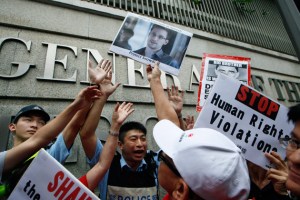
Now all the congressmen, the president, his cabinet, lobbyist and others know that the snooping is global, and this means that everyone is in this mass of information collected. Just anybody with access of this data can chose and pick and create an scenery that can be used to charge somebody with what ever they want to, to remove somebody from their job, even to remove a President. Every body that is everybody has something hidden in their closet, and the others the less important are used to create diversion, or simply to send messages of fear to others.
Comes to mind former former CIA Director David Petraeus (peh-TRAY’-uhs) over an extramarital affair, and defending the agency’s performance over the attack on a U.S. diplomatic post in Benghazi, Libya.
How do we know that they did not build the case of Petraeus out of thin air to take him out of the CIA, after all Benghazi fiasco still floating with answering questions. Obviously he was being spied on also.
Carefully watch the videos I m posting here, assimilate every word you hear, tied the lose ends and see how outrageous this program is, and it needs to go. The citizens of the world, we all need to work diligently in every one of our countries to make sure this programs and others disguise spying programs go, they are unnecessary surveillance programs that need to be scraped from the government agenda. This PRISM spying program makes all vulnerable in little or big scale.
Nothing New is going on, Whistleblowers come and go, some get indicted some don’t. Some are rotten in Jail, some are walking free making conferences in Universities and other public forums, others are hiding and making public conferences and others just underground.
I had been thinking lately really thinking about whistleblowers.
We know that every government, not just the US, but every government that exist in the world had thugs, mercenaries, private eyes, private contractors, private guards,secret service, Able to do ANYTHING..
I mean a real army of snoopers and mercenaries working to protect the interest of the corporations that use the government officials to draw laws and policies that allows them to keep pillaging the nations. ABLE TO DO ANYTHING they want.
Harassed, scare, employ, terminate, indict, incarcerated, set you free, impeach , coup,sit presidents, crown kings. I mean E V E R Y T H I N G
Saying that, I wonder if, ….just if…..the same government OR the people behind the curtain “unleash” once and while these whistleblowers to “expose” the secret of the governments, juts to show the governments WHO IS THE BOSS and the “smart’ ones are walking free and the real heroes are rotten in jail.????????
Whats going on? Are the governments OR THE PEOPLE BEHIND THE CURTAIN ARE testing the will of the people?, or they spreading false information to divert the attentio, or to confuse the already confused people.
I do not know if write in first or third person because I m confused as well. Just like the rest…It is hard being journalist where you are obliged to write what other said, never talk in first person because the article lose “credibility”, I was told by my journalist teacher that being a blogger was not being journalist, because our “sources” are not credible.
So, what you think.
Be the opinion makers, where the truth is the news and you are the Opinion Makers.
National Security Letters
Posted on June 11, 2013 by Akashma Online News
National Security Letters
Source: Electronic Frontier Foundation
Defending Your Rights in the Digital World
 Of all the dangerous government surveillance powers that were expanded by the USA PATRIOT Act the National Security Letter (NSL) power under 18 U.S.C. § 2709 as expanded by PATRIOT Section 505 is one of the most frightening and invasive. These letters served on communications service providers like phone companies and ISPs allow the FBI to secretly demand data about ordinary American citizens’ private communications and Internet activity without any meaningful oversight or prior judicial review. Recipients of NSLs are subject to a gag order that forbids them from ever revealing the letters’ existence to their coworkers to their friends or even to their family members much less the public.
The FBI’s systemic abuse of this power has been documented both by a Department Of Justice investigation and in documents obtained by Electronic Frontier Foundation through a Freedom of Information Act request.
EFF has fought for years to spread awareness of National Security Letters and add accountability and oversight to the process.
In 2007 EFF filed Freedom of Information Act litigation seeking documentation of National Security Letter misuse by the FBI. Thousands of pages of documents were released over a period of four years leading to repeated revelations of government abuses of power. An EFF report based on these documents led to tough questions for the FBI before Congress. The documents also helped prompt the Senate Judiciary Committee to investigate whether Attorney General Alberto Gonzales lied to Congress.
In 2008 EFF defended the Internet Archive from an inappropriate National Security Letter. Because NSLs come with a gag order most recipients are unable to ever reveal their existence. However with the help of EFF and the ACLU the Internet
Archive fought back and won the right to speak publicly about the letter. As a result it’s become one of the few well-documented and publicly-known cases of NSL use.
And in 2013, EFF won a landmark decision in the Northern District of California in which Judge Susan Illston declared one of the statutes unconstitutional in its entirety. EFF’s petition, brought on behalf of an unidentified telephone service provider, challenged both the underlying authority to obtain customer records as well as the concurrent gag provision that prevented the recipient from disclosing even that it had receiving an NSL.
EFF has been fighting in Congress for legislative reform of National Security Letters since 2005. In 2009 many hoped that President Obama having run for office promising to reform Bush-era surveillance abuses would work with Congress to curb NSL abuse. Unfortunately the Obama Administration has instead continued to block reform and has even sought to expand NSL powers.
Snowden Censored by Craven Media
Posted on June 10, 2013 by Akashma Online News
10 June 2013
Snowden Censored by Craven Media
Mr. Snowden, please send your 41 PRISM slides and other information to less easily cowed and overly coddled commercial outlets than Washington Post and Guardian. Their arm-waving, self-aggrandizing verbosity, after conspiring to obey official demand (below) to censor your information is a pattern well-documented by unfettered disclosure sites. Their piecemealing release is hoary dramatization, diverting cover-up, of failure to deliver untampered material. Your valor is yet to be fully disclosed, do not settle for being seduced by false promises portending being kicked under the bus. Heed this under-bus-kick published today by Secrecy News:
EDWARD SNOWDEN, SOURCE OF NSA LEAKS, STEPS FORWARD… “When you are subverting the power of government– that’s a fundamentally dangerous thing to democracy.”
“I’m willing to go on the record to defend the authenticity [of these disclosures]. This is the truth. This is what’s happening. You should decide whether we need to be doing this,” he said of his disclosures.
In the history of unauthorized disclosures of classified information, a voluntary admission of having committed such disclosures is the exception, not the norm. And it confers a degree of dignity on the action. Yet it stops short of a full acceptance of responsibility. That would entail surrendering to authorities and accepting the legal consequences of “subverting the power of government” and carrying out “a fundamentally dangerous thing to democracy.”
And two days ago this go-to-prison kick by The Atlantic:
Whistle-blowing is the moral response to immoral activity by those in power. What’s important here are government programs and methods, not data about individuals. I understand I am asking for people to engage in illegal and dangerous behavior. Do it carefully and do it safely, but — and I am talking directly to you, person working on one of these secret and probably illegal programs — do it.
High officers and rhetoricians convene safe at base to wargame, destined by history, to praise and send youngsters into harm’s way to protect high privilege, then crow about leadership, sacrifice, pretending remorse, gloating in amply-pensioned retirement. Bear in mind, fodder for their ambitions is how they see you imprisoned for disobedience, emblazoned in by-lined headlines, warehoused in vet hospitals, or best, flag-draped in coffins disappearing into vote-rigged databanks.
http://www.wect.com/story/22544509/snowdens-cautious-approach-to-post-reporter
To effect his plan, Snowden asked for a guarantee that The Washington Post would publish – within 72 hours – the full text of a PowerPoint presentation describing PRISM, a top-secret surveillance program that gathered intelligence from Microsoft, Facebook, Google and other Silicon Valley companies. He also asked that The Post publish online a cryptographic key that he could use to prove to a foreign embassy that he was the document’s source.
Gellman told him the Post would not make any guarantee about what the Post published or when. The Post broke the story two weeks later, on Thursday. The Post sought the views of government officials about the potential harm to national security prior to publication and decided to reproduce only four of the 41 slides, Gellman wrote in his story about their communications.

 Akashma Online News
Looks like a baby BDS statement. A baby step…boycotting the settlements instead of Israel itself.
I don’t doubt the EU would like to be stronger on Israel but so far they have haven’t been willing to use their teeth.
Still it’s better to have statement like this from the EU, along with all the other statements and warnings to Israel previously to build on, when and if Israel pushes their last button also and the statements become calls for sanctions on Israel itself.
I don’t think they are ignoring the Palestine plight in this, after all that is the main issue with Israel.
They are, like I said taking baby steps. But will probably be a day late and dollar short as always.