Archive
CPEC Logistics Capacity: Karakoram Highway vs. the Proposed Trans-Karakoram Rail Link
By Marivel Guzman | Akashma News
A Supplementary Technical Analysis to “The Strategic Nexus of the New Silk Road”
Prepared: September 11, 2026
1. Scope Note
The source document supplied for this analysis (Guzman, 2026) addresses CPEC’s geopolitical framing, Gawadar’s naval/commercial role, and Pakistan’s debt exposure to Chinese IPPs — it does not contain freight-throughput, TEU, or rail-engineering data. The figures below are drawn from separate research (government statements, NHA/Pakistan Railways disclosures, and peer-reviewed capacity modeling) to answer the logistics-specific questions posed. Where projections are estimates rather than confirmed government figures, this is flagged explicitly.
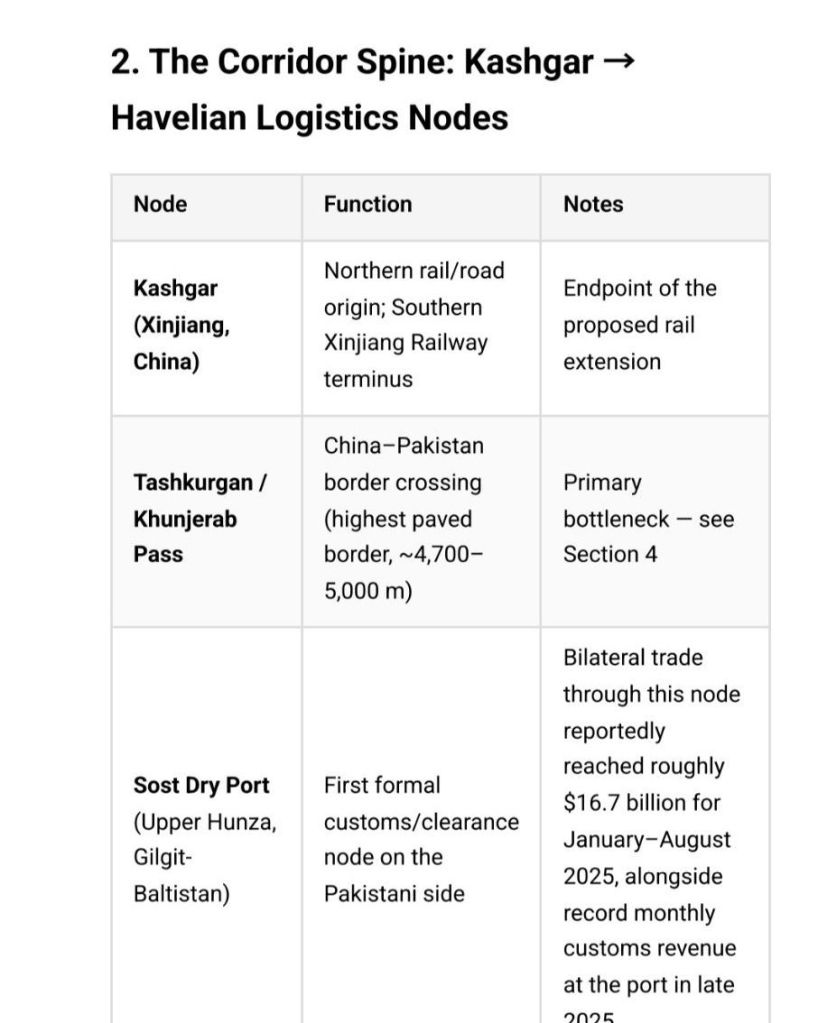
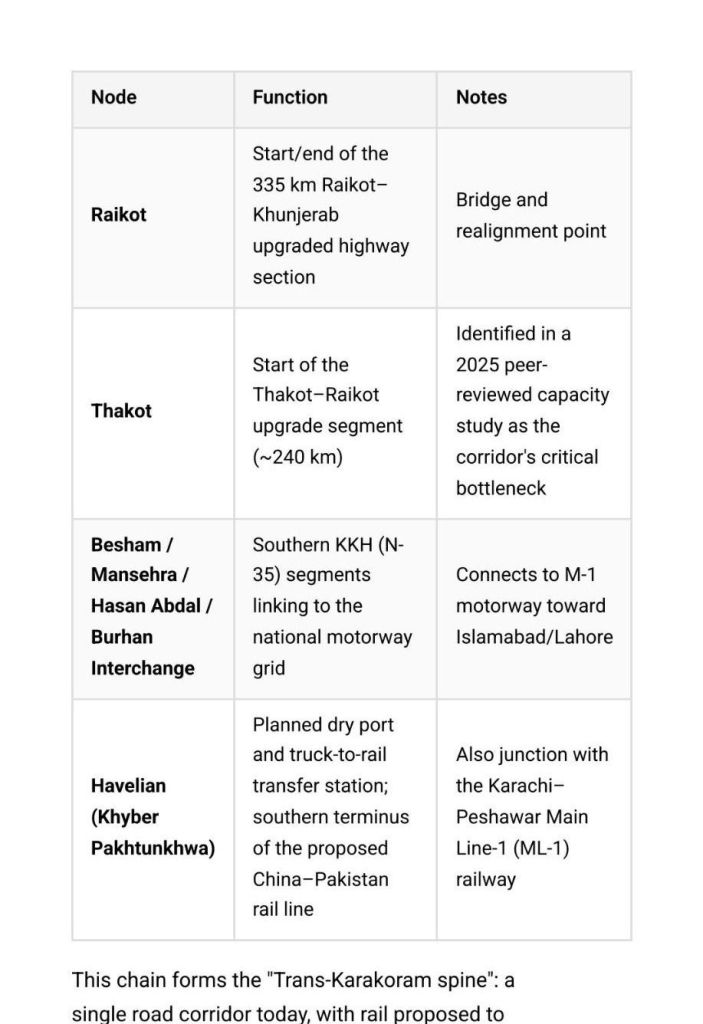
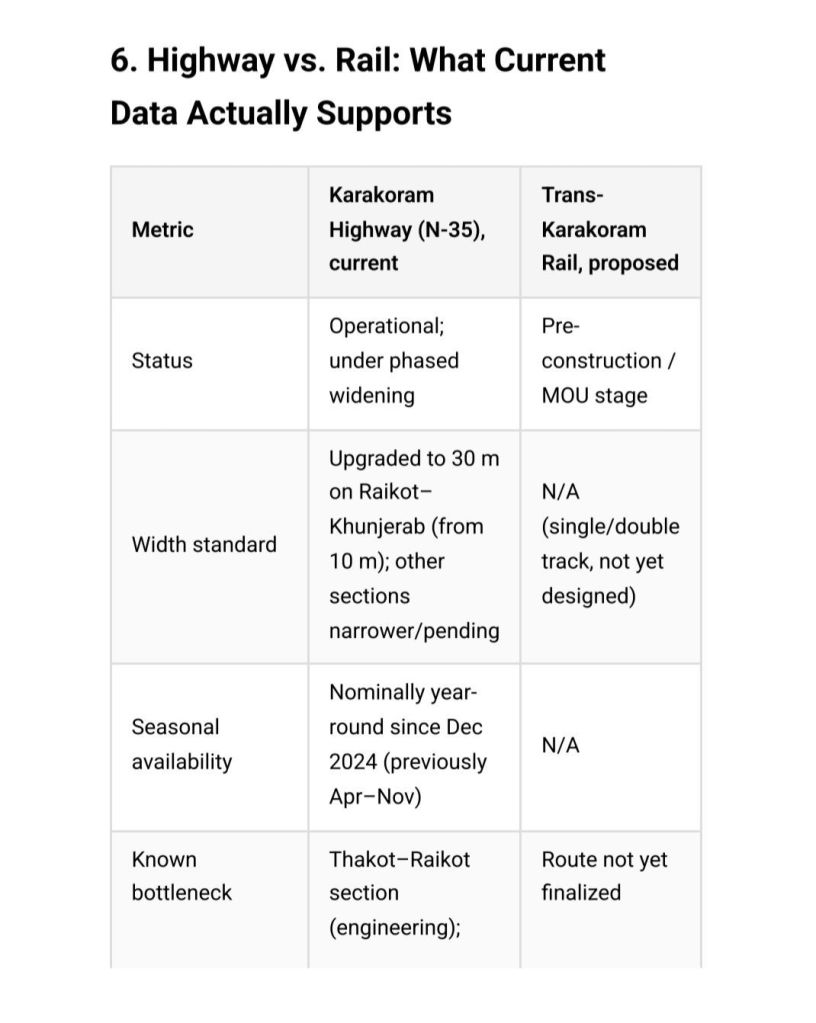
3. Highway Capacity: The 10 m → 30 m Widening Program
The Raikot–Khunjerab Section (335 km) was upgraded under a **$327.74 million China Eximbank loan** (total project cost ~$491–500 million), completed in November 2013. This project widened the roadway from 10 meters to 30 meters, added 32 new bridges (27 rehabilitated), and was designed to keep the route passable year-round and suitable for heavy, long-body freight vehicles.
Further upgrades are ongoing or planned:
Thakot–Raikot section (~240 km): MOU-stage realignment and upgrade, discussed during 2023 high-level visits, cost estimated in the billions of rupees.
Hasan Abdal–Mansehra section: NHA is reviewing dualization/rehabilitation of the existing carriageway to relieve congestion and slow-moving freight trailers.
Attabad Lake realignment section: Chinese-financed realignment, expected multi-year timeline.
Net effect: the KKH’s Pakistani alignment (N-35, 887 km) is being converted piecemeal from a narrow, seasonally vulnerable mountain road into a wider, hardened freight corridor — but full end-to-end dualization is not yet complete.
4. Bottleneck Analysis: Khunjerab Pass and the Thakot–Raikot Chokepoint
Altitude and seasonal closure (historical bottleneck):
– Khunjerab Pass sits at roughly 4,700–5,000 m, the highest paved international border crossing in the world.
– Under the 1985/2013 border protocols, the pass was traditionally open only April–November, closing December–March due to snow and low-oxygen conditions — a structural constraint on annual freight capacity.
– Following an October 2023 announcement at the Belt and Road Forum, China and Pakistan agreed to convert Khunjerab to **year-round operation; this took effect starting December 1, 2024. However, implementation has been uneven — the pass has also seen ad hoc closures tied to trader disputes over customs procedures (e.g., a multi-month suspension in 2025 over new scanning fees at Sost, resolved that October).
– Practical effect: even after the year-round policy, the corridor remains vulnerable to (a) residual heavy snowfall requiring active clearance, and (b) customs/administrative friction at Sost.
Engineering bottleneck (current capacity constraint):
A 2025 peer-reviewed capacity study (Adeel et al., *Scientific Journal of Silesian University of Technology – Transport*, 2025) modeling the Burhan–Khunjerab route specifically for a 2035 horizon found:
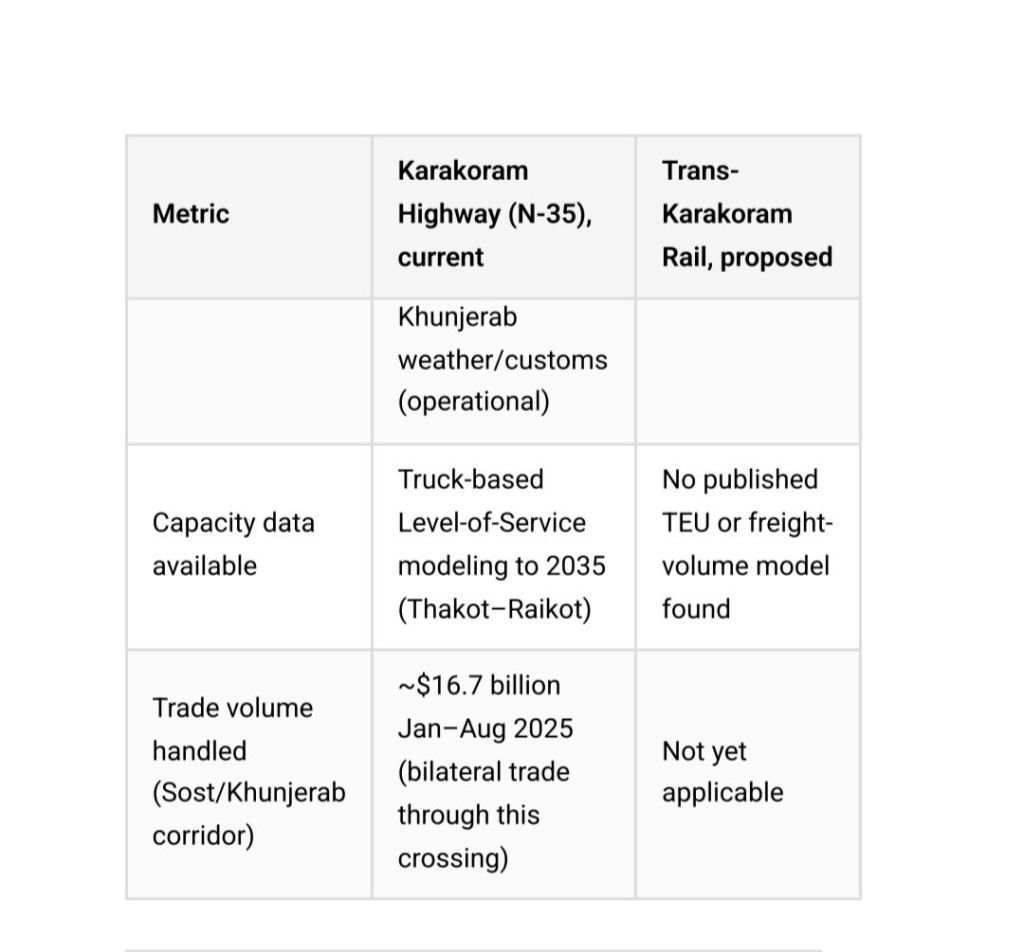
– The Thakot–Raikot section — not Khunjerab itself — is the critical bottleneck, with a modeled additional capacity of roughly 9,519 trucks/day at Level of Service “C” before saturation.
– Under trade-growth assumptions, the corridor is projected to carry about 7.93% of China’s total trade value** and 6.39% of trade tonnage by 2035 if current capacity-expansion plans proceed.
– Statistical relationships derived: each $1 million annual increase in Pakistan’s trade correlates with ~1.3 million ton-km of additional road freight; each 1-million-ton increase in trade volume adds ~1,684 million ton-km of freight movement.
Takeaway: Khunjerab’s altitude/weather profile is the *headline* bottleneck in public narratives, but the *binding engineering constraint* identified in recent modeling sits further south, at Thakot–Raikot — the still-unupgraded middle section of the highway.
No freight currently moves by rail across the Khunjerab/Kashgar frontier — this is a proposed, not operational, corridor.
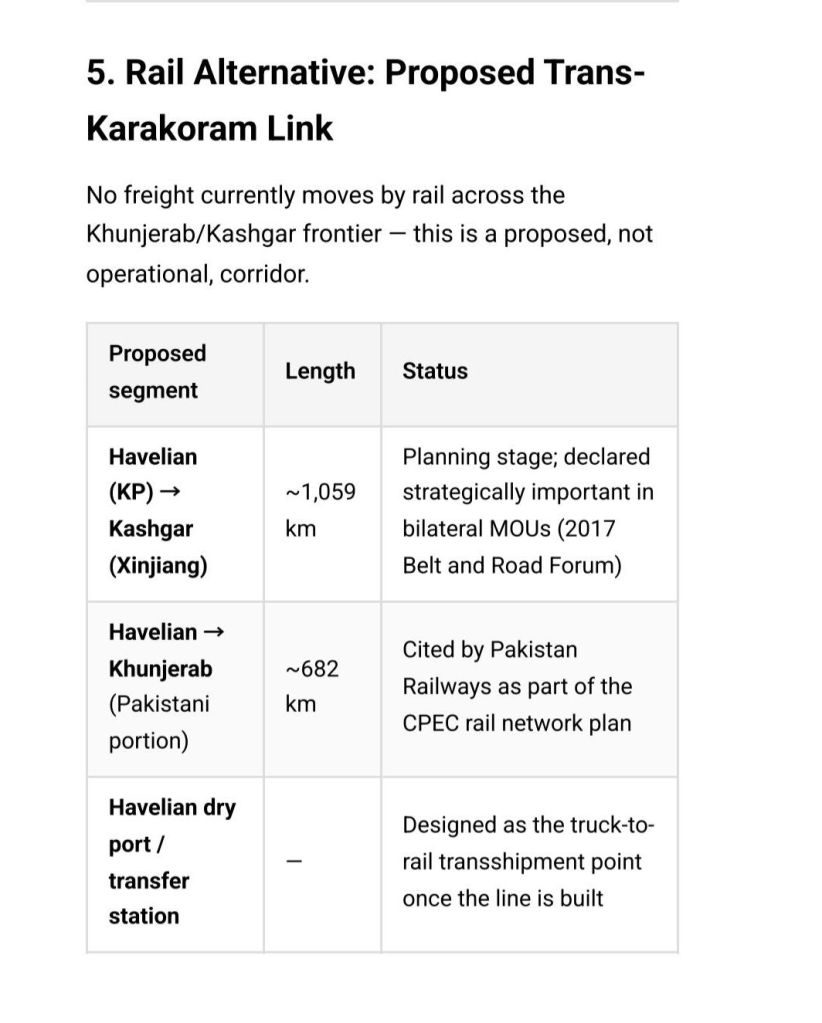
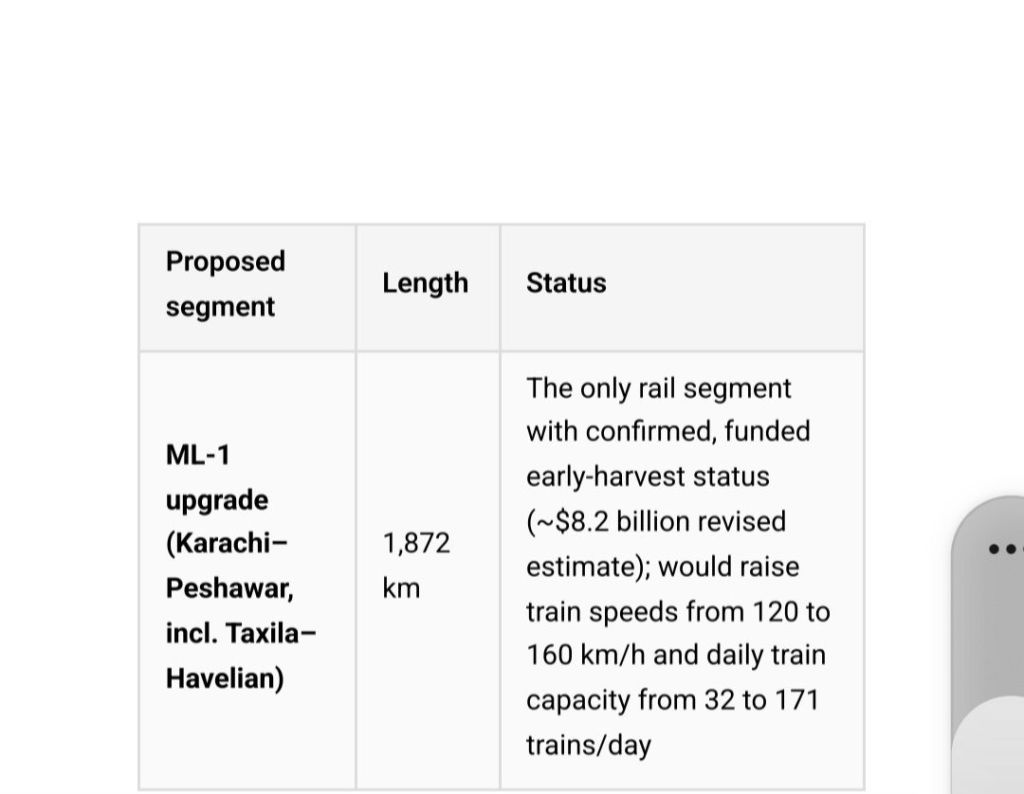
On TEU capacity: No official, engineering-grade TEU throughout projection specifically for the Kashgar–Havelian rail line has been published in government or peer-reviewed sources found in this research. Public statements to date describe the line only in route-length and strategic terms, not container-volume terms — the project remains pre-feasibility/MOU stage rather than at the design stage where TEU modeling would normally be produced. Any TEU figure attributed to this rail link in third-party commentary should be treated as speculative rather than an official target; I’d flag any such number to you rather than present it as sourced. If you need a comparative estimate, an alternative is to benchmark against ML-1’s confirmed capacity uplift (32→171 trains/day) and the trade-tonnage growth rates in Section 4 as a proxy for potential rail demand — I can build that model if useful.
7. Government Targets Toward 2030
– CPEC’s overarching route —
3,218 km of roads, railways, fiber-optic lines and pipelines linking Gwadar to Kashgar** — carries an official completion horizon of **2030**, per Pakistani government statements dating to the corridor’s 2015 launch.
– China’s cumulative investment/contribution under CPEC has been projected by Pakistan’s Planning Commission Centre of Excellence to exceed $100 billion by 2030** (up from an initial $46 billion, revised to $62 billion as of 2018 estimates).
– No single, current, official document was found in this research that sets a specific **TEU or tonnage target for 2030** on the Karakoram Highway or the rail corridor specifically; targets that do exist are expressed in dollar-value trade terms and megawatt/kilometer infrastructure terms rather than container throughput.
8. Caveats
– Figures on cost, length, and dates come from a mix of government statements, wire reporting, and one peer-reviewed engineering study; some (e.g., project costs, MOU-stage segment lengths) have shifted between sources over the corridor’s 15-year history and should be treated as approximate.
– The absence of a published TEU projection for the rail link is itself a finding — it indicates the project has not reached the design stage where such projections are normally produced, not that the figure exists but was simply unavailable to this search.
White Powder, Dark Legacy – Part II: The Merchant of Death and the Price of Redemption
How a Mistaken Obituary and a Life Built on Explosives Gave Birth to the Greatest PR Cover-Up in the History of Peace
By Marivel Guzman | Akashma News
Obituary of Infamy: The Death That Wasn’t

Digital illustration generated by AI | Concept by Marivel Guzman | Akashma News
In 1888, death knocked — but not for Alfred Nobel. It came for his brother Ludvig. Yet in a tragic twist of error, a French newspaper published an obituary for Alfred instead, bearing the now-infamous title: “Le marchand de la mort est mort” — “The Merchant of Death is Dead.”
The obituary condemned him in no uncertain terms: “Dr. Alfred Nobel, who became rich by finding more ways to kill people faster than ever before, died yesterday.” The paper, mistaking identity and fate, did not just misreport a death — it ignited a legacy crisis.
For Alfred Nobel, a man who held over 350 patents and presided over a transcontinental web of explosives and weapons factories, the headline struck deeper than any criticism he had ever faced. It wasn’t just public shame — it was a preview of how history would remember him–not as a benefactor of science, but as a harbinger of death. And he couldn’t allow that.
Thus began the most elaborate act of image laundering in modern history — the founding of the Nobel Peace Prize.
This moment didn’t inspire him. It terrified him. Within a few years, Nobel would write a new will — not to change the world, but to clean his name.
But contrary to the romantic mythology crafted by mainstream biographies and fanfare, Nobel’s creation was not born from an epiphany or a deep-seated yearning for peace. It was an act of strategic repentance — a calculated move to offset a violent empire with a philanthropic afterlife. The Peace Prize became a posthumous shield, not a symbol of his ideals, but a buffer against the damning truth of his industrial legacy.
Obituary of Infamy: The Death That Wasn’t
In April 1888, the Journal des Débats, a prominent French newspaper, ran an obituary that would echo through history—not for its tribute, but for its mistake. The paper believed Alfred Nobel had died while visiting Cannes. In truth, it was his brother Ludvig who had passed. But it was Alfred’s name, Alfred’s face, and Alfred’s legacy that graced the page under a damning headline:
“Le marchand de la mort est mort”
“The Merchant of Death is Dead”
Rather than a eulogy, it read like a public indictment.
It portrayed Nobel not as a man of science or innovation, but as a profiteer of carnage—a man who had made his fortune by engineering tools of destruction, and whose legacy would be written in blood, not ink.
This public misfire was no trivial error. For Nobel, it served as a preview of judgment day, not in a religious sense—he was a committed atheist—but in the court of public memory. The shame was immediate, and perhaps for the first time, irrevocable.
Though Nobel never publicly acknowledged the obituary’s impact, the timeline is telling. Within months, he began drafting revisions to his will. And by 1895—one year before his death—he completed a legally binding testament that redirected the bulk of his vast fortune not to family, not to science, but to the creation of a peace prize.
But not just peace — he included prizes for chemistry, physics, medicine, literature, and economics. Peace was almost an afterthought — tucked among disciplines that, ironically, had already helped refine warfare. This wasn’t about peace — it was about legacy control.
Contextual Anchor:
At the time of Ludvig’s death and the mistaken obituary, Alfred Nobel:
Held over 355 patents globally
Operated more than 90 factories tied to weapons, projectiles, and explosives production
Accumulated wealth through arms contracts from major European powers
Calling him a “man of peace” would be like calling an arms dealer a conflict resolution expert.
“He did not fear Hell. He feared being forgotten – or worse, remembered as what he truly was”
Marivel Guzman, Akashma News
Peace for Sale: Nobel’s Will and the Reinvention of a Warmonger
On November 27, 1895, Alfred Nobel signed his third and final will at the Swedish-Norwegian Club in Paris. It was brief, startlingly vague, and — for a man obsessed with precision — surprisingly open to interpretation.
In just over 1,200 words, Nobel allocated 94% of his vast fortune (roughly $200 million USD in today’s value) to establish annual prizes in Physics, Chemistry, Physiology or Medicine, Literature — and Peace.
But the wording of the Peace Prize bequest was as elusive as his character:
“…to the person who shall have done the most or the best work for fraternity between nations, for the abolition or reduction of standing armies and for the holding and promotion of peace congresses.”
On paper, this sounds noble. But in practice, it was a clause written without structure, oversight, or clarity — ripe for manipulation.
The Peace Clause: Loopholes, Ambiguity, and Historical Irony
Unlike the other prizes, which had clear scientific or literary criteria, the Peace Prize was rooted in subjective terms: “fraternity,” “peace congresses,” “abolition of armies.” Nobel did not name a peace foundation, a review committee, or even a political framework to define these goals.
The result? The Norwegian Storting (Parliament), not even mentioned in the will, quickly took ownership of the Peace Prize selection. This was a deeply political body — and its decisions over the next century would prove that “peace” was often awarded to military leaders, imperialists, and proxy-war apologists.
Contradictions Worth Highlighting:
Nobel left no requirement for transparency, allowing for secrecy in deliberations
Several Peace Prize recipients have been presidents, prime ministers, or military commanders — figures whose nations were actively at war at the time of the award
War criminals like Henry Kissinger, and preemptive invaders like Barack Obama, were laureates — mocking Nobel’s stated goal of reducing standing armies
Delucidation:
The Peace Prize was never designed to ensure peace. It was structured to protect Nobel’s name. By tying his fortune to an institution of “fraternity,” Nobel placed his legacy into a protective shell — a fortress of moral authority, guarded not by ethics but by gold and global ceremony.
“The man who gave the world dynamite also gave it a gold medal for pretending not to use it.”
Marivel Guzman, Akashma News
Laureates of Hypocrisy: When Peace Was Awarded for War
Alfred Nobel’s Peace Prize, supposedly intended to reward efforts to abolish war and promote fraternity between nations, has repeatedly fallen into the hands of those whose legacies are soaked in blood, surveillance, or strategic silence. Instead of honoring peacemakers, the Nobel Committee has often decorated power brokers, political opportunists, and even perpetrators of violence — all under the gilded mask of diplomacy.
Here are just a few of the most glaring contradictions:
Henry Kissinger – 1973
“Awarded for negotiating the Vietnam ceasefire.”
While Kissinger accepted the prize, the war raged on for two more years. Secret bombings in Cambodia and Laos, orchestrated under his authority, left millions dead and destabilized Southeast Asia. The irony was so grotesque that Le Duc Tho, his Vietnamese counterpart, refused the prize altogether.
Barack Obama – 2009
“For extraordinary efforts to strengthen international diplomacy.”
When awarded, Obama was barely in office. He would go on to expand drone warfare, authorize more arms sales than any president before him, and oversee NATO’s intervention in Libya, which led to the total collapse of a sovereign state.
Menachem Begin – 1978
“For peace negotiations with Egypt.”
Begin, former commander of the Zionist militant group Irgun, had overseen bombings, assassinations, and ethnic cleansing campaigns during Israel’s founding years. The group’s 1946 attack on the King David Hotel left 91 dead. Peace with Egypt was strategic, not moral.
Aung San Suu Kyi – 1991
White Powder, Dark Legacy: Alfred Nobel’s War for Peace**
This investigative feature revisits the life of Alfred Nobel, the inventor of dynamite, through a critical lens. It explores the contradictions between his contributions to warfare and his later public image as a benefactor of peace. Through analysis of Nobel’s writings and industrial empire, the piece dismantles the myth of a man driven by pacifism and reveals instead a legacy rooted in calculated power and destruction.
“For her non-violent struggle for democracy.”
Initially a global symbol of resistance, she later became complicit in the genocide of the Rohingya Muslims, defending the military’s atrocities at the International Court of Justice in 2019.
Yitzhak Rabin and Shimon Peres – 1994
“For efforts to create peace in the Middle East.”
Both men had long careers in the Israeli military establishment. Peres was instrumental in establishing Israel’s nuclear weapons program, while Rabin oversaw brutal military operations during the First Intifada.
Delucidation:
The Nobel Peace Prize, designed by a man seeking to rewrite his own obituary, has itself become a tool of historical laundering — a way for empires to appear humane, for wars to be masked as diplomacy, and for the most powerful actors to be rebranded as peacemakers. It is no longer (if it ever was) a prize for peace — but a strategic endorsement, handed out by elites to other elites.
“When murderers receive medals, peace is no longer a goal — it’s a brand.”
Marivel Guzman, Akashma News
Nobel’s Final Invention: A Peace Prize for Empire
Alfred Nobel may have invented dynamite, but his most enduring creation wasn’t an explosive — it was a myth. A myth so powerful, so polished, so gold-plated, that it managed to detonate truth itself. The Nobel Peace Prize was never truly about peace. It was about reputation, redemption, and the reinvention of a man who built an empire on controlled destruction.
And in the century since his death, that myth has only expanded — weaponized by governments, legitimized by media, and sold to the world as a symbol of human progress. But behind the prize is a ledger of blood, a list of laureates whose hands were not clean, whose nations were not at peace, and whose policies deepened conflict under the banner of diplomacy.
The Peace Prize today stands not as a testament to peace, but as a trophy of power. It rewards the powerful for gestures, not consequences. It cloaks violence in statesmanship. It turns war into ceremony. And it does so using the name of a man who once feared being remembered as The Merchant of Death
But no medal can erase truth. No eulogy can sterilize legacy.
And no prize — no matter how prestigious — can silence the reckoning that comes when the myth begins to crack.
“Alfred Nobel didn’t invent peace. He invented a prize to hide from what he’d done — and gave the empire a medal to wear while doing the same.”
Alfred Nobel invented dynamite, dreamed of peace, and built a legacy that fuels both.
White Powder, Black Legacy–Part I: Alfred Nobel’s War for Peace
In Part III of White Powder, Dark Legacy, Akashma News peels back the curated legacy of Alfred Nobel, diving into his unpublished writings and private contradictions. Was the Nobel Peace Prize born out of conscience or calculation? With sharp analysis and rare archival reflections, this installment exposes the ghost behind the medal—where regret, fear, and strategic reinvention collide.

 Akashma Online News